Reconstructing the past and attributing the responsibility for the Holocaust
Main Article Content
Since the beginning of the new Federal Republic of Germany, foreigners have evaluated much of the political and social cultures of Germany in accordance with their interpretations of the Nazi past. The former German Democratic Republic’s identification with the antifascist resistance against the Nazi regime permitted much of the social and political responsibility for the crimes of the Third Reich to be avoided. This official position played an important role in shaping the perception of the Nazi past. Survey data gathered in the former East Germany in 1995 and 2000 reveal a complex pattern of acceptance and denial of this historical past. There was a significant shift in the attribution of responsibility for the Holocaust, but no change in the perceptions of grandparents’ involvement in it. Results are interpreted with reference to social identity theory, which provides a framework for the understanding of national identity, collective self-esteem, and collective memory.
As an occupied nation, partitioned between two power blocs, Germany was positioned by the Allies not only physically, but also morally, in terms of a narrative about history (Kocka, 1993; Mommsen, 1993; Schulze, 1993). The former German Democratic Republic’s (GDR) identification with the antifascist resistance against the Nazi regime permitted much of the social and political responsibility for the crimes of the Third Reich to be avoided. This still has important implications for the attribution of responsibility for the Holocaust and the continuing debates on the Vergangenheitsbewältigung (coming to terms with the past) and the issue of Wiedergutmachung (reparations) in unified Germany.
Hence, narratives of the past offer a unique opportunity not only to better understand a particular people, but also to extend the research on social identity theory more generally.
Collective Past, Collective Memory, and Collective Identity
Every nation has a collective past, collective memory and collective recollection process, which give legitimacy to its history (Enriquez, 1983). The collective past is created through the people’s social interactions. Collective memory describes the recounting of shared experiences in remembering, forgetting, or reappropriating the knowledge of the social past. It is the people’s jointly acknowledged cultural and generational identity, together with their shared ideology, which affect how the nation is collectively commemorated and remembered through a particular historical event. The shared memory is preserved, collectively recollected and passed on to form the cultural past and serve as the structural basis of belonging and connection among members of a nation (Boesch, 1991).
Tajfel and Turner’s (1979) social identity theory offers a framework for the analysis of collective memory. Being a member of a social group involves the sharing of common traditions, historical experiences and social representations. Collective memory provides a context for individual and social identity (Pennebaker & Banasik, 1997). Different social groups have different relation- ships to a particular historical past. They also generate different memories, which shape their ideology and political actions to contribute positively to personal and social identity, and thus serve to maintain or enhance self-esteem (Gaskell & Wright, 1997).
In their collective memory, people have the capacity to forget, to reconstruct, to reelaborate, and reinvent themselves (Guerra, 1992). The actual events may not always allow for the construction of a positive image, thus it is necessary to revise the meaning of events. Baumeister and Hastings (1997) suggest that group memories are systematically distorted using strategies such as selective omission, fabrication, exaggeration and embellishment, manipulated associations, blaming the circumstances and so on, to maintain a positive image and the self-esteem of the group. This leads to a new past, creating a new historical understanding, a new present, and a new expectation for the future.
The Question of Collective Guilt
Once the evidence which proved that ordinary German people had either participated in – or silently tolerated – the horrors of the Nazi state became known, it was no longer a matter of merely a few guilty individuals – a whole nation stood accused of the atrocities of the Third Reich. Central to the question of collective guilt is the issue of Wiedergutmachung (reparations). The Allies – and the West in general – understood Wiedergutmachung in terms of justice, moral obligation, and politics. It was the democratic parties and the government of the Federal Republic of Germany (FRG), who accepted a broad political and moral responsibility. The Wiedergutmachung Treaty (10.09.1952) was seen as a crucial measure for establishing the international political credentials of the new German state (Traverso, 1995). In contrast, as a new antifascist state, the GDR claimed a complete break with the fascist past. Moreover, according to official GDR historiography, the GDR owed its existence to the resistance against Hitler’s regime, and, with its proud antifascist record, dissociating itself from the crimes of the nation in this way made it possible for the GDR to absolve its citizens from responsibility for the fascist crimes (Buruma, 1994). Consequently, the issue of reparations was of little concern to the GDR as they sought to present the past in the manner that would serve the current political situation. It was a relatively guilt-free approach because, supposedly, the people of the GDR had struggled against – and were persecuted under – the Nazi regime. Therefore they could celebrate and commemorate their achievement in defeating it (Fulbrook, 1999). Consequently, the GDR did not seek to commemorate the victims of Nazism but rather to celebrate the heroes of the resistance (Rosenthal & Völter 1997; Traverso, 1995).
The position of the antifascist resistance does not incorporate the masses, which include a large percentage of the GDR citizens, who had played an active role in supporting Hitler and the Nazi ideology. The official position, however, played an important role in shaping the perception of the Nazi past. Kahn (1993) found that the second generation had a lack of connection between their parents’ own responsibility and the crimes of the Third Reich. Rather “...they look upon Nazi ‘fascist-capitalists’ as if these had been evil foreigners, unrelated to them...” (p. 383). The disconnection from the Nazi past is evident also in the school texts. The outline of the Nazi era, together with alarming pictures of the concentration camps, was presented to the children. These atrocities, however, do not affect them as they were not asked to atone for, or reflect on, the crimes committed by their parents or grandparents because they were, supposedly, the children of the antifascist resistance. They were taught to identify with the heroes and these crimes were not part of their identity (Buruma, 1994).
The reunification of West and East Germany provided yet another occasion for the Nazi past to be the focus of much national and international attention. It was considered to have brought together two opposing ideological political systems (democracy in the former West Germany, and communism in the former East Germany) which generated different political identities and historical images of its citizens. Given this situation, the people from the former East Germany may be expected to have a different relationship to this historical event from those of the former West Germany.
Overview of the Study
This research is concerned with the perceptions of the third generation after the Holocaust1 and examined both East and West German students’ attributions of the extent to which German people were responsible for the Holocaust, and perceptions of their family members’ involvement during the Holocaust.2 These objectives were investigated through a survey design organized into two interrelated parts.
In Part 1 several theoretical perspectives are drawn together to examine both East and West German participants’ attribution of responsibility for the Holocaust and perceptions of their family members’ involvement during the Holocaust. First, in social identity theory it is proposed that people strive to maintain a positive social identity (Tajfel & Turner, 1979). Second, history is continually being reinterpreted to confirm an ideology or, alternatively, to invent new meanings (Guerra, 1992). Third, the formulation of national identity and acceptance of the political responsibility for the Nazi past are not carried out in isolation. They are all shaped by the background of the different political and social events of the community. After the collapse of the Hitler-Reich the German nation was divided and governed by two opposing political systems with different interpretations and historical images of the common national past. This presents an interesting opportunity to examine the attribution of responsibility for the Holocaust in the two former German states. To examine these ideas, four hypotheses were formulated:
It was expected that the East German group would be more likely than the West German group to hold the system – rather than the people who lived at the time – responsible for the Holocaust.
It was anticipated that the participants who attributed responsibility to the Nazi system would have higher collective self-esteem and be less willing to accept responsibility for the Nazi past than would those who attributed responsibility to the general population who lived at the time.
It was predicted that the East German group would be more likely than the West German group to perceive their grandparents in the roles of victims and/or opponents against, rather than as supporters of, the Nazi regime.
It was anticipated that the participants who perceived their grandparents as victims and/or opponents would have lower collective self-esteem and would be more willing to accept responsibility for the Nazi past than would participants who perceived their grandparents as regime supporters.
In Part 2 the impact of reunification on the remembered past of the former GDR participants was explored. As previously discussed, reunification brought together different ideological political systems and different historical treatments of the historical past. Ten years of reunification have brought rapid educational, social, political and economic changes to the former GDR. Since the collapse of the GDR, there has been much criticism from the West Germans about the GDR’s treatment of the Nazi past. One of the first acts of the GDR’s new democratic parliament elected in 1990 was to deliver a public apology to the state of Israel and the Jewish people, in acknowledgement of the East Germans’ share of responsibility for the crimes of the Nazi past (Watson, 1995). These changes should have important implications for the attribution of responsibility for the Holocaust. Specifically, it is of interest to examine whether or not these changes generate a significant shift in the attribution of responsibility for the Holocaust.
To test these ideas four hypotheses were formulated:
It was expected that the 2000 group would be more likely than the 1995 group to hold the people who lived at the time, rather than the Nazi system, responsible for the Holocaust.
It was anticipated that the participants who attributed responsibility to the Nazi system would have higher collective self-esteem and be less willing to accept responsibility for the Nazi past than would those who attributed responsibility to the general population who lived at the time.
It was predicted that the 2000 group would be less likely than the 1995 group to perceive their grandparents in the roles of victims and/or opponents rather than as Nazi regime supporters.
It was anticipated that the participants who perceived their grandparents as victims and/or opponents would have lower collective self-esteem and be more willing to accept responsibility for the Nazi past than would participants who perceived their grandparents as Nazi regime supporters.
1 The first generation is defined in this research as those adults who lived through the years of the Third Reich 1933-1945. The second generation refers to the children of those who lived through this period. The third generation, in general, are those born in the 1960s and 1970s, the grandchildren of the generation which lived during the Third Reich. Despite the fact that the boundaries between the generations are fluid and imprecise, the categories of first, second, and third generation are useful as they mark the progressive distance from the Third Reich.
2 Considering that this research was focused specifically on the perspectives of the third generation and is not intended to represent the population as a whole, the student sample is considered appropriate as many of the third generation are in tertiary education. Furthermore, given the age of the participants, the grandparents would be the most relevant family members on whom to focus.
Method
Participants
The total sample for the 1995 study comprised 232 university students from the former East and West Germany. The West group consisted of 94 participants, 61 women and 33 men. Their average age was 24.6 (SD = 4.59, range = 18-36). The East German group originally consisted of 138 participants, but 2 who did not specify their sex were omitted, leaving 98 women and 38 men. Their average age was 22.3 (SD = 3.08, range = 18-32). In the 2000 study, there were 129 participants from the former East Germany, 107 women and 22 men, with an average age of 22.5 (SD = 3.08, range = 18-36). All the East German participants of both studies were from the same university in former East Germany. It is vital to stress that this was not a longitudinal study that repeatedly measured the same sample over a period of time. Given the objectives of the study, a matched sample was considered more appropriate as all of the participants would have experienced the social and political changes brought about by reunification. More importantly, they would all have been exposed to the West Germans’ education system – that is, West Germans’ treatment of the Nazi past through the textbooks and teaching.
Measures
For all of the subsequent measures to be described, item responses were made on 5- point Likert scales, and scale items were reversed where appropriate so that the higher the score, the higher the concept in question.
Collective Self-Esteem The issues surrounding the Holocaust continue to act as a threat to national self-esteem. A collective self-esteem scale of 12 items was adapted from the 16 items developed by Luhtanen and Crocker (1992). The scale consisted of three categories, in which each category assessed different aspects of collective self-esteem. The items were phrased in terms of German identity. The public subscale items assessed the individual’s perception of others’ evaluation of one’s social group, for example, “The Germans are unpopular in the world”. The private subscale items assessed the individual’s self-evaluation of one’s social group as a whole, for example, “I have good feelings about Germany”. The identity concept subscale items assessed the self-evaluation of the relationship of one’s social group membership to one’s self-concept, for example, “Being German is an important reflection of who I am”. The membership subscale items, for example, “I feel I don’t have much to offer to the social group”, and “I am a cooperative participant in the social groups to which I belong” were omitted as they were not relevant to the present study. Reliability analysis indicated that the scale was internally consistent with the overall reliability coefficient alpha for the scale = .87.
Willingness To Accept Responsibility For The Nazi Past Over the years there have been numerous debates on Germany’s political responsibility for the Holocaust. These types of questions have been surveyed repeatedly by research institutes such as the Allensbach Institute (Allensbacher Jahrbuch der Demoskopie, 1997). This measurement is relevant for the purposes of this study, as it reveals the willingness of the third generation to see the continuing consequences of the Holocaust, and to accept responsibility for this part of their history. This scale consisted of 6 Likert-type items generated from previous national surveys conducted by the Allensbach Institute (1997). For example, “It is still Germany’s moral duty to pay for the compensation of living survivors of the Nazi terror”. Reliability analysis indicated that the scale was internally consistent, with a reliability coefficient of 0.77.
Attribution of Responsibility for the Holocaust
To examine the attribution of responsibility for the Holocaust, the participants were asked to state whom they thought were responsible for the Holocaust during the Third Reich. Five categories of responses were given;
1. Nazi leaders like Hitler, Himmler, or Goebbels
2. Nazi party (NSDAP)
3. Large industrial companies
4. General population that lived at the time
5. Most of the Jews that lived at the time
Perceptions of Grandparents’ Involvement During the Holocaust
To examine the participants’ perceptions of grandparents’ involvement during the Third Reich, they were asked to provide specific information regarding this (adapted from Brusten & Winkelmann, 1992). Nine categories of responses were given;
1. Were active Nazis
2. Were members of the Nazi party
3. Were supporters of the Nazis
4. Were bystanders
5. Were against the Nazis
6. Were members of the resistance
7. Were in prisons or concentration camps
8. Fled Germany during World War II
9. I don’t know what my grandparents did during the Third Reich
Procedure
The data were collected as part of a larger project on German identity. The questionnaires (“Deutsch-Sein, Wie ist das?”) were administered in a class setting. Foreign and Jewish-German students as well as students who are outside the age range answered the questionnaire, but had to be excluded, because the study was concerned exclusively with the perspective of non-Jewish Germans of the third generation. Excluding them right from the beginning was considered to be too disturbing for the German participants in the class, and too disruptive for the procedure.
The respondents were instructed that the research was about German identity and that participation was voluntary – also that the replies would be anonymous and only grouped statistical data would be used. Respondents were informed that there were no right or wrong answers, and that the researcher was interested only in their honest and spontaneous reactions. The self-administered questionnaire took approximately 25 minutes.
Results
Attribution of Responsibility for the Holocaust in the 1995 Sample
Overall, it could be said that there was a high level of accepting responsibility for the Nazi past (M = 3.9, SD = .54) in this sample. A moderate level of collective self- esteem (M = 2.5, SD = .56) was consistent with the data from previous national surveys conducted by the Allensbach Institute (1997).
The results indicated that a large proportion of the sample attributed responsibility for the Holocaust to the general population who were alive at the time (45.7%). The Nazi leaders were also held responsible (39.4%) (see Table 1).
Table 1. Categories of the People Who Were Held Responsible for the Holocaust

To examine the relationship between different historical treatments and attribution of responsibility for the Holocaust, five groups of responses were collapsed down into two broad categories:
The Nazi system which consisted of the Nazi leaders, the Nazi party, and large industrial companies (n = 125, 54.1%).
2. The general population (n = 105, 45.9%).
The data indicated that there was a strong tendency for the East group to attribute the responsibility for the Holocaust to the Nazi system, while the West group attributed the responsibility to the general population χ²(1, N = 231) = 12.87, p < .001. Thus the hypothesized relationship (Hypothesis 1) was supported.
The Nazi system group (M = 2.57, SD = .60) expressed a slightly higher level of collective self-esteem than did the general population group (M = 2.45, SD = .51) but this did not reach statistical significance t(224) = 1.167, p > .05. As expected, the group which attributed responsibility to the general population (M = 4.1, SD = .49) expressed a higher level of willingness to accept responsibility for the Nazi past than did the group that attributed responsibility to the Nazi system (M = 3.8, SD = .53), t(224) = 4.38, p < .001. Hypothesis 2 was partially supported.
Perceptions of Grandparents’ Involvement During the Holocaust in the 1995 Sample
The participants were also asked to provide specific information regarding their grandparents’ involvement during the Holocaust. Nine categories of responses are presented in Table 2.
Table 2. Categories of the Grandparents’ Involvement During the Holocaust (Percentage of Participants Giving Positive Information)
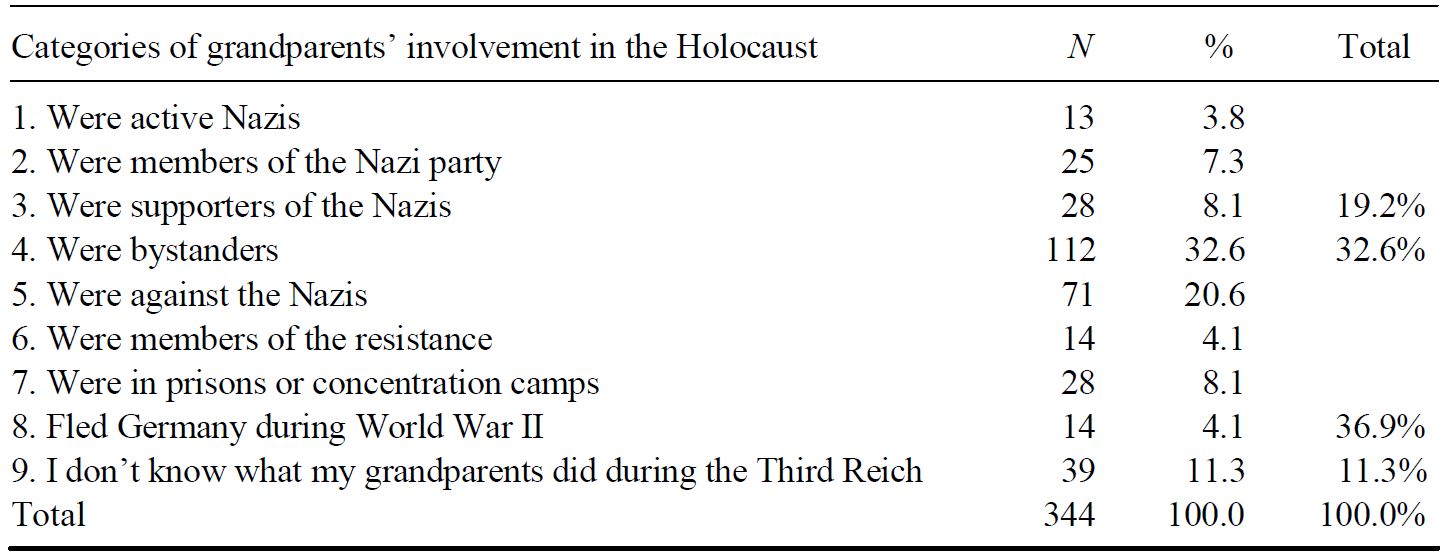
Note: Multiple responses were allowed.
To examine the relationship between different historical treatments of the Holocaust and perceptions of grandparents’ involvement during the Holocaust, nine groups were collapsed down into four broad categories;
Those who perceived their grandparents to be active Nazis, members of the Nazi party, who belonged to organizations such as the SS, and the supporters of the Nazis’ ideology are grouped together as grandparents perceived as the regime supporters.
Those who perceived their grandparents to be political opponents of the Reich, Germans in prisons or concentration camps, and those who fled Germany during the Third Reich are grouped together as grandparents perceived as the regime opponents.
The bystanders included German society at large; these bystanders are characterized by partial knowledge of the crimes committed, and by more or less sustained indifference and passivity.
The participants who had no knowledge of their grandparents’ involvement during the Third Reich.
The results showed that 19.2% of the sample stated that their grandparents were regime supporters, and 32.6% claimed that their grandparents were merely bystanders, while 11.3% stated that they had no knowledge of what their grandparents did during the Third Reich. Interestingly, 36.9% professed that their grandparents could be considered regime opponents (Table 2). The present data are consistent with Brusten and Winkelmann’s findings in 1992.
Further analyses were carried out between the regime supporters and the regime opponents. The regime supporter group consisted of those participants who gave all four responses from the category 1 (n = 28, 25%). The regime opponent group consisted of participants who gave all four responses from the category 2 (n = 84, 85%). Participants who gave responses from categories 3, 4, or from a mixture of categories 1 and 2 were excluded from further analyses.
The different historical treatments of the Holocaust did not make a significant impact on the participants’ perception of their grandparents’ role during the Third Reich χ²(1, N = 103) = .57, p > .05. Both East and West groups were more inclined to perceive their grandparents in the roles of victims and/or opponents than as regime supporters.
Comparison between the victims’ and/or opponents’ group and the regime supporters’ group failed to provide the predicted pattern. With regard to collective self-esteem, the data showed only a minor variation between the two groups. The victims’ or opponents’ group (M = 2.60, SD = .58) reported a slightly higher level of collective self-esteem than did the regime supporter group (M = 2.45, SD = .54) but this did not reach statistical significance t(109) = 1.28, p > .05. Similarly, the victims’ or opponents’ group (M = 3.9, SD = .51) did not differ significantly from the regime supporter group (M = 3.8, SD=.50) in their willingness to accept responsibility for the Nazi past t(109) = .80, p > .05.
1995-2000 Comparisons
Following the 1995 pattern, there was a high level of acceptance of responsibility for the Nazi past (M = 3.9, SD = .60) and a moderate level of collective self-esteem (M = 2.6, SD = .59) in the 2000 sample.
The results indicating that the higher proportion of the sample attributed responsibility to the general population as compared to the Nazi system should not go unnoticed (see Table 3).
Table 3. Categories of the People Who Were Held Responsible for the Holocaust

As expected, and supporting Hypothesis 1, there was a significant shift in the attribution of responsibility for the Holocaust from 1995 to 2000. The data indicated that the 1995 group attributed responsibility for the Holocaust to the Nazi system, while the 2000 group attributed responsibility to the general population χ²(1, N = 256) = 14.62, p < .001.
The Nazi system group (M = 2.8, SD = .60) expressed a higher level of collective self-esteem than did the general population group (M = 2.53, SD = .56) t(109) = 2.5, p < .05. Furthermore, those who thought that the general population (M = 4.09, SD = .51) was responsible reported a higher level of willingness to accept responsibility compared to those who perceived the Nazi system as being responsible (M = 3.70, SD = .62), t(109) = 3.66, p < .001. These results were in accord with Hypothesis 2.
Perception Of Grandparents’ Involvement during the Holocaust
In 2000, as in the 1995 pattern, there was no significant shift in the participants’ perception of their grandparents’ roles during the Holocaust χ²(1, N = 113) = .11, p > .05. Both 1995 and 2000 groups were more inclined to perceive their grandparents in the roles of victims and/or opponents of the regime than as regime supporters. Also the victims’ and/or opponents’ groups did not differ significantly from the regime supporters’ group in their collective self-esteem t(109) = 1.1, p > .05, or in their willingness to accept responsibility for the Nazi past t(109) = .41, p > .05.
Discussion
Social identity theorists have claimed that people may have a particular relationship to a historical event that contributes positively to their personal and social identity (Gaskell & Wright, 1997). Actual historical events, however, may not always fulfill such a positive image. Members of groups may be tempted to forget, to reconstruct, to reelaborate, and to reinvent themselves to maintain a positive self-concept. As innovative collective recollections generate a new past and new area of consensus, they can also generate new forms of conflict within a culture which result from the newly formed collective memory (Straub, 1993). The results from the 1995 sample indicated that the East German group’s perception of responsibility for the Holocaust was directed mainly at the Nazi system, while the West German group attributed responsibility to the general population. This supported the notion that individuals may, at times, disagree radically about their past (Davis & Starn, 1989). In this case, they cannot reach a consensus which would acknowledge their common past, as there is no common ground upon which to create a compatible construct of reality.
The findings in part 2 indicated a significant shift in the attribution of responsibility for the Holocaust 10 years after reunification. First, this illustrates how one group’s attempt to reconstruct the past may conflict with the attempts of other groups to enforce a different view, and how power relations influence people’s judgments. Secondly, the data supported the notion that collective memory is a reconstruction of the past in the broader contexts of community, politics and social dynamics of the present (Halbwachs, 1992; Radley, 1990; Thelen, 1989). Thus, what people choose to remember can reveal a complex relationship between their past and their present (Middleton & Edwards, 1990; Passerini, 1987; Tetlock, Peterson, McGuire, Chang, & Feld, 1992).
Overall, the differences between the participants who perceived their grandparents as having been victims and/or opponents, and those who perceived their grandparents as having been regime supporters, were far fewer than anticipated. However, it is interesting that there was a tendency for the participants to perceive their grandparents more in the role of victims and opponents, rather than as perpetrators. It is difficult to obtain exact figures to support the notion that the Nazis enjoyed widespread popularity. However, there are various discussions in the literature to indicate that this was the case. Noakes and Pridham (1974) stated that “a crucial element in popular consent to the regime was the fact that Nazism embodied, albeit in an extreme form, many of the basic attitudes of a very large section of the German people” (p. 574). Meier (1993) maintained that a large proportion of the population served the Nazi cause – whether they were directly, or indirectly, partakers in the crimes of the Third Reich.
The data of this study supported the notion that communications about recent German history are disturbed. In the former FRG it was primarily through the subtle mechanisms of psychological avoidance – whilst in the former GDR, it was through the more direct mechanism of disconnection (Brendler, 1991; Hübner- Funk, 1990; Rosenthal, 1992; Rosenthal & Völter, 1997). In neither of the former states did the young Germans receive accurate information about family members’ involvement in the Holocaust. The third generation views the Holocaust as an historical failure of the first generation of the Third Reich – but without accurate information about family members, this results in their inability to recognize that their grandparents were contributing to the overall criminal system (Brendler, 1991).
The element of distortion in the grandparents’ roles during the Holocaust could be interpreted within the framework of social identity theory. Tajfel and Turner (1979) asserted that people strive to maintain a positive social identity. One’s national identity may be shaped by historical experiences and these actual events may not always fulfill a positive image. Thus it is necessary to revise either the factual details or the meaning of events in order to fit them into the current set of beliefs. Hence, when the group analyzes some of the actions of its ancestors in the context of its effects on a new generation, it may selectively distort the memory of those events (Baumeister & Hastings, 1997). Perceiving grandparents in the role of the victims and/or opponents, rather than as perpetrators, creates a positive, or simply an acceptable, social identity. Essentially, the participants attributed responsibility for the Holocaust to those members of the population who were alive during that period, but they tended to view their own grandparents as victims or opponents of the regime, and, in this way, to absolve them from responsibility. This suits their view that their family and they themselves are innocent, and provides them with a positive identity. Furthermore, the present data are consistent with the findings of Brusten and Winkelmann in 1992. This indicates that there is powerful contradiction in need of further exploration to unpack the dynamics of Vergangenheitsbewältigung (coming to terms with the past) for the third generation after the Holocaust.
On the basis of the research, the concept of collective memory is extremely important in understanding German identity. German national identity is not only a set of characteristics but it is also a set of processes in which a nation develops from historical experiences in which its collective past, collective memory and collective recollection act as sources of orientation in identity and self-image.
Allensbacher Jahrbuch der Demoskopie. (1997). Vol. 32. München: Saur.
Baumeister, R. F., & Hastings, S. (1997). Distortions of collective memory: How groups flatter and deceive themselves. In J. W. Pennebaker, D. Paez, & B. Rime (Eds.), Collective memory of political events (pp. 277-293). Mahwah; NJ: Erlbaum.
Boesch, E. E. (1991). Symbolic action theory and cultural psychology. New York: Springer.
Brendler, K. (1991). Die Unumgänglichkeit des “Themas” Holocaust für die Enkelgeneration. In K. Brendler & G. Rexilius (Eds.), Drei Generationen im Schatten der NS-Vergangenheit (pp. 220- 258). Wuppertal: University Press.
Brusten, M., & Winkelmann, B. (1992). Understanding of the Holocaust and its influence on current perspectives on German youth. Soziale Probleme, 1, 1-27.
Buruma, I. (1994). The wages of guilt: Memories of war in Germany and Japan. London: Cape.
Davis, S. G., & Starn, R. (1989). Memory and counter-memory, Special Issue of Representations, 26 (Spring).
Enriquez, E. (1983). De la horde a l’état. Paris: Gallimard.
Fulbrook, M. (1999). German national identity after the Holocaust. Cambridge, UK: Polity Press.
Gaskell, G. D., & Wright, D. B. (1997). Group differences in memory for a political events. In J. W. Pennebaker, D. Paez, & B. Rime (Eds.), Collective memory of political events: Social psychological perspectives (pp. 175-189). Mahwah; NJ: Erlbaum.
Guerra, G. (1992). Psychosocial aspects of national belonging. Ricerche di Psicologia, 4, 121-138.
Halbwachs, M. (1992). On collective memory. Chicago. IL: University of Chicago Press.
Hübner-Funk, S. (1990). Hitler’s grandchildren in the shadow of the past: The burden of a difficult heritage. In S. Volkov & F. Stern (Eds.), Tel Aviver Jahrbuch für deutsche Geschichte (Vol 19, pp. 103-115). Gerlingen: Bleicher.
Kahn, C. (1993). The different ways of being a German. The Journal of Psychohistory, 20, 381-398.
Kocka, J. (1993). Hitler should not be repressed by Stalin and Pol Pot: On the attempts of German historians to relativize the enormity of the Nazi crimes. In Forever in the shadow of Hitler? The dispute about the Germans´ understanding of history. Original documents of the Historikerstreit, the controversy concerning the singularity of the Holocaust (pp. 85-92). Atlantic Highlands, NJ: Humanities Press International.
Luhtanen, R., & Crocker, J. (1992). A collective self-esteem scale: Self-evaluation of one´s social identity. Personality and Social Psychology Bulletin, 18, 302-318.
Meier, C. (1993) Condemning and comprehending. In Forever in the shadow of Hitler? The dispute about the Germans’ understanding of history. Original documents of the Historikerstreit, the controversy concerning the singularity of the Holocaust (pp. 24-33). Atlantic Highlands, NJ: Humanities Press International.
Middleton, D., & Edwards, D. (1990). Collective remembering. Thousand Oaks, CA: Sage.
Mommsen, H. (1993). The new historical consciousness and the relativizing of National Socialism. In Forever in the shadow of Hitler? The dispute about the Germans’ understanding of history. Original documents of the Historikerstreit, the controversy concerning the singularity of the Holocaust (pp. 114-124). Atlantic Highlands, NJ: Humanities Press International.
Noakes, J., & Pridham, G. (1974). Documents on Nazism, 1919-1945. London: Cape.
Passerini, L. (1987). Fascism in popular memory: The cultural experience of the Turin working class. Cambridge, MA: Harvard University Press.
Pennebaker, J. W., & Banasik, B. L. (1997). On the creation and maintenance of collective memories: History as social psychology. In J. W. Pennebaker, D. Paez, & B. Rime (Eds.), Collective memory of political events (pp. 3-19). Mahwah; NJ: Erlbaum.
Radley, A. (1990). Artefacts, memory and a sense of the past. In D. Middleton & D. Edwards (Eds.), Collective remembering (pp. 46-59). London: Sage.
Rosenthal, G. (1992). Kollektives Schweigen zu den Nazi-Verbrechen. Bedingungen der Institutionalisierung einer Abwehrhaltung. Psychosozial, 15, 22-33.
Rosenthal, G., & Völter, B. (1997). Erinnern an die Verfolgungs-vergangenheit in ostdeutschen Drei-Generationen-Familien nach der Wende 1989. Psychosozial, 20, 27-44.
Schulze, H. (1993). Questions we have to face: No historical stance without national identity. In For- ever in the shadow of Hitler? The dispute about the Germans´ understanding of history. Original documents of the Historikerstreit, the controversy concerning the singularity of the Holocaust (pp. 93-97). Atlantic Highlands, NJ: Humanities Press International.
Straub, J. (1993). Collective memory and collective past as constituents of culture: An action- theoretical and culture-psychological perspective. Schweizerische Zeitschrift für Psychologie, 52, 114-121.
Tajfel, H., & Turner, J. C. (1979). An integrative theory of inter-group conflict. In W. G. Austin & S. Worchel (Eds.), The social psychology of inter-group relations (2nd ed., pp. 33-48). Monterey, CA: Brooks-Code.
Tetlock, P. E., Peterson, R. S., McGuire, C., Chang, S., & Feld, P. (1992). Assessing political group dynamics: A test of the groupthink model. Journal of Personality and Social Psychology, 63, 403-425.
Thelen, D. (1989). Memory and American history. Journal of American History, 75, 1117-29.
Traverso, E. (1995). The Jew and Germany: From the “Judeo-German Symbiosis” to the memory of Auschwitz. Lincoln, NE: University of Nebraska Press.
Watson, A. (1995). The Germans: Who are they now? Oxford: BPC Paperbacks.
Table 1. Categories of the People Who Were Held Responsible for the Holocaust
Table 2. Categories of the Grandparents’ Involvement During the Holocaust (Percentage of Participants Giving Positive Information)
Note: Multiple responses were allowed.
Table 3. Categories of the People Who Were Held Responsible for the Holocaust
Appreciation is due to reviewers including
Elrud Ibsch
Vrije University of Amsterdam
Faculteit der Letteren
De Boelelaan 1105
1081 HV
Amsterdam
Netherlands
Andrei Novac
Diplomate
American Board of Psychiatry and Neurology
400 New Port Center Drive
Suite 309
Newport Beach
CA 92660
USA
Emma Dresler-Hawke, Massey University, Private Bag 22111, Palmerston North, New Zealand. Email: [email protected]