Internal service quality affects salespersons’ performance and turnover intention: Mediating role of job involvement
Main Article Content
We investigated the relationship between salespersons’ internal service quality and turnover intention through the mediators of their job involvement and sales performance. To that end, we distributed surveys to salespersons in Korea and used structural equation modeling to examine the hypotheses. The results of this study were as follows: First, internal service quality had a significant and direct impact on salespersons’ job involvement and sales performance, and also their turnover intention. Second, job involvement mediated the relationship between internal service quality and turnover intention. Third, internal service quality had a significant indirect effect on sales performance through the mediator of job involvement. Fourth, in a 2-stage mediation model internal service quality had a significant indirect relationship with turnover intention through the mediators of job involvement and then sales performance. Theoretical and practical implications are discussed for marketing management research.
Many researchers have proposed that frontline employees are often very stressed and fatigued from the requirements of dealing with customers, and high work stress inhibits their intrinsic motivation and innovativeness (Huhtala & Parzefall, 2007; Yoon & Lee, 2007), and impairs their service performance (Chan & Wan, 2012; C. C. V. Chen, Chen, & Lin, 2015). Sales performance can cause stress but when internal service quality is high, salespersons’ job effort and input are also higher, which can help sales performance (Sharma, Kong, & Kingshott, 2016). Moreover, sales performance may have a negative relationship with turnover intention (Li, Zhu, & Park, 2018).
Internal service quality can be defined as an individual employee’s evaluation of service from a department. Kang, James, and Alexandris (2002) suggested that internal service quality is composed of five substantive dimensions: tangibles relates to the ease of use and usability of internal working facilities, responsiveness occurs when coworkers quickly respond to salespersons’ requests, empathy concerns coworkers paying attention to salespersons, assurance relates to coworkers being knowledgeable and taking responsibility for their work, and reliability concerns coworkers’ dependability in handing sales problems. Previous researchers have proposed that internal service quality has a positive impact on external service quality, and that high internal service quality can increase a frontline service employee’s customer orientation, job satisfaction, and organizational performance (Anosike & Eid, 2011; Caruana & Pitt, 1997; Wildes, 2007). Internal marketing activity can be defined as company personnel implementing activities designed to meet their employees’ needs. Internal marketing activity has been found to have positive effects on organizational commitment and negative effects on turnover intention among casino employees in the hotel industry (Kim, Song, & Lee, 2016).
Furthermore, researchers have shown that sales performance is positively impacted by adaptive selling behaviors and relationship quality (Park & Deitz, 2006; Spiro & Weitz, 1990), hard work and working smart (Sujan 1986; Sujan, Weitz, & Kumar, 1994), work effort and trait competitiveness (Brown & Peterson, 1994; Shannahan, Bush, & Shannahan, 2013), and skill level and selling-related knowledge (Verbeke, Dietz, & Verwaal, 2011). However, there are relatively few studies on the relationship between internal service quality and sales performance as mediated by job involvement (Blau & Boal, 1987; Verbeke et al., 2011; Weitz, Sujan, & Sujan, 1986). In particular, there is little research in which the relationships between internal service quality, job involvement, sales performance, and turnover intention among salespersons have been explored in detail.
Kanungo (1982) defined job involvement as an employee’s level of absorption, that is, active participation and engagement, in their job. Blau and Boal (1987) and Zopiatis, Constanti, and Theocharous (2014) proposed that employees’ job involvement can improve their organizational commitment and reduce turnover intention, and Zhang (2014) proposed that job involvement has a positive relationship with organizational citizenship behaviors. Therefore, our aim was to demonstrate the effect of internal service quality on the turnover intention of salespersons through their job involvement and sales performance, using structural equation modeling analysis.
Hypothesis Development and Research Model
Effect of Internal Service Quality on Salespersons’ Turnover Intention
Positive evaluations of the quality of the internal services of a firm can help improve salespersons’ job involvement. Joung, Goh, Huffman, Yuan, and Surles (2015) observed that internal marketing positively and significantly affects food service employees’ job satisfaction and organizational commitment. Kim et al. (2016) found that internal marketing has positive effects on casino employees’ organizational commitment and negative effects on their turnover intention. The main source of salespersons’ stress is sales performance: The lower their sales performance, the higher their stress and emotional exhaustion, which can increase turnover intention (Li et al., 2018). However, the higher the quality of internal service that is provided within the company for salespersons, the greater their job satisfaction will be. Sharma et al. (2016) demonstrated that internal service quality has a positive effect on job satisfaction, commitment, and subjective well-being among Chinese manufacturing employees. Chiang and Wu (2014) also found that internal service quality can lead to employees doing their job better, which helps them feel more satisfied. Ashill, Rod, and Carruthers (2008) stated that internal service quality can increase frontline employees’ job satisfaction and organizational commitment, which can help reduce turnover intention. Accordingly, we proposed the following hypotheses:
Hypothesis 1a: Internal service quality will have a positive relationship with job involvement among salespersons.
Hypothesis 1b: Internal service quality will have a positive relationship with sales performance among salespersons.
Hypothesis 1c: Internal service quality will have a negative relationship with turnover intention among salespersons.
Mediating Effects of Job Involvement and Sales Performance
We proposed above that internal service quality will influence salespersons’ job involvement, sales performance, and turnover intention; however, there is no detailed research on these relationships. Lassk, Marshall, Cravens, and Moncrief (2001) found that job involvement has a positive relationship with sales performance and organizational commitment, and a negative relationship with turnover intention among salespersons. Kilroy, Flood, Bosak, and Chênevert (2016) demonstrated how high-involvement work practices decrease employee role conflict, role overload, and role ambiguity, and found that high-involvement work practices have a negative impact on employee burnout. In addition, Boles, Johnston, and Hair (1997) and Jones, Chonko, Rangarajan, and Roberts (2007) reported that work overload and emotional exhaustion increase salespersons’ turnover intention.
However, when a salesperson positively evaluates their workplace’s internal service, he or she works actively and makes an effort in the job, which can improve performance and job satisfaction. Brown and Peterson (1994) claimed that the sales performance of salespersons has a significant effect on their job satisfaction. Further, C.-C. Chen and Chiu (2009) demonstrated that employee job involvement mediates the relationship between job characteristics and organizational citizenship behavior. Accordingly, we proposed the following research hypotheses:
Hypothesis 2a: Internal service quality will have an indirect relationship with turnover intention among salespersons via the mediator of job involvement.
Hypothesis 2b: Internal service quality will have an indirect relationship with turnover intention among salespersons via the mediator of sales performance.
Hypothesis 2c: Internal service quality will have an indirect relationship with turnover intention among salespersons via the mediator of job involvement in a one-stage mediation model.
Hypothesis 2d: Internal service quality will have an indirect relationship with turnover intention among salespersons through the mediator of job involvement first and then sales performance second, in a two-stage mediation model.
Our theoretical research model is depicted in Figure 1.
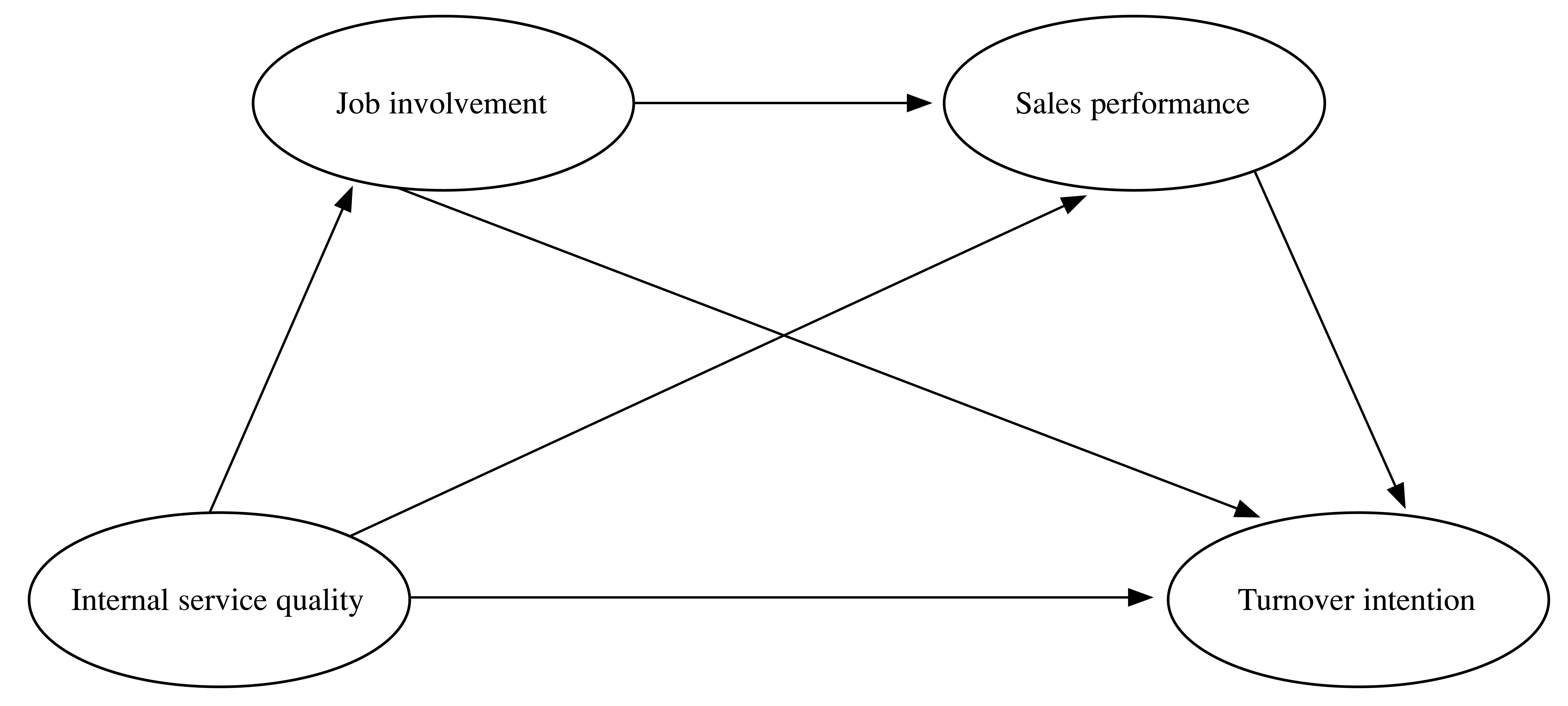
Figure 1. Research model.
Method
Participants and Procedure
The English survey items were translated into Korean by the first author, who has been living in Korea for 10 years. We also recruited two translators with PhDs who had majored in translation to check the survey items for improved readability.
We received ethical approval to conduct this study from the Research Ethics Truth Commission of Kyung Hee University, and obtained informed consent from the participants before they started the survey. Participants were salespersons working as frontline employees in several of the main industries in Korea (e.g., finance, insurance, automobiles, and pharmaceuticals). We distributed the questionnaire to 345 people, comprising 330 salespersons and 15 sales managers who were enrolled in a Master of Business Administration course at a large university. Respondents were allowed to fill out the form anonymously and confidentially over a period of several days. We received 288 usable forms for data analysis.
Participants’ demographic data were as follows: 87 (30.2%) were women and 201 (69.8%) were men. In terms of age, 14 (4.9%) were aged 25–29 years, 214 (74.3%) were aged 30–35 years, and 60 (20.8%) were aged 36–40 years. Regarding length of work experience as salespeople, seven (2.4%) had less than 5 years of experience, 227 (78.8%) had 5–10 years of experience, and 54 (18.8%) had over 10 years of experience. In terms of the industry they were employed in, 51 (17.7%) of the salespersons worked in pharmaceuticals, 47 (16.3%) worked in insurance, 158 (54.9%) worked in finance, and 32 (11.1%) worked in automobiles.
Measures
The response format for all measures was a 5-point Likert scale ranging from 1 = never to 5 = always.
We designed the 20-item measure of internal service quality based on the classification proposed by Kang et al. (2002), with subscales to assess tangibles, responsiveness, empathy, assurance, and reliability (four items each). Example items are “In this organization, the working environment is comfortable and attractive” and “In this organization, the materials are easy to use and the workplace is appealing” (tangibles); “My coworkers respond quickly and accurately to my requests” and “My communication with coworkers is efficient and clear” (responsiveness); “My coworkers pay enough attention to my opinion” and “My coworkers are sensitive to my work-related needs” (empathy); “My coworkers are knowledgeable” and “My coworkers take responsibility for their work” (assurance); and “My coworkers are dependable for handing my problems” and “I feel that my coworkers are reliable in their dealings with me” (reliability).
Job involvement was measured with six items from Gable and Dangello (1994) and Zopiatis et al. (2014). Example items are “I am very much involved personally in my sales job,” “I like to be absorbed in my job most of the time,” and “Most of my interests are centered around my sales job.”
To measure sales performance we used four items from Christen, Iyer, and Soberman (2006), Gable and Dangello (1994), and Panagopoulos and Ogilvie (2015). Example items are “I am good at achieving my assigned sales goals,” “I have a high retention rate for existing customers,” and “I achieve the target gross profit.”
To measure salespersons’ turnover intention we used four items from Darrat, Atinc, and Babin (2016) and Zopiatis et al. (2014). Example items are “I have often had job search intentions in the last several months,” “In the near future, I will quit my sales job,” and “I always think about quitting this company.”
Results
Reliability and Validity
We conducted reliability and confirmatory factor analyses (see Table 1). All of the variables had Cronbach’s alpha coefficients that were above the commonly accepted level of .70. Results of a confirmatory factor analysis show that all measures had acceptable validity, chi square (χ2) = 978.87, degrees of freedom (df) = 564, comparative fit index (CFI) = .95, Tucker–Lewis index (TLI) = .94, incremental fit index (IFI) = .95, root mean square residual (RMR) = .04, and all of the factor loadings, composite reliabilities, and average variance extracted (AVE) values were higher than their recommended coefficient weights (Fornell & Larcker, 1981).
Table 1. Convergent Validity of the Measurement Model

Note. N = 288. CR = composite reliability, AVE = average variance extracted.
The correlation analysis results show that the components of internal service quality had a positive relationship with job involvement and sales performance, and a negative relationship with turnover intention. Similarly, job involvement had a positive relationship with sales performance, and job involvement had a negative correlation with turnover intention. All the squared roots of AVE were higher than the correlation weights of each variable (see Table 2).
Table 2. Intercorrelations and Average Variance Extracted

Note. Correlations are presented below the diagonal and the squared roots of average variance extracted are presented on the diagonal.
p < .01.
Testing of Hypotheses
The hypotheses were tested by using structural equation modeling (see Figure 2). The research model fit indices were acceptable, χ2 = 1078.53, minimum discrepancy = 1.87, CFI = .93, TLI = .93, IFI = .93, RMR = .05. Internal service quality positively affected salespersons’ job involvement, supporting Hypothesis 1a. Internal service quality positively affected sales performance, supporting Hypothesis 1b. Internal service quality negatively affected turnover intention, supporting Hypothesis 1c. In addition, job involvement positively affected sales performance, the relationship of job involvement with turnover intention was negative, and sales performance negatively affected turnover intention. Our findings indicate that internal service quality was positively associated with salespersons’ job involvement and sales performance, and internal service quality was negatively associated with turnover intention among salespersons.

Figure 2. Structural equation modeling results.
* p < .01.
We used bootstrapping analysis with 500 resamples to test the mediation hypotheses (see Table 3). The results indicate that internal service quality had a significant indirect relationship with turnover intention through the mediator of job involvement. Thus, Hypothesis 2a was supported. Similarly, internal service quality had a significant indirect relationship with turnover intention through the mediator of sales performance. Therefore, Hypothesis 2b was supported. In addition, internal service quality had a significant indirect relationship with sales performance through the mediator of job involvement. Thus, Hypothesis 2c was supported. Last, internal service quality had an indirect positive relationship with turnover intention, first through the mediator of job involvement and then through the mediator of sales performance. Therefore, Hypothesis 2d was supported. Our analysis results indicate that salespersons’ job involvement and sales performance were significant mediators in the relationship between internal service quality and turnover intention.
Table 3. Bootstrapping Mediation Effects Testing

Note. N = 288. CI = confidence interval, LL = lower limit, UL = upper limit.
* p < .01.
Discussion
Previous researchers have suggested that internal service quality can enhance frontline employees’ customer orientation, job satisfaction, and organizational commitment, as well as their organizational performance in different service contexts (Anosike & Eid, 2011; Caruana & Pitt, 1997; Wildes, 2007). W.-J. Chen (2013) explored the relationship between organizational culture and leadership style with consideration given to internal service quality in international tourist hotels’ service. We extended and applied the internal service quality concept in the context of sales and marketing management research, and found that internal service quality among salespersons is composed of the same five substantive dimensions (i.e., responsiveness, empathy, tangibles, assurance, and reliability) as those among general service employees (see Kang et al., 2002).
In addition, many previous researchers have proposed that job satisfaction and organizational commitment play important mediating roles in reducing the turnover intention of salespersons. For example, Jaramillo, Mulki, and Solomon (2006) and Schwepker (2001) demonstrated how an ethical workplace climate enhances job satisfaction, and job satisfaction then decreases turnover intention. On the other hand, researchers have found that job stress, work overload, work–family conflict, and emotional exhaustion significantly affect salespersons’ turnover intention (Boles et al., 1997; Jones et al., 2007). We have further demonstrated that internal service quality can increase salespersons’ performance and decrease turnover intention through the key mediator of job involvement.
We have made several contributions to the literature. First, we developed and extended dimensions and scales related to internal service quality in sales organization. Second, we demonstrated that internal service quality is positively associated with salespersons’ job involvement and sales performance, and that internal service quality is negatively associated with turnover intention. Third, job involvement partially mediates the effect of internal service quality on sales performance and turnover intention. Fourth, sales performance partially mediates the effects of internal service quality and turnover intention. Fifth, internal service quality has a significant indirect relationship with turnover intention through two paths: first through job involvement then through sales performance, in two stages of a mediation model. Thus, we can conclude that job involvement mediates the relationship of internal service quality with salespersons’ performance and turnover.
Our findings have several practical implications for marketing managers. To increase salespersons’ job involvement and sales performance and decrease their turnover intention, sales or marketing managers should evaluate and implement a high level of internal service quality in the five dimensions of responsiveness, empathy, tangibles, assurance, and reliability (Kang et al., 2002; Sharma et al., 2016). In addition, managers should hold regular training programs to educate sales staff on the five dimensions of internal service quality. For the tangibles component, managers should ensure the workplace is clean and neat, and that sales equipment and materials is easy to use and up-to-date (W.-J. Chen, 2013). For the responsiveness aspect, we suggest that managers hold regular training sessions and educate sales employees on helping with and responding quickly to coworkers’ requests, and being willing to quickly accommodate coworkers’ needs. For the empathy aspect, we suggest that managers hold training programs for enhancing employees’ empathy and emotional intelligence. For assurance and reliability components, managers should actively train sales staff to be dependable in handing coworkers’ problems and in keeping promises. In addition, we suggest that department sales or marketing managers conduct screening during recruitment to identify people who will be interested and absorbed in sales jobs (Brown & Peterson, 1994; Kristof-Brown, Zimmerman, & Johnson, 2005).
This study has some limitations. First, we collected data from salespersons employed in a small number of industries in Korea. Because Korean people have a strong sense of service, this may have caused our research results to be affected by cultural orientation. Second, we did not consider the different personalities of salespersons. Third, the gender and age distribution in our sample was imbalanced, and we failed to consider how the salespersons’ personality characteristics or different types of leadership may have affected our research variables. Thus, we recommend that future researchers obtain a more extensive dataset and investigate how different types of leadership may affect the emotional or behavioral outcomes of sales staff.
Anosike, U. P., & Eid, R. (2011). Integrating internal customer orientation, internal service quality, and customer orientation in the banking sector: An empirical study. The Service Industries Journal, 31, 2487–2505. https://doi.org/10.1080/02642069.2010.504822
Ashill, N. J., Rod, M., & Carruthers, J. (2008). The effect of management commitment to service quality on frontline employees’ job attitudes, turnover intentions and service recovery performance in a new public management context. Journal of Strategic Marketing, 16, 437–462. https://doi.org/10.1080/09652540802480944
Blau, G. J., & Boal, K. B. (1987). Conceptualizing how job involvement and organizational commitment affect turnover and absenteeism. The Academy of Management Review, 12, 288–300. https://doi.org/10.2307/258536
Boles, J. S., Johnston, M. W., & Hair, J. F., Jr. (1997). Role stress, work-family conflict and emotional exhaustion: Inter-relationships and effects on some work-related consequences. Journal of Personal Selling & Sales Management, 17, 17–28. https://doi.org/10.1080/08853134.1997.10754079
Brown, S. P., & Peterson, R. A. (1994). The effect of effort on sales performance and job satisfaction. Journal of Marketing, 58, 70–80. https://doi.org/10.2307/1252270
Caruana, A., & Pitt, L. (1997). INTQUAL – An internal measure of service quality and the link between service quality and business performance. European Journal of Marketing, 31, 604–616. https://doi.org/10.1108/03090569710176600
Chan, K. W., & Wan, E. W. (2012). How can stressed employees deliver better customer service? The underlying self-regulation depletion mechanism. Journal of Marketing, 76, 119–137. https://doi.org/10.1509/jm.10.0202
Chen, C.-C., & Chiu, S.-F. (2009). The mediating role of job involvement in the relationship between job characteristics and organizational citizenship behavior. The Journal of Social Psychology, 149, 474–494. https://doi.org/10.3200/SOCP.149.4.474-494
Chen, C. C. V., Chen, C.-J., & Lin, M.-J. J. (2015). The impact of customer participation: The employee’s perspective. Journal of Business & Industrial Marketing, 30, 486–497. https://doi.org/10.1108/JBIM-06-2012-0104
Chen, W.-J. (2013). Factors influencing internal service quality at international tourist hotels. International Journal of Hospitality Management, 35, 152–160. https://doi.org/10.1016/j.ijhm.2013.06.004
Chiang, C.-F., & Wu, K.-P. (2014). The influences of internal service quality and job standardization on job satisfaction with supports as mediators: Flight attendants at branch workplace. The International Journal of Human Resource Management, 25, 2644–2666. https://doi.org/10.1080/09585192.2014.884616
Christen, M., Iyer, G., & Soberman, D. (2006). Job satisfaction, job performance, and effort: A reexamination using agency theory. Journal of Marketing, 70, 137–150. https://doi.org/10.1509/jmkg.70.1.137.qxd
Darrat, M., Atinc, G., & Babin, B. J. (2016). On the dysfunctional consequences of salesperson exhaustion. Journal of Marketing Theory and Practice, 24, 236–245. https://doi.org/10.1080/10696679.2016.1130563
Fornell, C., & Larcker, D. F. (1981). Evaluating structural equation models with unobservable variables and measurement error. Journal of Marketing Research, 18, 39–50. https://doi.org/10.2307/3151312
Gable, M., & Dangello, F. (1994). Job involvement, Machiavellianism and job performance. Journal of Business and Psychology, 9, 159–170. https://doi.org/10.1007/BF02230634
Huhtala, H., & Parzefall, M.-R. (2007). A review of employee well-being and innovativeness: An opportunity for a mutual benefit. Creativity and Innovation Management, 16, 299–306. https://doi.org/10.1111/j.1467-8691.2007.00442.x
Jaramillo, F., Mulki, J. P., & Solomon, P. (2006). The role of ethical climate on salesperson’s role stress, job attitudes, turnover intention, and job performance. Journal of Personal Selling & Sales Management, 26, 271–282. https://doi.org/10.2753/PSS0885-3134260302
Jones, E., Chonko, L., Rangarajan, D., & Roberts, J. (2007). The role of overload on job attitudes, turnover intentions, and salesperson performance. Journal of Business Research, 60, 663–671. https://doi.org/10.1016/j.jbusres.2007.02.014
Joung, H.-W., Goh, B. K., Huffman, L., Yuan, J. J., & Surles, J. (2015). Investigating relationships between internal marketing practices and employee organizational commitment in the foodservice industry. International Journal of Contemporary Hospitality Management, 27, 1618–1640. https://doi.org/10.1108/IJCHM-05-2014-0269
Kang, G.-D., James, J., & Alexandris, K. (2002). Measurement of internal service quality: Application of the SERVQUAL battery to internal service quality. Managing Service Quality: An International Journal, 12, 278–291. https://doi.org/10.1108/09604520210442065
Kanungo, R. N. (1982). Measurement of job and work involvement. Journal of Applied Psychology, 67, 341–349. https://doi.org/10.1037/0021-9010.67.3.341
Kilroy, S., Flood, P. C., Bosak, J., & Chênevert, D. (2016). Perceptions of high-involvement work practices and burnout: The mediating role of job demands. Human Resource Management Journal, 26, 408–424. https://doi.org/10.1111/1748-8583.12112
Kim, J., Song, H. J., & Lee, C.-K. (2016). Effects of corporate social responsibility and internal marketing on organizational commitment and turnover intentions. International Journal of Hospitality Management, 55, 25–32. https://doi.org/10.1016/j.ijhm.2016.02.007
Kristof-Brown, A. L., Zimmerman, R. D., & Johnson, E. C. (2005). Consequences of individuals’ fit at work: A meta-analysis of person–job, person–organization, person–group, and person–supervisor fit. Personnel Psychology, 58, 281–342. https://doi.org/10.1111/j.1744-6570.2005.00672.x
Lassk, F. G., Marshall, G. W., Cravens, D. W., & Moncrief, W. C. (2001). Salesperson job involvement: A modern perspective and a new scale. The Journal of Personal Selling and Sales Management, 21, 291–302.
Li, L., Zhu, Y., & Park, C. (2018). Leader–member exchange, sales performance, job satisfaction, and organizational commitment affect turnover intention. Social Behavior and Personality: An international journal, 46, 1909–1922. https://doi.org/10.2224/sbp.7125
Panagopoulos, N. G., & Ogilvie, J. (2015). Can salespeople lead themselves? Thought self-leadership strategies and their influence on sales performance. Industrial Marketing Management, 47, 190–203. https://doi.org/10.1016/j.indmarman.2015.02.043
Park, J. E., & Deitz, G. D. (2006). The effect of working relationship quality on salesperson performance and job satisfaction: Adaptive selling behavior in Korean automobile sales representatives. Journal of Business Research, 59, 204–213. https://doi.org/10.1016/j.jbusres.2005.04.002
Schwepker, C. H., Jr. (2001). Ethical climate’s relationship to job satisfaction, organizational commitment, and turnover intention in the salesforce. Journal of Business Research, 54, 39–52. https://doi.org/10.1016/S0148-2963(00)00125-9
Shannahan, K. L. J., Bush, A. J., & Shannahan, R. J. (2013). Are your salespeople coachable? How salesperson coachability, trait competitiveness, and transformational leadership enhance sales performance. Journal of the Academy of Marketing Science, 41, 40–54. https://doi.org/10.1007/s11747-012-0302-9
Sharma, P., Kong, T. T. C., & Kingshott, R. P. J. (2016). Internal service quality as a driver of employee satisfaction, commitment and performance: Exploring the focal role of employee well-being. Journal of Service Management, 27, 773–797. https://doi.org/10.1108/JOSM-10-2015-0294
Spiro, R. L., & Weitz, B. A. (1990). Adaptive selling: Conceptualization, measurement, and nomological validity. Journal of Marketing Research, 27, 61–69. https://doi.org/10.2307/3172551
Sujan, H. (1986). Smarter versus harder: An exploratory attributional analysis of salespeople’s motivation. Journal of Marketing Research, 23, 41–49. https://doi.org/10.2307/3151775
Sujan, H., Weitz, B. A., & Kumar, N. (1994). Learning orientation, working smart, and effective selling. Journal of Marketing, 58, 39–52. https://doi.org/10.2307/1252309
Verbeke, W., Dietz, B., & Verwaal, E. (2011). Drivers of sales performance: A contemporary meta-analysis. Have salespeople become knowledge brokers? Journal of the Academy of Marketing Science, 39, 407–428. https://doi.org/10.1007/s11747-010-0211-8
Weitz, B. A., Sujan, H., & Sujan, M. (1986). Knowledge, motivation, and adaptive behavior: A framework for improving selling effectiveness. Journal of Marketing, 50, 174–191. https://doi.org/10.2307/1251294
Wildes, V. J. (2007). Attracting and retaining food servers: How internal service quality moderates occupational stigma. International Journal of Hospitality Management, 26, 4–19. https://doi.org/10.1016/j.ijhm.2005.08.003
Yoon, J. A., & Lee, H.-J. (2007). Internal marketing, job stress, organizational commitment and turnover intention in nursing organization. Journal of Korean Academy of Nursing Administration, 13, 293–301. Retrieved from https://bit.ly/2Q89JnI
Zhang, S. (2014). Impact of job involvement on organizational citizenship behaviors in China. Journal of Business Ethics, 120, 165–174. https://doi.org/10.1007/s10551-013-1654-x
Zopiatis, A., Constanti, P., & Theocharous, A. L. (2014). Job involvement, commitment, satisfaction and turnover: Evidence from hotel employees in Cyprus. Tourism Management, 41, 129–140. https://doi.org/10.1016/j.tourman.2013.09.013
Figure 1. Research model.
Table 1. Convergent Validity of the Measurement Model
Note. N = 288. CR = composite reliability, AVE = average variance extracted.
Table 2. Intercorrelations and Average Variance Extracted
Note. Correlations are presented below the diagonal and the squared roots of average variance extracted are presented on the diagonal.
p < .01.
Figure 2. Structural equation modeling results.
* p < .01.
Table 3. Bootstrapping Mediation Effects Testing
Note. N = 288. CI = confidence interval, LL = lower limit, UL = upper limit.
* p < .01.
This study was supported by the Startup Foundation for Introducing Talent of Nanjing University of Information Science and Technology
People&rsquo
s Republic of China (2018r034)
the Research Center for Prospering Jiangsu Province with Talents
the National Natural Science Foundation of China (71771105
71603105)
the Ministry of Education of the Republic of Korea and the National Research Foundation of Korea (NRF-2018S1A5A2A03036952)
the Natural Science Foundation of Jiangsu in China (SBK2016042936)
and the China Postdoctoral Science Foundation (2017M610051
2018T110054).