Reflected self-efficacy and creativity: The power of being recognized by others toward individual creative performance
Main Article Content
Reflected self-efficacy, defined as one’s perception of how others assess one’s ability to perform a task, may be a meaningful predictor of creative performance over and above self-assessed self-efficacy. We examined if reflected self-efficacy, compared to self-assessed self-efficacy, is a more meaningful predictor of creative performance. A sample of 141 Master of Business Administration students completed measures of self-efficacy, reflected self-efficacy, proactive social management, team trust, and creative performance. Results showed that reflected self-efficacy had superior incremental validity compared to self-assessed self-efficacy, and that reflected self-efficacy affected individual creativity via the mediator of proactive social engagement. This relationship was more pronounced when a focal team member’s trust toward the team was low (vs. high). Our findings support the importance of the functions of social aspects of self-efficacy in enhancing individual creativity.
Self-efficacy, which is defined as the individual’s belief in his/her capacity to perform a specific task, has been widely acknowledged to influence aspects of performance, such as creativity (Tierney & Farmer, 2002, 2004). Self-efficacy has been reported as one of the most powerful determinants of behavioral engagement in creative tasks because it facilitates the initial decision to engage in an effortful and persistent endeavor in the face of adversity (Bandura, 1991; Shin, Kim, Lee, & Bian, 2012). Previous researchers have focused on self-perceptions of one’s own efficacy to study the relationship between self-efficacy and individual performance (Litrico & Choi, 2013; Stajkovic, Lee, & Nyberg, 2009).
However, the prevailing focus of measuring self-perceptions of efficacy may not fully explain the potential social side of self-efficacy because it neglects one’s belief regarding others’ view of one’s efficacy, which is termed reflected self-efficacy (Litrico & Choi, 2013). Creativity is achieved through a social process (Perry-Smith & Mannucci, 2017), so that understanding efficacy in terms of self-assessment along with evaluation regarding the extent to which others view one as being capable of completing given tasks can provide more nuanced explanations of the efficacy–creativity relationship. As such, we investigated if reflected self-efficacy, versus self-assessed self-efficacy, can predict individual creativity.
Understanding reflected self-efficacy is meaningful as it represents a socially constructed belief or social perception of an individual’s efficacy (Litrico & Choi, 2013). Symbolic interactionists have proposed that people’s self-perceptions may be associated with beliefs about how they are viewed by others (Kenny & DePaulo, 1993; Shrauger & Schoeneman, 1979). Litrico and Choi (2013) found empirical support for the existence of reflected self-efficacy and reported that it is distinguishable from self-efficacy. Thus, there is conceptual and empirical evidence that individuals hold both their own self-image and social perceptions of their social image as reflected from others.
The reflected self-efficacy construct may significantly expand and enrich the conventional notion of self-efficacy by capturing its social ramifications and offering improved understanding of individuals’ behavior and performance in social settings, such as work teams or organizations (Thatcher & Greer, 2008). The focus in previous research on reflected self-efficacy has been on the benefit of the congruence between self-efficacy and reflected self-efficacy, which resulted in increased collaboration and reduced task hindrance in work teams (Litrico & Choi, 2013). In this approach reflected self-efficacy is regarded as a mere contingency for promoting team members’ self-efficacy toward their social and task contributions. In the current study we moved reflected self-efficacy to the center of the theoretical and empirical analysis, with the goal of investigating its distinct and incremental contribution to the creative performance of individuals in work teams. Further, if reflected self-efficacy exerts a distinct effect, rather than being a contingency for self-efficacy, understanding the underlying mechanisms and boundary conditions that account for these distinct effect processes is important. Thus, we aimed to address these issues.
Our goal was to contribute to social cognitive theory and the literature on creativity by revealing the incremental validity, mediating mechanisms, and boundary conditions of the reflected self-efficacy construct. First, we sought to expand social cognitive theory and highlight the importance of socially reflected perceptions of self-efficacy by showing the incremental validity of reflected self-efficacy over the existing focus on self-efficacy (Stajkovic & Luthans, 1998). Second, we conducted an empirical examination of whether individuals with high reflected self-efficacy exhibit increased proactive social engagement, thereby promoting creative performance. This approach contributes to the literature on creativity by a) showing how creative performance is socially constructed and b) revealing the importance of self-perceived social recognition and subsequent social interactions with others as regards individual creativity. Finally, we investigated a contingency for the activation and operation of reflected self-efficacy in a work-team context: trust toward the team and members. Consideration of this boundary condition will enrich understanding of the way reflected self-efficacy affects individual performance in a work-team setting.
Literature Review and Hypotheses
Reflected Self-Efficacy
Self-efficacy has been regarded as a critical antecedent of performance, including creativity (Richter, Hirst, van Knippenberg, & Baer, 2012; Tierney & Farmer, 2002, 2004). According to social cognitive theory, self-efficacy refers to a belief that one has capabilities to “mobilize the motivation, cognitive resources, and courses of action needed to meet given situational demands” (Bandura & Wood, 1989, p. 408). Previous researchers have found that self-efficacy predicts important work-related outcomes, such as job attitudes (Saks, 1995), training proficiency (Martocchio & Judge, 1997), and job performance (Stajkovic & Luthans, 1998). Self-efficacy determines the initial decision to engage in a behavior, the intensity of expending effort, and the persistence demonstrated in the face of adversity (Bandura, 1991). Thus, it is regarded as a powerful determinant of behavioral changes (Shin et al., 2012).
Furthermore, self-efficacy is a pivotal mechanism for human agency, even in creativity contexts, by stimulating individuals to pursue a challenging goal of changing the status quo and generating novel and useful ideas, to exert more effort in the pursuit of the chosen goal, and to persevere with the course of action, even in the face of difficulties and failures (Bandura, 1986). Ford (1996) argued that the effects of self-efficacy on creativity can also be explained with sense-making theory (Weick, 1979), in regard to how individuals continually make decisions through sense-making processes in order to decide between creative and routine behavioral options.
Although numerous researchers have demonstrated the significance of self-efficacy in explaining one’s motivation, cognition, and performance (Tierney & Farmer, 2002, 2004), the possibility of self-efficacy beliefs with a social dimension has been overlooked (Litrico & Choi, 2013). According to symbolic interactionism, individuals’ self-belief can represent one’s own self-appraisal and can also be derived from one’s social interaction with others (Kenny & DePaulo, 1993). As a person interacts with others and receives social cues, he/she forms an efficacy belief based on the way he/she is being known and understood by others, which is referred to as reflected self-efficacy.
Reflected self-efficacy, with an explicit consideration of social dimensions, may be a meaningful component of self-cognition that is needed to fully understand individual performance. Therefore, we focused on creative performance, which typically involves, and can be achieved through, social processes and recognition from others (Perry-Smith & Mannucci, 2017). Individual creative performance is achieved by recombining and restructuring existing ideas or knowledge often shared from, and recognized by, others (Gilson, Lim, Luciano, & Choi, 2013; Ohlsson, 2011).
Social networks are conduits that provide access to others with differing ideas and perspectives (Perry-Smith & Shalley, 2003). A person’s high reflected self-efficacy may represent, or be driven by, a favorable and rich social network, which allows him/her to be situated in a better position to acquire cognitive and social resources from others. When increased resources are available, an individual with high reflected self-efficacy is apt to recombine or restructure different ideas or knowledge, resulting in strong creative performance (Ohlsson, 2011). We further proposed that the effects of reflected self-efficacy based on perceived social recognition would exert a distinct and incremental contribution over and above self-efficacy based on self-perception of competence. Thus, we proposed the following hypothesis:
Hypothesis 1: Reflected self-efficacy will be positively related to individual creative performance, after controlling for the effect of self-efficacy.
Proactive Social Engagement as an Underlying Mechanism
According to self-verification theory, when individuals have a social belief in their ability as acknowledged by others, they become motivated to maintain and further reinforce this belief by verifying their own ability with others’ perceptions (Swann & Read, 1981). The desire to maintain or improve positive social evaluations incites individuals to be proactive in managing their social relationships with others (Swann & Read, 1981). Thus, individuals with high reflected self-efficacy will proactively strive to develop a solid psychological association with groups to which they belong, and they will initiate collaborative interactions with others to achieve self-verification. Creative problem solving often involves social processes, such as information exchange and idea recognition (Perry-Smith & Shalley, 2003). Accordingly, proactive social engagement may function as an underlying mediating mechanism in the relationship between reflected self-efficacy and individual creativity.
Proactive social engagement may begin with the individual aligning his or her interests with those of the group and then further initiating and facilitating interactions with others to increase cooperation and resolve conflicts. Accordingly, we isolated group identification and interpersonal initiative as two core components of proactive social engagement. Group identification refers to “a relatively enduring state that reflects an individual’s readiness to define him- or herself as a member of a particular social group” (Haslam, 2001, p. 383). According to social identity theory (Hogg & Terry, 2001), individuals with strong group identification tend to value a sense of oneness with the group, and become motivated to promote the group’s interests even when it means sacrificing their own interests. Compared with collectivistic values, group identification more directly points to an individual’s psychological readiness to focus on the group’s overall well-being and goal achievement (Du, Choi, & Hashem, 2012). Thus, the group identification of a focal person with high reflected self-efficacy can further reinforce others’ favorable perceptions of that individual, such as him or her being cooperative and trustworthy (Paul, Samarah, Seetharaman, & Mykytyn, 2004), thereby motivating those others to reward the focal person (Černe, Nerstad, Dysvik, & Škerlavaj, 2014). In sum, developing group identification can further verify an individual’s reflected self-efficacy and generate social benefits toward creative performance by promoting the acquisition by the individual of resources such as information and knowledge from others.
Proactive social engagement also includes actually performing proactive behavior toward others, defined as taking interpersonal initiative. A person with high reflected self-efficacy draws on his or her social confidence based on others’ recognition, and is likely to initiate social exchanges and facilitate interpersonal collaboration within the group, further verifying his/her social image as a competent and contributing member (Swann, Polzer, Seyle, & Ko, 2004). A person can be regarded as cooperative and trustworthy when he/she proactively initiates and facilitates social interactions among team members by going beyond what is required, which encourages others to pay back this focal person with resources that could be beneficial for creative performance (Baker & Bulkley, 2014). Thus, we proposed the following hypothesis:
Hypothesis 2: Proactive social engagement (i.e., group identification and interpersonal initiative) will mediate the relationship between reflected self-efficacy and individual creativity.
Team Trust as a Boundary Condition
In an interactionist perspective on creativity (Woodman, Sawyer, & Griffin, 1993) there is emphasis on the complex interaction between individual and situational characteristics through which creative performance is achieved. Thus, the way reflected self-efficacy affects individual creative performance may depend on certain work environments or situations (Anderson, Potočnik, & Zhou, 2014). In our study we focused on team trust as a boundary condition for the relationship between reflected self-efficacy and creativity. Trust refers to “the willingness of a party to be vulnerable to the actions of another party, based on the expectation that the other will perform a particular action important to the trustor” (Mayer, Davis, & Schoorman, 1995, p. 712). This definition has two primary components: the intention to accept vulnerability and positive expectations regarding the target (Colquitt, Scott, & LePine, 2007). Hence, team trust is formed when team members are willing to accept vulnerability in their social interactions and have positive expectations toward other members.
When a person has a high level of trust toward his/her team and the other members, he/she experiences psychological safety, whereby he/she is willing to explore and freely express risky options or new possibilities (Gong, Cheung, Wang, & Huang, 2012). In this sense, team trust can substitute for, or complement, the function of a person’s reflected self-efficacy, thereby diminishing the effects of the latter. Similar to those with high team trust, members with high reflected self-efficacy trust, and feel comfortable with others who recognize their competence. Thus, the positive function of reflected self-efficacy based on others’ recognition becomes salient when team trust is low, limiting positive expectations among team members. By contrast, when team trust is high and most members tend to have mutually positive expectations, a member with high reflected self-efficacy may enjoy relatively little distinct benefit or differentiation in securing resources for creativity. Thus, we formed the following hypothesis:
Hypothesis 3: Team trust will moderate the positive relationship between reflected self-efficacy and individual creative performance, such that the relationship will be stronger when team trust is low than when it is high.
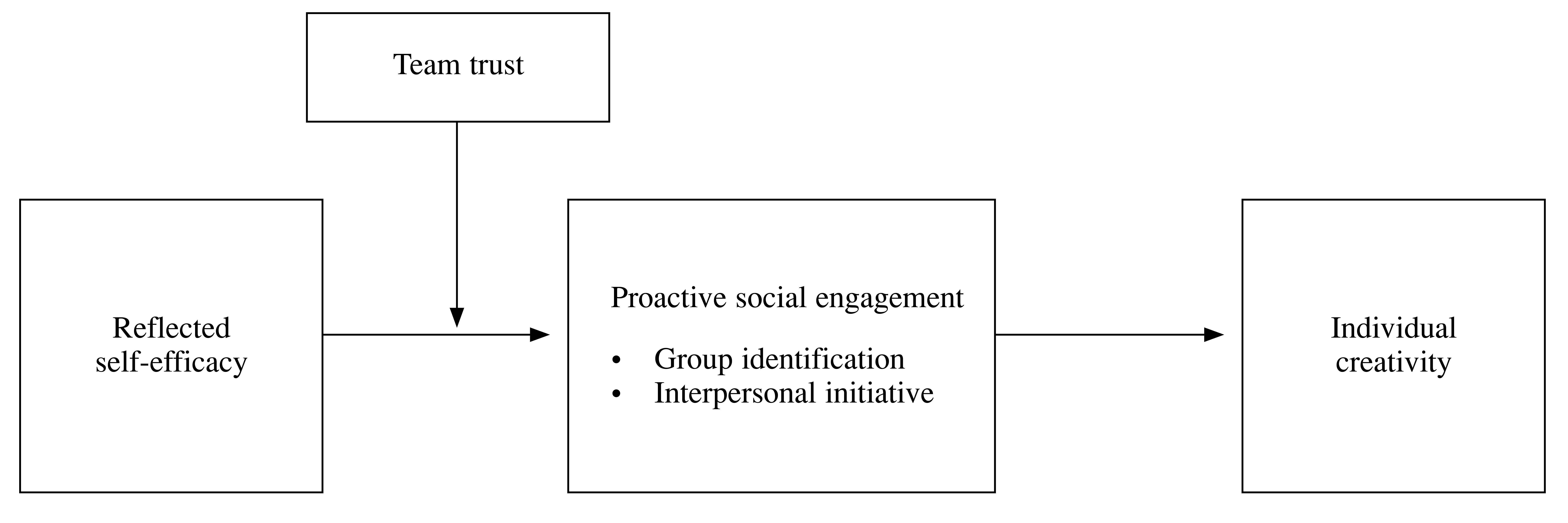
Figure 1. Study conceptual framework.
Method
Participants and Procedure
We conducted this research in accordance with the ethical guidelines provided by the National Research Foundation of Korea, obtained informed consent from the participants, and designed the study and collected data in accordance with the ethics protocol of the authors' affiliated institutions.
We collected data from Master of Business Administration (MBA) students taking an organizational behavior course at a large university in South Asia. In this course 146 students were grouped into 39 teams to conduct team exercises, discussions, and various projects on a regular basis. Each participant had extensive interactions with other team members throughout the semester and each was evaluated based on individual and group performance, similar to the practice in organizations. We used a longitudinal study design to examine the causal relationships around reflected self-efficacy. Data were collected in three phases: (a) in the first week of the course (T1), during which individuals’ demographic characteristics were assessed; (b) in the sixth week (T2), during which self-efficacy, reflected self-efficacy, and proactive social management were reported; and (c) in the last week of the course (T3), when team members rated each other’s creative performance. All surveys were administered in English.
Five of the 146 responses were removed because of missing values; thus, the final sample consisted of 39 teams made up of 141 individual participants. The average age was 25.81 years (SD = 2.93, range = 21 to 38 years), and 88% were men. Graduate Management Admission Test (GMAT) scores were included as a proxy of competence in the MBA program context. The maximum GMAT score is 800. The score of the top 10% of candidates who sit the test is usually 710, for the top 20% this is 670. Around 50% score 577. The GMAT scores in our sample ranged from 760 to 400, and the average score was 577 (SD = 78.35). The average years of work experience prior to enrollment in the MBA program was 2.99 years (SD = 2.37). Teams comprised from two to four members (M = 3.81, SD = 0.50).
Measures
All factors were assessed using multi-item measures rated on a 7-point Likert-type scale (1 = strongly disagree, 7 = strongly agree).
Self-efficacy (T2). Self-efficacy was measured using a five-item self-efficacy index (α = .79) from Locke, Frederick, Lee, and Bobko (1984). Sample items include “I have confidence in myself,” and “I feel I can solve any problem I encounter.”
Reflected self-efficacy (T2). Reflected self-efficacy was measured using a five-item scale (α = .88) adopted from Litrico and Choi (2013), in which the referent “I” in the original scale developed by Locke et al. (1984) was replaced with “My team.” Sample items are “My team has confidence in me,” and “My team feels I can solve any problem I encounter.” Thus, the measures of self-efficacy and reflected self-efficacy that we used are highly comparable and commensurate as they are identical in their evaluated conceptual domain but have different referents (“I” vs. “My team”).
Proactive social engagement (T2). The participants reported on their levels of active social engagement in two respects: identification with the project team and interpersonal initiative to facilitate interactions among team members. Specifically, we employed a five-item scale of group identification (α = .87), which was used by Kidwell, Mossholder, and Bennett (1997). The participants report the extent to which they identify with their team by rating items, such as “I feel that I am really part of my project group.” To measure interpersonal initiative we asked participants to evaluate the behaviors of all the other members of their team in initiating and facilitating interpersonal interactions among members (Waldman, Ramirez, House, & Puranam, 2001). To this end, two items (α = .89) were used: “This member encourages others to try new and more effective ways of doing their job,” and “This member often motivates others to express their ideas and opinions.”
Team trust (T2). Team trust was measured with six items (α = .92), which were adopted from Robinson and Rousseau (1994) and customized to the MBA class context. Sample items are “I fully trust my teammates in my project team,” and “My teammates are open and upfront with me.”
Individual creativity (T3). To avoid potential confounding and problems associated with common method bias, at the end of the semester (T3) we measured individual creativity by asking teammates to rate a focal member’s creative performance. We instructed each participant to evaluate all other team members on two representative items of creativity (α = .82), which were developed by Zhou and George (2001): “This member suggests new ways of performing work tasks,” and “This member often has a fresh approach to problems.”
Control variables (T1). Because individual differences may affect creative performance, we controlled for participants’ GMAT score, and their gender and age reported at T1.
Results
Table 1 shows the descriptive statistics and correlations between the variables analyzed. To test our hypotheses, we applied generalized linear mixed-effects models using STATA version 14.2 because our participants were nested under their project teams; thus, our observations were not independent from one another (Bruin, 2006).
Table 1. Descriptive Statistics of Study Variables

Note. N = 141. GMAT = Graduate Management Admission Test.
* p < .05, ** p < .01, *** p < .001.
Positive Effect of Reflected Self-Efficacy on Individual Creativity
We used generalized linear mixed-effect models to test if reflected self-efficacy was significantly associated with creativity beyond the effect of self-efficacy. Model 3 of Table 2 shows that after controlling for gender, age, GMAT score, and self-efficacy, reflected self-efficacy had a significantly positive relationship with individual creativity. As reported in Model 2, self-efficacy was a significant predictor of individual creativity but after the introduction of reflected self-efficacy this effect was no longer significant. The inclusion of reflected self-efficacy in the model accounted for an additional 5% of the variance in individual creativity beyond the controls and self-efficacy. Thus, Hypothesis 1 was supported.

Note. N = 141. Standardized beta coefficients are shown. Values in parentheses are standard errors. GMAT = Graduate Management Admission Test.
* p < .05, ** p < .01, *** p < .001.
Underlying Mechanism Between Reflected Self-Efficacy and Individual Creativity
To evaluate the proposed mediating effects by considering the nested data structure, we employed the Monte Carlo method (Preacher & Selig, 2010) and performed a multilevel mediation analysis using STATA 14.2 to generate the necessary data points (Bruin, 2006). Multilevel mediation analysis includes the simultaneous estimation of covariance for Level 1 random and indirect effects and the multiple paths that comprise the given indirect effects. This approach prevents the conflation of relationships observed at the individual and group levels of analysis (Wallace, Butts, Johnson, Stevens, & Smith, 2016).
We used a parametric bootstrapping procedure in which we employed 20,000 Monte Carlo replications to estimate a confidence interval around the indirect effects (Preacher & Selig, 2010). As shown in Table 3 there was a significant positive indirect effect of reflected self-efficacy on individual creativity via group identification and interpersonal initiative. These findings support Hypothesis 2.

Note. N = 141. CI = confidence interval.
Team Trust as a Boundary Condition
Model 4 in Table 2 shows that the interaction term between team trust and reflected self-efficacy without introducing proactive social engagement as a mediator, was a significant negative predictor of individual creativity. To further examine this significant interaction, we conducted a simple slope analysis that included the variance of covariates and multilevel unique effects (Aiken & West, 1991). The simple slope analysis results depicted in Figure 2 indicate that the slope between reflected self-efficacy and individual creativity was more significant and steeper when team trust was low (b = 2.67, p < .001) than when team trust was high (b = 1.99, p < .05). These patterns support Hypothesis 3.

Discussion
In this study we have extended the well-established construct of self-efficacy by introducing a new perspective based on the social constructionist view. Specifically, we examined how reflected self-efficacy, which is socially constructed by reflecting others’ view of competence, can be used to predict individual creativity over and above self-efficacy. Our analysis showed that reflected self-efficacy exerted a stronger influence on individual creative performance than did self-assessed self-efficacy. Moreover, the reflected self-efficacy of team members affected their individual creativity through the mediator of proactive social engagement, and this effect was more pronounced when the team trust level was low (vs. high). The effect of reflected self-efficacy on creativity exceeded the effect of self-perception of efficacy on creativity, which showed the power of social construction. Our findings highlight the need to consider the social side of self-efficacy and its ramifications for social and creative outcomes.
First, by demonstrating that reflected self-efficacy has a distinct effect beyond that of self-efficacy on individual creativity, we have expanded social cognitive theory, in which the potential social processes underlying efficacy perceptions have been neglected (Stajkovic & Luthans, 1998). Our results indicate that reflected self-efficacy is a stronger predictor of creativity than is self-efficacy, and the effect of the latter disappears when reflected self-efficacy is considered. As per the social cognitive literature one’s self-efficacy can be developed through persuasive messages or feedback from others. However, our results show the need for explicitly specifying such social underpinnings of self-efficacy as a separate conceptual dimension additional to self-perception of efficacy. These findings contrast with those obtained in studies where the social side of self-efficacy has been treated as a formative factor or complementary process of self-efficacy (Litrico & Choi, 2013; Stajkovic & Luthans, 1998). The social cognitive literature on self-efficacy should be expanded to include reflected self-efficacy as a distinct construct to be considered simultaneously along with self-efficacy.
Second, we found that creative performance is socially constructed, which reveals the importance of the effect of perceived social recognition on individual creativity. Our results show that reflected self-efficacy is a significant predictor of creative performance, even after controlling for the effect of self-efficacy. When a person is recognized by others, he/she will be situated in a favorable and rich social network, which assists him or her in acquiring resources from others (Perry-Smith & Shalley, 2003). Researchers and practitioners should be aware that one’s assessments of social or external resources are disparate from one’s own personal or internal resources and make distinct contributions to one’s performance.
Third, we have clarified how reflected self-efficacy affects individual creativity. In accordance with self-verification theory (Swann & Read, 1981), we identified proactive social engagement (i.e., group identification and interpersonal initiative) as the underlying mediating mechanism stimulated by reflected self-efficacy. When people are recognized by others as being competent and capable, they seem to become strongly identified with their group and proactive in initiating interpersonal exchanges, which can further verify and enhance their social image (Swann et al., 2004). These proactive social engagements help those with high reflected self-efficacy to use their social exchanges to secure relevant resources needed for solving creative problems (Gong et al., 2012). By showing how socially constructed efficacy beliefs lead to social processes and creativity, we have found evidence to support the value of reflected self-efficacy.
Finally, we identified and confirmed team trust as a boundary condition that can complement or substitute for the function of how reflected self-efficacy affects individual creativity. The interaction pattern between reflected self-efficacy and team trust denotes that the function of an individual’s socially constructed reflected efficacy belief can dissipate if the entire team is characterized by positive expectations shared among members (the function of which can be quite similar to reflected self-efficacy). In line with the interactionist perspective of creativity based on the person–situation interaction paradigm (Woodman et al., 1993), a comprehensive understanding of individual-specific reflected self-efficacy cannot be obtained without considering pertinent situational factors, such as team trust. It seems that both factors address comparable personal and social resources. Consideration of such contingencies should further enrich the theoretical development of research on reflected self-efficacy.
This study has several limitations that suggest directions for further research. First, given that our sample comprised MBA students, the results have limited external validity in relation to intact work teams in an organizational setting. It would be useful to investigate the function of reflected self-efficacy in other populations to increase the external validity of our findings. Second, we focused on group identification and interpersonal initiative as types of intermediate proactive social engagement that explain the effects of reflected self-efficacy on individual creativity in work teams. However, given that acquiring relevant resources, such as information, knowledge, and other social support, is critical in achieving creative performance, future researchers could consider alternative social processes to operationalize proactive social engagement, such as proactively securing internal and external resources needed for creativity. Finally, although we have demonstrated the incremental validity of reflected self-efficacy beyond that of self-assessed self-efficacy, the formative processes or conditions of reflected self-efficacy, which should be disparate from forming self-efficacy, are still not fully understood (Bandura, 1986). In light of the distinct value of reflected self-efficacy, investigations could be conducted into how organizations and leaders can increase the reflected self-efficacy of employees and team members.
Aiken, L. S., & West, S. G. (1991). Multiple regression: Testing and interpreting interactions. Newbury Park, CA: Sage.
Anderson, N., Potočnik, K., & Zhou, J. (2014). Innovation and creativity in organizations: A state-of-the-science review, prospective commentary, and guiding framework. Journal of Management, 40, 1297–1333. https://doi.org/10.1177/0149206314527128
Baker, W. E., & Bulkley, N. (2014). Paying it forward vs. rewarding reputation: Mechanisms of generalized reciprocity. Organization Science, 25, 1493–1510. https://doi.org/10.1287/orsc.2014.0920
Bandura, A. (1986). Social foundations of thought and action. Englewood Cliffs, NJ: Sage.
Bandura, A. (1991). Social cognitive theory of self-regulation. Organizational Behavior and Human Decision Processes, 50, 248–287. https://doi.org/10.1016/0749-5978(91)90022-L
Bandura, A., & Wood, R. (1989). Effect of perceived controllability and performance standards on self-regulation of complex decision making. Journal of Personality and Social Psychology, 56, 805–814. https://doi.org/10.1037/0022-3514.56.5.805
Bruin, J. (2006). Newtest: Command to compute new test. Los Angeles, CA: Statistical Consulting Group.
Černe, M., Nerstad, C. G. L., Dysvik, A., & Škerlavaj, M. (2014). What goes around comes around: Knowledge hiding, perceived motivational climate, and creativity. Academy of Management Journal, 57, 172–192. https://doi.org/10.5465/amj.2012.0122
Colquitt, J. A., Scott, B. A., & LePine, J. A. (2007). Trust, trustworthiness, and trust propensity: A meta-analytic test of their unique relationships with risk taking and job performance. Journal of Applied Psychology, 92, 909–927. https://doi.org/10.1037/0021-9010.92.4.909
Du, J., Choi, J. N., & Hashem, F. (2012). Interaction between one’s own and others’ procedural justice perceptions and citizenship behaviors in organizational teams: The moderating role of group identification. Group Dynamics: Theory, Research, and Practice, 16, 289–302. https://doi.org/10.1037/a0028524
Ford, C. M. (1996). A theory of individual creative action in multiple social domains. Academy of Management Review, 21, 1112–1142. https://doi.org/10.5465/amr.1996.9704071865
Gilson, L. L., Lim, H. S., Luciano, M. M., & Choi, J. N. (2013). Unpacking the cross-level effects of tenure diversity, explicit knowledge, and knowledge sharing on individual creativity. Journal of Occupational and Organizational Psychology, 86, 203–222. https://doi.org/10.1111/joop.12011
Gong, Y., Cheung, S.-Y., Wang, M., & Huang, J.-C. (2012). Unfolding the proactive process for creativity: Integration of the employee proactivity, information exchange, and psychological safety perspectives. Journal of Management, 38, 1611–1633. https://doi.org/10.1177/0149206310380250
Haslam, S. A. (2001). Psychology in organizations: The social identity approach. London, UK: Sage.
Hogg, M. A., & Terry, D. J. (2001). Social identity processes in organizational contexts. New York, NY: Psychology Press
Kenny, D. A., & DePaulo, B. M. (1993). Do people know how others view them? An empirical and theoretical account. Psychological Bulletin, 114, 145–161. https://dx.doi.org/10.1037/0033-2909.114.1.145
Kidwell, R. E., Jr., Mossholder, K. W., & Bennett, N. (1997). Cohesiveness and organizational citizenship behavior: A multilevel analysis using work groups and individuals. Journal of Management, 23, 775–793. https://doi.org/10.1177/014920639702300605
Litrico, J.-B., & Choi, J. N. (2013). A look in the mirror: Reflected efficacy beliefs in groups. Small Group Research, 44, 658–679. https://doi.org/10.1177/1046496413506943
Locke, E. A., Frederick, E., Lee, C., & Bobko, P. (1984). Effect of self-efficacy, goals, and task strategies on task performance. Journal of Applied Psychology, 69, 241–251. https://doi.org/10/cfsw89
Martocchio, J. J., & Judge, T. A. (1997). Relationship between conscientiousness and learning in employee training: Mediating influences of self-deception and self-efficacy. Journal of Applied Psychology, 82, 764–773. https://doi.org/10.1037/0021-9010.82.5.764
Mayer, R. C., Davis, J. H., & Schoorman, F. D. (1995). An integrative model of organizational trust. Academy of Management Review, 20, 709–734. https://doi.org/10.2307/258792
Ohlsson, S. (2011). Deep learning: How the mind overrides experience. New York, NY: Cambridge University Press.
Paul, S., Samarah, I. M., Seetharaman, P., & Mykytyn, P. P., Jr. (2004). An empirical investigation of collaborative conflict management style in group support system-based global virtual teams. Journal of Management Information Systems, 21, 185–222. https://doi.org/10/c7ck
Perry-Smith, J. E., & Mannucci, P. V. (2017). From creativity to innovation: The social network drivers of the four phases of the idea journey. Academy of Management Review, 42, 53–79. https://doi.org/10.5465/amr.2014.0462
Perry-Smith, J. E., & Shalley, C. E. (2003). The social side of creativity: A static and dynamic social network perspective. Academy of Management Review, 28, 89–106. https://doi.org/10/fskmk5
Preacher, K. J., & Selig, J. P. (2010). Monte Carlo method for assessing multilevel mediation: An interactive tool for creating confidence intervals for indirect effects in 1-1-1 multilevel models [Computer software]. Retrieved from http://www.quantpsy.org/medmc/medmc111.htm
Richter, A. W., Hirst, G., van Knippenberg, D., & Baer, M. (2012). Creative self-efficacy and individual creativity in team contexts: Cross-level interactions with team informational resources. Journal of Applied Psychology, 97, 1282–1290. http://doi.org/10.1037/a0029359
Robinson, S. L., & Rousseau, D. M. (1994). Violating the psychological contract: Not the exception but the norm. Journal of Organizational Behavior, 15, 245–259. https://doi.org/10.1002/job.4030150306
Saks, A. M. (1995). Longitudinal field investigation of the moderating and mediating effects of self-efficacy on the relationship between training and newcomer adjustment. Journal of Applied Psychology, 80, 211–225. https://doi.org/10.1037/0021-9010.80.2.211
Shin, S. J., Kim, T.-Y., Lee, J.-Y., & Bian, L. (2012). Cognitive team diversity and individual team member creativity: A cross-level interaction. Academy of Management Journal, 55, 197–212. https://doi.org/10.5465/amj.2010.0270
Shrauger, J. S., & Schoeneman, T. J. (1979). Symbolic interactionist view of self-concept: Through the looking glass darkly. Psychological Bulletin, 86, 549–573. https://doi.org/10/b8b9fn
Stajkovic, A. D., Lee, D., & Nyberg, A. J. (2009). Collective efficacy, group potency, and group performance: Meta-analyses of their relationships, and test of a mediation model. Journal of Applied Psychology, 94, 814–828. https://doi.org/10.1037/a0015659
Stajkovic, A. D., & Luthans, F. (1998). Self-efficacy and work-related performance: A meta-analysis. Psychological Bulletin, 124, 240–261. https://doi.org/10.1037/0033-2909.124.2.240
Swann, W. B., Polzer, J. T., Seyle, D. C., & Ko, S. J. (2004). Finding value in diversity: Verification of personal and social self-views in diverse groups. Academy of Management Review, 29, 9–27. https://doi.org/10.5465/amr.2004.11851702
Swann, W. B., Jr., & Read, S. J. (1981). Self-verification processes: How we sustain our self-conceptions. Journal of Experimental Social Psychology, 17, 351–372. https://doi.org/10/fn2swx
Thatcher, S. M. B., & Greer, L. L. (2008). Does it really matter if you recognize who I am? The implications of identity comprehension for individuals in work teams. Journal of Management, 34, 5–24. https://doi.org/10.1177/0149206307308909
Tierney, P., & Farmer, S. M. (2002). Creative self-efficacy: Its potential antecedents and relationship to creative performance. Academy of Management Journal, 45, 1137–1148. https://doi.org/10/c7cm
Tierney, P., & Farmer, S. M. (2004). The Pygmalion process and employee creativity. Journal of Management, 30, 413–432. https://doi.org/10/bstddp
Waldman, D. A., Ramirez, G. G., House, R. J., & Puranam, P. (2001). Does leadership matter? CEO leadership attributes and profitability under conditions of perceived environmental uncertainty. Academy of Management Journal, 44, 134–143. https://doi.org/10.5465/3069341
Wallace, J. C., Butts, M. M., Johnson, P. D., Stevens, F. G., & Smith, M. B. (2016). A multilevel model of employee innovation: Understanding the effects of regulatory focus, thriving, and employee involvement climate. Journal of Management, 42, 982–1004. https://doi.org/10.1177/0149206313506462
Weick, K. E. (1979). The social psychology of organizing (2nd ed.). New York, NY: Addison-Wesley.
Woodman, R. W., Sawyer, J. E., & Griffin, R. W. (1993). Toward a theory of organizational creativity. Academy of Management Review, 18, 293–321. https://doi.org/10.5465/amr.1993.3997517
Zhou, J., & George, J. M. (2001). When job dissatisfaction leads to creativity: Encouraging the expression of voice. Academy of Management Journal, 44, 682–696. https://doi.org/10.5465/3069410
Figure 1. Study conceptual framework.
Table 1. Descriptive Statistics of Study Variables
Note. N = 141. GMAT = Graduate Management Admission Test.
* p < .05, ** p < .01, *** p < .001.
Note. N = 141. Standardized beta coefficients are shown. Values in parentheses are standard errors. GMAT = Graduate Management Admission Test.
* p < .05, ** p < .01, *** p < .001.
Note. N = 141. CI = confidence interval.
This research was supported by the Institute of Industrial Relations at Seoul National University.
Jin Nam Choi, College of Business Administration, Seoul National University, 1 Gwanakro, Bldg. 58-510, Gwanakgu, Seoul 05006, Republic of Korea. Email: [email protected]