Do entrepreneurial alertness and self-efficacy predict Chinese sports major students’ entrepreneurial intention?
Main Article Content
Entrepreneurship is encouraged among graduates of Chinese higher education institutions as a solution to the increasingly competitive job market. Guided by social cognitive theory, we explored whether entrepreneurial self-efficacy (ESE) and entrepreneurial alertness (EA) predicted the entrepreneurial intention (EI) of a sample of 364 Chinese sports major students. In addition, we examined the influence of demographic differences, namely, gender, entre- preneurial education, and previous entrepreneurial experience, on students’ ESE, EA, and EI. Results showed that both EA and ESE were key cognitive predictors of participants’ EI, and that demographic differences affected their ESE, and EA, and EI. Practical and theoretical implications are discussed.
With an increasing number of individuals attending and completing higher education in China, job hunting has become an increasingly serious challenge for university graduates (Ye, 2014). Thus, students have been encouraged by universities to undertake entrepreneurship to relieve employment pressure for students as well as for universities and colleges. However, compared with the 20% university graduates’ entrepreneurship rate in developed countries, only 2% of Chinese university graduates choose to start their own business, and fewer than 10% of these enterprises succeed (Bai & Wang, 2009).
It is consistent with the difficult job market faced by most Chinese university graduates, that the employment rate of sports major graduates has declined by 20% in recent years, and fewer than 50% of them found jobs within a month after graduation (Hang, Hou, & Zhang, 2012). However, sports major students do not see entrepreneurship as a possible solution. In a survey of 300 social sports graduates from 10 Chinese universities, Hang et al. (2012) found that these students’ preferred choice for future employment was to be hired as gym instructors (40.4%), followed by sports administrators (37.7%), sports coaches (20%), and sports scientific researchers (5%). Furthermore, as entrepreneurship was not in the students’ top five career choices, this clearly demonstrates sports major students’ low intention to start their own business (Hang et al., 2012).
However, with the increasing emphasis on healthy lifestyles and leisure activities in Chinese society, university sports major graduates should have an entrepreneurial advantage. If their athletic ability developed through their collegial training is coupled with entrepreneurial knowledge and skills, sports majors should be able to establish a fruitful business. In addition, there are government policies that support students’ creation of their own business in the areas of the fitness service industry, public gymnasiums, and commercial sports events (Cong, Zheng, & Tong, 2013). With such opportunities available, the students’ low entrepreneurial intention seems puzzling.
From a psychological perspective, Krueger, Reilly, and Carsrud (2000) found that entrepreneurial intention predicted entrepreneurial behavior. Therefore, we explored the cognitive factors related to the entrepreneurship intention of Chinese sports major students, to offer a psychological explanation for these students’ low entrepreneurial intention.
Literature Review and Development of Hypotheses
Entrepreneurial Intention and Entrepreneurial Self-Efficacy
Entrepreneurial intention (EI) is “a self-acknowledged conviction by a person that they intend to set up a new business venture and consciously plan to do so at some point in the future” (Thompson, 2009, p. 676), and it plays an important role in entrepreneurial behavior. Research on EI as the cognitive antecedent of entrepreneurial behavior stems from the theory of planned behavior (TPB; Ajzen, 1991), according to which individuals’ future behavior is predicted by their intention to perform the behavior, and attitude toward the behavior, perceived behavioral control, and subjective norms are the key antecedents of intention. Krueger et al. (2000) proposed a cognitive influence model of EI based on the TPB, which confirmed that entrepreneurial self-efficacy, expectation values, and general beliefs were all central predictors of EI.
Grounded in social cognitive theory (Bandura, 1997), entrepreneurial self-efficacy (ESE) is the “the strength of a person’s belief that he or she is capable of successfully performing the various roles and tasks of entrepreneurship” (Chen, Greene, & Crick, 1998, p. 295). It has been confirmed that “individuals with high self-efficacy for a certain task are more likely to pursue and then persist in that task than those individuals who possess low self-efficacy” (Bandura, 1997, p. 238). Researchers have been interested in the influence of ESE on EI and the measurement of ESE for some time. For example, Zhao, Seibert, and Hills (2005) showed the positive mediating effect of ESE on the development of EI. More precisely, ESE has a positive influence on opportunity recognition, new venture performance, and individual entrepreneurial actions (Schenkel, D’Souza, & Braun, 2014). Barbosa, Gerhardt, and Kickul (2007) identified four underlying dimensions of ESE, namely, opportunity recognition self-efficacy (i.e., an individual’s perceived capability to find valuable market opportunities), relationship self-efficacy (i.e., an individual’s perceived capability to build a harmonious relationship with stakeholders), management self-efficacy (i.e., an individual’s perceived managerial capability in finance and economics), and uncertainty tolerance self-efficacy (i.e., an individual’s perceived capability to work efficiently in an uncertain environment). Barbosa et al. (2007) provided a model, based on this multidimensional framework, for measuring ESE, and confirmed the reliability and discriminant validity of the model, which helps highlight EI and nascent behavior. Therefore, we proposed the following hypothesis:
Hypothesis 1: Sports major students’ ESE will be positively related to their EI.
Entrepreneurial Alertness
“Alertness is a concept that has the potential to add substantially to our understanding of how new ideas get initiated and pursued” (Tang, Kacmar, & Busenitz, 2012, p. 78). Further, entrepreneurial alertness (EA) characterizes individuals who have a sensor that permits recognition of gaps with limited clues, and a high level of EA facilitates a mental framework to increase adaptability to different situations (Tang et al., 2012). McMullen and Shepherd (2006) provided empirical evidence that EA directly contributed to individuals’ judgment and opportunity identification, which helps to form their EI and future business behavior. Li, Wang, and Liang (2015), in a study of Chinese students, confirmed that EA significantly and directly predicted opportunity recognition and that EA is at the heart of being an entrepreneur. Tang et al. (2012) built on previous research (e.g., McMullen & Shepherd, 2006) and cognitive theory to produce a 13-item model to test EA, which involved three distinct elements of alertness: scanning and search, association and connection, and evaluation and judgment. As Tang et al.’s model has strong reliability, it is a valuable tool for further research. Therefore, we proposed the following hypothesis:
Hypothesis 2: Sports major students’ EA will be positively related to their EI.
The Influence of Demographic Factors on Entrepreneurial Intention, Entrepreneurial Self-Efficacy, and Entrepreneurial Alertness
Demographic factors have been shown to have a close link with entrepreneurial behavior. For example, Davidsson (1995) found that demographic variables had a significant effect on EI. Furthermore, Ye (2009) reported that entrepreneurial personality, entrepreneurial social resources, and antecedent entrepreneurial knowledge had a significant influence on university students’ EI.
However, a gender gap still exists in EI. Women have relatively lower EI than men, which may be explained by women having lower levels of self-efficacy and perceived self-control, and lacking external support in a complicated environment (BarNir, Watson, & Hutchins, 2011). Maes, Leroy, and Sels (2014) summarized that “female students are somewhat less driven toward entrepreneurship by beliefs of internal control that are more dominant in predicting perceived control” (p. 788).
Martin, McNally, and Kay (2013) confirmed that participants with a higher level of entrepreneurial education (EE), in contrast to those with a lower level of EE, tended to have a higher level of EI. Martin et al. also noted that the effect of EE on EI could be indirect, and that ESE was a positive moderator on this relationship. Li et al.’s (2015) findings with Chinese university students confirmed that EE significantly and indirectly influenced opportunity recognition through its impact on EA. Furthermore, little research has been conducted on the relationships between the ESE, EA, and EI of students majoring in sports. Thus, we proposed the following hypothesis:
Hypothesis 3: Gender, previous entrepreneurial experience, and EE will positively influence sports major students’ ESE, EA, and EI.
Method
Participants and Procedure
The participating universities were stratified randomly according to their location, that is, 48.9% (n = 178) of the participants were from universities in the provincial capital of Zhejiang, and 51.1% (n = 186) of the participants were not from universities in the provincial capital. Students majoring in sports (N = 400) were randomly selected from three institutions in Southeast China: Zhejiang University, Hangzhou Normal University, and Ningbo University.
Data were collected from the 400 students either through an online data collection platform, SOJUMP, or from paper-and-pencil testing by completing the questionnaire in the classroom. Of these, 364 valid questionnaires were returned, with a 91% effective response rate. The average age of the participants was 21.27 years, and there were 257 (70.6%) men and 107 (29.4%) women. Furthermore, 96 (26.4%) of the participants were freshmen, 95 (26.1%) were sophomores, 74 (20.3%) were juniors, 63 (17.3%) were seniors, and 36 (9.9%) were studying for a master’s degree. In addition, 58 (15.9%) had taken entrepreneurship courses, 297 (81.6%) had not, and nine (2.5%) students did not respond to this item. Of the participants, 28 (7.7%) had entrepreneurial experience, 322 (88.5%) did not, 13 (3.6%) were struggling after starting their own business, and one (0.3%) student did not respond to this item.
All students were informed that participation was both voluntary and anonymous.
Measures
Entrepreneurial intention. EI was measured using six items of Krueger et al.’s (2000) nine-item scale. Three items were deleted because of their similarity to other items after they had been translated into Chinese by two teachers who majored in English. A sample item is “I’m ready to start my own business.” Participants assessed EI by responding to the items on a 5-point scale anchored by 1 = strongly disagree and 5 = strongly agree. Cronbach’s α for the EI scale was .91.
Entrepreneurial self-efficacy. We measured ESE by adapting Barbosa et al.’s (2007) 18-item scale to design 13 items, based on the proposed four factors, namely, opportunity recognition self-efficacy, relationship self-efficacy, management self-efficacy, and uncertainty tolerance self-efficacy. A sample item is “I have the ability to deal with a variety of interpersonal relationships during the entrepreneurial process.” Participants assessed ESE by responding to the items on a 5-point scale anchored by 1 = strongly disagree and 5 = strongly agree. Cronbach’s α for the ESE scale in this study was .93.
Entrepreneurial alertness. EA was assessed using Tang et al.’s (2012) scale, which comprises 13 items loading on three factors: scanning and search, association and connection, and evaluation and judgment. A sample item is “I often communicate with others to obtain new information.” Participants assessed EA by responding to the items on a 5-point scale anchored by 1 = strongly disagree and 5 = strongly agree. Cronbach’s α for the EA scale was .88.
Control variables. We controlled for two variables because of their possible effect on EI: gender and EE. These were dichotomous nominal variables, and we treated them as dummy variables, with one category coded as 0 and the other coded as 1.
Data Analysis
Participants’ demographic differences in each factor of ESE, EA, and EI were analyzed using t and F tests. We analyzed the relationships between each variable using Pearson’s correlation coefficient and SPSS version 11.5. We used hierarchical regression analysis to explore the predictive effects of the variables and to build an influence model of EA and ESE on EI.
Results
Validity of Measures
In this study, we revised the EA and ESE scales, which have not previously been used in China. Therefore, we tested the construct validity of these two scales by confirmatory factor analysis (CFA), and the construct validity of the EI scale has been tested by Ye (2009). We subsequently developed two CFA models: the fit indices of the EA model were χ2/df = 3.09, goodness-of-fit index (GFI) = .92, comparative fit index (CFI) = .92, and root mean square error of approximation (RMSEA) = .07, and the fit indices of the ESE model were χ2/df = 2.00, GFI = .93, CFI = .98, and RMSEA = .05. Thus, both models showed adequate fit and the two scales had good construct validity.
Preliminary Analysis
The analysis of the participants’ EI, EA, and ESE indicated that the average scores of each were around 3.50 (see Table 1).
Table 1. Descriptive Results of Scores for Each Study Variable

Note. N = 364.
Demographic Differences in Entrepreneurial Intention and Related Variables
The t-test and F-test results showed the participants’ demographic differences in each factor of EI, EA, and ESE. Gender differences were significant for EI and its antecedents, except for management self-efficacy. Moreover, all the male participants scored higher than their female counterparts.
In terms of entrepreneurial experience differences, students with previous entrepreneurial experience scored significantly higher than the students without entrepreneurial experience in all factors. This indicated that entrepreneurial experience was significantly correlated with students’ EI, EA, and ESE. In addition, students with EE scored higher in EI, in terms of scanning and search, opportunity recognition self-efficacy, EA, ESE, and EI, than those without EE did. However, there were no significant differences in the other five factors (see Table 2).
Table 2. Results of Differences Between Gender, Entrepreneurial Experience, and Entrepreneurial Education
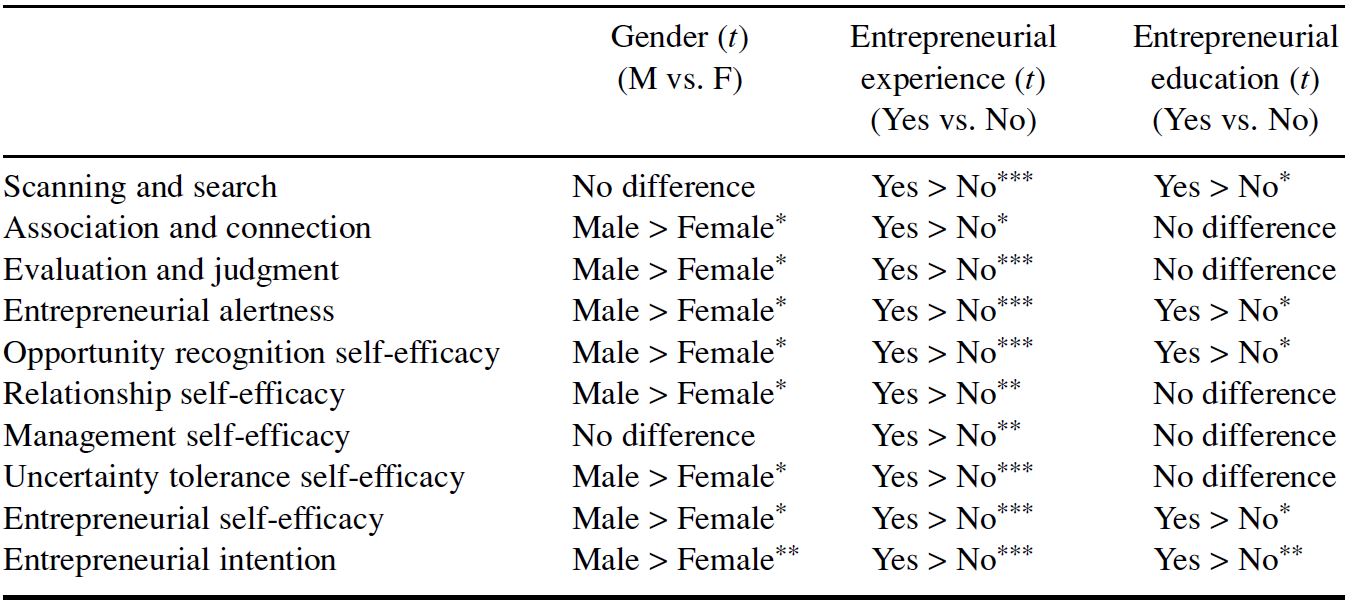
Note. N = 364. * p < .05, ** p < .01, *** p < .001.
In addition, significant differences were found among students from different universities in terms of association and connection, F(2, 361) = 4.66, p = .01, relationship self-efficacy, F(2, 361) = 4.63, p = .01, management self-efficacy, F(2, 361) = 6.89, p = .001, uncertainty tolerance efficacy, F(2, 361) = 3.24, p = .04), ESE, F(2, 361) = 4.90, p = .008, and EI, F(2, 361) = 6.98, p = .001. The least significant difference method results demonstrated that students from the university not in the provincial capital scored significantly lower in six factors (i.e., ESE, association and connection, relationship self-efficacy, management self-efficacy, uncertainty tolerance self-efficacy, and EI) than their counterparts from the universities in the provincial capital.
The Effect of Entrepreneurial Alertness and Entrepreneurial Self-Efficacy on Entrepreneurial Intention
Using Pearson’s correlation coefficient, we analyzed the related status of each EI, EA, and ESE factor. The outcome showed that EI had a significant correlation with all EA and ESE factors. Preliminary results further indicated that a correlation existed among these variables, with the coefficient ranging from .43 to .92.
Following confirmation of correlations among variables, we used hierarchical regression analysis to test the effects of EA and ESE on EI when controlling for gender and EE, as seen in Table 3, which shows that the effects of EA and ESE on EI were significant and ΔR2 was significant. Meanwhile, the single effects of gender and EE on EI were also significant.
Table 3. Results of Hierarchical Regression Analysis
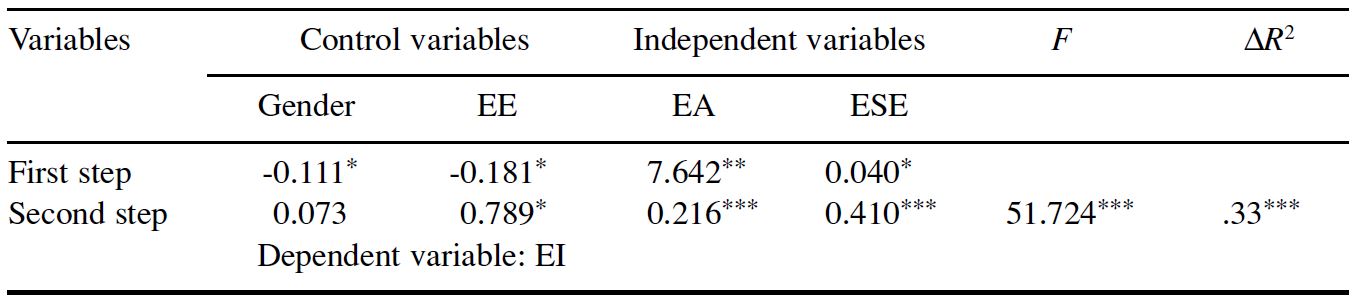
Note. EE = entrepreneurial education, EA = entrepreneurial alertness, ESE = entrepreneurial self-efficacy, EI = entrepreneurial intention. * p < .05, ** p < .01, *** p < .001.
Discussion
The significance of our findings lies in our exploration of the cognitive influence factors of EI with a case study of university students majoring in sports in China. We also tested the influence of demographic differences as well as the influence of ESE and EA on EI. Our findings not only support our hypotheses but also extend social cognitive theory, by confirming that both ESE and EA affected participants’ EI, even if students majoring in sports are a relatively specific group.
Furthermore, we identified how different antecedents influence sports major students’ EI. Our findings on gender, EE, and previous entrepreneurial experience empirically supported our hypothesis. The finding that the female students in this study scored lower in EI than the male students did is consistent with the findings of BarNir et al. (2011) and Shinnar, Hsu, and Powell (2014). Further, students with previous entrepreneurial experience scored significantly higher than those without it, which is in line with the findings of Martin et al. (2013) and Bae, Qian, Miao, and Fiet (2014). In addition, students with EE scored higher in ESE, EA, and EI compared to those without EE. These findings conform to social cognitive theory, which provides a theoretical basis for EE’s positive impact on ESE.
Our results also have several implications for entrepreneurship educators. First, because ESE and EA have a strong influence on sports major students’ EI, it is necessary to provide effective EE and practical training to develop the students’ efficacy and alertness in performing specific tasks and in identifying potential business opportunities. In terms of students majoring in sports, the curriculum should consist of entrepreneurship training, sports entrepreneurship practice and contests, and sports marketing and management, and assistance should be provided to aid students in understanding the sports industry and relevant national economic policies (Deng, 2012).
There are several limitations in this study. First, we measured demographic differences in gender, EE, and previous entrepreneurial experience only. Although the questionnaire had high validity and reliability, we omitted some elements. For example, we did not consider academic grades as a variable because no explanation could be provided for why junior sports major students showed lower EI than students in other grades. Therefore, we suggest that future researchers increase the demographic variable range to enhance the rationality of an explanation for this situation. Further, data were sourced from Southeast China, which is one of the most developed areas in China. We encourage future researchers to examine our results in other provinces in China or in other countries.
Ajzen, I. (1991). The theory of planned behavior. Organizational Behavior and Human Decision Processes, 50, 179–211. https://doi.org/cc3
Bae, T. J., Qian, S., Miao, C., & Fiet, J. O. (2014). The relationship between entrepreneurship education and entrepreneurial intentions: A meta-analytic review. Entrepreneurship Theory and Practice, 38, 217–254. https://doi.org/10/f3s9jk
Bai, T. L., & Wang, H. M. (2009, June 22). The rate of college students’ entrepreneurship is less than 1%; how to solve the problem [In Chinese]. Retrieved from https://bit.ly/2kf09Bo
Bandura, A. (1997). Self-efficacy: The exercise of control. New York, NY: Freeman.
Barbosa, S. D., Gerhardt, M. W., & Kickul, J. R. (2007). The role of cognitive style and risk preference on entrepreneurial self-efficacy and entrepreneurial intentions. Journal of Leadership & Organizational Studies, 13, 86–104. https://doi.org/10/bfzq53
BarNir, A., Watson, W. E., & Hutchins, H. M. (2011). Mediation and moderated mediation in the relationship among role models, self-efficacy, entrepreneurial career intention, and gender. Journal of Applied Social Psychology, 41, 270–297. https://doi.org/10/dg8tnc
Chen, C. C., Greene, P. G., & Crick, A. (1998). Does entrepreneurial self-efficacy distinguish entrepreneurs from managers? Journal of Business Venturing, 13, 295–316. https://doi.org/10/bm99vh
Cong, H.-P., Zheng, F., & Tong, Y.-J. (2013). Research on China’s sport industrial policy [In Chinese]. China Sport Science, 33, 3–14. https://doi.org/10/f3s9k4
Davidsson, P. (1995, November). Determinants of entrepreneurial intentions. Paper presented at the RENT IX Workshop, Piacenza, Italy. Retrieved from https://bit.ly/2vTV2cu
Deng, W.-J. (2012). Research on self-employed sports school students and their education patterns [In Chinese]. Journal of Shandong Institute of Physical Education and Sports, 28, 112–115. https://doi.org/10/f3s9k3
Hang, X. P., Hou, S. H., & Zhang, H. X. (2012). A survey about the employment conditions and subject construction of social sports major students in Hunan Province [In Chinese]. Theory and Practice of Contemporary Education, 4, 1–5.
Krueger, N. F., Jr., Reilly, M. D., & Carsrud, A. L. (2000). Competing models of entrepreneurial intentions. Journal of Business Venturing, 15, 411–432. https://doi.org/dq9tqw
Li, Y., Wang, P., & Liang, Y.-J. (2015). Influence of entrepreneurial experience, alertness, and prior knowledge on opportunity recognition. Social Behavior and Personality: An international journal, 43, 1575–1583. https://doi.org/10/f3s9kt
Maes, J., Leroy, H., & Sels, L. (2014). Gender differences in entrepreneurial intentions: A TPB multi-group analysis at factor and indicator level. European Management Journal, 32, 784–794. https://doi.org/10/f3s9jt
Martin, B. C., McNally, J. J., & Kay, M. J. (2013). Examining the formation of human capital in entrepreneurship: A meta-analysis of entrepreneurship education outcomes. Journal of Business Venturing, 28, 211–224. https://doi.org/10/f3s9jp
McMullen, J. S., & Shepherd, D. A. (2006). Entrepreneurial action and the role of uncertainty in the theory of the entrepreneur. Academy of Management Review, 31, 132–152. https://doi.org/10/cc8m3j
Schenkel, M. T., D’Souza, R. R., & Braun, F. C. (2014). Entrepreneurial self-efficacy, intent and intensity: Does experiential training enhance or inhibit predisposition? Journal of Developmental Entrepreneurship, 19, 1–21. https://doi.org/10/f3s9jm
Shinnar, R. S., Hsu, D. K., & Powell, B. C. (2014). Self-efficacy, entrepreneurial intentions, and gender: Assessing the impact of entrepreneurship education longitudinally. The International Journal of Management Education, 12, 561–570. https://doi.org/10/f3s9jn
Tang, J., Kacmar, K. M., & Busenitz, L. (2012). Entrepreneurial alertness in the pursuit of new opportunities. Journal of Business Venturing, 27, 77–94. https://doi.org/10/chnc37
Thompson, E. R. (2009). Individual entrepreneurial intent: Construct clarification and development of an internationally reliable metric. Entrepreneurship Theory and Practice, 33, 669–694. https://doi.org/10/dfqdqj
Ye, Y. (2014). Role of career decision-making self-efficacy and risk of career options on career decision-making of Chinese graduates. Psychological Reports, 114, 625–634. https://doi.org/6xf
Ye, Y. H. (2009). Research on the factors influencing undergraduates’ entrepreneurial intention [In Chinese]. Education Research, 4, 71–78.
Zhao, H., Seibert, S. E., & Hills, G. E. (2005). The mediating role of self-efficacy in the development of entrepreneurial intentions. Journal of Applied Psychology, 90, 1265–1272. https://doi.org/br8fb6
Table 1. Descriptive Results of Scores for Each Study Variable
Note. N = 364.
Table 2. Results of Differences Between Gender, Entrepreneurial Experience, and Entrepreneurial Education
Note. N = 364. * p < .05, ** p < .01, *** p < .001.
Table 3. Results of Hierarchical Regression Analysis
Note. EE = entrepreneurial education, EA = entrepreneurial alertness, ESE = entrepreneurial self-efficacy, EI = entrepreneurial intention. * p < .05, ** p < .01, *** p < .001.
The authors thank Dr. William Lan
Texas Tech University
for his valuable advice on our paper. This research was supported by the National Natural Science Foundation of China (71302062 and 71603094)
China Academic Degrees and Graduate Education (2015Y0104)
and Philosophy and Social Sciences Foundation of Zhejiang Province (10CGJY10YBQ).
Yinghua Ye, College of Education, Zhejiang University, 148 Tian Mu Shan Road, Hangzhou, Zhejiang 310028, People’s Republic of China. Email: [email protected]