Motivations and gratification in an online game: Relationships among players' self-esteem, self-concept, and interpersonal relationships
Main Article Content
We applied uses and gratifications (U & G) theory to investigate how and why people satisfy their needs through playing games online. In this study, conducted with a group of young people aged from 11 to 18 years, we examined the relationships among the psychological traits of self-esteem and self-concept, their interpersonal relationships, and playing a Facebook game called Happy Farm. The results support the assumption in U & G theory that if a specific medium fulfills the expected gratifications initially sought, then individuals will have greater motivation to continue to use the medium. Male players had a significantly greater need for friendship than did females. We also found a positive association among use intensity, self-esteem, self-concept, and interpersonal relationships. Finally, the results showed that recreational motivation, recreational gratification, peer relationships, and caring are all strong predictors of adolescents’ usage intensity.
In recent years, the prevalence of microblogging has led to the rapid development of Facebook, Twitter, and other microblogging companies. The former provides a platform for many community games, with the advantage of combining social networking sites (SNS) and online games, and the game called Happy Farm has made Facebook the most widely used SNS in Taiwan (Lee, 2009). In this game, players act as farmers, raising and selling their crops and livestock. They can also help their friends and neighbors manage their farms, or, alternatively, they can steal from others’ gardens. Thus, users not only engage in an enjoyable pastime, but also socialize with others while playing the game.
Because Happy Farm is one of the best known Facebook applications, this game provides a natural platform for researching Taiwanese users’ online socializing and gaming behaviors. Researchers have noted that not all game players play for the same reasons (Greenberg, Sherry, Lachlan, Lucas, & Holmstrom, 2010; Yee, 2006). Online gamers may be motivated by extrinsic and tangible motivators (e.g., prizes, grades, or fame), or they may be driven by the achievement of accumulating status or power. They may simply enjoy immersing themselves in the game’s characters, or they may be driven by the desire for social interaction, a sense of belonging, or by the satisfaction derived from forming and maintaining relationships. The focus in previous SNS and game research has been on participants’ addictions (Wu, 2013), flow experiences (Seger & Potts, 2012), and mental traits (Seger & Potts, 2012; Yang & Huang, 2011). However, gamers’ motivations have not been explored and, thus, the reasons that individuals use online community games, such as Happy Farm, is a topic that we were interested in investigating.
In this study, our aims were to examine the motivations driving players aged from 11 to 18 years to satisfy certain needs and how media can gratify their social-psychological needs for communication (Rubin, 2009). We employed uses and gratifications theory (U & G) as the theoretical basis to examine the underlying motivations of Happy Farm players. In U & G theory, it is postulated that individuals are aware of their social and psychological needs and, by use of media, seek to obtain particular types of gratification in order to fulfill these needs (Katz, 1959).
We examined gamers’ usage patterns, usage motivation, gratification obtained from playing the game, and interpersonal relationships. We also explored gender differences in relation to these variables, and the effect of the psychological variables of self-esteem and self-concept, as well as the influence of different types of motivation and gratification, on usage intensity of the Happy Farm game. Self-esteem relates to the individual’s feeling of his or her own self-worth (Rosenberg, 1965). Self-concept refers to the view, perception, attitude, and evaluation of oneself after long-term interaction with the environment.
Literature Review and Research Questions
The theory of U & G is an important mass communication paradigm that has been extended to the study of the gratification provided by use of diverse types of computer-mediated communication (CMC) technology. Concepts forming the basis of U & G theory are that individuals’ media selection and use are motivated by their needs from, expectations about, and goals in relation to the media, and that their active participation in the communication process may facilitate, regulate, or otherwise influence the types of gratification and the effects associated with exposure (Urista, Dong, & Day, 2009).
In a number of studies, researchers have examined the appeal of user-generated media or CMC technology from the U & G perspective (see e.g., Shao, 2009; Zhou & Leung, 2012). However, there is no existing research on online computer games, such as Happy Farm, from the U & G perspective. Given that Happy Farm is popular in Taiwan and based on previous research findings (Ku, Chu, & Tseng, 2013), we believed that the U & G perspective could be extended to provide a sound theoretical framework within which to investigate why and how Taiwanese adolescents are using Happy Farm.
Regarding research variables, empirical evidence has shown that psychological constructs are significant in the study of online gaming. Research findings indicate that the individual’s self-concept, self-esteem, and interpersonal relationships may all be enhanced through participation in online gaming, although concurrent negative effects have also been documented. For instance, Sponcil and Gitimu (2012) found that the intensity of using SNS was highly positively correlated with individual self-concept. Grasmuck, Martin, and Zhao (2009) further found that SNS can act as a place to develop and enhance group membership, while Steinkuehler and Williams (2006) postulated that playing online games may increase individuals’ sociability and social skills.
Regarding the negative effects of playing online games, Yang and Huang (2011) found that, compared with students who did not play games, the family relationships, self-esteem, and life adaptation skills of students with online gaming experience were of a lesser quality. These individuals may be attracted to game playing as a means of alleviating social difficulties or as an escape (Colwell, Grady, & Rhaiti, 1995). Likewise, Zhou and Leung (2012) found that loneliness and leisure boredom were significant predictors of both the level of SNS game use and the likelihood of addiction to online gaming. Moreover, they found that addicts were usually motivated by winning virtual money, together with gaining a sense of achievement. In addition, most addicts were found to be lonely males.
In a study of the influence of materialism on addiction to the Happy Farm game, Wu (2013) found that materialism had less impact on the degree of addiction for users with good interpersonal relationships, compared to those with poor interpersonal relationships. This researcher cautioned that gamers who misrepresent themselves online may develop a negative self-concept by way of self-comparisons, judgments, and cyber-bullying. These links reveal a close connection between the psychological state of adolescents and their online game involvement. Therefore, in this study, we examined the relationships among Taiwanese adolescents’ self-esteem, self-concept, their interpersonal relationships, and playing the game Happy Farm.
Method
Participants
Because of the lack of a reliable sampling frame, we adopted a nonrandom sampling technique (convenience sampling) in this study. The sampling procedure was conducted via three coordinators who were distributed among 12 primary, junior high, senior high, and vocational high schools in southern Taiwan. Although the potential bias of convenience sampling prevented the sample from being representative of the entire population, this approach made it easy to identify the target sample.
We distributed 886 survey forms to students aged from 11 to 18 years, receiving 855 valid survey forms in return. Among the 855 respondents, 46.73% were males and 53.27% were females; 21.52% were in primary school, 39.23% were in junior high, and 39.5% were in senior high school or vocational high school.
Instruments
Usage Scale. The Usage Scale was designed to measure respondents’ Happy Farm usage intensity and their usage of the Happy Farm social network. This inventory has the following three parts: the first part measures users’ game behavior and game role level, the second part addresses the intensity of gamers’ usage, and the third part relates to the gamers’ maintenance of interpersonal relationships via the Happy Farm social network. The usage intensity measure in this study was adapted from Ellison, Steinfield, and Lampe’s (2007) Facebook Intensity Scale. Response options ranged from 1 (strongly disagree) to 5 (strongly agree).
Self-Esteem Scale. The participants’ self-esteem was assessed using the Self-Esteem Scale, developed by Rosenberg (1965), which consists of 10 items for which the participants indicate their level of agreement or disagreement on a 4-point Likert-type scale, where a higher score indicates a higher level of agreement. The Cronbach’s coefficient alpha of the scale was .86.
Self-Concept Scale. The Self-Concept Scale (Chuang, 2002) has five subscales (biological, mental, family, school, and moral self-concept) and is designed to measure level of agreement or disagreement with the items in the subscales on a 5-point Likert-type scale, where 1 = strongly disagree and 5 = strongly agree. The alpha value of the scale was .93. It should be noted that we selected only the mental self-concept, family self-concept, and moral self-concept subscales as measures relevant for this study.
Usage Motivation and Gratification Scale. The Usage Motivation and Gratification Scale was designed by the authors of this study to clarify the relationship between users’ motivation for, and gratification with, their participation in Happy Farm. This scale has the following three factors: instrumental purposes (experiencing a different lifestyle), recreational purposes (enjoying the fun of the game), and social purposes (maintaining friendships). A 6-point Likert-type scale is used to measure participants’ level of disagreement or agreement, where 1 = strongly disagree and 6 = strongly agree. Participants indicate, with separate responses for level of motivation and level of gratification, their agreement/disagreement with 10 items that were identified from the related U & G literature. Principal components analysis with direct oblimin rotation yielded instrumental, recreational, and social purposes as the three factors, and these accounted for 64.53% of the variance. The item loadings ranged from .60 to .88. The Cronbach’s coefficient alpha reliability for the whole scale was .94, with .88 for motivation and .91 for gratification subscales.
Interpersonal Relationship Scale. The Interpersonal Relationship Scale was designed by the authors of this study to measure the participants’ friendships on Happy Farm (see Table 1). The scale measures level of agreement or disagreement on a 5-point Likert-type scale, where a score of 5 indicates strong agreement with the statement. Exploratory factor analyses with direct oblimin rotation were used to assess the construct validity. A three-factor construct was developed according to the content of the items. The factor of Friendship Need refers to the need of an individual to interact with others by sharing thoughts and feelings. Peer Relationship refers to the behavior of nurturing and constructing relationships with people in the same age group as the individual. Caring refers to the act of showing concern for, and involvement with, friends’ needs. The Cronbach’s coefficient alpha reliability for the whole scale was .91, with .84 for both peer relationship and caring and .89 for friendship needs.
Table 1. Means and Standard Deviations for Happy Farm Usage Frequency and Intensity
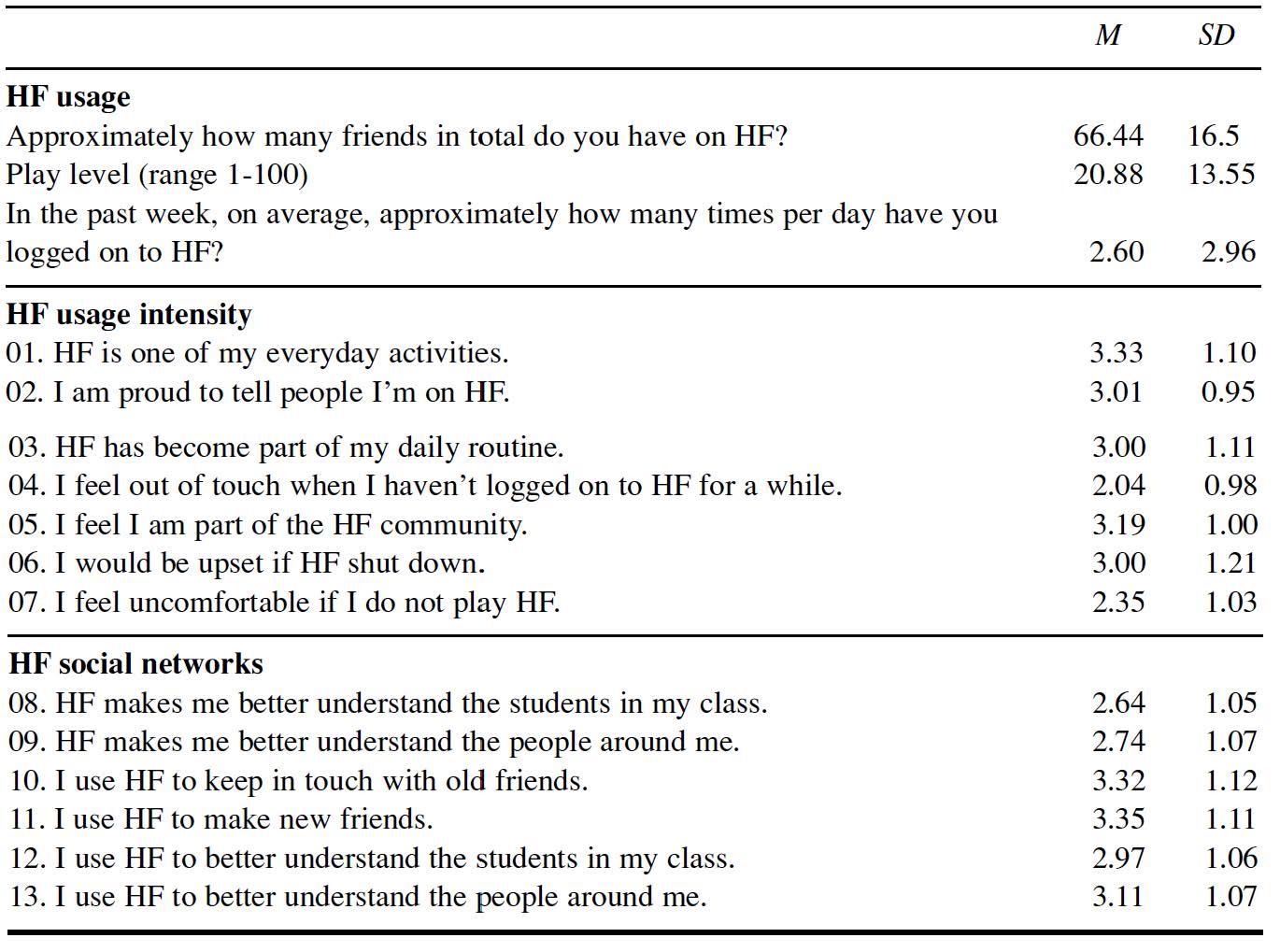
Note. HF = Happy Farm.
Results
Users’ Intensity
Participants’ usage intensity results can be seen in Table 1. The high frequency of playing the game reflects the popularity of Happy Farm in Taiwan, supporting the findings reported by Lee (2009). The average game level players had reached showed that the students were generally active gamers.
Happy Farm Players’ Usage Motivations and Gratifications
The results indicated that the three strongest motivations and gratifications for players of Happy Farm were “being satisfied by harvesting crops” (M M = 3.88, M G = 4.22), “relieving stress” (M M = 3.85, M G = 4.04), and “increased chatting with friends” (M M = 3.66, M G = 4.03), whereas the three weakest motivations and gratifications were “avoiding feeling left out if I do not play while others are playing” (M M = 2.93, M G = 3.53), “finding a sense of belonging in the game” (M M = 2.95, M G = 3.48), and “experiencing the feeling of being a farmer” (M M = 2.12, M G = 3.69).
Associations Among Intensity, Self-Concept, Self-Esteem, and Interpersonal Relationships
In Table 2, the coefficients of association among different variables and positive correlations among all variables are presented. The same patterns were observed with regard to both Happy Farm usage intensity and involvement with social networks.
Table 2. Correlations Among Study Variables

Note. * p < .05, ** p < .01, *** p < .001. HF = Happy Farm.
Gender Differences in Happy Farm-Related Variables
The only significant gender differences in Happy Farm-related variables, was that male players showed a greater need for friendships than did females (M M = 25.97, M F = 22.98; t = 5.31, p < .001).
Multiple Regression Analysis of Variables Predicting Happy Farm Usage Intensity
We conducted a multiple regression analysis to examine how psychological traits, motivation, and gratification influenced Happy Farm gamers’ usage intensity. Results showed that the entire model exhibited an overall explanatory power of 33%, reflecting a medium level of predictive power (F = 37.80, p < .001, R2 = .34, ΔR2 = .33). Among the predictors, peer relationships (β = .22), recreational purposes (both motivation and gratification; β = .15, .12), and caring (β = .11) were the most powerful.
Discussion
In this study, we investigated how and why adolescents in Taiwan satisfy their needs by playing Happy Farm. The average number of times per day that the students played the game and the average number of game friends they reported, demonstrated that Happy Farm is popular among adolescents in Taiwan. Keeping in touch with old friends and making new friends were the two major reasons for playing the game, indicating that Happy Farm plays an important role in interpersonal relationships of our participants. The findings are consistent with those of Cole and Griffiths (2007), showing that social interactions in online gaming are an important element of the enjoyment of playing.
We also found that Happy Farm players were motivated and gratified by various factors, implying that Taiwanese adolescent gamers are aware of their psychological and social needs and seek specific types of gratification from media use to fulfill these needs. Our results also echo the three categories of content gratification, process gratification, and social gratification from CMC technologies, as classified by Stafford, Stafford, and Schkade (2004).
Regarding content gratification, Happy Farm gamers express themselves and strive for self-actualization by producing their own content through harvesting crops. Concerning process gratification, in our study, the results showed that amusement was an important gratification for the participants that could be fulfilled through playing Happy Farm. Similarly, we also found support for social gratification, that is, relationship maintenance via increased chatting with Happy Farm friends. Not only do people playing online games interact with user-generated content, but they also interact with others to enhance their social connections. This finding echoes that of Pempek, Yermolayeva, and Calvert (2009), who reported that, in their social-networking experiences on Facebook, college students focused on interpersonal relationships.
Our findings show that it is a complex mix of desires and motivations that leads individuals to play Happy Farm. In addition, the varying degree of importance placed on the three types of gratification provide evidence in support of the assumptions upon which U & G theory is based: different expectations and motives drive people’s choices regarding online game involvement.
Notably, we found a symmetrical relationship between motivation and gratification, with the motivations for playing and gratifications from playing Happy Farm that were ranked first and last among the three types, almost corresponding to each other, and all correlation coefficients strongly related. This finding also provides evidence in support of U & G theory, in that a stronger desire to play Happy Farm may lead to greater satisfaction when playing.
Another issue may involve whether or not greater intensity of use of games always accompanies increased satisfaction or whether level of intensity of use moderates/mediates the relationship between uses and gratifications. For example, Wan and Chiou (2006) found that the psychological needs of players of online games reflected Heizberg’s (1966) two-factor theory (satisfaction– dissatisfaction or motivation–hygiene), with differing evaluations on satisfaction and dissatisfaction dimensions. Because addicts’ compulsive use of online games appears to come from a reduction in their dissatisfaction rather than from the quest for satisfaction, it is worth examining further whether or not Happy Farm players who are not addicted have different patterns of use and gratification from players who are addicted.
Consistent with findings reported by Sponcil and Gitimu (2012), we found that the more the adolescents were involved in playing Happy Farm, the stronger were their self-concept, self-esteem, and interpersonal relationships.
Regarding gender differences in variables related to playing Happy Farm, our findings are consistent with those reported by Colwell et al. (1995). Specifically, they found that boys who were excessive computer game players had high scores on the need for friends. Indirect evidence from Cole and Griffiths (2007) may provide an explanation for this, as they found that, compared to female players, male players made more friends online and were more likely to form friendships with other players, whereas the friendships formed by females were emotionally stronger than those formed by males and were more likely to involve discussion of sensitive issues. Likewise, Mazman and Usluel (2011) found that males had stronger goals of making new friendships on Facebook than did females. Given these previous findings, it is not surprising that we also found that our male participants had stronger needs for friendship than did the females.
With respect to the multiple regression analysis of variables predicting Happy Farm usage intensity, our findings revealed that friendship was extremely important for these adolescents. Chou and Tsai (2007) found that both males and females adolescent respondents reported that playing computer games improved the quality of their friendships. Therefore, it did not surprise us that peer relationships were the strongest predictor of usage intensity in our study. We found that, in descending order, recreational motivation and recreational gratification were the second and third most powerful predictors of usage intensity, implying that entertainment is a core inducement for adolescents to get involved in Happy Farm. Adolescents devote themselves to Happy Farm for amusement, and the resulting pleasure activates their craving to play. Finally, caring is a strong predictor, confirming the importance of interpersonal relationships for adolescents.
Conclusion
The finding of correspondence between gratifications and motivations provides evidence in support of our assumption, based on U & G theory that if a specific medium fulfills an individual’s expectation for gratification, he or she will have greater motivation to use that medium consistently. As mentioned in the discussion, the relationship between enhanced gratification and increasing intensity of usage remains uncertain. Whether or not a linear relationship exists between use and gratification should be further examined to gain further understanding of the applicability of U & G theory in relation to online gaming. Additionally, comparing relationships among use, gratification, and dissatisfaction between two target groups (addicts vs. those who are not addicted) might be an interesting area for future study.
Notably, our finding that adolescent boys have a greater need for friendship than do adolescent girls not only supported the findings reported by Colwell et al. (1995) and Chou and Tsai (2007) but also provided useful information about motivations according to gender. It seems that boys prefer to establish new relationships in online gaming environments, whereas girls tend to view online social gaming platforms as a private field. Therefore, future researchers could examine and compare how males and females perceive and experience online computer games, especially their respective attitudes toward social relationships. Moreover, in this study, we found positive associations among Happy Farm intensity of usage, self-esteem, self-concept, and interpersonal relationships. However, the cross-sectional design of the survey we used did not allow for any conclusions about causality. In future studies, the validity of our findings could be enhanced by employing a longitudinal design. Finally, based on U & G theory, Happy Farm addiction might be seen as a factor that may moderate or mediate an individual’s self-esteem, self-concept, and interpersonal relationships as well as their motivations and gratifications. Further research is needed to develop integrative and comprehensive theories, using methods that explore the negative and positive impact of games on psychosocial issues from cognitive, emotional, and motivational perspectives.
Chou, C., & Tsai, M.-J. (2007). Gender differences in Taiwan high school students’ computer game playing. Computers in Human Behavior, 23, 812-824. http://doi.org/bkzhcv
Chuang, J. C. (2002). Study of the relationship of junior high school students’ self-concept, life adjustment, and self-damage. Unpublished master’s thesis, Nanhua University, Chiayi, Taiwan.
Cole, H., & Griffiths, M. D. (2007). Social interactions in massively multiplayer online role-playing gamers. CyberPsychology & Behavior, 10, 575-583. http://doi.org/cr3fzj
Colwell, J., Grady, C., & Rhaiti, S. (1995). Computer games, self-esteem and gratification of needs in adolescents. Journal of Community & Applied Social Psychology, 5, 195-206. http://doi.org/d7x6st
Ellison, N. B., Steinfield, C., & Lampe, C. (2007). The benefits of Facebook “friends”: Social capital and college students’ use of online social network sites. Journal of Computer-Mediated Communication, 12, 1143-1168. http://doi.org/cqv79r
Grasmuck, S., Martin, J., & Zhao, S. (2009). Ethno-racial identity displays on Facebook. Journal of Computer-Mediated Communication, 15, 158-188. http://doi.org/bhw3g2
Greenberg, B. S., Sherry, J., Lachlan, K., Lucas, K., & Holmstrom, A. (2010). Orientations to video games among gender and age groups. Simulation & Gaming, 41, 238-259. http://doi.org/drw5w9
Heizberg, F. (1966). Work and the nature of man. Cleveland, OH: World.
Katz, E. (1959). Mass communications research and the study of popular culture: An editorial note on a possible future for this journal. Studies in Public Communication, 2, 1-6.
Ku, Y.-C., Chu, T.-H., & Tseng, C.-H. (2013). Gratifications for using CMC technologies: A comparison among SNS, IM, and e-mail. Computers in Human Behavior, 29, 226-234. http://doi.org/w8s
Lee, H. Y. (2009). Taiwan internet gamers addicted to “Happy Farm”. Retrieved from http://worldfocus.org/blog/2009/10/28/
Mazman, S. G., & Usluel, Y. K. (2011). Gender differences in using social networks. Turkish Online Journal of Educational Technology, 10, 133-139.
Pempek, T. A., Yermolayeva, Y. A., & Calvert, S. L. (2009). College students’ social networking experiences on Facebook. Journal of Applied Developmental Psychology, 30, 227-238. http://doi.org/ftrz56
Rosenberg, M. (1965). Society and the adolescent self-image. Princeton, NJ: Princeton University Press.
Rubin, A. M. (2009). Uses-and-gratifications perspective on media effects. In J. Bryant & M. B. Oliver (Eds.), Media effects: Advances in theory and research (pp. 165-184). New York: Routledge.
Seger, J., & Potts, R. (2012). Personality correlates of psychological flow states in videogame play. Current Psychology, 31, 103-121. http://doi.org/wxv
Shao, G. (2009). Understanding the appeal of user-generated media: A uses and gratification perspective. Internet Research, 19, 7-25. http://doi.org/dhvhkh
Sponcil, M., & Gitimu, P. (2012). Use of social media by college students: Relationship to communication and self-concept. Journal of Technology Research, 4, 16-28.
Stafford, T. F., Stafford, M. R., & Schkade, L. L. (2004). Determining uses and gratifications for the internet. Decision Sciences, 35, 259-288. http://doi.org/cnq87v
Steinkuehler, C. A., & Williams, D. (2006). Where everybody knows your (screen) name: Online games as “third places”. Journal of Computer-Mediated Communication, 11, 885-909. http://doi.org/bf2fvp
Urista, M. A., Dong, Q., & Day, K. D. (2009). Explaining why young adults use MySpace and Facebook through uses and gratifications theory. Human Communication, 12, 215-119.
Wan, C.-S., & Chiou, W.-B. (2006). Psychological motives and online games addiction: A test of flow theory and humanistic needs theory for Taiwanese adolescents. CyberPsychology & Behavior, 9, 317-324. http://doi.org/bt64k7
Wu, P.-C. (2013). Addictive behavior in relation to the Happy Farm Facebook application. Social Behavior and Personality: An international journal, 41, 539-554. http://doi.org/wxw
Yang, S.-C., & Huang, K.-L. (2011). Analyses of junior high school students’ online gaming experience and its relationship with self-concept, life adaptation and well-being. Journal of Educational Media & Library Sciences, 48, 407-442.
Yee, N. (2006). Motivations for play in online games. CyberPsychology & Behavior, 9, 772-775. http://doi.org/cm9hfc
Zhou, S. X., & Leung, L. (2012). Gratification, loneliness, leisure boredom and self-esteem as predictors of SNS-game addiction and usage pattern among Chinese college students. International Journal of Cyber Behavior, Psychology, & Learning, 2, 34-48. http://doi.org/wxx
Table 1. Means and Standard Deviations for Happy Farm Usage Frequency and Intensity
Note. HF = Happy Farm.
Table 2. Correlations Among Study Variables
Note. * p < .05, ** p < .01, *** p < .001. HF = Happy Farm.
Shu Ching Yang, Graduate Institute of Education, National Sun Yat-sen University, 70 Lien-hai Road, Kaohsiung 80424, Taiwan, ROC. Email: [email protected]