Context and creativity: The theory of planned behavior as an alternative mechanism
Main Article Content
Creativity researchers have identified intrinsic motivation as the critical intervening process that explains the effects of contextual characteristics on individual creativity. Departing from this prevailing focus on intrinsic motivation, in the present study an alternative theoretical model was advanced based on the theory of planned behavior (TBP; Ajzen, 1991). Specifically, it was proposed that TPB-based psychological mechanisms (attitude toward creativity, creative self-efficacy, and creativity intention) would mediate the effects of contextual factors (leader encouragement and peer support) on individual creative performance. Multisource data collected at 3 time points from 386 students and their 28 instructors largely supported the hypothesized mediating role of creative self-efficacy. The current findings suggest a need to rethink the role of intrinsic motivation in the context-creativity link by identifying alternative psychological mechanisms.
Contemporary organizations are obsessed with generating ideas that modify the business paradigm, and thus experiment with various ways to produce innovations in products and services more effectively (Gong, Huang, & Farh, 2009). Because individuals are the source of novel ideas, the focus in many early studies was on creative individuals and their characteristics such as intelligence, cognitive style, personality, motivation, and so forth (Hirst, Van Knippenberg, & Zhou, 2009; Sung & Choi, 2009). As creativity was recognized as a core competence for personal and organizational performance, organizational scholars started to examine predictors of creativity, largely focusing on contextual variables and their interactions with individual characteristics (e.g., Amabile, Conti, Coon, Lazenby, & Herron, 1996; Choi, Anderson, & Veillette, 2009).
In existing studies researchers have produced an extensive list of organizational, social, and other workplace characteristics that predict creativity of organizational members, including leader behavior, coworker characteristics, job design features, and organizational climate (for a review, see Shalley, Zhou, & Oldham, 2004). To explain the mechanism through which these environmental variables influence employee creativity, most researchers have utilized the notion of intrinsic motivation (Oldham & Cummings, 1996; Shalley et al., 2004). Drawing on cognitive evaluation theory (Deci & Ryan, 1985), scholars have argued that contextual factors influence creativity because they play an important role in determining an individual’s level of intrinsic motivation, which is a direct, proximal antecedent of creativity (Zhang & Bartol, 2010).
Despite the prominence and widespread acceptance of the intrinsic motivation argument (Amabile et al., 1996; Choi et al., 2009; Oldham & Cummings, 1996; Zhang & Bartol, 2010), the efficacy of intrinsic motivation as an intervening process has been largely untested. Moreover, even when empirical evidence has indicated that intrinsic motivation may be a significant mediator, the link between context and creativity has not been explained solely by intrinsic motivation (Liao, Liu, & Loi, 2010). This presents a need to pursue additional theoretical explanations, an activity that, thus far, has rarely been engaged in perhaps because of the prominence of the intrinsic-motivation explanation.
In the present study I expand the horizon of the organizational creativity literature by developing and empirically validating alternative intervening processes on the basis of the theory of planned behavior (TPB; Ajzen, 1991). In this new conceptualization, contextual variables are hypothesized to predict individual creativity indirectly through their direct effects on employees’ attitudes, behavioral control, and intentions related to creativity in the given setting. This additional theoretical perspective enriches understanding of contextual influences on creativity by offering a novel perspective through which to construe the context-creativity link. These TPB-based intervening processes that link context and creativity were tested using longitudinal panel data collected from undergraduate business students and their instructors.
Problems of Intrinsic Motivation as the Intervening Process
Although intrinsic motivation has been widely acknowledged as a potential intervening process between context and creativity (Shalley et al., 2004), this position suffers from several problems. First, as already pointed out, empirical validation of this process is lacking and the limited existing evidence has failed to support it in both laboratory (Shalley & Perry-Smith, 2001) and field settings (Shin & Zhou, 2003). Second, there is a plausible alternative possibility that intrinsic motivation moderates (instead of mediates) the relationship between context and creativity. For example, Andrews and Smith (1996) found that product managers’ intrinsic motivation moderated the relationship between a situational factor (i.e., time pressure) and marketing program creativity. It may be that intrinsically motivated individuals are more sensitive to, and respond in a more positive manner to, creativity-enhancing contextual factors. Third, the singular reliance on intrinsic motivation theory may be hindering the exploration of other potential mechanisms that might offer better theoretical accounts of the context-creativity link (Eisenberger & Aselage, 2009). In fact, scholars have suggested alternative intervening processes such as increased attention to opportunities for improvement (Anderson & West, 1998) and self-efficacy or willingness to try risky options (Liao et al., 2010). When faced with a nonsignificant mediation effect of intrinsic motivation, Shin and Zhou also suggested the presence of an alternative intervening process such as self-efficacy related to creative performance.
Alternative Intervening Processes Based on the Theory of Planned Behavior
In an effort to address the challenges associated with intrinsic motivation described above, in this study I argue for alternative psychological processes between context and creativity by drawing on the theory of planned behavior (see Ajzen, 1991). The TPB is a well-established social psychological model of human behavior that has been successfully applied to numerous domains including altruistic behavior, health-related behavior such as diet and exercise, task-related behavior, and innovation use (Hartwick & Barki, 1994; Manstead, 2000). The TPB is useful in the specification of psychological mechanisms that lead to human behavior. According to the TPB, human behavior is a function of perceived behavioral control and intention, where intention is directly predicted by subjective norms, attitudes toward the behavior, and perceived behavioral control. Because the goal in the present study was to identify an alternative intervening process between context and creativity, I excluded subjective norms, which represent social expectations regarding a particular behavior, and thus constitute part of the social context surrounding the person. Specifically, in the present study, I looked to leader encouragement of participation and peer support as contextual factors that affect individual creativity as demonstrated in a number of prior empirical studies (Gong et al., 2009; Liao et al., 2010; Shalley et al., 2004).
Using the three remaining components of the TPB, I proposed that contextual factors influence the creativity of individuals by shaping their attitudes toward creativity, perceived behavioral control related to creative performance, and intention to exert creative effort in a given setting. Drawing on Ajzen’s (1991) definitions of the components of the TPB, I defined creativity intention as “indications of how hard individuals are willing to try, of how much of an effort they are planning to exert, in order to produce creative output in a given setting” (p. 181). Creativity intention is predicted by the other two components: (a) attitude toward creativity, defined as “the degree to which a person has a favorable or unfavorable evaluation or appraisal of creativity in a given setting” (p. 188); and (b) perceived behavioral control for creative performance, referring to “the perceived ease or difficulty of performing creative behavior in a given setting” (p. 188). Similar to the TPB, I expected creativity to be predicted by both creativity intention and perceived behavioral control related to creative performance – hereafter referred to as creative self-efficacy.
Contextual factors such as leader encouragement and peer support may influence creativity by shifting these components of the TPB. Specifically, I expected that leader encouragement and peer support would enhance positive attitudes toward creativity and creative self-efficacy. It is almost axiomatic to state that people’s attitudes are shaped by their social surroundings (Salancik & Pfeffer, 1978). When leaders encourage free exchange of ideas and participation from group members, and when group members are supportive of others’ diverse ideas and share their own, individuals may construe this social context as being supportive of the generation of novel ideas, which may increase their positive attitudinal judgments regarding creativity in that particular setting (Liao et al., 2010; Zhang & Bartol, 2010). Anderson and West (1998) also maintained that based on interpersonal interaction patterns among members, a team’s psychological safety promotes that team’s creative performance by creating positive attitudes toward creative efforts of members.
Leader encouragement and peer support are also apt to increase individual efficacy belief related to creative performance because, as stated by Tierney and Farmer (2002, p. 1139) “employees rely on cues from members of their work environment to form views relevant to creative acts, including their own capability”. Tierney and Farmer showed that creative self-efficacy is positively associated with supervisors’ supportive behavior, including verbal persuasion and role modeling in that, when a leader demonstrates behaviors that are favorable to creativity and convinces followers that they are capable of producing creative outcomes, the self-efficacy belief of the followers related to creativity is likely to increase (Gong et al., 2009). Choi, Price, and Vinokur (2003) also showed that group members’ self-efficacy beliefs tend to increase over time with the presence of supportive and encouraging leaders and peer members. The findings in these studies present theoretical and empirical grounds to support the idea that leader encouragement and peer support enhance individual creative self-efficacy.
On the basis of the TPB (Ajzen, 1991), it was further hypothesized in the current study that positive attitudes toward creativity and creative self-efficacy would determine a person’s intention to exert creative effort. Behavioral intention is likely to be the most proximal predictor of actual performance in situations in which behavior is largely volitional (Manstead, 2000). However, when behavior is under incomplete volitional control, perceived behavioral control (or creative self-efficacy in the present study) also exerts a direct effect on behavioral performance in addition to its indirect effect via intention (Ajzen, 1991). Given that creativity requires that the individual possesses a certain set of skills and capabilities, such as domain-specific knowledge and creative cognitive processes (Amabile, 1988; Zhang & Bartol, 2010), I expected that creativity would be directly predicted by both creativity intention and creative self-efficacy. Although there are complex relationships among the three TPB components, for the sake of simplicity, in the present study I focused on their intervening role between context and creativity. Thus, I advanced the following meditational relationship as an alternative to the prevailing intrinsic motivation theory:
Hypothesis: The effects of the social context variables of leader encouragement and peer support on individual creativity will be mediated by attitudes toward creativity, creative self-efficacy, and creativity intention.
Method
The validity of the three TPB components as intervening processes between context and creativity was tested using longitudinal panel data collected from undergraduate management students and their instructors.
Procedure and Participants
The data were collected from undergraduate students enrolled in an introductory organizational behavior course at a North American business school. The course included 14 sections taught by 28 instructors (two instructors cotaught each section with approximately 30 students). The class met twice a week for two-hour sessions that were largely devoted to experiential exercises and discussions. Students were expected and encouraged to participate actively in class activities and to offer ideas and questions for discussion.
Data were collected at three time points: at the 6th week (T1), at the 12th week (T2), and at the 14th week (T3) of the semester. Of the 430 students enrolled, 386 students (response rate = 89.8%) completed either the T1 (n = 344) or T2 questionnaire (n = 331). This sample included 51.6% females with an average age of 19.8 and an average year in school of 2.1 (1 = freshman, 2 = sophomore, 3 = junior, 4 = senior). At T3, instructors provided ratings of their students’ creativity in class.
Measures
The T1 and T2 questionnaires for students entailed scales to assess contextual factors (instructor encouragement and peer support) and the three intervening components based on the TPB (attitudes toward creativity, creative self-efficacy, and creativity intention), respectively. A 7-point Likert-type scale was used as the response format for all items.
Leader encouragement (T1). Five items (α = .73) were taken from Choi et al. (2003) to measure the extent to which instructors encouraged students’ participation and ideas. Example items included “How much opportunity did the instructors give the class to answer other students’ questions?” and “How closely did the instructors listen to comments?” Each item was followed by a 7-point scale ranging from 1 = not at all true to 7 = a great deal.
Peer support (T1). Three items (α = .72) were used from Choi et al. (2003) to assess the degree to which classmates trusted and supported each other (e.g., “During the classes, how much did you feel that you could trust other classmates to listen to your ideas and opinions?” and “During the classes, how much did you feel that it was comfortable to participate?”).
Attitude toward creativity (T2). Because of the lack of existing measures designed to assess the three TPB components in the context of creativity, scales for these components were constructed based on their conceptual definitions (Ajzen, 1991) and on prior scales developed to measure them in different research contexts such as innovation use behavior (e.g., Hartwick & Barki, 1994). A 2-item measure (α = .81) was developed to assess the extent to which participants had positive evaluative judgments regarding creativity in the classroom setting. The items were: “I believe that sharing different viewpoints during the class is beneficial for my learning” and “I believe that creativity enriches our class activities and improves my learning”. Scale anchors for these items were 1 = strongly disagree and 7 = strongly agree.
Creative self-efficacy (T2). The TPB component of perceived behavioral control was measured using a 3-item index (α = .81) that was designed to assess the level of comfort and confidence related to creative performance in the classroom setting. This scale included the following items: “I can easily fulfill the required level of creativity in this class”, “My creativity level is enough to perform creative work in this class”, and “This class requires too much creativity from me” (reverse coded).
Creativity intention (T2). Participants’ intention to exert creative effort during class was measured using a 2-item scale (α = .83) that included “I am highly motivated to offer new and constructive ideas to the class” and “I am willing to use my creativity during this class”.
Creative performance (T3). At the end of the semester (T3), each of the two instructors for each section independently evaluated the level of creativity they observed in their students during class. In the evaluation sheet prepared for instructors, creativity was operationally defined as “The extent to which this particular student (a) is open to and actively listens to others’ ideas, (b) generates and presents new/fresh ideas, alternative explanations, different perspectives, or other creative solutions, and (c) integrates multiple perspectives or combines ideas or materials from different modules in a constructive manner”. Instructors rated each student’s creative performance on a 7-point scale (1 = very little, 7 = a lot). Creativity ratings from the two instructors exhibited an acceptable level of interrater agreement (effective reliability of judges = .70, see Rosenthal & Rosnow, 1991, pp. 51-52).
Results
Means, standard deviations, and intercorrelations among all study variables are presented in Table 1. The hypothesized intervening role of task motivation between contextual variables and employee creativity was tested using structural equation modeling (SEM; Bentler, 1995). The SEM analysis provides simultaneous estimation of the hypothesized regressions by using a covariance matrix generated from the observed covariance matrix of the measured variables. The estimated covariance matrix is also used for evaluating goodness of fit between the actual data and the estimated model.
Table 1. Means, Standard Deviations, and Correlations among Study Variables
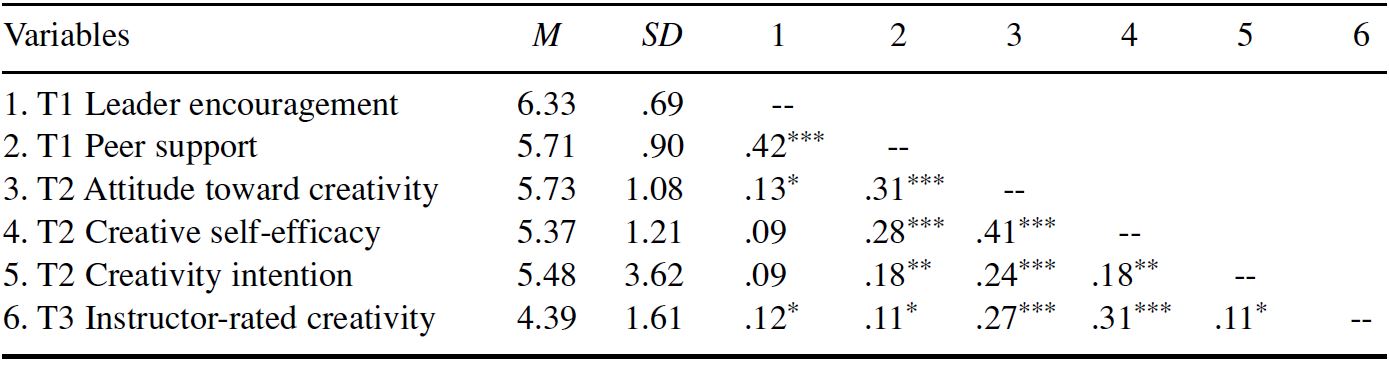
Notes: * p < .05, ** p < .01, *** p < .001.
The hypothesized intervening role of the three TPB components was tested by creating a structural model that was based on T1 contextual variables, T2 TPB components, and T3 creative performance as rated by instructors. In this model I incorporated the following relationships: (a) T1 leader encouragement and peer support predict T2 attitude toward creativity and creative self-efficacy, (a) T2 attitude toward creativity and creative self-efficacy predict T2 creativity intention, and (c) T2 creative self-efficacy and creativity intention predict T3 instructor-rated creativity. The second and third relationships precisely replicate the process suggested by TPB (Ajzen, 1991), excluding the role of subjective norms related to the given behavior. This hypothesized model produced a very good fit to the present data (χ2(38) = 57.33, p < .05; comparative fit index (CFI) = .99, goodness of fit index (GFI) = .97, root mean square error of approximation (RMSEA) = .043, Akaike information criterion (AIC) = -18.67).

Figure 1. Intervening role of TPB components between context and creativity.
Notes: Thicker lines represent statistically more significant results. Dotted lines represent nonsignificant paths.
χ2(df = 38) = 57.33, p > .01; CFI = .99; GFI = .97; RMSEA = .043
* p < .05, ** p < .01, * p < .001.
Although the results indicate that the hypothesized model provides a good explanation of the observed pattern in the present data, they do not rule out the possibility that other models will provide an equally good or better fit. For example, there may be nonzero direct effects of contextual factors on creativity, thus rendering the mediation by the TPB components incomplete. This possibility was tested by adding two direct paths from T1 leader encouragement and peer support to T3 creativity. This model substantially lowered the model fit (χ2(36) = 255.91, p < .001; CFI = .83, GFI = .87, RMSEA = .148, AIC = 183.91), suggesting that after controlling for indirect effects via the TPB components, the direct paths linking contextual factors and creativity were redundant.
In addition, I tested the possibility that the three TPB components and two contextual factors exerted independent effects on creativity without being connected via mediation as hypothesized. To this end, I developed a structural model in which the two contextual factors and the three TPB components have direct main effects on creative performance. This alternative model produced only marginally acceptable model fit (χ2(38) = 176.43, p < .001; CFI = .92, GFI = .93, RMSEA = .107, AIC = 100.43).
All in all, the present analyses confirmed the hypothesis that the three TPB components completely mediated the context-creativity link. This model is depicted visually in Figure 1 using standardized parameter estimates. The two contextual factors were significantly correlated (r = .49, p < .001). However, of the two, only peer support exerted significant effects on attitude toward creativity and creative self-efficacy (r = .37 and .46 respectively, both p < .001), both of which were significant predictors of creativity intention. Instructor-rated creativity was positively and significantly associated with creative self-efficacy (β = .31, p < .05), and was positively, but nonsignificantly, associated with creativity intention.
Discussion
Departing from the prevailing focus on intrinsic motivation (Shalley et al., 2004), in the present study I offered an alternative intervening process to that presented in literature currently available, based on the theory of planned behavior (TPB), that might better explain the effect of contextual factors on creative performance of individuals (Zhang & Bartol, 2010). Thus, it was my intention to expand the theoretical horizon and overcome the prevailing reliance on the intrinsic motivation theory in the organizational creativity literature. The results in this study demonstrated that the three TPB components specified in the creativity context (attitude toward creativity, creative self-efficacy, and creativity intention) fully mediated the effects of leader encouragement and peer support on individual creativity. The strong mediational effects of the TPB components may be owing to their clear situation specificity (all constructs were strongly tied to the given setting) and content proximity to the outcome (all constructs were clearly linked to creative behavior or performance), which have been previously identified as particular strengths of the TPB (Ajzen, 1991; Manstead, 2000).
The present findings suggest that, of the two TPB-derived direct predictors of creativity, creative self-efficacy (or perceived behavioral control) was significantly related to creativity, but creativity intention was not. Given that creativity in many situations is not under an individual’s complete volitional control, willingness and motivation may not be sufficient to predict creative performance. This presents another reason to broaden theoretical efforts to explain the context-creativity link by including additional variables such as psychological empowerment, creative thinking skills, and performance-outcome expectancy related to creative effort (Eisenberger & Aselage, 2009; Gong et al., 2009; Shin & Zhou, 2003). This more comprehensive approach would also be more consistent with Amabile’s (1988) three-component model of creativity, in which task motivation is only 1 of 3 specific conditions that are required for creativity.
One pattern observed in the present data that I found interesting is that, of the two contextual factors, only peer support exerted significant effects on attitude toward creativity and creative self-efficacy. Leader encouragement did not. This difference is also reflected in the zero-order correlations (see Table 1), which show stronger associations between peer support and the TPB components than those between leader encouragement and the TPB components. Clearly, leaders and peers generate different interactive dynamics involving different types of resources (cf. leader-member exchange or LMX vs. team-member exchange or TMX, Liao et al., 2010). In the setting of my research involving management students of a highly interactive class, peer expectation of, and support for, individual class members turns out to be more important than instructors’ encouragement in shaping these students’ attitudes and efficacy belief related to creative performance. Unlike in organizational settings where managers are the source of both economic and social support (Liao et al., 2010), students appear to be more prone to peer pressure. The roles of different types of contextual factors in differing social environments in regard to shaping the intermediate psychological processes – such as attitude and self-efficacy for creativity – should be further investigated.
The present findings should be interpreted with caution considering several limitations. Although the research design involved collecting data from multiple sources at three different time points, the study sample was composed of undergraduate management students, which raises concerns about the generalizability of the findings to other populations. In addition, the measures of the three intervening TPB components were constructed using previous measures developed to explain other types of behavior such as innovation use. The validity of these new measures should be further examined in future studies. Finally, in this study I did not draw any definite conclusions regarding comparative performance of the intrinsic motivation theory and the TPB. This presents a need to compare the significance of these different intervening processes of the context-creativity link in a single empirical study.
Although subject to limitations, the findings in this study offer valuable insights for future researchers on creativity. My analysis indicates that individuals may exhibit more or less creativity in a particular context for many different reasons. Although the dominant assumption has, until now, been that contextual factors affect creativity by either increasing or decreasing intrinsic motivation such as enjoyment or interest in the task itself (Oldham & Cummings, 1996; Zhang, & Bartol, 2010), available empirical evidence (Shalley & Perry-Smith, 2001; Shin & Zhou, 2003) largely disconfirms this view. The value of intrinsic motivation as a potential mediator between context and creativity, thus, remains to be determined. Hence, there is a need to identify additional, perhaps more influential, intervening processes to explain the context-creativity link. As demonstrated in the present study, the three TPB components of individuals’ attitudes, behavioral control, and intention might provide efficacious, empirically valid explanations of the context-creativity link. Therefore, situation-specific attitudes and cognitions pertinent to creativity as suggested by the TPB may be a promising alternative or complementary process that enriches understanding of individual creativity in various social contexts.
Ajzen, I. (1991). The theory of planned behavior. Organizational Behavior and Human Decision Processes, 50, 179-211. http://doi.org/cc3
Amabile, T. M. (1988). A model of creativity and innovation in organizations. In B. M. Staw & L. L. Cummings (Eds.), Research in organizational behavior (Vol. 10, pp. 123-167). Greenwich, CT: JAI.
Amabile, T. M., Conti, R., Coon, H., Lazenby, J., & Herron, M. (1996). Assessing the work environment for creativity. The Academy of Management Journal, 39, 1154-1184.
Anderson, N. R., & West, M. A. (1998). Measuring climate for work group innovation: Development and validation of the Team Climate Inventory. Journal of Organizational Behavior, 19, 235-258.
Andrews, J., & Smith, D. C. (1996). In search of the marketing imagination: Factors affecting the creativity of marketing programs for mature products. Journal of Marketing Research, 33, 174-187.
Bentler, P. M. (1995). EQS structural equations program manual. Los Angeles, CA: BMDP.
Choi, J. N., Anderson, T. A., & Veillette, A. (2009). Contextual inhibitors of employee creativity in organizations: The insulating role of creative ability. Group & Organization Management, 34, 330-357. http://doi.org/d8p96s
Choi, J. N., Price, R. H., & Vinokur, A. D. (2003). Self-efficacy changes in groups: Effects of diversity, leadership, and group climate. Journal of Organizational Behavior, 24, 357-372. http://doi.org/dghq5t
Deci, E. L., & Ryan, R. M. (1985). Intrinsic motivation and self-determination in human behavior. New York: Plenum.
Eisenberger, R., & Aselage, J. (2009). Incremental effects of reward on experienced performance pressure: Positive outcomes for intrinsic interest and creativity. Journal of Organizational Behavior, 30, 95-117. http://doi.org/cphzgw
Gong, Y., Huang, J.-C., & Farh, J.-L. (2009). Employee learning orientation, transformational leadership, and employee creativity: The mediating role of employee creative self-efficacy. The Academy of Management Journal, 52, 765-778.
Hartwick, J., & Barki, H. (1994). Explaining the role of user participation in information system use. Management Science, 40, 440-465.
Hirst, G., Van Knippenberg, D., & Zhou, J. (2009). A cross-level perspective on employee creativity: Goal orientation, team learning behavior, and individual creativity. The Academy of Management Journal, 52, 280-293.
Liao, H., Liu, D., & Loi, R. (2010). Looking at both sides of the social exchange coin: A social cognitive perspective on the joint effects of relationship quality and differentiation on creativity. The Academy of Management Journal, 53, 1090-1109.
Manstead, A. S. R. (2000). The role of moral norm in the attitude-behavior relation. In D. J. Terry & M. A. Hogg (Eds.), Attitudes, behavior, and social context: The role of norms and group membership (pp. 11-30). Mahwah, NJ: Erlbaum.
Oldham, G. R., & Cummings, A. (1996). Employee creativity: Personal and contextual factors at work. The Academy of Management Journal, 39, 607-634.
Rosenthal, R., & Rosnow, R. L. (1991). Essentials of behavioral research: Methods and data analysis (2nd ed.). New York: McGraw-Hill.
Salancik, G. R., & Pfeffer, J. (1978). A social information processing approach to job attitudes and task design. Administrative Science Quarterly, 23, 224-253.
Shalley, C. E., & Perry-Smith, J. E. (2001). Effects of social-psychological factors on creative performance: The role of informational and controlling expected evaluation and modeling experience. Organizational Behavior and Human Decision Processes, 84, 1-22. http://doi.org/c7tx9d
Shalley, C. E., Zhou, J., & Oldham, G. R. (2004). The effects of personal and contextual charac- teristics on creativity: Where should we go from here? Journal of Management, 30, 933-958. http://doi.org/cnxtb9
Shin, S. J., & Zhou, J. (2003). Transformational leadership, conservation, and creativity: Evidence from Korea. The Academy of Management Journal, 46, 703-714.
Sung, S. Y., & Choi, J. N. (2009). Do Big Five personality factors affect individual creativity? The moderating role of extrinsic motivation. Social Behavior and Personality: An international journal, 37, 941-956.
Tierney, P., & Farmer, S. M. (2004). The Pygmalion process and employee creativity. Journal of Management, 30, 413-432. http://doi.org/bstddp
Zhang, X., & Bartol, K. M. (2010). Linking empowering leadership and employee creativity: The influence of psychological empowerment, intrinsic motivation, and creative process engagement. The Academy of Management Journal, 53, 107-128.
Table 1. Means, Standard Deviations, and Correlations among Study Variables
Notes: * p < .05, ** p < .01, *** p < .001.
Figure 1. Intervening role of TPB components between context and creativity.
Notes: Thicker lines represent statistically more significant results. Dotted lines represent nonsignificant paths.
χ2(df = 38) = 57.33, p > .01; CFI = .99; GFI = .97; RMSEA = .043
* p < .05, ** p < .01, * p < .001.
Jin Nam Choi, College of Business Administration, Seoul National University, 599 Gwanangno, Gwanak-gu, Seoul 151-916, Republic of Korea. Email: [email protected]