Narcissists as consumers: The effects of perceived scarcity on processing of product information
Main Article Content
We examined how narcissists engage in information processing in a scarcity-related purchase situation. We proposed that narcissists would engage in purchase-related information processing in a way consistent with their conception of themselves as unique and distinctive and would tend to have a strong preference for scarce products that impart unique value. We also predicted that narcissists would tend to purchase scarce products without undertaking deliberate information processing regarding utilitarian product characteristics. We found that narcissists have a stronger preference for scarce products when compared to their nonnarcissistic counterparts and that narcissists tend to purchase scarce products without engaging in deliberate information processing regarding utilitarian product characteristics.
Narcissists can be defined as people characterized by self-centered, self-aggrandizing, dominant, and manipulative tendencies (Emmons, 1987; Sedikides, Campbell, Reeder, & Elliot, 2002). The concept of narcissism was introduced to the psychology literature by Ellis (1898), who cited the young man in Greek mythology, Narcissus, who fell in love with his own reflection in a pool and ultimately perished as a result of his self-preoccupation (Chatterjee & Hambrick, 2007). Following in this tradition, narcissism has typically been viewed and studied as a clinical disorder. Although still considered as such among clinicians, narcissism has also been both conceived of and measured as a personality dimension by numerous researchers (Chatterjee & Hambrick, 2007; Emmons, 1987; Morf, Weir, & Davidov, 2000; Raskin & Terry, 1988). In an effort to reconceptualize narcissism as an individual difference dimension, such researchers have built up a reasonably clear concept of the “normal” narcissist based not on clinical patients but on the general public. Raskin and Hall’s (1979) Narcissistic Personality Inventory (NPI) has received particularly wide attention, and remains one of the most frequently used scales for measuring narcissism. Using the Diagnostic and Statistical Manual of Mental Disorders (DSM-II; American Psychiatric Association, 1968) behavioral criteria as a template, Raskin and Hall initially developed a 220-item questionnaire for measuring narcissism, subsequently reducing this scale to comprise fewer items (as reviewed in Raskin & Terry, 1988; cf. Campbell, Goodie, & Foster, 2004). Recently, narcissism as an individual difference dimension has been operationalized as a higher score on the NPI (Raskin & Hall, 1979, 1981; Raskin & Terry, 1988).
Narcissism as a personality trait has both cognitive and motivational elements. Cognitively, narcissism involves belief in one’s superior qualities (Chatterjee & Hambrick, 2007). Narcissists tend to evaluate themselves highly on an array of agentic dimensions, including intelligence, creativity, competence, and leadership abilities (Chatterjee & Hambrick, 2007; Farwell & Wohlwend-Lloyd, 1998; John & Robins, 1994; Judge, LePine, & Rich, 2006). As a result, narcissists tend to be overly proud of their abilities in task domains (Campbell et al., 2004). From a motivational perspective, narcissists possess intense needs to have their presumed superiority reaffirmed. They tend to be motivated to receive admiration from others to validate their superiority. That is to say, substantiation of the narcissist’s positive self-image is, to a great extent, attained via the responses of others, in the forms of affirmation, applause, and adulation (Chatterjee & Hambrick, 2007; Wallace & Baumeister, 2002).
Recently, several researchers have shown greater interest in the characteristics and behavior patterns of narcissists as consumers. Dunning (2007) and Sedikides, Gregg, Cisek, and Hart (2007) proposed that narcissists as consumers are likely to purchase prestigious and exclusive products in an attempt to sustain and elevate their self-positivity. According to this logic, narcissism can drive people to purchase highly exclusive and luxurious products because the consumption of such goods potentially serves as a means of validating excessively positive self-views. As a result, narcissists may show a particular affinity for prestigious products of high symbolic value. In doing so, they seek to regulate their self-esteem by increasing their apparent status, and thereby obtaining others’ admiration and envy (Sedikides et al., 2007).
Generally speaking, people often sacrifice utilitarian needs to obtain symbolic ones. For instance, Leary, Tchividijian, and Kraxberger (1994) found that people can engage in potentially health-damaging behaviors such as tanning and smoking if they believe these behaviors will make them appear sexy and cool. However, although symbolic needs may play an important role in purchasing decisions made by every consumer, in the case of narcissistic individuals a particularly interesting consideration is the degree to which this tendency is either augmented or suppressed. Researchers have suggested that when narcissistic consumers make a choice, they have a greater tendency than their nonnarcissistic counterparts to sacrifice utilitarian aspects for symbolic ones (Sedikides et al., 2007). For narcissists as consumers, whether or not a product will serve their practical needs may not be important. The utilitarian value of a product is likely to be of lesser importance to them, in comparison with the product’s symbolic value. Therefore, we hypothesized that narcissists were likely to have a stronger propensity to pursue symbolic product aspects at the expense of utilitarian aspects because, by placing a premium on symbolic characteristics of a product, narcissistic consumers are believed to have met the need to validate their excessively self-positive view.
Scarcity can be defined as insufficiency of product supply or time of availability (Brock, 1968; Lynn, 1989, 1991). Generally, when product quantities are limited, consumers tend to show more positive evaluation toward the product. The effect of perceived scarcity on value perception has been an extensively researched topic in consumer behavior. Researchers have shown the positive effect of perceived scarcity on both preference and perceived desirability of a product, and hence, on purchase intentions and behavior (Eisend, 2008; Lynn, 1989; Verhallen, 1982; Verhallen & Robben, 1994). For example, Verhallen (1982) and Verhallen and Robben (1994) found that when people perceive recipe books as not being readily available, they show greater preference for these books. Similarly, Lynn (1989) showed that when paintings are perceived as scarce, they are perceived as being more desirable than paintings that are seen to be readily available. Consistent with such findings, Eisend (2008) showed that advertising with a scarcity appeal leads to enhanced value perception, which, in turn, increases purchase intention. Researchers have also suggested that consumers tend to perceive scarcity as a cue for product value, whereby they infer that a very scarce product must be more valuable than a less scarce product. The underlying mechanism for this inference of scarcity as value rests on the assumption that people tend to desire uniqueness (Amaldoss & Jain, 2005; Lynn & Harris, 1997; Snyder & Fromkin, 1980; van Herpen, Pieters, & Zeelenberg, 2009). Scarce products are more likely to be unique or exclusive than products that are easily obtained and numerous. Consequently, scarce products can be valuable to consumers as a way of differentiating themselves from others (Amaldoss & Jain, 2005; van Herpen et al., 2009). In other words, people evaluate scarce products as being more valuable because they believe that possessing something that is rare or exclusive because of its scarcity can produce positive feelings of personal uniqueness. The proposed model is summarized in Figure 1.
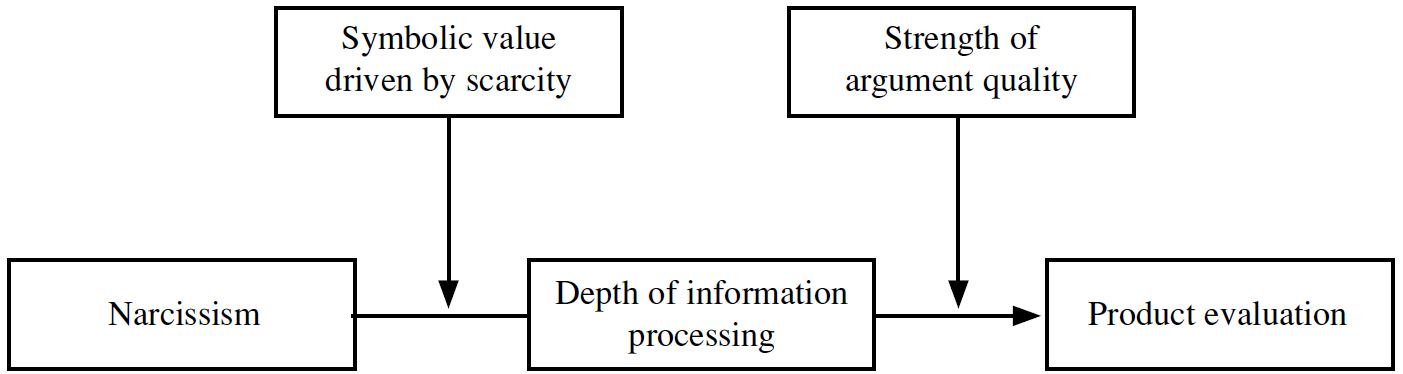
Figure 1. The proposed model.
Study 1
As described, the basic argument we have advanced is that, when compared to nonnarcissists, narcissistic consumers are more likely to strive to purchase scarce products in order to gain others’ admiration and envy, because they believe that the possession of a scarce product demonstrates their uniqueness and hence validates their excessively positive self-view. On the other hand, we argued that nonnarcissistic consumers would be relatively less likely to strive to purchase scarce products because they may not have a strong desire for uniqueness. This forms the basis of the first hypothesis.
Hypothesis 1: Scarcity will have a stronger positive effect on product evaluation for consumers with high narcissism, compared to those with low narcissism.
Method
Participants. Undergraduate students (N = 100) from a large university in Canada were invited to participate in the study and were compensated with cash. Participants were randomly assigned to a two-level (scarcity: not scarce versus scarce) between-subjects design. To assess the participants’ propensity towards narcissism they were asked to complete the 40-item (α = .92) Narcissistic Personality Inventory (NPI; Raskin & Hall, 1979, 1981). Participants were asked to indicate their level of agreement with such statements as “I really like to be the center of attention”, and “I am more capable than other people”, using a 7-point scale with endpoints labeled as 1 = strongly disagree and 7 = strongly agree. Consistent with other studies in this area (cf. Morf et al., 2000), participants scoring in the top third of the NPI were considered to exhibit high narcissism, and those who scored in the bottom third of the NPI were considered to exhibit low narcissism. Two-level narcissism (low versus high) was the second between- subjects factor in the analysis. After eliminating data from participants scoring in the middle third of the NPI, responses from 72 participants, including 37 individuals classed as high narcissists and 35 classed as low narcissists, were analyzed.
Procedure. The participants were told that they would be asked to answer questions related to their attitude towards a “new product” that we would present using a hypothetical retail scenario. They were then asked to imagine that they needed to buy a new watch and were shown one of two advertisements for a fictitious brand of wristwatch (EQUINOXE©). Both advertisements were modeled on real-world print advertising, and featured a picture of the brand with advertisement copy reading: “The EQUINOXE watch was introduced at the iF Design conference 2009. Add an accent to your business ensemble with the EQUINOXE automatic chronometer”. The level of scarcity was manipulated across these promotions by varying the version of the advertisements presented to a participant. In the scarce condition, the advertisement had the following product description: “Exclusive limited edition. Hurry, limited stocks”. In the not scarce condition, it stated “New edition. Many items in stock”. Participants were presented with the advertisement representing one of these two levels of scarcity and asked to evaluate the wristwatch on the basis of the dependent measurements and fill in the accompanying questionnaire. After completing the above procedure, all participants were thoroughly debriefed and dismissed.
Measures. The dependent variable of product evaluation was measured by purchase intent and willingness to pay (WTP). Purchase intent was measured using a single item, 9-point scale (1 = not at all likely, 9 = very likely): “How likely is it that you would buy this watch, if you saw it in the store?” WTP was measured by an open-ended item eliciting the maximum price respondents were willing to pay for the watch. The scarcity manipulation was checked by a two-item, 9-point scale (α = .91): “How many watches were available for sale?” (1 = few, 9 = many) and “What was the availability of the watches?” (1 = low availability, 9 = high availability). There was a significant difference between the scarce and not scarce conditions (M = 3.85 vs. 8.30, t(70) = 10.53, p < .001).
Results
The first hypothesis was tested using analysis of variance (ANOVA); means and standard deviations are shown in Table 1. The narcissism x scarcity ANOVA on purchase intent revealed a significant interaction (F(1, 68) = 4.56, p < .04), with main effects of narcissism (F(1, 68) = 9.53, p < .003) and scarcity (F(1, 68) = 10.99, p < .001). Consistent with our first hypothesis, scarcity increased purchase intent for high narcissistic participants (t(35) = 4.57, p < .001), but not for low narcissistic participants (t(33) = .72, p > .47). The results were similar when willingness to pay (WTP) was used as the dependent variable. A Narcissism x Scarcity ANOVA for WTP showed a significant interaction effect (F(1, 68) = 4.09, p < .05), along with a significant main effect of scarcity (F(1, 68) = 5.78, p < .02), but no main effect of narcissism (F(1, 68) = 3.67, p > .59). Consistent with our first hypothesis, scarcity increased WTP for high narcissistic participants (t(35) = 2.64, p < .02), but not for low narcissistic participants (t(33) = .36, p > .73).
Table 1. Narcissism and Scarcity: Study 1

Note: Standard deviations are in parentheses.
The results of Study 1 supported our first hypothesis. As predicted, scarcity had a stronger positive effect on product evaluation for participants with high narcissism compared to those with low narcissism. This result indicates that narcissistic individuals evince a stronger desire for scarce products when compared to their nonnarcissistic counterparts.
Study 2
We had two objectives in this study. First, we examined the possibility that narcissists presented with a scarce product tend to purchase such a product without undertaking deliberate information processing, because they put more weight on its symbolic value than on other diagnostic characteristics. Specifically, we predicted as follows:
Hypothesis 2a: For consumers with high narcissism, scarcity will reduce depth of processing.
Hypothesis 2b: For consumers with low narcissism, scarcity will increase depth of processing.
Second, we explored whether or not the different effects of scarcity on depth of processing posited in Hypotheses 2a and 2b had consequences for product evaluation. Specifically, we hypothesized as follows:
Hypothesis 3a: For consumers with high narcissism, the positive effect of scarcity on product evaluation will not be affected by argument quality.
Hypothesis 3b: For consumers with low narcissism, the positive effect of scarcity on product evaluation will be affected by argument quality.
Method
Participants. Study 2 was designed as a 2 (scarcity: not scarce versus scarce) × 2 (argument quality: weak versus strong) between-subjects ANOVA. The participants were undergraduate students (N = 150) who were compensated with cash. As in Study 1, to assess the participants’ propensity towards narcissism, the students were asked to complete the 40-item (α = .93) NPI questionnaire. As in Study 1, participants scoring in the top third of the NPI were considered as having high narcissism and those who scored in the bottom third of the NPI were considered as having low narcissism. Two-level narcissism (low versus high) was the third between-subjects factor in the analysis. Data from participants’ scores in the middle third of the NPI were not analyzed further. Responses from 100 participants (46 individuals classed as high narcissists and 54 classed as low narcissists) were analyzed.
Procedure and measures. Participants were told that they would be asked to answer questions related to attitude towards a “new product”. The same hypothetical retail scenario as used in Study 1 was then presented. Participants were shown one of four advertisements for a fictitious brand of wristwatch (EQUINOXE©); each advertisement manipulated the level of scarcity and the strength of the argument quality. The four advertisements were modeled on real-world print advertising, and featured a picture of the brand. In the scarce condition, the advertisement had the following product description: “Exclusive limited edition. Hurry, limited stocks”. In the not scarce condition, it stated: “New edition. Many items in stock”. Under the condition of strong argument quality, the advertisement contained this product description: “Comfortable and elegant, the EQUINOXE watch is winner of the iF Design Award 2009. Add a commanding accent to your business ensemble with the EQUINOXE, certified as a chronometer by the COSC® (Swiss Official Chronometer Control)”. Conversely, in the weak argument quality condition, the advertisement had the following product description: “The EQUINOXE watch was introduced in the iF Design conference 2009. Add an accent to your business ensemble with the EQUINOXE automatic chronometer”. The product description also contained a survey result on three important and two unimportant attributes, selected from the paper by Li and Wyer (1994). The three important attributes were “style/ design”, “durability”, and “accuracy”. The two unimportant attributes were “watch case material” and “water resistance”. Participants were led to believe that these attribute ratings had been conducted by a famous consumer research company that reports annual results on product satisfaction. The ratings were measured on a 5-point scale (excellent, very good, good, fair, and poor). In the strong argument quality condition, the product had excellent ratings on the three important attributes. However, in the weak argument quality condition, the product had two good ratings and one fair rating on the three important attributes.
In both conditions, the unimportant attributes were held consistent at a good rating. In summary, the strong argument quality condition encompassed two dimensions: a) a certification of quality by an independent testing agency, and b) a high rating by a research company on salient product attributes. After reading the advertisement, participants responded to measures of the dependent variables and manipulation checks. Upon completion of these tasks all individuals were debriefed.
The dependent variable of product evaluation was measured by attitude toward the target product and purchase intent. Attitude toward a target product was measured using a 9-point bipolar semantic differential scale (dislikable/ likable, unfavorable/favorable, and undesirable/desirable). Purchase intent was measured by a single-item, 9-point scale (1 = not at all likely, 9 = very likely): “How likely is it that you would buy this watch, if you saw it in the store?”
Participants were asked to list any and all thoughts that crossed their minds while they were completing this survey. They were encouraged to mention these product-related thoughts as though they were speaking to a friend who was interested in buying the product but who was not familiar with it. Thoughts served as dependent variables for the extent of depth of processing. Two independent raters who were blind to the hypotheses coded participants’ thoughts into message-related counterarguments (CA), message-related support arguments (SA), message-related neutral statements (N), and irrelevant thoughts. The sum of CA, SA, and N was treated as the total message-relevant thinking and served as one measure of depth of processing (Chaiken & Maheswaran, 1994; Jain & Maheswaran, 2000). We also developed a two-item scale (a = .89) as an additional measurement of depth of processing: “While reading the advertisement for EQUINOXE, how much effort did you put into evaluating this watch?” (1 = very little effort, 9 = a lot of effort) and “While reading the advertisement for EQUINOXE, how much thought did you put into evaluating this watch?” (1 = very little thought, 9 = a lot of thought). This two-item scale was adapted from the composite Cognitive Effort Index validated by Menon, Block, and Ramanathan (2002).
The scarcity manipulation was successfully checked with the two-item scale from Study 1, with a significant difference evident between not scarce and scarce conditions (M = 3.50 vs. 6.71, t(98) = 9.17, p < .001). The strength of the presented product argument quality was checked on the four 9-point ratings (α = .89) on the scale (i.e., 1 = low quality, 9 = high quality; 1 = weak, 9 = strong; 1 = irrelevant, 9 = relevant; and 1 = not very convincing, 9 = very convincing). We found a significant difference between the weak and strong argument quality conditions (M = 4.19 vs. 5.33, t(98) = 3.77, p < .001).
Results
Hypotheses 2a and 2b were tested using ANOVA; means and standard deviations are shown in Table 2. A Narcissism x Scarcity ANOVA on the total message-related thoughts showed a significant interaction effect (F(1, 96) = 9.51, p < .003), along with a significant main effect of narcissism (F(1, 96) = 4.79, p < .04), but no main effect of scarcity (F(1, 96) = .02, p > .86). Consistent with H2a, narcissistic participants in the scarce condition reported fewer message- related thoughts than did narcissistic participants in the not scarce condition (t(44) = -2.02, p < .05). As predicted in H2b, however, this effect was reversed for nonnarcissistic participants (t(52) = 1.15, p < .02). The Cognitive Effort Index showed the same pattern of results. A Narcissism x Scarcity ANOVA on cognitive effort showed a significant interaction effect (F(1, 96) = 10.12, p < .002), with no main effects of narcissism (F(1, 96) = .12, p > .72) or of scarcity (F(1, 96) = .06, p > .80). Narcissistic participants in the scarce condition undertook less cognitive effort than did narcissistic participants in the not scarce condition (t(44) = -2.25, p < .02), but this effect did not hold for nonnarcissistic participants (t(52) = 2.23, p < .02).
Table 2. Narcissism, Scarcity, and Depth of Information Processing: Study 2

Note: Standard deviations are in parentheses.
Hypotheses 3a and 3b were tested with ANOVA; means and standard deviations are shown in Table 3. Consistent with H3a, the positive effect of scarcity on purchase intent under the high narcissism condition was not affected by argument quality. That is, in the high narcissism condition, scarcity increased purchase intent both when argument quality was strong (t(21) = 2.48, p < .03) and when argument quality was weak (t(21) = 2.54, p < .02). In contrast, and as predicted in H3b, in the low narcissism condition, the positive effect of scarcity on purchase intent was affected by argument quality. In the low narcissism condition, scarcity increased purchase intent when argument quality was strong (t(24) = 2.13, p < .05), but not when argument quality was weak (t(26) = -1.46, p > .16).
The effect of scarcity on attitude toward the target product showed the same pattern of results. The positive effect of scarcity on attitude toward the product in the high narcissism condition was not affected by argument quality. In the high narcissism condition, scarcity was associated with positive feelings toward the product both when argument quality was strong (t(21) = 2.25, p < .04) and when argument quality was weak (t(21) = 2.83, p < .01). However, as predicted in Hypothesis 3b, the positive effect of scarcity on attitude toward the product in the low narcissism condition was affected by argument quality. In the low narcissism condition, scarcity was associated with positive feelings toward the product when argument quality was strong (t(24) = 2.05, p < .05), but not when argument quality was weak (t(26) = -1.25, p > .22).
Table 3. Narcissism, Scarcity, Strength of Argument Quality, and Product Evaluation: Study 2

Note: Standard deviations are in parentheses
In summary, the results of Study 2 were consistent with Hypotheses 2 and 3. As we predicted, for consumers with high narcissism, scarcity reduced depth of processing, whereas results showed no such effect for consumers with low narcissism. In addition, for consumers with high narcissism, the effect of scarcity on purchase intent was not affected by argument quality, whereas for consumers with low narcissism, scarcity increased purchase intent only when argument quality was strong. These results indicate that for narcissistic consumers, scarcity tends to activate heuristic processing. Under such circumstances, individuals are not expected to process argument quality information (Petty & Cacioppo, 1986). Consequently, for consumers with high narcissism, the positive effect of scarcity on product evaluation is not affected by argument quality. In contrast, for consumers with low narcissism, scarcity leads to more systematic processing and individuals base their product judgments on argument quality (Petty & Cacioppo, 1986). Consequently, for consumers with low narcissism, scarcity has a stronger positive effect on product evaluation when argument quality is strong than when it is weak.
General Discussion
Narcissistic individuals are characterized by self-centeredness, extremely positive self-image, and the need for external validation of their presumed uniqueness. Because narcissists have a strongly felt need to demonstrate their individuality to others, it is reasonable to infer that such motivations may influence patterns of purchasing behavior by such people. In this research we sought to demonstrate the link between narcissism as a personality trait, scarcity of marketed products, and the depth of processing undertaken by consumers presented with a specific purchase decision. The findings from Study 1 show that, for participants with high narcissism, scarcity increases the perceived value when these individuals are making a product evaluation, whereas such an effect was not found for participants with low narcissism. This result indicates that, compared to nonnarcissistic individuals, narcissistic individuals have a stronger desire to possess scarce products. Results from Study 2 show that, for participants with high narcissism, scarcity reduces depth of processing; this effect was, again, not found for participants with low narcissism. As a result of the different effect of scarcity on depth of processing, for participants with high narcissism the positive effect of scarcity on purchase intent was not affected by argument quality. Conversely, for participants with low narcissism, scarcity increased purchase intent when argument quality was strong, but not when argument quality was weak.
These results indicate that highly narcissistic individuals are motivated to validate their excessively positive self-view by obtaining a scarce product that they perceive as conferring a unique value upon them. Therefore, when highly narcissistic individuals are presented with a scarce product, they are likely to interpret the scarcity-related purchase situation as an opportunity to validate their excessively positive self-view. For narcissists, whether or not a product can fulfill their practical needs is often a secondary consideration. The utilitarian value of the product is likely to be of less importance for them, than is a product’s symbolic value. For this reason narcissistic individuals are less motivated to undertake systematic information processing with regard to diagnostic information. That is to say, they feel less need to deliberately process cues related to utilitarian values of a scarce product because the primary value they expect to gain from such goods is symbolic.
We have made several theoretical contributions to the literature on narcissism in this research. First, although recently several researchers have studied narcissists as consumers, the characteristics and behavior patterns of narcissists have been examined empirically in the context of consumer behavior in only a very few studies. Our objective was to determine how narcissists as consumers process information and make decisions in attempting to validate their excessively positive self-view. We extended the scope of past research by showing that when narcissists are presented with a scarce product, they tend to purchase without deliberate information processing, as they put more weight on symbolic gain than on other diagnostic attributes. This shallow information processing, in turn, has implications for product judgment and purchase intent. Second, in our study we identified two factors – scarcity and argument quality – that influence product preference for narcissistic individuals. Finally, we specified a depth-of- processing mechanism; in the context of narcissists as consumers this dynamic underlies the effects of scarcity and argument quality on product evaluation.
We suggest that there are several avenues for future research. Subsequent researchers could explore under what situations narcissistic individuals may be motivated to validate their excessively positive self-view, and when they are willing to sacrifice potential utilitarian values to gain symbolic values. For example, narcissists may be driven more strongly by social recognition than by monetary rewards, for example, when an individual is recognized publicly by posting his or her name, picture, and ideas on websites or in magazines.
Another topic yet to be investigated is the extent to which a social component of purchase is required in order to motivate the behavior of narcissists as consumers. It has been claimed that the personality trait of narcissism comprises two important dimensions: one cognitive and one motivational. The relative importance of each aspect in the context of purchase merits further study. For example, an exclusive product that cannot be consumed in a conspicuous manner may satisfy the cognitive element of perceived uniqueness inherent in a narcissistic individual; however, the associated absence of an opportunity to arouse envy and admiration on the part of others may attenuate this benefit.
Our findings also offer guidelines to practitioners. Marketing managers might consider the possibility of segmenting consumers into tiers of narcissism using proxies such as age (Foster, Campbell, & Twenge, 2003; Morris, 1996), education (Sautter, Brown, Littvay, Sautter, & Bearnes, 2008), income, or culture (Foster et al., 2003), and when communicating to high narcissism individuals could use scarcity claims that will be particularly resonant with this subset of customers, who need to validate their strong positive self-perception through the approval and admiration of others.
Finally, given the fact that marketers of exclusive goods such as Louis Vuitton limited edition handbags and Rolls Royce Phantom limited collection cars advertise their products using a variety of scarcity-related claims, it is plausible that many of their target consumers exhibit elevated levels of narcissism, because, presumably, these individuals ascribe more importance to symbolic value than to instrumental benefits of consumption. As found in the studies reported here, for highly narcissistic consumers, argument quality is of secondary importance when a scarcity claim is also present in a marketing message. Marketers whose clientele is composed mainly of narcissistic individuals may find it more profitable to focus on communicating the symbolic positive attributes of consumption rather than the utilitarian product-specific attributes inherent in the offering.
Amaldoss, W., & Jain, S. (2005). Pricing of conspicuous goods: A competitive analysis of social effects. Journal of Marketing Research, 42, 30-42. http://doi.org/dw62z5
American Psychiatric Association. (1968). Diagnostic and statistical manual of mental disorders (2nd ed.). Washington, DC: Author.
Brock, T. C. (1968). Implications of commodity theory for value change. In A. G. Greenwald, T. C. Brock, & T. M. Ostrom (Eds.), Psychological foundations of attitudes (pp. 243-275). New York: Academic Press.
Brock, T. C., & Brannon, L. A. (1992). Liberalization of commodity theory. Basic and Applied Social Psychology, 13, 135-144. http://doi.org/d98zgn
Campbell, W. K., Goodie, A. S., & Foster, J. D. (2004). Narcissism, confidence, and risk attitude. Journal of Behavioral Decision Making, 17, 297-311. http://doi.org/cm55z7
Chaiken, S., & Maheswaran, D. (1994). Heuristic processing can bias systematic processing: Effects of source credibility, argument ambiguity, and task importance on attitude judgment. Journal of Personality and Social Psychology, 66, 460-473. http://doi.org/chsfnm
Chatterjee, A., & Hambrick, D. C. (2007). It’s all about me: Narcissistic chief executive officers and their effects on company strategy and performance. Administrative Science Quarterly, 52, 351-386. http://asq.sagepub.com/content/52/3/351.abstract
Dunning, D. (2007). Self-image motives and consumer behavior: How sacrosanct self-beliefs sway preferences in the marketplace. Journal of Consumer Psychology, 17, 237-249. http://doi.org/dv2tc2
Eisend, M. (2008). Explaining the impact of scarcity appeals in advertising: The mediating role of perceptions of susceptibility. Journal of Advertising, 37, 33-40. http://doi.org/c3cx43
Ellis, H. (1898). Auto-erotism: A psychological study. Alienist and Neurologist, 19, 260-299.
Emmons, R. A. (1987). Narcissism: Theory and measurement. Journal of Personality and Social Psychology, 52, 11-17. http://doi.org/bj3mfd
Farwell, L., & Wohlwend-Lloyd, R. (1998). Narcissistic processes: Optimistic expectations, favorable self-evaluations, and self-enhancing attributions. Journal of Personality, 66, 65-83. http://doi.org/crn8hw
Foster, J. D., Campbell, W. K., & Twenge, J. M. (2003). Individual differences in narcissism: Inflated self-views across the lifespan and around the world. Journal of Research in Personality, 37, 469-486. http://doi.org/cbzgs9
Jain, S. P., & Maheswaran, D. (2000). Motivated reasoning: A depth-of-processing perspective. Journal of Consumer Research, 26, 358-371. http://doi.org/dv34pw
John, O. P., & Robins, R. W. (1994). Accuracy and bias in self-perception: Individual differences in self-enhancement and the role of narcissism. Journal of Personality and Social Psychology, 66, 206-219. http://doi.org/hnv
Judge, T. A., LePine, J. A., & Rich, B. L. (2006). Loving yourself abundantly: Relationship of the narcissistic personality to self- and other perceptions of workplace deviance, leadership, and task and contextual performance. Journal of Applied Psychology, 91, 762-776. http://doi.org/bz5s6r
Leary, M. R., Tchividijian, L. R., & Kraxberger, B. E. (1994). Self-presentation can be hazardous to your health: Impression management and health risk. Health Psychology, 13, 461-470. http://doi.org/fpmpmp
Li, W.-K., & Wyer, R. S., Jr. (1994). The role of country of origin in product evaluations: Informational and standard-of-comparison effects. Journal of Consumer Psychology, 3, 187-212. http://doi.org/cmk2f2
Lynn, M. (1989). Scarcity effects on desirability: Mediated by assumed expensiveness? Journal of Economic Psychology, 10, 257-274. http://doi.org/d3zcwt
Lynn, M. (1991). Scarcity effects on desirability: A quantitative review of the commodity theory literature. Psychology and Marketing, 8, 43-57. http://doi.org/dn6gr6
Lynn, M., & Harris, J. (1997). The desire for unique consumer products: A new individual differences scale. Psychology and Marketing, 14, 601-616. http://doi.org/cdt5mm
Menon, G., Block, L. G., & Ramanathan, S. (2002). We’re at as much risk as we are led to believe: Effects of message cues on judgments of health risk. Journal of Consumer Research, 28, 533-549.
Morf, C. C., Weir, C., & Davidov, M. (2000). Narcissism and intrinsic motivation: The role of goal congruence. Journal of Experimental Social Psychology, 36, 424-438. http://doi.org/dmbvc3
Morris, C. G. (1996). Psychology: An introduction (9th ed.). Upper Saddle River, NJ: Prentice Hall.
Petty, R. E., & Cacioppo, J. T. (1986). The elaboration likelihood model of persuasion. In L. Berkowitz (Ed.), Advances in experimental social psychology (Vol. 19, pp. 123-205). New York: Academic Press.
Raskin, R. N., & Hall, C. S. (1979). A narcissistic personality inventory. Psychological Reports, 45, 590. http://doi.org/drktcb
Raskin, R. N., & Hall, C. S. (1981). The Narcissistic Personality Inventory: Alternative form reliability and further evidence of construct validity. Journal of Personality Assessment, 45, 159-162. http://doi.org/ch4b6b
Raskin, R. N., & Terry, H. (1988). A principal-components analysis of the Narcissistic Personality Inventory and further evidence of its construct validity. Journal of Personality and Social Psychology, 54, 890-902. http://doi.org/chj
Sautter, J. A., Brown, T. A., Littvay, L., Sautter, A. C., & Bearnes, B. (2008). Attitude and divergence in business students: An examination of personality differences in business and non-business students. Electronic Journal of Business Ethics and Organizational Studies, 13, 70-78. Retrieved from http://ejbo.jyu.fi/pdf/ejbo_vol13_no2_pages_70-78.pdf
Sedikides, C., Campbell, W. K., Reeder, G. P., & Elliot, A. J. (2002). The self in relationships: Whether, how, and when close others put the self “in its place”. European Review of Social Psychology, 12, 237-265. http://doi.org/fkc7hm
Sedikides, C., Gregg, A. P., Cisek, S., & Hart, C. M. (2007). The I that buys: Narcissists as consumers. Journal of Consumer Psychology, 17, 254-257. http://doi.org/ft44vk
Snyder, C. R., & Fromkin, H. L. (1980). Uniqueness: The human pursuit of difference. New York: Plenum.
van Herpen, E., Pieters, R., & Zeelenberg, M. (2009). When demand accelerates demand: Trailing the bandwagon. Journal of Consumer Psychology, 19, 302-312. http://doi.org/d5sdsx
Verhallen, T. M. M. (1982). Scarcity and consumer choice behavior. Journal of Economic Psychology, 2, 299-322. http://doi.org/frpkkj
Verhallen, T. M. M., & Robben, H. S. J. (1994). Scarcity and preference: An experiment on unavailability and product evaluation. Journal of Economic Psychology, 15, 315-331. http://doi.org/ddxzd6
Wallace, H. M., & Baumeister, R. F. (2002). The performance of narcissists rises and falls with perceived opportunity for glory. Journal of Personality and Social Psychology, 82, 819-834. http://doi.org/bpkzxf
Figure 1. The proposed model.
Table 1. Narcissism and Scarcity: Study 1
Note: Standard deviations are in parentheses.
Table 2. Narcissism, Scarcity, and Depth of Information Processing: Study 2
Note: Standard deviations are in parentheses.
Table 3. Narcissism, Scarcity, Strength of Argument Quality, and Product Evaluation: Study 2
Note: Standard deviations are in parentheses
Seung Yun Lee, Assistant Professor, College of Economics and Business Management, Hanyang University, ERICA, 55 Hanyangdaehak-ro, Sangnok-gu, Ansan, Kyeonggi-do, Republic of Korea. Email: [email protected]