Interpersonal rejection experiences and shame as predictors of susceptibility to peer pressure among Korean children
Main Article Content
We examined the relationships among parental and peer rejection, shame, and susceptibility to peer pressure during late childhood. A sample of 610 boys and 575 girls from Korea filled out questionnaires and nominated 3 classmates to measure peer rejection. The results showed that shame is the strongest predictor of susceptibility to peer pressure, and shame provided a pathway by which interpersonal rejection was related to susceptibility to peer pressure. The findings also highlighted the moderating effect of gender with regard to susceptibility to peer pressure. The implications of the effect of interpersonal rejection relationships and shame are discussed in relation to the internal working model perspective.
Peer pressure is a feeling or perception of being forced or coerced by peers to do positive or negative things together (Barkin, Smith, & DuRant, 2002). According to reference group theory and its corresponding socialization component, for children, peer groups act as reference groups within which children orient themselves, adopting the norms and values of the reference groups as criteria for their behaviors. Therefore, children who are under peer pressure or susceptible to peer pressure tend to conform to peer groups’ decisions and/or behaviors. Researchers have studied peer pressure as a cause of both children’s misbehaviors and their positive developmental outcomes, in relation to topics such as alcohol use (Crawford & Novak, 2007), delinquency (Santor, Messervey, & Kusumakar, 2000), and academic achievement (Atkinson, 2009; Casella, 1989).
Although most researchers have viewed peer pressure as a cause of developmental outcomes and focused on examining the results of peer pressure, relatively few have examined the causes of peer pressure. What makes children susceptible to peer pressure? According to Lashbrook (2000), who stated that there is a need for research on the emotional dimension and motivational components of peer pressure, most reference group and socialization models have cognitive and behavioral emphases and omit the emotional dimension. Within this perspective, some researchers (Lashbrook, 2000; Retzinger, 1995; Scheff, 1990) have turned their focus to socioemotional factors in order to explore the causes of peer pressure.
In addition, despite the growing body of work on peer pressure, the focus in most studies has been restricted to adolescents. Thus, little is known about susceptibility to peer pressure in late childhood and preadolescence. However, because children in later childhood now experience earlier maturity, such as puberty and teenage culture, childhood is another period in which peer influence increases through time spent with peers and peer pressure.
A Model of Child Susceptibility to Peer Pressure
In this study, susceptibility to peer pressure is conceptualized as the outcome of interpersonal rejection and shame. Theoretical perspectives on the internal working model and defense mechanism are used. As can be seen in Figure 1, the conceptual framework depicts susceptibility to peer pressure as being caused by shame as a weak internal self (that is a negative part of the self, such as negative appraisal of the self), which is a response to interpersonal rejection. This process can also be explained by the defense mechanism working against interpersonal rejection.

Figure 1. Model of children’s susceptibility to peer pressure.
Shame and Interpersonal Rejection as Predictors of Peer Pressure
Considering that conforming to peer norms and opinions refers to some aspect of the weak self or yielding self-assertion, it is necessary to explore the selfhood of children who are susceptible to peer pressure. Various aspects of the self develop partly based on the process of forming the internal working model, that stems from interpersonal relationships. Positive self-perception, which may act as an internal working model, develops through the experience of an accepting, warm, and responsive interpersonal relationship. Conversely, a negative self-perception develops through the experience of cold, indifferent, or interpersonal rejection relationships.
Primary elements of children’s interpersonal relationships that have significant impact on the internal working model are parental and peer relationships. Experiencing rejection from parents or peers makes children feel isolated and inadequate (Lashbrook, 2000). Children who experience frequent rejection from parents may develop and extend the negative aspect of the self, and this may influence the development of shame.
Parenting has been reported as a significant predictor of children’s emotional development (Denham, Bassett, & Wyatt, 2007; Eisenberg, Cumberland, & Spinrad, 1998). Shame-inducing behavior refers to parents’ negative appraisals of the child, which is supported by the attributional perspective (Campos, Thein, & Owen, 2004; Gershoff, 2002; Khaleque & Rohner, 2002; Lewis, 1992; Weiner, 1986). According to this perspective, it is also asserted that this shame-inducing parenting includes criticism, scolding that involves blaming essential characteristics of the child, love withdrawal, humiliation, physical punishment, and expressions of disappointment, anger, disapproval, disgust, or contempt. These forms of rejection contribute to the growth of children’s shame by nurturing their negative self-attribution (Mills, Arbeau, Lall, & De Jaeger, 2010).
Connections with peers are some of the most important relationships formed in childhood, in which children seek support and aim to belong. Peer rejection has been viewed as a predictor of emotional and relational difficulties (Asher & Paquette, 2003; Burks, Dodge, & Price, 1995; Coie, Lochman, Terry, & Hyman, 1992; Dodge et al., 2003; McDougall, Hymel, Vaillancourt, & Mercer, 2001; Prinstein & LaGreca, 2004; Sandstrom, Cillessen, & Eisenhower, 2003). Peers’ social preference or popularity/unpopularity among peers is considered objective evidence of peer acceptance or rejection, and is often measured using peer nomination. This sociometric popularity or unpopularity index has been found to be related to an aspect of the self. According to De Bruyn and Van den Boom (2005), popularity has a significant influence on self-esteem. Self-esteem functions as a sociometer, keeping people continuously aware of their level of acceptance within a group (Leary & Downs, 1995). Based on the internal working model perspective, rejection and isolation among peer groups may lead children to describe themselves negatively as disliked by others and considered worthless by a group. This negative self-image, experienced as a feeling of shame, may be considered as an internal working model for children.
Previous researchers have found significant evidence of a positive relationship between peer support and a healthy self. It has been reported that children with higher levels of peer support showed significantly higher self-esteem (Arslan, 2009; Siyez, 2008). Adolescents who receive more peer support tend to perceive themselves as worthwhile and efficacious (Liem, Cavell, & Lustig, 2010). Self-esteem and shame are not located at the extreme poles of the psychological continuum (Han, 2009). However, it is reasonable to infer a positive relationship between shame and peer rejection from the positive relationship between self-esteem and peer support in that self-esteem is a positive and healthy aspect of the self, whereas shame is a negative aspect of the self.
Thus, shame is the part of the negative self that relates to interpersonal rejection, which works as an internal working model. Some researchers approach and measure shame as a part of personality (including the tendency to appraise oneself negatively) regardless of events, but others measure it as a specific response to specific shameful events (Thomaes, Bushman, Stegge, & Olthof, 2008). In addition, others have viewed shame as a part of one’s personality (Mills et al., 2010). From the former perspective, shameful events involve the public exposure of failure (Olthof, Schouten, Kuiper, Stegge, & Jennekens-Schinkel, 2000; Smith, Webster, Parrott, & Eyre, 2002), and the individual’s response is to withdraw and avoid social contact (Lindsay-Hartz, De Rivera, & Mascolo, 1995). The latter perspective, on which this study is based, approaches shame as a development and internalization of negative self-appraisal, termed shame-proneness (Tangney, Burggraf, & Wagner, 1995).
Shame is a negative way to perceive the self and has been found to be connected to the emotion of helplessness (Menesini et al., 2003). In other words, shame is an emotional aspect of motivation in which a person feels his or her own worth or value and preserves acceptance by others (Mills et al., 2010). Given that succumbing to peer pressure is an act of conforming to peers’ values and opinions rather than insisting on one’s own values and opinions, bowing to peer pressure is likely to be related to the disrupted self and experienced as emotions such as shame. Children expect to be accepted by parents and peer groups, so we posit that shame may result when they are rejected by these significant figures. This sense of shame can cause psychological disturbance to the children, preventing them from behaving in the way they want to. It can be inferred that children with a shameful sense of self tend to fear criticism as well as pursue acceptance and a sense of belonging, which leads them to try to conform to the group’s norms.
Some researchers have found a significant relationship between shame and susceptibility to peer pressure. Rossiter (1994) explored shame as an internal working mechanism for social relationships in late childhood, and Rabow and Duncan-Schill (1995) found that children’s conformity to peers’ alcohol consumption was related to the emotion of shame. The emotional and motivational components of peer pressure are somewhat related to shame according to Lashbrook (2000), who, based on Retzinger’s (1995) work, found that isolation and feelings of inadequacy and ridicule are shame-related emotions attributable to peer pressure. Kim, Talbot, and Cicchetti (2009) explored the relationship between earlier abuse and later interpersonal conflict with the role of shame, and gained results that support our model.
Other than the internal working model, there is one more way it is possible to approach our model. Experiences of rejection lead children to construct a defense mechanism, protecting them from the negative aspects of rejection. The need to feel accepted by others is one of the most fundamental desires in human development (Baumeister & Leary, 1995). Thus, experiences of rejection, which cause feelings of fear and isolation, induce children to operate the defense mechanism of shame, thereby protecting themselves from the rejection.
Typical shame defense mechanisms include contempt, power over others, self-deprecation, striving for perfection, withdrawal, and denial. However, when such mechanisms do not work effectively and shame overwhelms individuals, typical reactions include hiding, anger, transfer of responsibility, humor, acting as if one is not ashamed, and mortification (Loader, 1998). That is, the results of shame diverge into two contrasting styles of self-expression. One is the outburst and explosion of emotion (e.g., aggression), and the other is hiding or deprecating the self. Susceptibility to peer pressure is an index of the latter. Under the operating defense mechanism of shame children try to avoid situations in which peers may reject them. Instead, they position themselves in a safe place by conforming to peers’ opinions and activities. In empirical studies on rejection sensitivity, it has been proposed that the defense system works when an individual experiences interpersonal rejection. Rejection experiences may reduce one’s ability to cope with social interactions, a condition that some researchers have described as interpersonal rejection sensitivity (Harb, Heimberg, Fresco, Schneier, & Leibowitz, 2002).
Gender
Numerous researchers have reported gender differences in the development of shame and interpersonal relationships. Mills et al. (2010) reported that girls showed more shame by school age than did boys. The gender of the child is one characteristic that may affect the relationship between shame-inducing parenting and children’s shame development. Girls may be more sensitive to shame-inducing stimuli than are boys (Barrett, Zahn-Waxler, & Cole, 1993; Lewis, Alessandri, & Sullivan, 1992). However, other researchers have suggested that girls are encouraged to experience or express shame more than are boys. Thus, parental shame-inducing behavior may be more strongly related to girls’ shame than to boys’ shame because girls are exposed to more shaming and, thus, are more sensitive to it than are boys (Mills et al., 2010). However, there are inconsistent research results regarding gender differences insofar as some researchers have reported that boys’ development of shame was significantly influenced by mothers’ intrusive parenting (Belsky, Domitrovich, & Crnic, 1997). That is, mothers’ parenting influences both boys’ and girls’ shame development. Additionally, in some studies gender differences have been found to be associated with children’s parental and peer relationships, as well as peer pressure. For example, parental support has been reported to moderate peer influence for girls but not for boys (Marshal & Chassin, 2000). Bogenschneider, Wu, Raffaelli, and Tsay (1998) found that mothers’ responsiveness had a stronger negative association with young adolescents’ peer orientation than did fathers’ responsiveness, and only fathers’ monitoring of their children (i.e. fathers’ awareness of what their children are doing, who they are meeting, where they are, etc.) had a significant negative association with young adolescents’ peer orientation. In sum, the development of shame and peer relationships has been found to differ across the gender of both children and parents. However, there is still a lack of empirical research on gender differences in this field.
This Study
In this study, shame was assumed to be a psychological mechanism operating as an internal working model and defense mechanism that forms the link between rejection experiences and the susceptibility to peer pressure. The mediation model of shame and the moderation model of gender were tested. Further, as late childhood is a period during which peer influence increases, one area of interest in this study was the relative influence peers and parents had on children’s shame and susceptibility to peer pressure. Therefore, the mediational hypothesis of this study was that interpersonal rejection will be related to susceptibility to peer pressure by way of shame. The moderational hypothesis was that interaction between gender and interpersonal rejection or shame and susceptibility to peer pressure will be significant. The last hypothesis was that the influence peers and parents have on children’s shame and susceptibility to peer pressure will be relatively different.
Method
Participants
Participants were recruited from Chungcheong province in South Korea and comprised 1,185 students (610 boys and 575 girls). We deleted 39 questionnaires from the data because of a high number of incomplete responses. The final sample varied somewhat from analysis to analysis owing to missing data and the use of listwise deletion for the analysis. Respondents were in the fifth and sixth grades at the time of the study, with ages ranging from 11 to 12.
The average age of participants’ mothers was 40.99 and that of fathers was 43.77. In terms of education, 20% of mothers held a high school diploma, 52% held a college degree, and 18% held a master’s degree; 13% of fathers held a high school diploma, 50% held a college degree, and 27% held a master’s degree.
Instruments
Parental rejection was measured using 10 items for the mother and 10 items for the father, adopted from the scale developed by Park (1995). In pilot testing (N = 139), Cronbach’s alpha was .82 for parents. The 10 items are concerned with criticism, expressing a negative emotion, hostile discipline, repression, ignorance, and mistrust (e.g., “My father always blames me for my misbehavior in the past” and “My mother often shows a cold attitude toward me”). Responses were made on a 4-point Likert scale, ranging from 1 = never to 4 = always. Cronbach’s alpha for the scale was .86 for mothers and .82 for fathers.
Peer rejection was measured using a standardized index of social preference by peers, which was adapted from Marshall and McCandless’ (1957) scale. In general, children nominate three classmates using positive and negative standards. In this study, children were provided with a list of classmates’ names, and they were asked to nominate classmates they did not want to invite to their birthday party. That is, children were asked to nominate peers they disliked. Standardized scores for most disliked were used to assess peer rejection.
Shame was measured using the State Shame and Guilt Scale (SSGS), which was developed by Tangney and Dearing (2002). Five items were used to assess children’s self-image (e.g., “I feel worthless and powerless”, “I want to sink into the floor and disappear”, “I feel humiliated and disgraced”). Participants were asked to respond using a 4-point Likert scale, ranging from 1 = I do not feel this way at all to 4 = I feel this way very strongly. Cronbach’s alpha for the scale was .86.
Susceptibility to peer pressure was measured using 9 of the 24 items of the Tough Turf Peer Pressure Quiz (TTQ) developed by Sanders (1986) and adapted for Korean participants by Kim (1996). In Kim’s pilot test with a sample of 129 participants, an internal reliability of .71 was gained using factor analysis. The TTQ contains items like “I have lied because of my friends’ expectations”, “I’m afraid that my friends will criticize my decisions”. Participants were asked to rate their agreement with each item on a 4-point Likert scale, ranging from 1 = never to 4 = always. Cronbach’s alpha for the scale was .79.
Procedure
Data were collected in the fall semester, which is the second semester of the academic year in Korea, so that participants were familiar with all of their classmates. The children were told that their answers would be confidential and participation was not compulsory. Researchers distributed and then collected the completed questionnaires during study periods with the assistance of teachers. Participants received a small gift (e.g., marker pens) for taking part in the study.
We employed t tests, Pearson correlation coefficients, and regression analyses in order to analyze the data. SPSS version 14.0 was used.
Results
The results are presented in two parts: descriptive relationships among variables in relation to preliminary analyses, and regression analyses in relation to the main analysis.
Preliminary Analyses
Gender differences in parental rejection and susceptibility to peer pressure can be seen in Table 1. Boys reported experiencing significantly more parental rejection than did girls. Girls, however, felt significantly stronger peer pressure than did boys. No gender differences were found in relation to peer rejection and shame.
Table 1. Gender Differences on Parental and Peer Rejection, Shame, and Susceptibility to Peer Pressure

Note: ** p < .01, *** p < .001.
Table 2. Intercorrelations Among Gender, Parental and Peer Rejection, Shame, and Susceptibility to Peer Pressure

Notes: * p < .05, ** p < .01, *** p < .001.
Gender: dummy variable; gender was coded such that 0 = male, and 1 = female.
Intercorrelations among gender, parental and peer rejection, shame, and susceptibility to peer pressure can be found in Table 2. In support of our hypothesis, there were significantly positive correlations between shame and susceptibility to peer pressure, and between shame and interpersonal rejection. Susceptibility to peer pressure was also significantly related to interpersonal rejection predictors, with the exception of peer rejection.
Main Analyses
The hypothesis in this study was that interpersonal rejection would be related to susceptibility to peer pressure by way of shame. To examine this mediation hypothesis, a series of multiple-regression analyses were conducted. Moderation hypotheses were also tested by including gender x interpersonal rejection predictors, and gender x shame interaction terms in the models. Variables were mean-centered in order to control for possible effects of collinearity.
Predictors of Susceptibility to Peer Pressure
It was hypothesized that children’s interpersonal rejection experiences would be related to their susceptibility to peer pressure by way of shame. To test this hypothesis, susceptibility to peer pressure was regressed on rejection by mothers, fathers, and peers. Gender as a demographic variable was entered at the first step, parental and peer rejection at the second step, shame at the third step, and the gender x interpersonal rejection predictors and gender x shame interaction terms at the last step.
Table 3. Hierarchical Regression of Susceptibility to Peer Pressure on Gender, Parental and Peer Rejection, and Shame

Notes: * p < .05, ** p < .01, *** p < .001, n = 1098. Gender was coded such that 0 = male, and 1 = female.
The standardized regression coefficients of parental/peer rejection and shame predictors for children’s susceptibility to peer pressure are reported in the models in Table 3. Gender was significantly related to susceptibility to peer pressure in Step 1. The effect of mother’s rejection as well as gender became significant in Step 2, and shame was found to be the strongest predictor of children’s susceptibility to peer pressure. That is, girls, having had a greater number of rejection experiences from their mothers and feeling more shame, are more likely to be susceptible to peer pressure. In Step 4, the interaction effects of gender and shame, and of gender and peer rejection, were found to be significant for children’s susceptibility to peer pressure. The model explained 29% of the variance in susceptibility to peer pressure.
Gender, mother’s rejection, shame, and the interaction terms were significant predictors of susceptibility to peer pressure at the last step (Table 3). This result established shame as a direct predictor of susceptibility to peer pressure when other rejection predictors were taken into account. In particular, the decreasing beta weight for mother’s rejection at Step 2 combined with significant relationships between mother’s rejection and shame (see Tables 2 and 4), and between shame and susceptibility to peer pressure (see Table 3) met the conditions for mediation (Baron & Kenny, 1986). A follow-up Sobel (1982) test indicated that the indirect effect of mother’s rejection on the susceptibility to peer pressure by way of shame was significant (z = 11.48, p < .001).
Unlike mother’s rejection, father’s rejection and peer rejection were not direct predictors of susceptibility to peer pressure (see Table 3). However, they were significant predictors of shame (see Table 4). This result, combined with significant relationships between shame and susceptibility to peer pressure (see Table 3) implied the indirect relationships between father’s/peer rejection and susceptibility to peer pressure. The Sobel (1982) test also indicated that the indirect effect of father’s rejection (z = 10.16, p < .001) and peer rejection (z = 2.80, p < .01) on susceptibility to peer pressure by way of shame was significant.
In addition, our moderation hypotheses were also supported by the two significant interaction terms. The slopes for peer rejection and susceptibility to peer pressure differed significantly for boys and girls (β = -.06, p < .05). The interaction effects of gender and peer rejection on children’s susceptibility to peer pressure are displayed in Figure 2. Girls with high peer rejection showed stronger susceptibility to peer pressure as compared to girls with low peer rejection, whereas boys with high rejection showed less susceptibility to peer pressure than boys with low peer rejection.
The interaction effects of shame and gender on susceptibility to peer pressure are shown in Figure 3. The slopes for shame and susceptibility to peer pressure differed significantly for boys and girls (β = -.09, p < .05). For both boys and girls, experiences of higher shame increased their level of susceptibility to peer pressure. However, shame worked more actively to make boys susceptible to peer pressure than it did for girls.
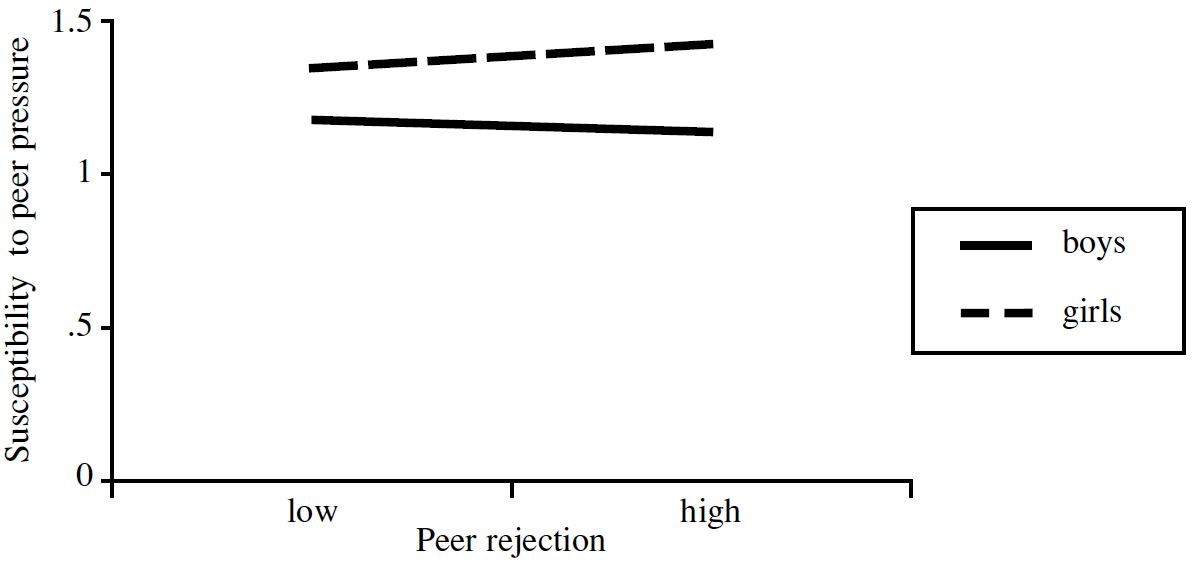
Figure 2. Interaction effects of peer rejection and gender on susceptibility to peer pressure
Note: Low rejection is 1 SD below mean rejection; high rejection is 1 SD above mean rejection. Slopes are estimated from the hierarchical linear modeling analyses.

Figure 3. Interaction effects of shame and gender on susceptibility to peer pressure.
Notes: Low shame is 1 SD below mean shame; high rejection is 1 SD above mean shame. Slopes are estimated from the hierarchical linear modeling analyses.
Predictors of Shame
Shame was regressed on gender, parental and peer rejection, and the interaction terms. The standardized regression coefficients of parental and peer rejection predictors for children’s shame are displayed in the models in Table 4. Gender, mother’s rejection, father’s rejection, and peer rejection were significant predictors. The strongest predictor for shame was mother’s rejection, followed by father’s rejection, gender, and then peer rejection. That is, if a child perceives more rejection from his or her mother, father, and peers he or she is much more likely to feel more shame. The model explained 17% of the variance in child shame.
These findings indicate that shame provides a pathway linking interpersonal rejection experiences to susceptibility to peer pressure.
Table 4. Hierarchical Regression of Shame on Gender, Parental Rejection, and Peer Rejection

Notes: + p < .10, ** p < .01, *** p < .001, N = 1,098. Gender was coded such that 0 = male, and 1 = female.
Discussion
We explored two major areas in this study. First, how shame and interpersonal rejection relationships are related to susceptibility to peer pressure. Second, how gender is related to susceptibility to peer pressure.
In the preliminary analysis, significant gender differences were found in relation to parents’ rejection and susceptibility to peer pressure. Boys felt more parental rejection and were less susceptible to peer pressure than were girls. Stronger rejection from parents for boys is an unsurprising result. It has been reported, in many previous studies, that boys display more aggressive and problematic behaviors than do girls (Baillargeon et al., 2007). This gender difference may be the cause of the difference in parental rejective response.
One possible explanation for the result that girls are more susceptible to peer pressure than are boys relates to the characteristics of the sample of this study. Because girls in late childhood or preadolescence grow more rapidly than do boys, girls may have adapted earlier to adolescent peer culture and peer relationships regardless of the levels of their shame-induced social relationships. Another possible explanation is that girls are more vulnerable and sensitive to the influence from interpersonal relationships than are boys. Thus, more dependency on interpersonal relationships among girls caused them to be more susceptible to peer pressure than were boys. Previous studies in which it was suggested that girls may be more sensitive to shame-inducing experiences than are boys (Barrett et al., 1993; Lewis et al., 1992; Mills et al., 2010) support this explanation.
Predictors of Susceptibility to Peer Pressure
Because research on the role of shame in the development of susceptibility to peer pressure is sparse, we aimed to extend the research interest on shame and shame-inducing interpersonal relationships. It is noteworthy that the effect shame has on susceptibility to peer pressure is the strongest predictor, even when taking into account a set of interpersonal rejection relationships for understanding susceptibility to peer pressure. As expected, we found that shame served as a pathway by which shame-inducing, interpersonal rejection relationships were related to susceptibility to peer pressure, thus supporting our mediation hypotheses. The findings concerning mediation provide evidence that the significant relationships between susceptibility to peer pressure and interpersonal rejection could be explained in part by another variable, shame. The strength of the associations between mother’s rejection and susceptibility to peer pressure weakened when shame was taken into account. In addition, shame was found to be related to a unique set of predictors: multiple levels of interpersonal rejection relationships, including those involving the mother, father, and peers.
The role of shame can be explained via both the internal working model and the defense mechanism. When children are confronted with peer pressure, higher levels of shame drive children to conform to their peers’ opinions. From the perspective of the internal working model, higher levels of shame represent strong negative self-appraisal and self-perception created from the experience of interpersonal rejection, and it continues to operate internally as children’s self-image. As a result, children with high shame levels tend not to believe in themselves and easily yield their own values and opinions in order to follow their peers’ norms and activities.
This process could also explain the perspective of the defense mechanism working against interpersonal rejection relationships. In confronting rejection, the classic defense mechanisms include yielding and hiding. Children who have experienced interpersonal rejection try to protect themselves from further rejection by making themselves appear small or helpless, and conforming to the peer group’s norms and rules to increase the likelihood of peer acceptance.
Shame-inducing interpersonal relationships were differently related to susceptibility to peer pressure or shame, suggesting that the development of shame and susceptibility to peer pressure is relation-specific, to some extent. In predicting shame (Table 4), the strongest factor was mother’s rejection, followed by father’s rejection, and then peer rejection. From the internal working model approach, mother’s rejection contributes to the formation of children’s negative self-appraisal of shame to a larger extent than do father’s and peer’s rejection. It is a result consistent with the widely accepted notion that mothers are children’s closest caregivers who provide them with the most frequent interaction. This result supports Siyez’s (2008) finding that parents have more influence on young adolescents’ self-development than do peers. Participants in this study comprised children in their late childhood or preadolescence, so they were still in the developmental period that requires their mother’s affective and responsive caregiving behavior. That is, they were still sensitive to their mother’s care and response, and thus the parenting of mothers who usually act as major caregivers contributes more to the formation of children’s self-image, and affects children’s internal working models. Father’s rejection and peer rejection have been proved to be significant predictors of children’s shame, but to a lesser degree. However, it is obvious that the influence of parental rejection on children’s shame development is stronger than is that of peer rejection.
We found it interesting that the effect of peer rejection on children’s susceptibility to peer pressure showed a different pattern from the effect of mother’s rejection, in the moderating effect of gender (see Figure 2). Unlike experiences of mother’s rejection which increased children’s shame and thus increased their susceptibility to peer pressure (see Tables 3 and 4), a higher number of experiences of peer rejection increased children’s shame (see Table 4) and increased girls’ susceptibility to peer pressure whereas boys’ susceptibility to peer pressure decreased (see Figure 2).
We can provide two possible explanations. One is that peer rejection, counter to parental rejection, may be twofold in its effects on the internal working model and defense mechanism. Although the effect of peer rejection on shame was significant, it was much weaker than that of parental rejection (Table 3), and there might be more room in the process of peer rejection affecting the self. That is, peer rejection may include factors, other than shame and susceptibility to peer pressure, that affect the self. And the other defense mechanism factors or another aspect of the self may refer to some factors that decrease susceptibility to peer pressure. For instance, peer rejection, unlike parental rejection, occurs in the middle of the peer relationship itself. Therefore, having a rejected status among peers makes children give up on having a good relationship with their peers and leads to their not conforming to their peers’ group norms. And this process may have a stronger effect on boys.
The other explanation is that it is possible that children who experienced peer rejection had also experienced acceptance by their peers, that is, ambivalence in popularity. Children who are concurrently rejected and accepted by their peers are known to have unique characteristics, such as showing leadership and aggression at the same time. Therefore, the result of the negative association between peer rejection and boys’ susceptibility to peer pressure gave rise to a research hypothesis that rejection experiences from peers include twofold deviant peer relationships. That is, children who have experienced rejection and acceptance by their peers may have developed shame to some degree because of rejection experiences, but are less susceptible to peer pressure because of the peer support or acceptance they received at the same time. This possibility raises a need for future researchers to investigate peer rejection and peer acceptance in one model, because rejection and acceptance do not exist at opposite ends on the same continuum, but are different kinds of peer relationships that may occur simultaneously. For the most part, children who are well accepted by peers are less likely to be rejected by peers; however, some of them experience concurrent rejection and acceptance by their peers.
This explanation could be investigated as part of a methodological approach. In this study we applied a different methodological approach to parental rejection and peer rejection. In order to assess parental rejection, children reported their perception of their parents’ rejection, which appears to be a psychological approach. However, peer rejection was measured sociometrically using peer nomination, which is generally used to assess social rank among peers. Thus, peer rejection in this study partly represents social status, including ambivalent status as well as unpopular status. Future researchers should, therefore, examine shame and peer pressure by comparing the popular group, rejected or unpopular group, and ambivalent group.
Because this result was found only for boys and another significant interaction term of shame and gender was significant, our moderation hypothesis was supported. In regard to the moderation effect of peer rejection and gender, we cannot state that girls are more susceptible to peer pressure than are boys because children of both genders experienced rejection by peers. The influences of peer rejection on both boys and girls appear similar in degree based on their slopes in Figure 2. It seems that boys’ experience of peer rejection may include more self-related factors than does girls’ experience. Furthermore, boys’ experience of peer rejection may be more complex than is girls’ experience, as stated above. This finding requires replication, but the implication that peer rejection influences boys and girls differently is clear. Additionally, the moderation effect of shame and gender showed that boys’ conformity to the norms of a peer group is more deeply rooted in their negative self-concept, or shame, than is that of girls.
Limitation and Implications
A primary limitation of this study concerns the inability to determine a causal relationship among the variables. The data used in this study were cross-sectional and correlational. It was, therefore, impossible to conclude causal effects. Further studies are needed to better disentangle causal relationships using longitudinal designs.
As reported in the results, the regression analyses showed that the effectiveness of parental and peer relationships and shame are dependent on the gender of the individual. This moderating effect of gender should be considered in developing prevention and treatment programs for children.
In conclusion, shame operates as an internal working model and defense mechanism that connects rejection experiences and susceptibility to peer pressure. Among interpersonal rejections, mother’s rejection is the strongest predictor of shame and susceptibility to peer pressure. Gender moderates the association between peer rejection and susceptibility to peer pressure, and between shame and susceptibility to peer pressure.
Arslan, C. (2009). Anger, self-esteem, and perceived social support in adolescence. Social Behavior and Personality: An international journal, 37, 555-564. http://doi.org/hkn
Asher, S. R., & Paquette, J. (2003). Loneliness and peer relations in childhood. Current Directions in Psychological Science, 12, 75-78. http://doi.org/hkp
Atkinson, C. (2009). Promoting high school boys’ reading engagement and motivation: The role of the school psychologist in real world research. School Psychology International, 30, 237-254. http://doi.org/hkq
Baillargeon, R. H., Zoccolillo, M., Keenan, K., Côté, S., Pérusse, D., Wu, H., … Tremblay, R. E. (2007). Gender differences in physical aggression: A prospective population-based survey of children before and after 2 years of age. Developmental Psychology, 43, 13-26. http://doi.org/hkr
Barkin, S. L., Smith, K. S., & DuRant, R. H. (2002). Social skills and attitudes associated with substance use behaviors among young adolescents. Journal of Adolescent Health, 30, 448-454. http://doi.org/ft826r
Baron, R. M., & Kenny, D. A. (1986). The moderator-mediator variable distinction in social psychological research: Conceptual, strategic, and statistical considerations. Journal of Personality and Social Psychology, 51, 1173-1182. http://doi.org/d7bst5
Barrett, K. C., Zahn-Waxler, C., & Cole, P. M. (1993). Avoiders vs. amenders: Implications for the investigation of guilt and shame during toddlerhood? Cognition and Emotion, 7, 481-505. http://doi.org/hks
Baumeister, R. F., & Leary, M. R. (1995). The need to belong: Desire for interpersonal attachments as a fundamental human motivation. Psychological Bulletin, 117, 497-529. http://doi.org/hkt
Belsky, J., Domitrovich, C., & Crnic, K. (1997). Treatment and parenting antecedents of individual differences in three-year-old boys’ pride and shame reactions. Child Development, 68, 456-466. http://doi.org/hkv
Bogenschneider, K., Wu, M., Raffaelli, M., & Tsay, J. C. (1998). Parent influences on adolescent peer orientation and substance use: The interface of parenting practices and values. Child Development, 69, 1672-1688. http://doi.org/bk63vm
Burks, V. S., Dodge, K. A., & Price, J. M. (1995). Models of internalizing outcomes of early rejection. Development and Psychopathology, 7, 683-695. http://doi.org/hkw
Campos, J. J., Thein, S., & Owen, D. (2004). A Darwinian legacy to understanding human infancy: Emotional expressions as behavior regulators. Annals of the New York Academy of Sciences, 1000, 110-134. http://doi.org/hkx
Casella, V. (1989). Peer pressure turns into peer cooperation in this computer classroom. Instructor, 98, 34-46.
Coie, J., Lochman, J., Terry, R., & Hyman, C. (1992). Predicting early adolescent disorder from childhood aggression and peer rejection. Journal of Consulting and Clinical Psychology, 60, 783-792. http://doi.org/hkz
Crawford, L. A., & Novak, K. B. (2007). Resisting peer pressure: Characteristics associated with other-self discrepancies in college students’ levels of alcohol consumption. Journal of Alcohol and Drug Education, 51, 35-62.
De Bruyn, E., & Van den Boom, D. (2005). Interpersonal behavior, peer popularity, and self-esteem in early adolescence. Social Development, 14, 555-573. http://doi.org/bc936s
Denham, S. A., Bassett, H. H., & Wyatt, T. (2007). The socialization of emotional competence. In J. E. Grusec & P. D. Hastings (Eds.), Handbook of socialization: Theory and research (pp. 614-637). New York: Guilford.
Dodge, K. A., Lansford, J. E., Burks, V. S., Bates, J. E., Pettit, G. S., & Fontaine, R. (2003). Peer rejection and social information-processing factors in the development of aggressive behavior problems in children. Child Development, 74, 374-393. http://doi.org/hk2
Eisenberg, M., Cumberland, A., & Spinrad, T. L. (1998). Parental socialization of emotion. Psychological Inquiry, 9, 241-273. http://doi.org/hk3
Gershoff, E. T. (2002). Corporal punishment by parents and associated child behaviors and experiences: A meta-analytic and theoretical review. Psychological Bulletin, 128, 539-579. http://doi.org/bx424r
Han, S. (2009). The effects of children’s shame and communication with their parents on peer pressure. Journal of the Korean Home Economics Association, 47, 119-130.
Harb, G. C., Heimberg, R. G., Fresco, D. M., Schneier, F. R., & Leibowitz, M. R. (2002). The psychometric properties of the Interpersonal Sensitivity Measure in social anxiety disorder. Behavior Research and Therapy, 40, 961-979. http://doi.org/cbvtr3
Khaleque, A., & Rohner, R. P. (2002). Perceived parental acceptance-rejection and psychological adjustment: A meta-analysis of cross-cultural and intracultural studies. Journal of Marriage and Family, 64, 54-64. http://doi.org/hk4
Kim, J. (1996). Coping with peer pressure in church education. Unpublished master’s thesis, Chimlae University. Daejeon, Republic of Korea.
Kim, J., Talbot, N. L., & Cicchetti, D. (2009). Childhood abuse and current interpersonal conflict: The role of shame. Child Abuse & Neglect, 33, 362-371. http://doi.org/hk5
Lashbrook, J. T. (2000). Fitting in: Exploring the emotional dimension of adolescent peer pressure. Adolescence, 35, 747-757.
Leary, M. R., & Downs, D. L. (1995). Interpersonal functions of the self-esteem motive: The self-esteem system as a sociometer. In M. Kernis (Ed.), Efficacy, agency, and self-esteem (pp. 123-144). New York: Plenum.
Lewis, M. (1992). Shame: The exposed self. New York: Free Press.
Lewis, M., Alessandri, S. M., & Sullivan, M. W. (1992). Differences in shame and pride as a function of children’s gender and task difficulty. Child Development, 63, 630-638. http://doi.org/bvz2xz
Liem, J. H., Cavell, E. C., & Lustig, K. (2010). The influence of authoritative parenting during adolescence on depressive symptoms in young adulthood: Examining the mediating roles of self-development and peer support. The Journal of Genetic Psychology, 171, 73-92. http://doi.org/hk6
Lindsay-Hartz, J., De Rivera, J., & Mascolo, M. (1995). Differentiating shame and guilt and their effects on motivation. In J. Tangney & K. Fischer (Eds.), Self-conscious emotions: Shame, guilt, embarrassment, and pride (pp. 274-300). New York: Guilford.
Loader, P. (1998). Such a shame: A consideration of shame and shaming mechanisms in families. Child Abuse Review, 7, 44-57. http://doi.org/bxdr4p
Marshal, M. P., & Chassin, L. (2000). Peer influence on adolescent alcohol use: The moderating role of parental support and discipline. Applied Developmental Science, 4, 80-88. http://doi.org/bxrd23
Marshall, H. R., & McCandless, B. R. (1957). A study in prediction of social behavior of preschool children. Child Development, 28, 149-159. http://doi.org/d5ztw3
McDougall, P., Hymel, S., Vaillancourt, T., & Mercer, L. (2001). The consequences of childhood peer rejection. In M. R. Leary (Ed.), Interpersonal rejection (pp. 213-247). Oxford, England: Oxford University Press.
Menesini, B., Sanchez, V., Fonzi, A., Ortega, R., Costabile, A., & Feudo, G. L. (2003). Moral emotions and bullying: A cross-national comparison of differences between bullies, victims, and outsiders. Aggressive Behavior, 29, 515-530. http://doi.org/hk7
Mills, R. S., Arbeau, K. A., Lall, D. K., & De Jaeger, A. E. (2010). Parenting and child characteristics in the prediction of shame in early and middle childhood. Merrill-Palmer Quarterly, 56, 500-528.
Olthof, T., Schouten, A., Kuiper, H., Stegge, H., & Jennekens-Schinkel, A. (2000). Shame and guilt in children: Differential situational antecedents and experiential correlates. British Journal of Developmental Psychology, 18, 51-64. http://doi.org/cjkcbq
Park, Y. (1995). The relationships among parenting behaviors, sibling relationships, and self-esteem in childhood. Unpublished doctoral dissertation, Korea University. Seoul, Republic of Korea.
Prinstein, M., & LaGreca, A. M. (2004). Childhood peer rejection and aggression as predictors of adolescent girls’ externalizing and health risk behaviors: A 6-year longitudinal study. Journal of Consulting and Clinical Psychology, 72, 103-112. http://doi.org/hk8
Rabow, J., & Duncan-Schill, M. (1995). Drinking among college students. Journal of Alcohol and Drug Education, 40, 52-64.
Retzinger, S. M. (1995). Identifying shame and anger in discourse. American Behavioral Scientist, 38, 1104-1113. http://doi.org/bhd26w
Rossiter, A. B. (1994). Chips, coke, and rock-n-roll: Children’s mediation of an invitation to a first dance party. Feminist Review, 46, 1-20. http://doi.org/b2rfvt
Sanders, B. (1986). Tough turf: A teen survival manual. Old Tappan, NJ: Revell.
Sandstrom, M. J., Cillessen, A. H. N., & Eisenhower, A. (2003). Children’s appraisal of peer rejection experiences: Impact on social and emotional adjustment. Social Development, 12, 530-550. http://doi.org/hk9
Santor, D., Messervey, D., & Kusumakar, V. (2000). Measuring peer pressure, popularity, and conformity in adolescent boys and girls: Predicting school performance, sexual, attitudes and substance abuse. Journal of Youth and Adolescence, 29, 163-182. http://doi.org/bmpbfb
Scheff, T. J. (1990). Microsociology: Discourse, emotion, and social structure. Chicago, IL: University of Chicago Press.
Siyez, D. M. (2008). Adolescent self-esteem, problem behaviors, and perceived social support in Turkey. Social Behavior and Personality: An international journal, 36, 973-984. http://doi.org/hmb
Smith, R. H., Webster, J. M., Parrott, W. G., & Eyre, H. L. (2002). The role of public exposure in moral and nonmoral shame and guilt. Journal of Personality and Social Psychology, 83, 138-159. http://doi.org/hmc
Sobel, M. E. (1982). Asymptotic intervals for indirect effects in structural equation models. In S. Leinhart (Ed.), Sociological methodology 1982 (pp. 290-312). San Francisco, CA: Jossey-Bass.
Tangney, J. P., Burggraf, S. A., & Wagner, P. E. (1995). Shame-proneness, guilt-proneness, and psychological symptoms. In J. P. Tangney & K. W. Fischer (Eds.), Self-conscious emotions: The psychology of shame, guilt, embarrassment, and pride (pp. 343-367). New York: Guilford.
Tangney, J. P., & Dearing, R. R. L. (2002). Shame and guilt. New York: Guilford.
Thomaes, S., Bushman, B. J., Stegge, H., & Olthof, T. (2008). Trumping shame by blasts of noise: Narcissism, self-esteem, shame, and aggression in young adolescents. Child Development, 79, 1792-1801. http://doi.org/cznjkb
Weiner, B. (1986). An attributional theory of motivation and emotion. New York: Springer-Verlag.
Figure 1. Model of children’s susceptibility to peer pressure.
Table 1. Gender Differences on Parental and Peer Rejection, Shame, and Susceptibility to Peer Pressure
Note: ** p < .01, *** p < .001.
Table 2. Intercorrelations Among Gender, Parental and Peer Rejection, Shame, and Susceptibility to Peer Pressure
Notes: * p < .05, ** p < .01, *** p < .001.
Gender: dummy variable; gender was coded such that 0 = male, and 1 = female.
Table 3. Hierarchical Regression of Susceptibility to Peer Pressure on Gender, Parental and Peer Rejection, and Shame
Notes: * p < .05, ** p < .01, *** p < .001, n = 1098. Gender was coded such that 0 = male, and 1 = female.
Figure 2. Interaction effects of peer rejection and gender on susceptibility to peer pressure
Note: Low rejection is 1 SD below mean rejection; high rejection is 1 SD above mean rejection. Slopes are estimated from the hierarchical linear modeling analyses.
Figure 3. Interaction effects of shame and gender on susceptibility to peer pressure.
Notes: Low shame is 1 SD below mean shame; high rejection is 1 SD above mean shame. Slopes are estimated from the hierarchical linear modeling analyses.
Table 4. Hierarchical Regression of Shame on Gender, Parental Rejection, and Peer Rejection
Notes: + p < .10, ** p < .01, *** p < .001, N = 1,098. Gender was coded such that 0 = male, and 1 = female.
Sae-Young Han, Department of Child Welfare, College of Human Ecology, Chungbuk National University, 52 Naesudong-ro, Heungduk-gu, Cheongju, Chungbuk 361-763, Republic of Korea. Email: [email protected]