Early adolescent players’ playfulness and psychological needs in online games
Main Article Content
Early adolescent in-game playfulness (state), playfulness trait rated during the study procedure, and psychological needs fulfilled through online gaming were explored. Taiwan adolescents (N = 132) were recruited to connect to an online game for a certain period of time. Immediately after this gaming procedure, they completed questionnaires of players’ momentary playfulness and psychological needs. Online game playfulness trait was mapped onto 2 broad dimensions: self-game focused and cognition-affect driving. In-game playfulness was a more suitable indicator (than playfulness trait) to describe adolescents’ immediate experience of playfulness. Adolescents’ psychological needs included in-game autonomy, in-game competence, and in-game relatedness, and adolescents’ psychological needs predicted in-game playfulness.
Online games are among the fastest growing forms of human recreation (Ryan, Rigby, & Przybylski, 2006) and Taiwan has become the second largest online game-playing market in the world (Tu, Chen, Wang, & Lin, 2007). Online game playing now represents a significant and rapidly expanding segment of daily media usage among children and adolescents (Roberts, 2000; Wallenius, Punamaki, & Rimpela, 2007).
Adolescent players seem to regard online games as amusing, interesting, and a gateway through which to seek satisfaction and release from schoolwork; this perception of playfulness in regard to online games may play a role in motivating adolescents’ heavy engagements (Woszczynski, Roth, & Segars, 2002). However, few researchers have investigated adolescents’ online game playfulness, which we believe is a critical component of various motivations of adoption and continuance of playing online games. Previous researchers have studied computer playfulness as a stable trait (microcomputer playfulness; Webster & Martocchio, 1992) and as a state (Woszczynski et al., 2002). It is likely that playfulness perception about online games may also include two categories of playfulness: game playfulness (trait) which refers to players’ appraisal of online games, and in-game playfulness (state) which represents a short-lived cognitive experience felt by an individual. In the current research, firstly we investigated game playfulness, which is described as a relatively stable trait. In addition, we believe that playfulness evoked during online gaming reveals players’ situation-specific state of playfulness while playing a specific online game. This “in-game playfulness” fluctuates when players associate with comrades to compete and gain game points, status promotion or treasures, explore and view attractive environments/avatars within ongoing game worlds, and build fascinating skills (e.g., battling or racing) through controlling character avatars. It is also important to consider how adolescents’ in-game playfulness is influenced by their psychological needs (Ryan & Deci, 2000) which in turn can enhance adolescents’ positive development. Finally, we also explored adolescent players’ in-game psychological needs while playing online games.
First, we studied adolescent players’ game playfulness appraisal (trait). We observed the playful trait in a specific online game (Kart Rider) in order to examine adolescent players’ playfulness appraisal. Second, we studied adolescent players’ in-game playfulness and observed the transitory states in a specific online game (Kart Rider) in order to examine adolescent players’ momentary experience of in-game playfulness. Third, we investigated the adolescent players’ psychological needs (Ryan & Deci, 2000; Ryan et al., 2006). Based on self-determination theory (SDT) (Ryan & Deci, 2000), the needs for competence, autonomy, and relatedness can facilitate adolescents’ positive development and personal well-being. If online games can satisfy these three adolescent psychological needs, they hold the potential for facilitating adolescent players’ optimal growth (Ryan & Deci, 2000). Finally, we examined the influence of three psychological needs on in-game playfulness. We suggest that playfulness is one of the critical reasons that involve many adolescents in online game playing.
Online Game Playfulness
Lieberman (1965) firstly identified five components of playfulness: physical spontaneity, social spontaneity, cognitive spontaneity, manifest joy, and sense of humor. Researchers have identified two specific playfulness categories in computer-human interaction. The first, microcomputer playfulness trait (MCP; Webster & Martocchio, 1992), is a relatively stable trait representing an intellectual or cognitive playfulness. MCP describes an individual’s appraisal of computers as spontaneous, flexible, creative, playful, imaginative, original, and inventive (Hackbarth, Grover, & Yi, 2003; Webster & Martocchio, 1992; Woszczynski et al., 2002). We believe that the playfulness trait allows us to categorize participants’ current patterns of online game playfulness appraisal.
H1: Online game playfulness (trait) is subjected to an unweighted nonmetric multidimensional scaling procedure (Stalans, 1995).
The second playfulness category in computer-human interaction, computer playfulness state (Woszczynski et al., 2002), refers to a situation-specific, short-lived, cognitive experience perceived by a player. Applying the definition, Moon and Kim (2001) identified three dimensions of perceived playfulness in surfing the Internet: concentration (the extent to which users perceive that their attention is focused), curiosity (the extent to which users are inquisitive about an interaction), and enjoyment (the extent to which users find an interaction fun or interesting). We believe that adolescent players’ in-game playfulness could be better described as momentary experiences (states of mind) when they interact spontaneously with online games, rather than as a stable playfulness trait.
H2: In-game playfulness is a more suitable indicator (than playfulness trait) of adolescents’ immediate experience of playfulness.
Psychological Needs and Online Games
Wan and Chiou (2006) have demonstrated that the psychological needs of online gamers resemble a 2-factor construct consisting of satisfaction and dissatisfaction dimensions. In the self-determination theory (Ryan & Deci, 2000) three human psychological needs are defined: competence, autonomy, and relatedness when a satisfactory result enhances intrinsic motivation and well-being. Ryan et al. (2006) have applied SDT to study the motivation for playing online games and found that personal needs for autonomy, competence, and relatedness significantly predict enjoyment and future game play. Autonomy represents a sense of volition or willingness when performing a task (Ryan & Deci, 2000). Factors that enhance autonomy include provisions for choice, the use of rewards as a mechanism for informational feedback rather than behavior control, and noncontrolling instructions. A specific example is that most popular online games provide multiple means of playing and give immediate and continuous feedback in the form of game points or status promotion.
According to SDT (Ryan & Deci, 2000), a sense of competence entails a need for challenge and perceptions of having control over – or being able to perform – certain tasks that require special abilities. Online games offer a context for players to compete with others and to show their abilities by controlling character avatars and building skills within consistent and ongoing game worlds. Rewards consist of money, items, and experience points, which in turn give players access to scenarios in which they can further improve their skills and achieve new levels of proficiency.
Relatedness refers to a feeling of connection with others (Ryan & Deci, 2000). Many online games are specifically designed so that players join groups and interact with each other in order to overcome team challenges (e.g., battles and sieges and in Kart Rider the team works to become the racing champions). Other players join bulletin boards or other forms of online gathering places to discuss gaming issues. Many online relationships correspond to real-world connections. Jansz and Tanis (2007) found, with regression analyses, that the social interaction motive is one of the strongest predictors of time spent gaming. Accordingly, we also hypothesized that online games can satisfy adolescents’ psychological needs.
H3: Adolescents’ psychological needs while playing online games will include in-game autonomy, in-game competence, and in-game relatedness.
Relationships with Psychological Needs and In-Game Playfulness
Chung and Tan (2008) proposed that the most relevant antecedent of perceived playfulness is users’ intrinsic motivation. Researchers have explored various motives of players, including the social interaction motive (Jansz & Tanis, 2007), role-playing motivation, escapism motivation, teamwork motivation, advancement motivation (Jeng & Teng, 2008), harmonious passion, and obsessive passion (Wang & Chu, 2007) in games. Nevertheless, little attention has been given to understanding the relationships between three psychological needs and in-game playfulness. Because it is postulated in SDT (Ryan & Deci, 2000) that three psychological needs enhance intrinsic motivation, we investigated the antecedent, psychological needs, for in-game playfulness.
H4: Adolescents’ psychological needs will predict in-game playfulness.
Method
We developed a questionnaire consisting of items designed to collect online game playing habits, adolescent playfulness – both as players’ playfulness state (Moon & Kim, 2001) (in-game playfulness) and trait (Hackbarth et al., 2003; Webster & Martocchio, 1992) as well as players’ psychological needs (Ryan et al., 2006). The scale of in-game playfulness (state) was modified from Ahn, Ryu, and Han’s (2007) Web Users’ Playfulness Scale to fit the online gaming context. The scale of Playfulness Trait (Hackbarth et al., 2003) consisted of adjective checklists modified to fit the online game. Participants were asked to select adjectives to describe subjective feelings for the game they were playing or characteristics of that game. The scale of Adolescent Players’ Psychological Needs was revised from the Player Experience of Need Satisfaction Scale (Ryan et al., 2006) to fit the context of online games. It consisted of three subscales: in-game competence, in-game autonomy, and in-game relatedness to be rated on a 5-point Likert scale.
Participants and Procedure
In order to elicit the transitory state of playfulness (in-game playfulness in a specific game), we recruited 132 sixth graders in a northern Taiwanese primary school as our sample. Participants were contacted by posting a leaflet on the school noticeboard. At the end of the procedure all participants were thanked and each of them received a gift. All participants had experienced playing Kart Rider, the most popular online game among students in that age range according to surveys conducted in Taiwan at the time of the study (http://tw.games.yahoo.com). Game tracks in Kart Rider are divided into three categories: speed, item, and flag. Players can compete as individuals or as teams consisting of two or more players. Confining participants to playing a specific game is a way to hold a game constant and avoid possible contaminating resources.
To collect players’ momentary experiences, they were required to play Kart Rider for 20 minutes, and then to spend the subsequent 15 minutes completing the Web-based questionnaire. The participants were required to have played the specific game regularly and frequently during the month prior to our study and to connect to the specific online game at the moment of study in the research place. By this procedure, their in-game experience and psychological arousal could be evoked. Their authentic reports were able to be collected right after gaming instead of using a retrospective questionnaire to collect past experiences which may have occurred days or weeks ago. With the limitations imposed by the experimental setup, it was not easy to recruit a large number of participants.
According to the 105 usable questionnaires, 51 of the respondents were male and 54 were female. Just under half (52, or 49.5%) had 1 month’s experience of playing Kart Rider, 44 (41.9%) had between 2 and 6 months’ experience, and 9 (8.6%) students had between 7 and 12 months’ experience. The majority (56, 53.3%) reported spending fewer than 7 hours per week playing online games, 30 (28.6%) spent 8-16 hours, and 19 (18.1%) more than 16 hours.
Data Analysis
Online game playfulness (trait) The scale was validated by factor analysis and yielded two factors: Game design and Manifest joy, explaining 59.41% of total variance. Cronbach’s alphas for these factors were .83 and .68, respectively, and .72 for the entire scale.
In the next analysis, the online game playfulness trait was subjected to an unweighted nonmetric multidimensional scaling procedure (Stalans, 1995). A two-dimensional solution provided the best fit to the data after examining stress values (Stress = 0.12, with numbers approaching zero representing a better fit; R2 = .94, with numbers above .9 representing a better fit; Kruskal and Carmone (1969) and the interpretability of variable positions on the configuration plot (Figure 1).
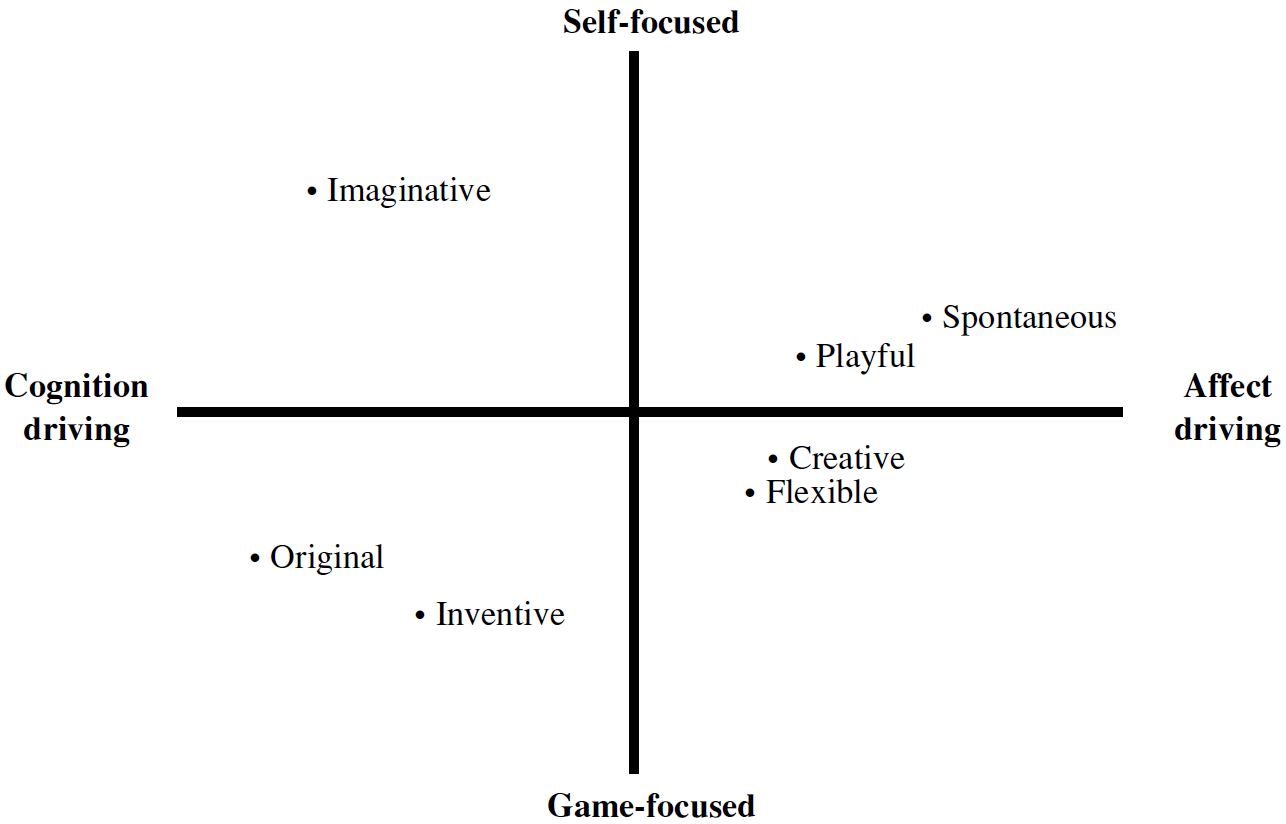
Figure 1. Two-dimensional configuration of ways of online game playfulness.
In-game playfulness (state) The scale was validated by factor analysis, indicating a single Playfulness state factor and explaining 57.14% of total variance (Cronbach’s alpha = .90). This factor analysis result violates the 3-component structure found by Moon and Kim (2001) and we suggest that fleeting experiences happen in a flash and may not be fit for rational analysis of the emergence of delicate psychological differentiation. Another possible reason is that all 11- and 12-year-old adolescents are relatively immature and may not be able to recognize multiple experiences from a car driving event.
Adolescent Players’ Psychological Needs This factor analysis indicated three factors (relatedness, autonomy, and competence), explaining 49.91% of the total variance. The reliability coefficients (Cronbach’s alpha) were .82, .85, and .80 for the three factors, respectively, and .83 for the entire scale.
Regression analysis Because of the limitations of the survey procedure, 105 usable questionnaires may not be sufficient to conduct structural equation modeling (SEM). We therefore conducted several regression analyses.
Results
Results from the multidimensional scaling analysis appear in Figure 1. The online game playfulness trait was mapped onto two broad dimensions. The first dimension, self-game focused, reflected playfulness that was more purely pragmatic and functional versus those kinds of playfulness that are spontaneous and imaginative. The second dimension, cognition-affect driving, reflected the playfulness trait that is more purely cognitive versus that which is affective. The results supported H1: Online game playfulness (trait) is subjected to an unweighted nonmetric multidimensional scaling procedure (Stalans, 1995).
According to the correlation results, the playfulness trait (Webster & Martocchio, 1992) was related to in-game playfulness (Ahn et al., 2007) (r = .255, p < .01). However, there was no significant relationship between playfulness trait and number of hours spent playing per week, a critical criterion of the conception of playfulness. The playfulness trait describes an individual’s cognitive appraisal of online games (Webster & Martocchio; Woszczynski et al., 2002) which has nothing to do with individuals’ volition to become involved in active engagement – while in-game playfulness refers to a situation-specific state aroused by a vivid playing experience during an episode of online racing gaming and from individuals’ joining groups and interacting with each other in order to overcome team challenges. It is, therefore, more capable of revealing players’ momentary experiences of concentration, enjoyment, and curiosity. The results supported H2: In-game playfulness is a more suitable indicator (than playfulness trait) of adolescents’ immediate experience of playfulness.
As presented in the data analysis section, three factors were extracted from a factor analysis to represent adolescent players’ psychological needs: competence, autonomy, and relatedness. In accordance with Ryan et al.’s (2006) assertion, in-game autonomy, in-game competence and in-game relatedness can account for online players’ psychological needs. The results supported H3: Adolescents’ psychological needs while playing online games will include in-game autonomy, in-game competence, and in-game relatedness.
Finally, according to the results of regression analysis, adolescent players’ psychological needs were predictors of in-game playfulness (R2 = .362, β = .607, p < .001). Although psychological needs were also predictors of game playfulness (R2 = .167, β = .409, p < .001), the effect sizes were smaller. In addition, three psychological needs were added using the stepwise method, with relatedness entering the regression before autonomy; competence did not enter at all. Combined, relatedness and autonomy explained 38.8% of the total variance in predicting playfulness (F = 33.997, p < .001). The overall results from the regression analyses suggest that adolescent players’ psychological needs have predictive power for in-game playfulness. This supports Jansz and Tanis’ (2007) finding that social interaction is the strongest predictor of time spent gaming. The results supported H4: Adolescents’ psychological needs will predict in-game playfulness.
Discussion
The aim in the present study was to explore adolescent players’ online game playfulness trait, in-game playfulness, and the influence of psychological needs on in-game playfulness. Firstly, the multidimensional scaling analysis yielded evidence that the online game playfulness trait was mapped onto two broad dimensions. The first dimension, self-game focused, reflected that playfulness was more purely pragmatic and functional versus those kinds that are spontaneous and imaginative. At one end of the continuum are relatively self-focused, joy playfulness such as playing games with happiness and inspiration of imagination, while at the other end are more game-focused, with playfulness such as an original interface and a flexible way of operating. The second dimension, cognition-affect driving, reflected playfulness that was more purely cognitive versus that which is affective. At the cognitive end of the continuum was learning playfulness such as inventive and imaginative; while at the other end was affect playfulness such as spontaneous and creative.
Secondly, the results showed that in-game playfulness is a suitable indicator of adolescents’ immediate experience of playfulness during gaming. Adolescents aged 11 and 12 did perceive in-game playfulness which describes their involvement in a fleeting, fluctuating playful state. This is one of the reasons that adolescents nowadays keep seeking pleasure from online games and so online games gradually replace those interesting raw materials or toys that help them to amuse themselves during childhood. Online games are likely age-matching toys for adolescents.
Thirdly, extending research on SDT (Ryan & Deci, 2000) to online games, our results revealed that adolescents’ psychological needs for competence, autonomy, and relatedness can be satisfied through online gaming. If online games can satisfy these three psychological needs, they may have potential to facilitate adolescent players’ psychological growth. Furthermore, our findings revealed that adolescents’ psychological needs predicted in-game playfulness. When psychological needs are satisfied, intrinsic motivation and well-being are enhanced (Ryan & Deci, 2000). In-game playfulness can be regarded as an intrinsic motive – the current results indicating higher in-game playfulness was related to a longer time being spent on gaming. Once adolescent players’ psychological needs are satisfied, their playfulness will be enhanced.
Finally, an interesting finding is that among the three psychological needs, only relatedness and autonomy could predict in-game playfulness. Adolescent development tasks (Lerner, 2002) include establishing autonomy, intimacy, achievement, and so on. Online games seem to satisfy adolescents’ psychological needs of establishing autonomy and intimacy (relatedness) through in-game playfulness. However, the psychological need for competence had no effect on adolescents’ in-game playfulness. We argue that online gaming offers adolescents plenty of chances to seek excitement and pleasure, but such entertaining experiences have nothing to do with – or can even be counterproductive to – serious competition and effortful craving for success embedded in ways of satisfying psychological needs for competence. Because of the limitation of our sample size, we suggest that in future studies the numbers of participants should be increased which will make it possible to adopt structural equation modeling (SEM) for a more parsimonious analysis in which multiple error variances in a model could be considered.
Ahn, T., Ryu, S., & Han, I. (2007). The impact of web quality and playfulness on user acceptance of online retailing. Information and Management, 44, 263-275.
Chung, J., & Tan, F. B. (2004). Antecedents of perceived playfulness: An exploratory study on user acceptance of general information-searching websites. Information and Management, 41, 869- 881.
Hackbarth, G., Grover, V., & Yi, M. Y. (2003). Computer playfulness and anxiety: Positive and negative mediators of the system experience effect on perceived ease of use. Information and Management, 40, 221-232.
Jansz, J., & Tanis, M. (2007). Appeal of playing online first person shooter games. CyberPsychology and Behavior, 10(1), 133-136.
Jeng, S. P., & Teng, C. I. (2008). Personality and motivations for playing online games. Social Behavior and Personality: An international journal, 36(8), 1053-1060.
Kart Rider. (2009). Retrieved August 7, 2009 from http://tw.kartrider.gamania.com/index.aspx
Kruskal, J. B., & Carmone, F. J. (1969). How to use MDScal and other useful information. Murray Hill: Bell Telephone Laboratories.
Lerner, R. M. (2002). Concepts and theories of human development (3rd ed.). Mahwah, NJ: Lawrence Erlbaum Associates.
Lieberman, J. N. (1965). Playfulness and divergent thinking: An investigation of their relationship at the kindergarten level. Journal of Genetic Psychology, 107, 219-224.
Moon, J., & Kim, Y. (2001). Extending the TAM for a World-Wide-Web context. Information and Management, 38, 217-230.
Roberts, D. F. (2000). Media and youth: Access, exposure and privatization. Journal of Adolescent Health, 27(2), 8-14.
Ryan, R. M., & Deci, E. L. (2000). Self-determination theory and the facilitation of intrinsic motivation, social development, and wellbeing. American Psychologist, 55, 68-78.
Ryan, R. M., Rigby, C. S., & Przybylski, A. (2006). The motivational pull of video games: A self- determination theory approach. Motivation and Emotion, 30, 344-360.
Stalans, L. J. (1995). Multidimensional scaling. In L. G. Grimm & P. R. Yarnold (Eds.), Reading and understanding multivariate statistics (pp. 137-168). Washington, DC: American Psychological Association.
Tu, H. H. J., Chen, L. S. L., Wang, M. C. H., & Lin, J. Y. C. (2007). The impact of neuroticism on leisure satisfaction: Online game application. Social Behavior and Personality: An international journal, 35(10), 1399-1404.
Wallenius, M., Punamaki, R.-L., & Rimpela, A. (2007). Digital game playing and direct and indirect aggression in early adolescence: The roles of age, social intelligence, and parent-child communication. Journal of Youth and Adolescence, 36, 325-336.
Wan, C. S., & Chiou, W. B. (2006). Psychological motives and online games addiction: A test of flow theory and humanistic needs theory for Taiwanese adolescents. CyberPsychology and Behavior, 9(3), 317-324.
Wang, C. C., & Chu, Y. S. (2007). Harmonious passion and obsessive passion in playing online games. Social Behavior and Personality: An international journal, 35, 997-1006.
Webster, J., & Martocchio, J. J. (1992). Microcomputer playfulness: Development of a measure with workplace implications. Management Information Systems Quarterly, 16, 201-226.
Woszczynski, A. B., Roth, P. L., & Segars, A. H. (2002). Exploring the theoretical foundations of playfulness in computer interactions. Computers in Human Behavior, 18, 369-388.
Figure 1. Two-dimensional configuration of ways of online game playfulness.
This research was supported by two financial grants from the National Science Council of the Republic of China
(1) Game-based learning project (NSC96-2520-S-009-006-MY3) and (2) Net and Taiwan Adolescents&rsquo
Physical/Mental Development (NetYouth project) (NSC 97-2631-S-009-001) which is a branch under a nationwide project
&ldquo
Taiwan E-Learning and Digital Archive Program.&rdquo
Appreciation is due to anonymous reviewers.
M. E. Yu-Tzu Chiang, Division of Educational and Counseling Psychology, Institute of Education, National Chiao Tung University, 1001 Ta-Hsueh Rd., Hsinchu 300, Taiwan, ROC. Phone: +886-3-5712121 ext 31714; Fax: +886-3-5738083; Email: [email protected]