Interpersonal trust and knowledge sharing: Moderating effects of individual altruism and a social interaction environment
Main Article Content
The relationship between interpersonal trust and knowledge sharing was explored, along with the impact of individual altruism and a social interaction environment. Participants were employees in Taiwanese high-tech industries. Employees’ perceived interpersonal trust, of either their colleagues or supervisor, was found to be positively correlated with their knowledge-sharing behaviors in the workplace. Employees’ altruism traits were found to be a factor for them to share knowledge in the workplace and the trait of altruism was also found to reduce the positive association between trust of colleagues and knowledge sharing. An organizational social interaction environment intensifies the positive association between trust of colleagues and knowledge sharing. Theoretical and managerial implications of the study are discussed.
Knowledge sharing is one of the most important managerial concerns in organizations as it creates a competitive advantage in the knowledge economy (Quinn, Anderson, & Finkelstein, 1996). Nevertheless, organizations still do not make enough effort to devise mechanisms that effectively encourage employees to share knowledge. Knowledge is valuable and knowledge-sharing behavior is one kind of social exchange in the workplace (Davenport & Prusak, 1998); it can be expected that those who possess knowledge may not share their knowledge unless they perceive potential benefits. A substantive monetary reward system alone may not be sufficient to encourage employees to exchange knowledge because the focal determinant in a social exchange relationship is trust (Davenport & Prusak, 1998; Wasko & Faraj, 2005). Interpersonal trust thus becomes a crucial factor when an employee decides to share knowledge in the workplace.
Past studies have identified trust of colleagues (TOC) as a component of the construct of interpersonal trust (e.g., Wu, Hsu, & Yeh, 2007). Nevertheless, the relationships between employees and supervisors are also important in the workplace (Chen, Tsui, & Farh, 2002), and thus trust of supervisor (TOS) should be taken into account in explaining employees’ knowledge-sharing behaviors. Despite the proposed effect of trust of a supervisor, the empirical results are ambiguous because of potential methodological discrepancies (e.g., Cheng & Li, 2001). It is necessary to reexamine the respective influences of trust of colleagues and trust of supervisor on knowledge-sharing behavior.
In addition to the dyadic relationships mentioned above (i.e., TOC and TOS), individual dispositional traits and environmental factors involved in situations where knowledge sharing occurs were also considered in this study. Although in previous studies it has been posited that employees’ altruism and social interaction settings are critical in facilitating knowledge sharing (e.g., Davenport & Prusak, 1998; Dixon, 2000; Nonaka & Takeuchi, 1995), how and when these factors have the most significant effects are still unknown. In our study we tried to close this gap by integrating the construct of interpersonal trust with individual altruism and the social interaction environment in explaining knowledge-sharing behaviors in organizational fields.
Based on the above, we had two aims in this study. Our first aim was to investigate the relative effects of trust of colleagues and trust of supervisor on knowledge sharing. Second, we examined the impacts of the propensity of employees to be altruistic and the social interaction environment on the association between interpersonal trust and knowledge sharing. The principal contribution of this study to the research on these subjects is to integrate three levels of influences in explaining knowledge-sharing behaviors, namely altruism at an individual level, trust at an interpersonal level, and social interaction at the team level. Figure 1 depicts the research framework of our study.

Figure 1: Research framework.
Interpersonal Trust and Knowledge Sharing
According to the social exchange theory (Blau, 1964), an individual may be glad to establish an exchange relationship with others by voluntarily giving benefits to others first and then expecting returns in the future. Generally, trust is an essential component in a social exchange relationship. The higher the degree of trust perceived by the giver and the recipient, the stronger will be the social exchange relationship that exists between them (Blau, 1964; Wasko & Faraj, 2005). As for the association between trust of colleagues (TOC) and knowledge sharing, those who possess knowledge and who have high TOC might be more likely to believe that when they share their knowledge with colleagues, they could gain a return from their colleagues in the future. Similarly, when trust of supervisor (TOS) exists, subordinates have more confidence that their efforts will be recognized by the supervisor and that they will get a return from the supervisor in the future. Our hypotheses for the study were:
Hypothesis 1a Trust of colleagues is positively correlated with knowledge- sharing behavior.
Hypothesis 1b Trust of supervisor is positively correlated with knowledge- sharing behavior.
The Impact of a Social Interaction Environment
An environment of social interaction is important in the research agenda of knowledge sharing. The social interaction environment refers to mechanisms designed by organizations for employees to have more interaction opportunities (Wu et al., 2007). According to previous studies, there are various activities that facilitate social interaction, such as meetings, open and free interaction during work, spending after-work hours together, mentor programs, and so on (Brown, 1991; Davenport & Prusak, 1998; Nonaka & Takeuchi, 1995). In this study, we posited that social interaction environments reinforce the relationship between interpersonal trust and knowledge-sharing behavior because an environment where there is social interaction increases knowledge givers’ expectation that future potential rewards from knowledge recipients will be forthcoming. In other words, individuals situated in a setting where there is little social interaction may not perceive reciprocal relationships that can be maintained in a meaningful way in the long run, and thus these people are less likely to share knowledge.
A well-established social interaction environment creates more opportunities for employees to exchange knowledge. When high-TOC possessors of knowledge work in a well-established social interaction environment, they would be more willing to share knowledge than in an environment where social interaction is not well established. Accordingly, a social interaction environment strengthens the relationship between TOC and knowledge-sharing behavior. Likewise, we also reasoned that social interaction would have a positive moderating effect on the relationship between TOS and knowledge sharing. Usually, a supervisor could be one of the participants in social-interaction activities. Employees who have great trust in their supervisors would therefore be more willing to share knowledge because they expect that their sharing behaviors will be more easily observed and recognized by their supervisors in a well-established interaction setting. As a result, social interaction strengthens the relationship between interpersonal trust (i.e., TOC and TOS) and knowledge sharing. Therefore, we formulated the following hypotheses:
Hypothesis 2a Social interaction environments positively moderate the positive correlation between trust of colleagues and knowledge-sharing behavior.
Hypothesis 2b Social interaction environments positively moderate the positive correlation between trust of supervisor and knowledge-sharing behavior.
The Influence of Individual Altruism
Modern economic theorists have assumed that individuals are rational and self-interested. However, alongside self-concern, the altruistic nature also exists (Hoffman, 1981; Zamagni, 1995). People’s altruistic behaviors could be driven by the altruistic nature of an individual or by self-concern such as pursuing a good social reputation, earning friendship or a future benefit and return, and so forth (Becker, 1974; Obler, 1981). Similarly, with regard to knowledge-sharing behavior, there may exist two kinds of motivation − altruistic motivation and self-concern motivation. According to our Hypothesis 1, the relationship between interpersonal trust and knowledge sharing is based on the assumption of a self- concern motivation. That is, knowledge givers expect potential returns from knowledge recipients in the future. However, some people do have the propensity to share knowledge without expecting returns from others. For possessors of knowledge high in altruism, their knowledge-sharing behaviors depend mainly on their altruistic motivation, and hence interpersonal trust might be less important. In contrast, for possessors of knowledge low in altruism, perceived interpersonal trust becomes an important determinant when they consider sharing knowledge with colleagues. In other words, individuals who have little altruism have to be assured of the potential returns before sharing knowledge. Hence, we proposed that the effect of interpersonal trust is greater for employees low in altruism than for highly altruistic employees.
Hypothesis 3a Individual altruism negatively moderates the positive correlation between trust of colleagues and knowledge-sharing behavior.
Hypothesis 3b Individual altruism negatively moderates the positive correlation between trust of supervisor and knowledge-sharing behavior.
Method
Participants
We chose research and development (R & D) teams in high-tech industries in Taiwan as the context to test the research framework. The sampling frame was judged to be adequate for several reasons: (a) R & D projects are more knowledge intensive than labor intensive and hence knowledge sharing is a major component in these companies; (b) R & D members have specific targets (i.e., colleagues and supervisor in the same team) to refer to when they administer the questionnaire; (c) these companies may employ cutting-edge practices in designing interaction environments. During the survey we sent four copies of questionnaires for each of the R & D teams. The final usable sample included 297 employees from 85 R & D teams. The sample of team members had more men (86.2%) than women, was relatively young (78.8% between the ages of 26 and 35), and was well educated (92.6% respondents had completed vocational college or university education).
Measures
Interpersonal trust Interpersonal trust consists of employees’ trust of colleagues (TOC) and supervisor (TOS). TOC and TOS were measured with six items adapted from Cheng and Li (2001). The items were statements responded to on 6-point scales anchored by 1 = strongly disagree and 6 = strongly agree. The items of TOC included “I think my colleagues are worthy of trust,” “I think the commitment from my colleagues is credible,” and “I think when I expose my weakness in front of my colleagues, they would help me to overcome it instead of hurting me.” The items of TOS included “I think my supervisor is worthy of trust,” “I think the commitment from the supervisor is credible,” and “No matter what happens in the future, my supervisor would always give me support and help.” The Cronbach’s alpha values were .85 for TOC and .89 for TOS, indicating that the measures had high internal consistency.
Social interaction environment Social interaction was measured with five items modified from Wu et al. (2007). Team leaders were asked to indicate the degree of social interaction on 5-point scales (1 = strongly disagree, 5 = strongly agree). Since members in the same team were assumed to encounter a similar interaction environment, these items were rated only by R & D team leaders. The sample items include “The company holds regular meetings for colleagues to share successful experiences or to resolve work problems,” “The company invites high-performance employees to share their knowledge with others in meetings,” and “There are tearooms and rest rooms where employees can talk to each other and share experiences.” The Cronbach’s alpha for social interaction measures was .80.
Altruism This construct was measured with two items adapted from the altruism facet of agreeable personality in the Five-Factor Personality Scale (Costa & McCrae, 1992). The items in this scale were “Some people think I’m selfish and egotistical,” and “Some people think of me as cold and calculating.” Both of the items were reverse scored. Participants were asked to indicate their degree of altruism on 5-point scales (1 = strongly disagree, 5 = strongly agree). The Cronbach’s alpha for this scale was .65.
Knowledge sharing Knowledge sharing was measured with 10 items adapted from Cheng and Li (2001). Examples of the items are: “offering suggestions when discussing matters with colleagues”; “being willing to talk about knowledge and experience with colleagues”; and “replying to colleagues’ questions with sincerity.” Participants were asked to indicate their degree of knowledge-sharing behavior on a 6-point scale (1 = strongly disagree, 6 = strongly agree). The Cronbach’s alpha for this scale was .93.
The sample’s demographic data including sex, age and education level were also collected as control variables. Table 1 shows the basic characteristics of the team and team members.
Results
Hierarchical regression analyses were conducted to examine the effects of independent variables on knowledge sharing. Table 2 sets out the results of hierarchical regression analyses. Model 1 tested the main effects of trust of colleagues and trust of supervisor. The results indicated that both TOC and TOS had significantly positive effects on knowledge sharing (p < 0.001); increasing trust of colleagues and supervisor enhanced the possibility that an employee would share knowledge in the workplace. Hypotheses 1a and 1b were both supported. Further, it was meaningful to compare the relative effects between TOC and TOS. From Model 1 through to Model 3, the effects of TOC were consistently stronger than the effects of TOS. The results indicated that trust of colleagues was the most important determinant of employees’ knowledge- sharing behaviors.
Table 1. Basic Characteristics of Team and Team Members

Table 2. Results of Hierarchical Regression Analyses
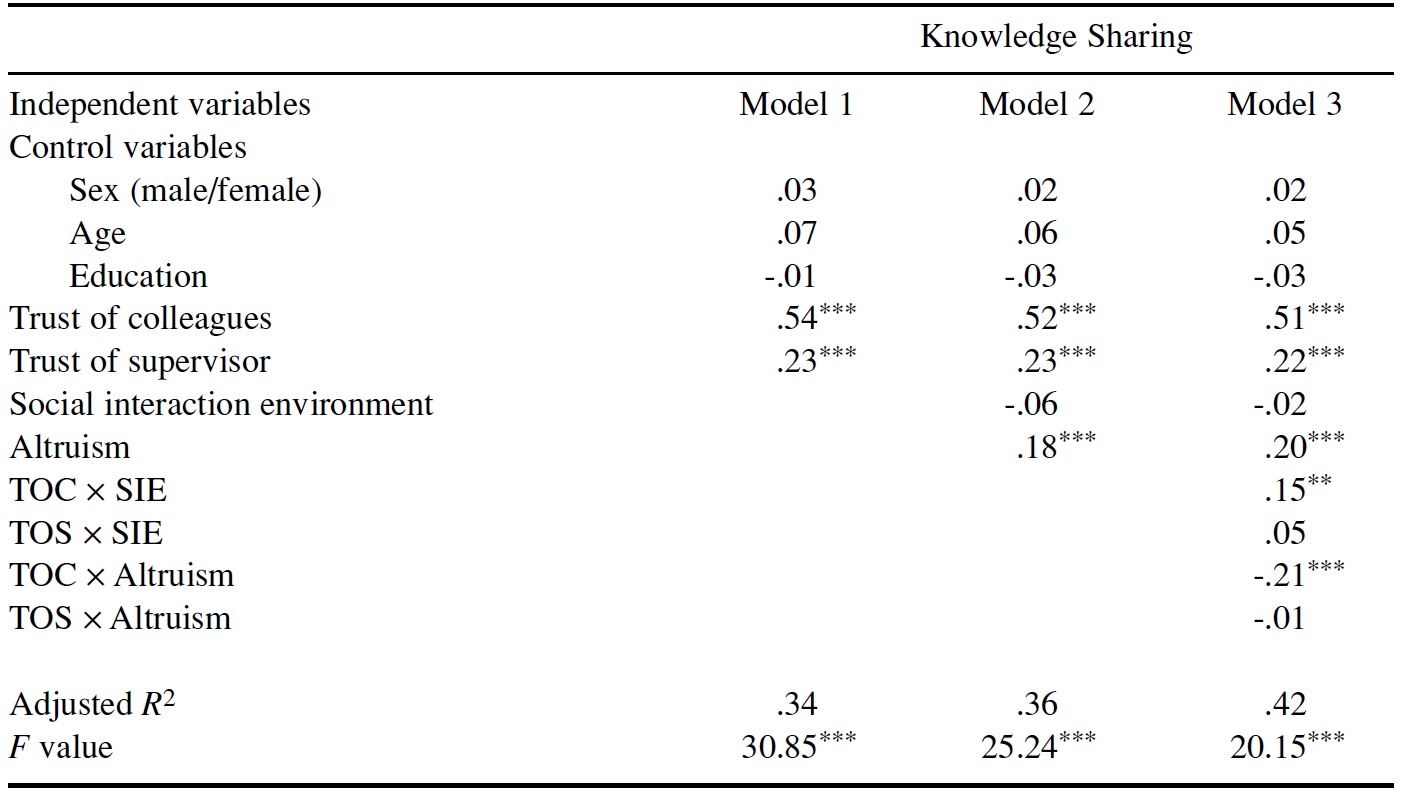
Note: Coefficients are standardized beta weights.
* p < 0.05 ** p < 0.01 *** p < 0.001
In Model 2 the effects of the employees’ altruism and social interaction environment were examined. The results indicated that the positive effect of altruism on knowledge sharing was significant (p < 0.001) but for social interaction the effect was not significant. Although the main effects of altruism and social interaction were not the focus of this study, the purpose of the analyses was to establish a basis for subsequent moderating effects analyses, which were examined in Model 3. The results of Model 3 showed that the coefficient of interaction term between TOC and social interaction was significant (p < 0.01), implying that social interaction environments reinforced the positive effect of TOC on knowledge sharing. The coefficient of interaction term between TOC and altruism was negatively significant (p < 0.001), suggesting that individual altruism minimized the positive influence of TOC on knowledge sharing. Contrary to our hypotheses, a social interaction environment and individual altruism exerted no influences on the association between TOS and knowledge sharing. Overall, Hypotheses 2a and 3a were confirmed, but Hypotheses 2b and 3b were not confirmed.
Conclusion and Discussion
In summary, our purpose in this study was to examine the relationship between interpersonal trust and knowledge sharing in the workplace, and to look at the impact of individual altruism and a social interaction environment. We found that employees’ perceived interpersonal trust, either of their colleagues or supervisor, was positively correlated with their knowledge-sharing behaviors in the workplace. These results are consistent with previous studies where it was found that trust is important in knowledge-sharing activities (Currie & Kerrin, 2003; Davenport & Prusak, 1998; Zárraga & Bonache, 2003). Our results also add to the generality of the effects of TOC and TOS on knowledge sharing. In terms of relative effects, trust of colleagues is a stronger determinant of knowledge sharing than is trust of supervisor. Employees’ altruism traits are facilitators for them to share knowledge in the workplace. The trait of altruism also reduces the positive association between trust of colleagues and knowledge sharing. In other words, trust of colleagues is more influential in explaining the act of knowledge sharing for employees who are low in altruism than for highly altruistic ones. This result also sheds light on the nature of altruism. For highly altruistic employees, having trust of colleagues is not a major concern in sharing knowledge. An organizational social interaction environment intensifies the positive association between trust of colleagues and knowledge sharing. That is, the effect of trust of colleagues on knowledge sharing is greater in a well- established social interaction environment. This result supports the argument that increasing interaction activities among employees promotes the spread of knowledge within an organization (Brown, 1991; Davenport & Prusak, 1998; Nonaka & Takeuchi, 1995). In summary, our study contributes to the literature by examining the influences of knowledge sharing across three levels − individual altruism, interpersonal trust, and the team social interaction environment. There are also several managerial implications.
First, although knowledge sharing mainly occurs between colleagues, there exists an incremental effect of trust of supervisor in explaining knowledge- sharing behavior (although it should be noted that its effect is less than the effect of trust of colleagues). Being one manifestation of organizational citizenship behavior, knowledge sharing may have instrumental value (Hui, Lam, & Law, 2000); that is, subordinates may try to convey virtues (e.g., being active, helpful, friendly, and collaborative) by their knowledge-sharing behaviors, and may expect or believe that they will, therefore, get future positive evaluation from their supervisors. Conversely, unfulfilled expectation, and hence distrust of their supervisors, may reduce their intention to share knowledge.
Next, individual altruism has both direct and moderating effects on knowledge sharing, implying that the trait of altruism may be emphasized in human resource management. Since individual traits are relatively stable over time, it would be preferable for organizations to select through their recruiting process, candidates who are already highly altruistic rather than trying to alter employees’ propensity for altruism by training programs after they have been employed. Mutual trust between colleagues should be established for those employees already in organizations who are low on altruism.
Moreover, many organizations have established social interaction environments in anticipation that knowledge-sharing behaviors will occur in the workplace. This expectation may be an illusion. Our results suggest that social interaction environments per se do not generate knowledge sharing; instead, knowledge sharing is generated through the effects of interpersonal trust. This means that knowledge sharing does not occur even in a highly facilitated social-interaction setting if people within that setting do not perceive mutual trust. Hence, the next question is how interpersonal trust forms in the workplace. Establishing a workplace friendship may boost interpersonal trust (Nugent & Abolafia, 2006); however, this proposition needs to be empirically tested.
Our study had limitations. We did not consider the type of knowledge shared (e.g., tacit knowledge vs. explicit knowledge). For example, tacit knowledge may be more valuable than explicit knowledge and may need more time and more complex social process to be transferred; therefore, greater perceived mutual trust might be needed for the exchange of tacit knowledge. Moreover, we used self- report measures to examine knowledge sharing and altruism in this study, and this practice may cause bias due to social desirability; for example, employees might overestimate their degree of performing knowledge-sharing behaviors. In future studies an attempt could be made to measure these two constructs more objectively through different informants, for example, by asking employees’ colleagues or supervisors to rank their performance on the scales.
Becker, G. S. (1974). A theory of social interactions. Journal of Political Economy, 82, 1063-1193. Blau, P. M. (1964). Exchange and power in social life. New York: Wiley.
Brown, J. S. (1991). Research that reinvents the corporation. Harvard Business Review, 69, 102- 110.
Chen, Z. X., Tsui, A. S., & Farh, J. L. (2002). Loyalty to supervisor versus organizational commitment: Relationships to employee performance in China. Journal of Occupational and Organizational Psychology, 75, 339-356.
Cheng, J. W., & Li, S. C. (2001). The relationships of organization justice, trust and knowledge sharing behaviors. Journal of Human Resource Management, 1, 69-93 (In Chinese).
Costa, P. T., Jr., & McCrae, R. R. (1992). Revised NEO personality inventory (NEO PI-RTM) and NEO Five-Factor inventory (NEO-FFI): Professional manual. Odessa, FL: Psychological Assessment Resources.
Currie, G., & Kerrin, M. (2003). Human resource management and knowledge management: Enhancing knowledge sharing in a pharmaceutical company. International Journal of Human Resource Management, 14, 1027-1045.
Davenport, T. H., & Prusak, L. (1998). Working knowledge. Boston, MA: Harvard Business School Press.
Dixon, N. M. (2000). Common knowledge. Boston, MA: Harvard Business School Press.
Hoffman, M. L. (1981). Is altruism part of human nature? Journal of Personality and Social Psychology, 40, 121-137.
Hui, C., Lam, S. S. K., & Law, K. K. S. (2000). Instrumental values of organizational citizenship behavior for promotion: A field quasi-experiment. Journal of Applied Psychology, 85(2), 822- 828.
Nonaka, I., & Takeuchi, H. (1995). The knowledge-creating company. New York: Oxford University Press.
Nugent, P. D., & Abolafia, M. Y. (2006). The creation of trust through interaction and exchange: The role of consideration in organizations. Group & Organization Management, 31(6), 628-650.
Obler, J. (1981). Private giving in the welfare state. British Journal of Political Science, 11, 17-48.
Quinn, J. B., Anderson, P., & Finkelstein, S. (1996). Managing professional intellect: Making the most of the best. Harvard Business Review, 74, 71-80.
Wasko, M. M., & Faraj, S. (2005). Why should I share? Examining social capital and knowledge contribution in electronic networks of practice. MIS Quarterly, 29, 35-57.
Wu, W. L., Hsu, B. F., & Yeh, R. S. (2007). Fostering the determinants of knowledge transfer: A team-level analysis. Journal of Information Science, 33(3), 326-339.
Zamagni, S. (1995). The economics of altruism. Vermont: Edward Elgar.
Zárraga, C., & Bonache, J. (2003). Assessing the team environment for knowledge sharing: An empirical analysis. International Journal of Human Resource Management, 14, 1227-1245.
Figure 1: Research framework.
Table 1. Basic Characteristics of Team and Team Members
Table 2. Results of Hierarchical Regression Analyses
Note: Coefficients are standardized beta weights.
* p < 0.05 ** p < 0.01 *** p < 0.001
Appreciation is due to anonymous reviewers.