Harmonious passion and obsessive passion in playing online games
Main Article Content
The concepts of passion as proposed by Vallerand et al. (2003) were employed to describe the passion of online computer game players. An empirical survey was conducted, and statistical analysis was utilized to analyze the 404 responses. The empirical evidence confirms the theory of Vallerand et al. that the passion for online computer games can be divided into two subdimensions, namely harmonious passion and obsessive passion. Furthermore, the influences of harmonious and obsessive passion on players’ addiction to online computer games differ significantly. Obsessive passion may lead to addiction, while harmonious passion normally does not. These results support the argument that only obsessive passion leads to negative outcomes.
Online games have become increasingly popular, especially among young adults, as the Internet pervades daily life. Many individuals play online computer games. However, playing of online games may be associated with negative consequences. Lo, Wang, and Fang (2005) demonstrated that heavy online game players often suffer from anxiety. Some computer game players have become addicted to online computer games. In the worst cases, addiction to online computer games has already had harmful effects (Parsons, 2005).
Some youths play online computer games daily with a passion, which can lead to addiction to online games. Although passion is not a new concept in psychology, Vallerand et al. (2003) redefined passion, and divided it into harmonious and obsessive passion. These two passions have completely different effects. Vallerand et al. predicted that obsessive passion would have negative effects, while harmonious passion would bring positive outcomes. This finding leads to the question of whether or not those with obsessive passion for online games are likely to become addicted to online computer games. Another issue is whether harmonious passion is irrelevant to online game addiction. This study is focused on how these two passions relate to online computer game addiction and usage.
According to the definition of Vallerand et al. (2003), passion refers to a strong tendency towards an object or activity that an individual likes and finds important, and on which he or she invests time and energy. Passion can be classified as harmonious or obsessive. Harmonious passion results from a spontaneous internalization of an activity into an individual’s identity. A spontaneous internalization occurs when an individual has freely accepted for himself the activity or object as significant. Furthermore, harmonious passion is defined as a persuasion leading individuals to engage in an activity or to accept an object. People with harmonious passion for an activity or object enjoy it and feel cheerful about it. Conversely, obsessive passion results from a controlled internalization of an activity or object into a person’s identity. In contrast to harmonious passion, obsessive passion leads a person to be controlled by the activity or object. In contrast to harmonious passion, people with obsessive passion for an activity will enjoy the activity or object and feel fanatical over it. If they are disturbed from the activity or object, they become angry, anxious and unable to concentrate on other activities.
Some empirical studies by Vallerand and his colleagues have focused on the different impacts of harmonious and obsessive passion on behavior. Mageau, Vallerand, Rousseau, Ratelle, and Provencher (2005) concluded that individuals with a harmonious passion for gambling tend to have concentration, vitality and positive emotions, while people with obsessive passion for gambling tend to have ruminations, anxiety and feelings of guilt. Ratelle, Vallerand, Mageau, Rousseau, and Provencher (2004) found that gambling can induce both harmonious and obsessive passion, but that only obsessive passion predicts problem gambling. Séguin-Lévesque, Laliberté, Pelletier, Blanchard, and Vallerand (2003) contended that Internet users can become obsessively involved in bad interpersonal relationships. An empirical survey of Vallerand et al. (2003) revealed that obsessive passion forces people to participate in their favorite activities.
Based on the above studies, it was predicted that both obsessive passion and harmonious passion increase the intention to play online computer games. However, only obsessive passion is linked with negative consequences such as poor vitality and negative moods.
Addiction is an important issue that should be addressed in relation to online computer games. Young (1996) defined Internet addiction as a pathological use of the Internet. Young (1998) provided a general picture of Internet addiction and defined a scale for Internet addiction. Whang, Lee, and Chang (2003) concluded that around 22% of Internet users were Internet addicts. Most Internet addicts stated that they played online games to escape from reality. Parsons’ (2005) survey of online computer game players demonstrated that approximately 15% of online game players fulfilled the criteria for addiction. Parsons revealed that online game addiction increases as online game playing raises. With relevance to the previous studies mentioned, it was inferred that obsessive rather than harmonious passion leads to addiction to online computer games. Based on these inferences, we propose the following two hypotheses:
H1: Obsessive passion is positively related to players’ addition to online games.
H2: Harmonious passion is not related to players’ addition to online games.
Method
Participants
An online survey was conducted in an online game virtual community (http://www.gamer.com.tw) in Taiwan. The number of registered members of this virtual community exceeds two million, and more than 320,000 users visit the website daily. It is the largest online game website in size, and ranks 16th among all websites in Taiwan. This website is also listed in the top 500 websites in the world, according to Internet traffic investigation by Alexa.com (2005). The site is popular not only because of its size, but also because of its nature, and the number of visitors who access this site represents the population of online computer game players in Taiwan.
Procedure
An online survey was performed to collect data. A call for voluntary participation was posted in the selected online game virtual community for about seven days. Subjects clicked the hyperlink in response to the call for voluntary participation in the survey. All responses were automatically recorded into the database.
The online survey website obtained 404 complete responses for data analysis in a period of one week. Among the respondents, 101 (25%) were female and 303 (75%) were male. The average age of the respondents was 18.23 years old, ranging from 10 to 45 years old, with a standard deviation of 5.08. The subjects spent 18.14 hours each week on average playing online computer games.
Instruments
An online questionnaire survey was utilized to explore the level of obsessive and harmonious passion for online computer game users, and to discuss the different effects of harmonious and obsessive passion in relation to online computer game addiction. The questionnaire was composed of three parts. In the first part, online computer game usage and demographic data were measured using five questions. The second part comprised ten questions relating to passion. Vallerand et al. (2003) developed a 14-item questionnaire scale to evaluate the levels of obsessive and harmonious passion. Ratelle et al. (2004) reduced the scale to ten questions, five questions for harmonious and five questions for obsessive passion. This study adopted the scale from the study of Ratelle et al. to explore online computer game players’ passions. The scale has two dimensions, namely harmonious and obsessive passion. A sample question from this scale was, “How often do you have an obsessive feeling for online games?”
For the online computer game addiction measurement in the third part, this study adopted Young’s (1998) Internet addiction scale, which was also utilized in previous investigations such as those by Simkova and Cincera (2004) and Whang et al. (2003). It was derived from an eight-item scale, also presented by Young (1996). Young modified the eight question scale into a 20-item questionnaire for compulsive Internet addiction. A sample question from this scale is, “How often do you fear that life without online games would be boring, empty and joyless?”
Five-point Likert scales were applied to measure passion and addiction. Each answer corresponded to a degree from one to five, where rarely was given a score of 1, occasionally was given 2, frequently 3, often 4 and always a score of 5. Items of Likert scales were summed to indicate the harmonious passion, obsessive passion, and addiction scores. Scores on obsessive and harmonious passion had a potential value range of 5-25, with higher scores indicating higher levels of passion. Scores on addiction had a potential value range from 20 to 100, with higher scores indicating higher levels of addiction.
Since the empirical survey was undertaken on a Taiwanese website, the English version of the questionnaire was translated into Chinese, the official language of Taiwan, by two different translators. These translators discussed any major inconsistencies in the translations to reconcile the differences.
Cronbach’s alphas were calculated to measure the reliability of the scales. The Cronbach’s alphas of harmonious passion, obsessive passion and online game addiction were .78, .87 and .90, respectively. All of the reliability values exceeded .70, and were thus within the acceptable range. Reliabilities of all three scales were confirmed.
According to Anderson and Gerbing (1998) and Gefen, Straub, and Boundreau (2000), convergent validity can be measured from the factor loading of the measuring model of structural equation model (SEM). This study found that all the factor loadings for the same scale dimensions were statistically significant, confirming that the convergent validity was acceptable. Discriminant validity is the degree to which concepts that should not be related theoretically are, in fact, not interrelated in reality (Bagozzi, 1981). Discriminant validity is attained when the correlation between any two latent variables is significantly different from unity (Bagozzi, Yi, & Phillips, 1991). All correlation coefficients among obsessive passion, harmonious passion and online game addiction differences from unity were found to be statistically significant at p < .05. Thus, the discriminant validity in this survey was confirmed. Table 1 presents the correlation coefficients of variables.
Table 1. Correlation Coefficients Among Latent Variables

Results
This study adopted SEM to test the proposed hypotheses, and to measure the relationships among harmonious passion, obsessive passion and online game addiction. SEM analysis comprises many approaches that can be employed to perform parameter estimation. According to Hu, Bentler, and Kano (1992), the generalized least squares (GLS) method performs better than others when the sample size is below 500. Therefore, GLS was selected to analyze the data. Figure 1 illustrates the SEM analysis results. The model-fit-evaluation results indicate that the value of goodness-of-fit index (GFI) was .85, and the value of adjusted goodness-of-fit index (AGFI) was .83, which were both above .80 and within the acceptable range. The chi-squared value was 889.34. The ratio of chi-square to the degree of freedom, using degree of freedom 403, was 2.21, which is below 5. Gefen et al. (2000) and Jiang, Klein, and Carr (2002) have found that GFI is best when the value is larger than .90 and is marginally acceptable when the value is above .80; AGFI is acceptable when the value is above .80, and the ratio of chi-square to degree of freedom is acceptable when the value is below 5. Hence, these indices reveal that the proposed model shows an acceptable fitness.
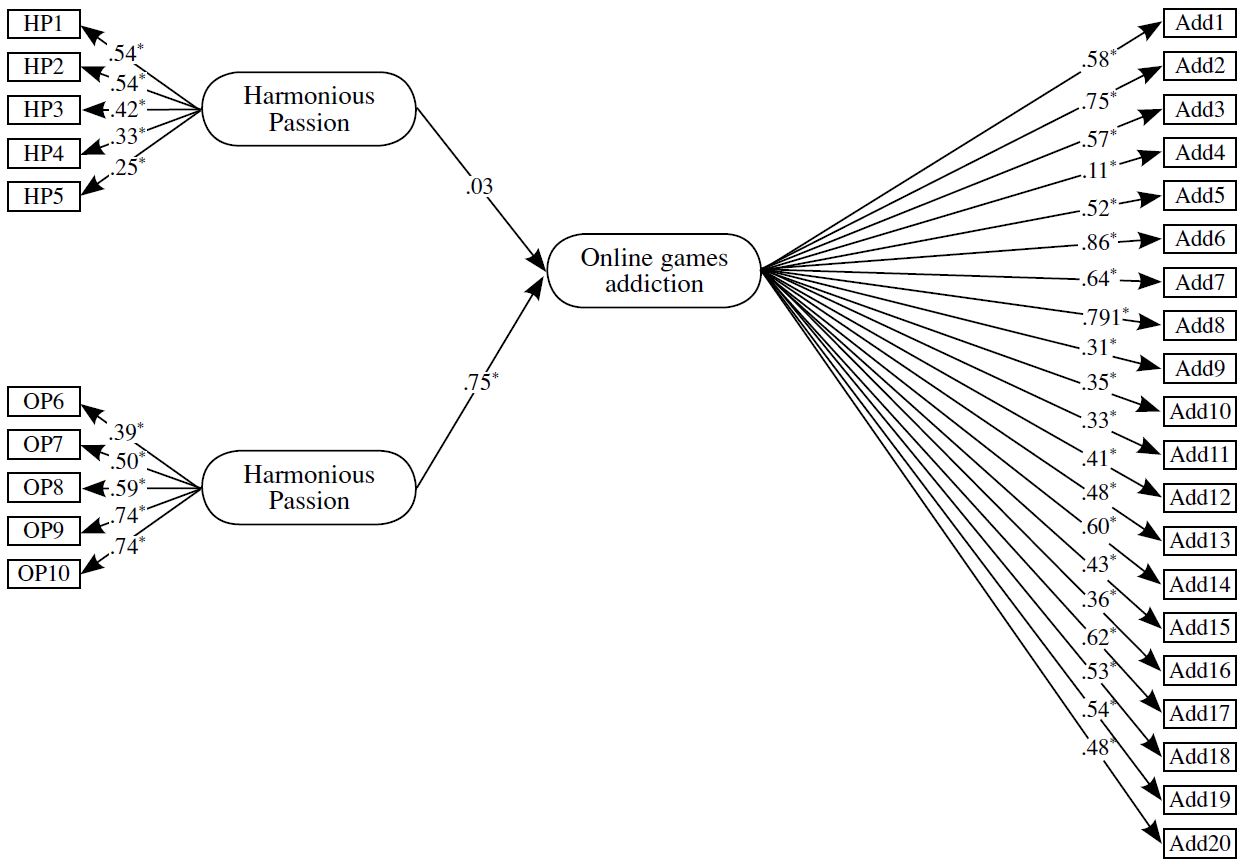
Figure 1. The result of SEM Analysis
*p < .05, **p < .01, ***p < .001
As demonstrated in Figure 1, a positive correlation (.75; p < .05) was observed between obsessive passion and online game addiction, thus supporting hypothesis 1. Additionally, the influence of harmonious passion on online game addiction was not significant (.03; p > .05), which also supported the second hypothesis. In summary, obsessive passion for online games might result in addiction, while harmonious might not. This result confirms the theory developed by Vallerand et al. (2003) that only obsessive passion is associated with negative consequences including poor vitality and negative mood.
The subjects were separated into groups according to harmonious and obsessive passion. Since scores on obsessive and harmonious passion have a potential value range of 5-25, a score of 15 was adopted as the threshold to differentiate between high and low passion. Subjects with scores of 15 or above on harmonious passion were considered to have high harmonious passion, while those with lower scores were considered to have low harmonious passion. Subjects with scores of 15 or above on obsessive passion were treated as high-obsessive-passion players, while those with lower scores were labeled low-obsessive-passion players. The t test was utilized to examine the difference between low-passion and high- passion players. The statistical results demonstrate that the difference in online game usage between users with high and low harmonious passion users was not significant. However, a significant difference was observed between users with high and low obsessive passion. These findings confirm the hypothesis of this study that obsessive passion leads to negative consequences of excessive online game playing, while harmonious passion does not.
Table 2. Test Results of Online Game Usage for Harmonious Passion
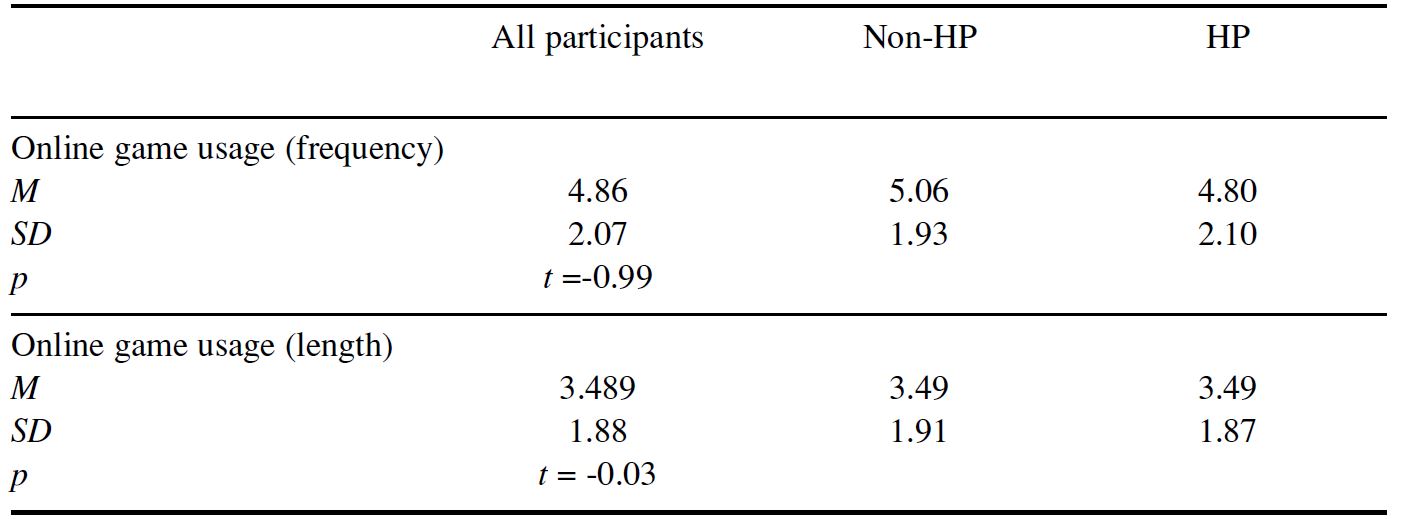
Note: All participants n = 404. Non-HP n = 80. HP n = 324.
*p < .05, **p < .01, ***p < .001
Table 3. Test Results of Online Game Usage for Obsessive Passion
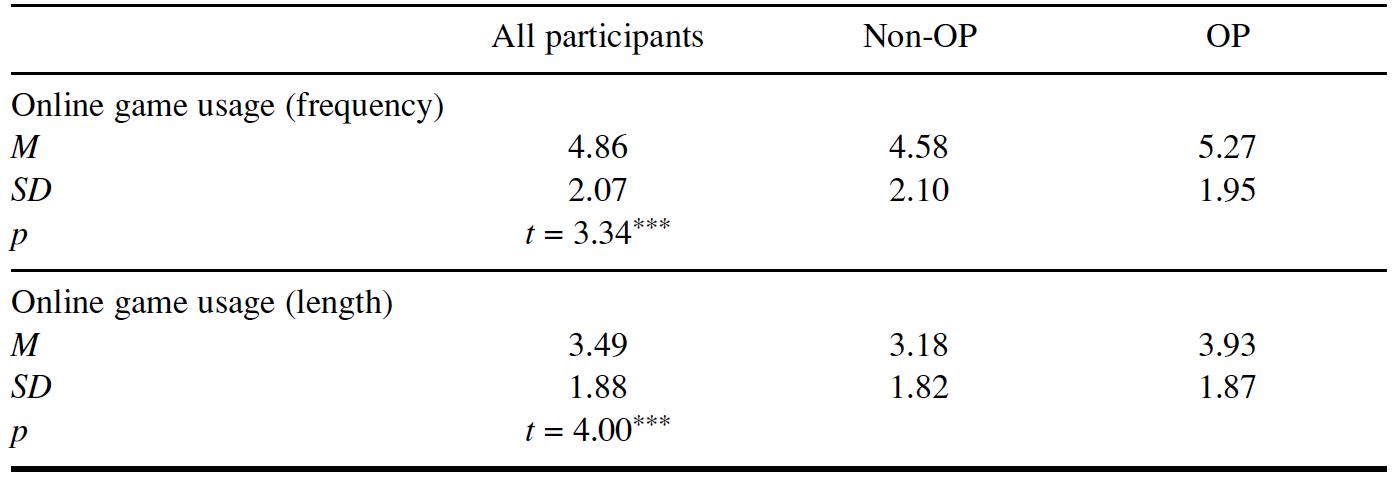
Note: All participants n = 404. Non-OP n = 240. OP n = 164.
*p < .05, **p < .01, ***p < .001
Discussion
The following conclusions are drawn from the empirical survey results. First, a positive correlation between obsessive passion and online computer game usage was observed. Second, the impact of harmonious passion on online computer game usage was not significant. This study found that harmonious and obsessive passion affect addiction differently. The empirical survey results indicate that only obsessive passion affects online game players’ addiction. Harmonious passion does not significantly affect online game players’ addiction. Vallerand (2003) found that people with harmonious passion for gambling normally exhibit concentration, vitality and positive emotions, while people with obsessive passion for gambling tend to exhibit ruminations, anxiety and feeling of guilt. Compared with the players with harmonious passion, the players with obsessive passion for online computer games have significant differences in online computer game usage, and also tend to be addicted to online computer games.
The major contribution of this study is to the understanding of the impact of harmonious and obsessive passion on addiction to online computer games. Vallerand et al. (2003) first proposed separating passion into the two subdimensions, harmonious and obsessive. This study confirms the existence of two dimensions of passion for playing online computer games. Furthermore, this study confirms that only obsessive passion leads to addiction to online games. Harmonious passion does not lead to negative outcomes, as Vallerand et al. (2003) anticipated. Empirical results of this study demonstrate that obsessive passion may create addiction in users of online gaming. Preventing obsessive passion to online games may also protect users from addiction. However, if users’ passion to online games is harmonious, then they will not become addicted to online games. These harmonious passion users may regard online games as entertainment activities to “kill time”. These harmonious users stop playing online game when they have other business to do.
Alexa (2005). Internet traffic investigation. Retrieved August, 2007 from www.alexa.com
Anderson, J. C., & Gerbing, D. W. (1988). Structural equation modeling in practice: A review and recommended two-step approach. Psychological Bulletin, 103(3), 411-423.
Bagozzi, R. P. (1981). An examination of the validity of two models of attitude. Multivariate Behavioral Research, 16, 323-359.
Bagozzi, R. P., Yi, Y., & Phillips, L. W. (1991). Assessing construct validity in organizational research. Administrative Science Quarterly, 36(3), 421-459.
Gefen, D., Straub, D. W., & Boundreau, M. C. (2000). Structural equation modeling and regression: Guidelines for research practice. Communications of the Association for Information Systems, 4(7), 1-70.
Hu, L., Bentler, P. M., & Kano, Y. (1992). Can test statistics in covariance structure analysis be trusted? Psychological Bulletin, 112(2), 351-362.
Jiang, J. J., Klein, G., & Carr, C. L. (2002). Measuring information system service quality: SERVQUAL from the other side. MIS Quarterly, 26(2), 145-166.
Lo, S.-K., Wang, C.-C., & Fang, W. (2005). Physical interpersonal relationships and social anxiety among online game players. CyberPsychology & Behavior, 8(1), 15-20.
Mageau, G. A., Vallerand, R. J., Rousseau, F. L., Ratelle, C. F., & Provencher, P. J. (2005). Passion and gambling: Investigating the divergent affective and cognitive consequences of gambling. Journal of Applied Social Psychology, 35(1) 100-118.
Parsons, J. M. (2005). An examination of massively multiplayer online role-playing games as a facilitator of internet addiction. Unpublished doctoral dissertation, University of Iowa, USA.
Ratelle, C. F., Vallerand, R. J., Mageau, G. A., Rousseau, F. L., & Provencher, P. (2004). When passion leads to problematic outcomes: A look at gambling. Journal of Gambling Studies, 20(2), 105-119.
Séguin-Lévesque, C., Laliberté, M. L. N., Pelletier, L. G., Blanchard, C., & Vallerand, R. J. (2003). Harmonious and obsessive passion for the internet: Their associations with the couple’s relationship. Journal of Applied Social Psychology, 33(1), 197-221.
Simkova, B., & Cincera, J. (2004). Internet addiction disorder and chatting in the Czech Republic. CyberPsychology & Behavior, 7 (5), 536-539.
Vallerand, R. J., Blanchard, C., Mageau, G. A., Koestner, R., Ratelle, C., Léonard, M., Gagné, M., & Marsolais, J. (2003). Les Passions de L’Âme: On obsessive and harmonious passion. Journal of Personality and Social Psychology, 85(4), 756-767.
Whang, S. M., Lee, S., & Chang, G. (2003). Internet over-users’ psychological profiles: A behavior sampling analysis on internet addiction. CyberPsychology & Behavior, 6(2), 143-150.
Young, K. S. (1996). Caught in the net. New York: Wiley & Sons.
Young, K. S. (1998). Internet addiction: The emergence of a new clinical disorder. CyberPsychology & Behavior, 1(3), 237-244.
Table 1. Correlation Coefficients Among Latent Variables
Figure 1. The result of SEM Analysis
*p < .05, **p < .01, ***p < .001
Table 2. Test Results of Online Game Usage for Harmonious Passion
Note: All participants n = 404. Non-HP n = 80. HP n = 324.
*p < .05, **p < .01, ***p < .001
Table 3. Test Results of Online Game Usage for Obsessive Passion
Note: All participants n = 404. Non-OP n = 240. OP n = 164.
*p < .05, **p < .01, ***p < .001
The authors would like to thank the Taiwan National Science Council for financially supporting this research under Contract No. NSC 95-2416-H-305-006-
Appreciation is due to reviewers including
Raul Cordeiro
Psychiatry and Mental Health
Escola Superior de Enfermagem de Portalegre
Av. Santo Antó
nio
7301-901 Portalegre
Portugal
Demet Ö
ngen
PhD
Faculty of Education
Akdeniz University
07058 Antalya
Turkey
Chih-Chien Wang, National Taipei University, P.O. Box 179-45, Taipei City 11699, Taiwan. Phone: +886-2-8674-6673; Fax: +886-2-2673-6551; Email: [email protected]