Attitudes and beliefs about death and dying held by Black South African university students
Main Article Content
Using the Lester Attitude Towards Death Scale (LATDS), a study was conducted using a convenience sample of 179 Black South African university students to investigate their attitudes towards, and beliefs about, death and dying. It was found that overall the students held positive attitudes towards death and dying. However, this was not influenced by any of the demographic variables tested. The implications of these findings on several topical death-related issues in South Africa are discussed.
Although the issues of death and dying have been widely written about in the past (e.g., see Boston & Trezise, 1987; Burnell & Burnell, 1989; Craig, 1989; Gordon, 1978; Howarth & Jupp, 1996; Kubler-Ross, 1986a, 1986b; Wass, Berardo, & Neimeyer, 1988), relatively few empirical studies have been carried out, mostly in the Western world, to investigate attitudes and beliefs towards them (for a review, see Lonneto & Templer, 1986). In these studies it has been revealed that in spite of recent advances in medicine, science, and technology, people in the West generally still fear death (Gesser, Wong, & Reker, 1987; Kubler-Ross, 1986a, 1986b; Stevens & Hassan, 1994) and that this behavior is mediated by factors such as age (see Neusadt, 1982 in Lonetto & Templer, 1986; although cf. Lonetto & Templer, 1986), gender (Templer, Ruff, & Franks, 1971 in Lonetto & Templer, 1986), and culture as well as religion (see Howarth & Jupp, 1996; Kalish & Reynolds, 1981). The present study was therefore carried out in response to the dearth of similar studies in non-Western and developing countries like South Africa.
The aims in this study were twofold: firstly, to describe the attitudes towards and beliefs about, death and dying held by a sample group of Black psychology students at a South African university; secondly, to determine the influence of age, gender, culture and religion on such behavior.
Two hypotheses were advanced. The first hypothesis was that Black South African university students’ attitudes towards death and dying would be negative as was found in previous studies conducted in the West and as alluded to above. This was anticipated because of the hegemony and pervasiveness of Western culture found throughout the world today. Secondly, age, gender, culture, and religion were thought to be likely to influence the students’ attitudes towards, and beliefs about, death, and dying, as has been found in previous studies conducted in the West.
Method
Participants
A convenience sample of 179 Black second-year psychology students studying at a South African university served as participants in the study. The majority of the participants were indigenous Africans (80%) and the rest were Coloreds (20%) (see Reference Note 1). The mean age of the participants was 22.5 years and the majority of them (72.5%) were females. Furthermore, most of them (85% in both cases) were single as well as Christian – both being norms for this population. Finally, the majority of them (75.4%) came from urban areas. The site of the study is located in Cape Town, a large metropolitan city of over 3 million people.
Research Tool
The Lester Attitude Toward Death Scale (LATDS) developed by Lester (1991) was employed to collect data. This scale consists of 21 items describing views about death to which respondents respond by either agreeing or disagreeing. The scores are weighted differently as per response corresponding to the statement on the questionnaire. The median values of the items a respondent agrees to are added to give the maximum score possible for that respondent. The higher the score, the more positive attitude towards death one holds. For the present study, a median cut-off score of 70.28 was used with scores equal to and higher being interpreted as holding a positive attitude towards death and dying while lower scores were interpreted as showing a negative attitude.
With regard to reliability of the LATDS, Lester (1991) found the Spearman rank correlation between the two parallel forms to be 0.65. A similar reliability coefficient (0.64) was also found in the present study. As for validity, the scale itself has been found to have no association with scores on a locus of control scale, having been close to one’s own or someone else’s death or having recent thoughts about death, or with semantic differential ratings of suicide, frequency of dreams and nightmares, femininity, having parachute jumping as a hobby, the need to achieve, the number of siblings and birth order, and smoking behavior, between police officers and mail carriers (Lester, 1991). Thus, the LATDS has been found to have both adequate validity and reliability.
Research Design
An exploratory descriptive method was used to determine the overall attitudes and beliefs about death and dying in the first part of the study. The second part of the study was analytical in that the method of systematic observation – a quasi- experimental design (McGuigan, 1997) – was used to determine which demo- graphic and organismic variables influenced such behavior. In spite of the immense practicality of the method of systematic observation, a major drawback of its use is the inherent confounding which limits the generalizability of the findings.
Procedure
The LATDS was administered to the participants during the first 15 minutes of a regular psychology lecture period at the university. It took participants 10 minutes to complete the questionnaire.
A pilot study to pretest the LATDS was conducted on one tutorial group. Furthermore, the parallel form of the scale was also administered to determine its reliability as reported above.
Ethical Issues
Ethical approval was sought and obtained from the university’s Higher Degrees Committee. Informed consent was sought and obtained from the participants at the start of data collection. Confidentiality was assured. Participants who felt they were disturbed by the questions during the study were referred to the university’s Student Counseling Centre for consultation and follow up.
Results
The mean LATDS score for the sample was found to be 71.33 (SD = 23.68). Scores greater than the median cut-off point of 70.28 specified earlier, meant that the participants held a positive attitude towards death and dying.
When between-group differences were assessed using t tests (for gender, race, and home background) and several one-way analyses of variance (ANOVAs) for age and religion, none of them was found to be significant (see Table 1). Thus, none of the independent variables studied influenced the participants’ attitudes towards death and dying.
Table 1. Mean LATDS Scores and Standard Deviations and Results of Statistical Tests for Significance of the Difference Between or Among Groups
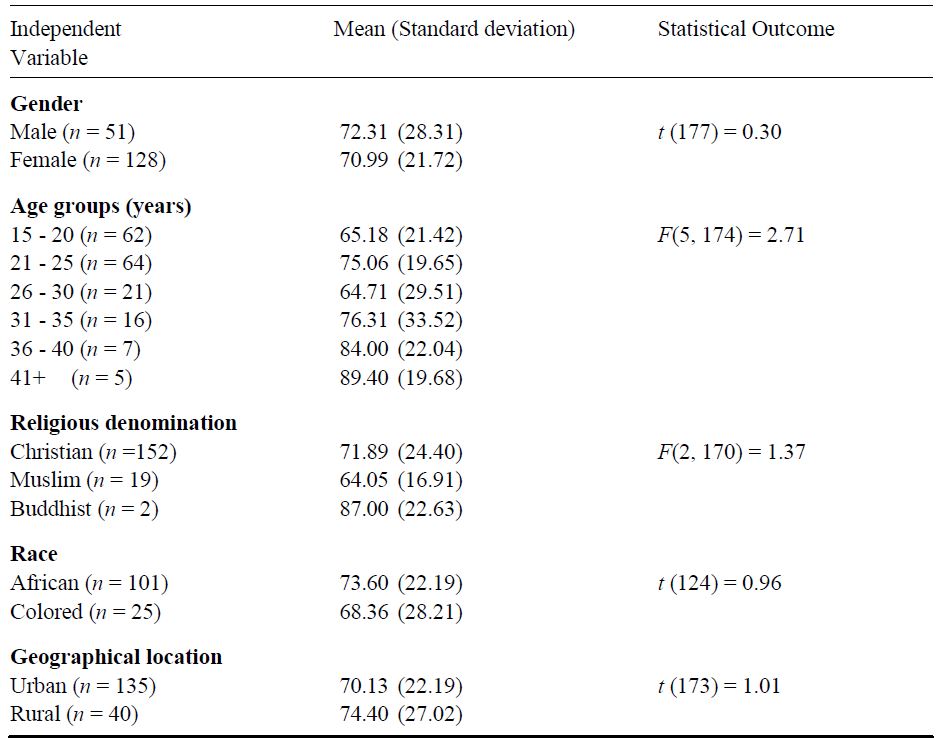
Notes: 1 These mean LATDS scores, standard deviations, and results of statistical tests for significance of the difference between, or among groups, were obtained from participants (N = 179) according to various demographic variables used as independent variables in the study.
2 A number of participants did not report their religious denomination (n = 6), race (n = 53), and geographical location of their home (n = 4) (see Reference Note 2).
Discussion
Two main findings emerged from the present study. First, the participants held positive attitudes towards, and beliefs about, death and dying. Second, age, gender, race, home background, and religion were found not to influence these attitudes and beliefs. Therefore, these findings failed to support the two hypotheses advanced for the present study.
The first finding contradicted previous findings (see e.g., Gesser et al., 1987; Kubler-Ross, 1986a, 1986b; Stevens & Hassan, 1994). This suggests that death and dying are not as feared among the Black South African university students studied as is the case in the West. It is possible that this is because of strong cultural influences that still control the lives of these students despite the competing cultural pressures they encounter due to the hegemony and pervasiveness of the Western culture throughout the world today.
The second finding also disagreed with previous findings from the West that suggest that attitudes towards, and beliefs about, death and dying depended on gender (see e.g., Neusadt, 1982 in Lonetto & Templer, 1986), age (see e.g., Templer et al, 1971 in Lonetto & Templer, 1986), as well as culture and religion (see e.g., Howarth & Jupp, 1996; Kalish & Reynolds, 1981). This probably suggests that once these attitudes and beliefs are formed during childhood they are durable and extremely resistant to change (see Petty & Krosnick, 1994). Although Africans and Colored students are culturally distinct, it appears that, just as they largely share the same Christian background, so too, they generally share the same death and dying beliefs.
The generalizability of the present findings to all Black university students at the university where it was conducted and also at other universities throughout South Africa is limited due to the nonrepresentative nature of the sample used. Future researchers should employ a larger and more representative sample of all South African university students that includes all cultural groups (i.e., Africans, Whites, Coloreds, and Indians). This is essential if the impact of culture is to be better understood. This could also be further accomplished by employing qualitative research methodology such as focus groups, in-depth interviews and an open-ended questionnaire in order to obtain a more in-depth understanding of attitudes about death and dying than was possible in the present study. Thus, the present study should serve as a springboard for future research.
These findings have implications for death and dying as well as for bereavement counseling. Since the Black students hold positive attitudes about death and dying, some of the steps in such counseling are perhaps trivial as these students do not fear death per se. Furthermore, these findings might also help to explain negative attitudes towards the death penalty as well as positive attitudes towards abortion and euthanasia underlying some recent legislation or initiatives in South Africa.
Reference Notes
1) Africans (Blacks) and Coloreds (i.e., includes people of mixed race and also some aboriginal people) constitute 77% and 6% respectively of the South African population. Therefore, there were no Whites or Indian students in the sample – both racial minorities constituting 12% and 2% of the population – because the university was historically meant for Coloreds only although it also accepted increasing numbers of Africans during the dying years of the apartheid era. Although racial discrimination has been outlawed since the early 1990s, the classification system used under apartheid persists in use because of the inequalities that still exist. The majority of Africans, Coloreds, and Indians are still disadvantaged compared to the majority of their White compatriots, and thus there is still need for redress.
2) Racial classification is a very contentious issue, especially among some Coloreds, due to its misuse during the apartheid era. Consequently, many Coloreds refuse to divulge their racial identity on these grounds. Others identify themselves simply as Black although they differ culturally from the majority Africans.
Boston, S., & Trezise, R. (1987). Merely mortal: Coping with dying, death and bereavement. London: Methuen.
Burnell, A. L., & Burnell, G. M. (1989). Clinical management of bereavement: A hand book for healthcare professionals. New York: Human Science Press.
Craig, G. J. (1989). Human development (5th ed.). London: Prentice-Hall.
Gesser, G., Wong, P. T. P., & Reker, G. T. (1987). Death attitudes across the life-span: The development and evaluation of the death attitude profile. Omega Journal of Death and Dying, 18, 113-128.
Gordon, R. (1978). Death and creating: A research for meaning. London: Butler & Tanner Ltd.
Howarth, G., & Jupp, P. C. (1996). Contemporary issues in the sociology of death, dying and disposal. London: Macmillan.
Kalish, R. A., & Reynolds, D. K. (1981). Death and ethnicity: A psychological study. New York: Baywood.
Kubler-Ross, E. (1986). On death and dying. London: Lavistock.
Kubler-Ross, E. (1986). On children and death. London: Lavistock.
Lester, D. (1991). The Lester Attitude Toward Death Scale. Omega Journal of Death and Dying, 23, 67-75.
Lonneto, R., & Templer D. I. (1986). Death anxiety: The series in health psychology and behavioral medicine. Washington, DC: Hemisphere.
McGuigan, F. J. (1997). Experimental psychology: Methods of research (7th ed.). Upper Saddle River, NJ: Prentice-Hall.
Petty, R. E., & Krosnick, J. (1994). Attitude strength: An overview. Hillsdale, NJ: Erlbaum.
Stevens, C. A., & Hassan, R. (1994). Management of death, dying and euthanasia: Attitudes and practices of medical practitioners in South Australia. Journal of Medical Ethics, 20, 41-46.
Wass, H., Berardo, F. M., & Neimeyer, R. B. (1988). Dying: Facing the facts. Washington, DC: Hemisphere.
Table 1. Mean LATDS Scores and Standard Deviations and Results of Statistical Tests for Significance of the Difference Between or Among Groups
Notes: 1 These mean LATDS scores, standard deviations, and results of statistical tests for significance of the difference between, or among groups, were obtained from participants (N = 179) according to various demographic variables used as independent variables in the study.
2 A number of participants did not report their religious denomination (n = 6), race (n = 53), and geographical location of their home (n = 4) (see Reference Note 2).
This article is based on a mini-thesis submitted by the first author in partial fulfillment of the requirements for the degree of Master of Arts Research Psychology under the supervision of the second author.
Appreciation is due to reviewers including
Kristen Coppola
6 Pinehurst Drive
Manalapan
NJ 07726
USA
Kelvin Mwaba
Psychology Department
University of the Western Cape
Private Bag X17
Bellville 7535
Cape Town
South Africa
Leickness C. Simbayi, Human Sciences Research Council, P. Bag X9182, Cape Town 8000, South Africa. Email: [email protected]