Relationship between empathy and the Big Five personality traits in a sample of Spanish adolescents
Main Article Content
Empathy can be understood as the vicarious affective responses with an emphasis on the congruent response to others’ emotional state (del Barrio, 2002; Eisenberg, 2000). Empathy is considered an effective control of aggression in childhood and adolescence (Bandura, 1999; Tremblay, Pihl, Vitaro, & Dobkin, 1994), as well as an important predictor of prosocial behavior, and the development of moral reasoning during childhood (Eisenberg, Miller, Shell, McNalley, & Shea, 1991). This positive role of empathy in interpersonal relationships has been shown in American (Bryant, 1985), Colombian (Rey, 2001), and Spanish (Mestre, Semper, & Frías, 2002) samples.
Nowadays, the Five Factor model is considered as the dominant paradigm in personality research (Matthews & Deary, 1998). Following this model, Neuroticism, Extraversion, Openness to Experience, Agreeableness, and Conscientiousness are the basic traits of personality. Empathy is expected to correlate with various traits of the Five Factor model. In detail, empathy should correlate mainly with Agreeableness. This trait is primarily a dimension of interpersonal behavior, and represents the quality of interaction from compassion to antagonism (Costa, McCrae, & Dye, 1991). Agreeableness is also strongly implicated in the prediction of prosocial and aggressive behaviors (Graziano & Eisenberg, 1997). On the other hand, there are two reasons for expecting a positive correlation between empathy and Conscientiousness. High scores on this trait inhibit aggressive behaviors in adolescent populations (John, Caspi, Robins, Moffitt, & Stouthamer-Loeber, 1994), and Conscientiousness correlates negatively with Eysenck’s dimension of Psychoticism (Aluja, García, & García, 2002), defined by a lack of empathy.
The relationship between empathy and Neuroticism appears less clear. Whereas prosocial behaviors and concern for others have been related to low scores on negative emotionality or Neuroticism (e.g. Shiner & Caspi, 2003), Eysenck defended a positive relationship between empathy and Neuroticism (Eysenck & Eysenck, 1991).
As far as we know, no study has related the Five Factor model with an index of empathy in the adolescent population. Thus, the purpose of this study was to explore the convergent and discriminant validity of empathy in regard to the Big- Five personality traits.
Method
Subjects
Eight hundred and thirty-two children between 12 and 17 years (Mean age: 14.39; SD: 0.92) participated in the study. The sample was composed of 408 boys (Mean age: 14.39; SD: 0.96), and 424 girls (Mean age: 14.38; SD: 0.88). Questionnaires were administered in the classroom in the presence of a trained psychologist.
Measures
IECA. The Spanish version of Bryant’s Empathy Index for Children and Adolescents (Bryant, 1982; del Barrio, Aluja, & García, in press) is a 22-item questionnaire, with a +2 to -2 response format. Response choices were visually aided by two circles of increasing size on either the yes, like me or the no, not like me sides of the paper. All children understood the procedure, as indicated by their responses to trial items such as “I like ice cream” and “I don’t like soap in my eyes”. The alpha coefficient in the sample was 0.73.
The Spanish version of the Big Five Questionnaire (BFQ). (Caprara, Barbaranelli, Borgogni, & Perugini, 1993) is a 132-item questionnaire measuring five domains (Energy, Friendliness, Conscientiousness, Emotional Stability, and Openness). Note that those terms will be employed hereafter to name the “Big Five”. The respondent has a 5-choice answer format that ranges from complete disagreement (1 = very false for me) to complete agreement (5 = very true for me). Alpha reliability indices in the present sample were 0.65, 0.65, 0.71, 0.73, and 0.65 for Energy, Friendliness, Conscientiousness, Emotional Stability and Openness, respectively.
Results
Table 1 shows the statistical descriptives and correlations among empathy and the Big-Five, separately by sex. Differences between sexes replicate previous findings regarding empathy (Eisenberg & Lennon, 1983), and the Big-Five (Costa, Terracciano, & McCrae, 2001). Girls score higher on Empathy, Friendliness, Conscientiousness, and Openness, whereas boys show a larger mean on Emotional Stability. No sex differences were found for Energy.
Table 1. Statistical Descriptives (Mean and Standard Deviation), Correlations Between Empathy and the Big Five, and Standardized Regression Coefficients
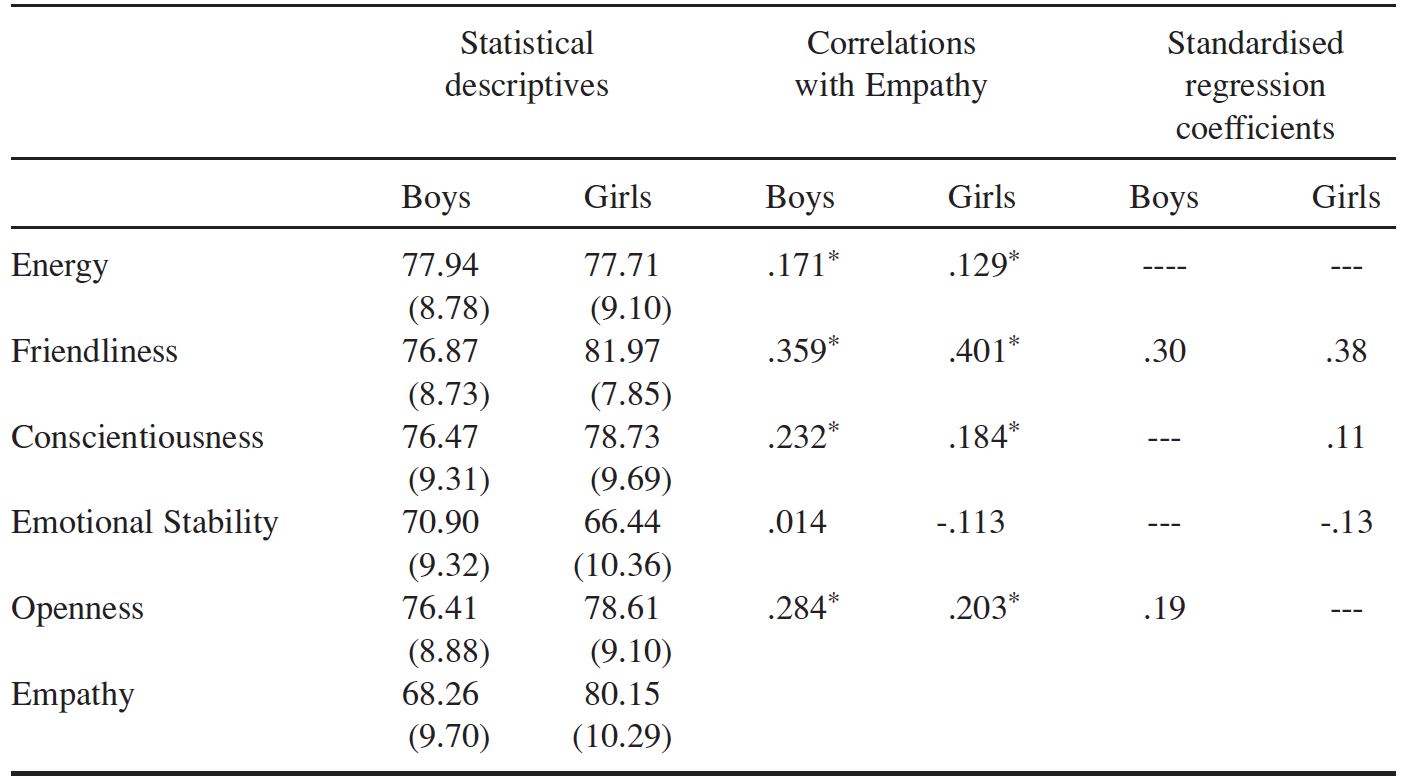
As expected, the largest correlations were with Friendliness. In order to correct for the lack of reliability of the scales, a correction for attenuation was computed for the correlations between Empathy and Friendliness. The corrected coefficients were 0.53 and 0.58 for boys and girls, respectively. On the other hand, correlations with Energy, Conscientiousness and Openness were significant for both sexes, although much lower than those for Friendliness. Unexpectedly, Emotional Stability was not related with Empathy. It should be highlighted that the same pattern arises for both boys and girls. Moreover, Table 1 shows also the standardized regression coefficients of the personality traits included in the final regression model (stepwise method) taking Empathy as the dependent variable. The adjusted R2 were 0.15, and 0.18 for boys and girls, respectively. The adjusted R2 was also obtained with a linear regression using the enter method. Values were 0.16 and 0.18 for boys and girls, respectively.
Discussion
Empathy is strongly linked to Friendliness for boys and girls. So an important component of the individual differences in the quality of interpersonal behavior during adolescence is the ability to respond appropriately to others’ emotions. But also, Empathy could play a minor role in the need for social encounters, the control of one’s own impulses, and intellectual curiosity. Our study supports no relevant relationship (either positive or negative) between Empathy and Neuroticism. This fact does not confirm Eysenck’s view that feeling anxiety or fear oneself would engender the ability of feeling another’s emotional state (Eysenck & Eysenck, 1985). However, caution should be exercised in relying on this fact since other authors remark that very young adolescents could have limitations in their ability to recognize their own emotional states through self-report measures (Eisenberg & Strayer, 1987). In general, these results reflect the importance of the empathy construct in explaining the self-reported differences in the Friendliness trait during adolescence.
Aluja, A., García, O., & García, L. F. (2002). A comparative study of Zuckerman’s three structural models for personality through the NEO-PI-R, ZKPQ-III-R, EPQ-RS and Goldberg’s 50-bipolar adjectives. Personality and Individual Differences, 33, 713-725.
Bandura, A. (1999). Moral disengagement in perpetration of inhumanities. Personality and Social Psychology Review, 3, 193-209.
Bryant, B. K. (1982). An index of empathy for children and adolescents. Child Development, 53, 413- 425.
Bryant, B. K. (1985). The neighborhood walk: Sources of support in middle childhood. Monographs of the Society for Research in Child Development, 50 (3, Serial No. 210).
Caprara, G. V., Barbaranelli, C., Borgogni, L., & Perugini, M. (1993). The “Big Five Questionnaire”: A new questionnaire to assess the Five Factor Model. Personality and Individual Differences, 15, 281-288.
Costa, P. T., Terracciano, A., & McCrae, R. R. (2001). Gender differences in personality traits across cultures: Robust and surprising findings. Journal of Personality and Social Psychology, 81, 322-331.
Costa, P. T., McCrae, R. R., & Dye, D. A. (1991). Facet scales for agreeableness and conscientiousness: A revision of the Neo Personality Inventory. Personality and Individual Differences, 12, 887-898.
del Barrio, V. (2002). Emociones Infantiles. [Childhood Emotions] Madrid: Pirámide.
del Barrio, V., Aluja, A., & García, L.F. (in press). Bryant’s Empathy Index for Children and Adolescents: Psychometric properties in the Spanish language. Psychological Reports.
Eisenberg, N. (2000). Emotion regulation and moral development. Annual Review of Psychology, 51, 665-697.
Eisenberg, N., & Lennon, R. (1983). Sex differences in empathy and related capacities. Psychological Bulletin, 94, 100-131.
Eisenberg, N., Miller, P. A., Shell, R., McNalley, S., & Shea, C. (1991). Prosocial development in adolescence: A longitudinal study. Developmental Psychology, 27, 849-857
Eisenberg, N., & Strayer, J. (1987). Empathy and its development. Cambridge: University Press.
Eysenck, H. J., & Eysenck, M. W. (1985). Personality and individual differences: A natural science approach. New York: Plenum.
Eysenck, H. J., & Eysenck, S. B. G. (1991). Eysenck Personality Scales (EPS Adult). London: Hodder & Stoughton.
Graziano, W. G., & Eisenberg, N. (1997). Agreeableness: A dimension of personality. In R. Hogan, J. A. Johnson, & S. R. Briggs (Eds), Handbook of personality psychology. San Diego: Academic Press. Pp 795-824.
John, O. P., Caspi, A., Robins, R. W., Moffitt, T. E., & Stouthamer-Loeber, M. (1994). The “Little Five”: Exploring the nomological network of the Five-Factor Model of personality in adolescent boys. Child Development, 65, 160-178.
Matthews, G., & Deary, I. J. (1998). Personality traits. Cambridge, UK: Cambridge University Press.
Mestre, V., Semper, P., & Frías. D. (2002). Procesos cognitivos y emocionales predictores de la conducta prosocial y agresiva. [Cognitive and emotional process as predictors of prosocial and aggressive behavior]. Psicothema, 14, 227-232.
Rey, C. (2001). Empatía en niños y adolescentes con trastorno disocial, y el grado de rechazo, marginación afectiva y permisividad de que son objeto por parte de sus padres y madres. [Empathy in children and adolescents with Disocial disorder, and the level of rejection, affective alienation, and permissiveness produced by their fathers and mothers]. Avances en Psicología Clínica Latinoamericana, 19, 25-36.
Shiner, R., & Caspi, A. (2003). Personality differences in childhood and adolescence: Measurement, development, and consequences. Journal of Child Psychology and Psychiatry, 44, 2-32.
Tremblay, R., Pihl, R. O., Vitaro, F., & Dobkin, P. L. (1994). Predicting early onset of male antisocial behavior from preschool behavior. Archives of General Psychiatry, 51, 732-739.
Table 1. Statistical Descriptives (Mean and Standard Deviation), Correlations Between Empathy and the Big Five, and Standardized Regression Coefficients
Appreciation is due to reviewers including
Oscar Garcia Lopez
PhD
Universidad Europea de Madrid
c/ Tajo s/n
Villaviosa de Odon
28670 Madrid
Spain
Professor Jerome Rossier
Institute of Psychology
University of Lausanne
BFSH 2 &ndash
Dorigny
CH &ndash
1015 Lausamme
Switzerland
[email protected]" target="_blank">[email protected]