Determinants of players’ stickiness in online sports simulation games: Evidence from China
Main Article Content
Leveraging uses and gratification theory, we explored the key determinants of players’ stickiness in online sports simulation games (OSSG). We collected data in China through an online survey and used structural equation modeling to test the hypotheses. The results revealed that gratification of both enjoyment and achievement needs were key antecedents to players’ stickiness in OSSG, and the role of enjoyment was stronger than that of achievement. Players’ sports knowledge and the fantasy level of OSSG had a significant positive impact on gratification of both needs, whereas players’ fanship and novelty level of OSSG had a significant positive influence on enjoyment need gratification. This study contributes to e-sports research by uncovering the motivations for stickiness in OSSG and by extending uses and gratification theory in e-sports context.
Article Highlights
- Gratification of players’ enjoyment and achievement needs was found to contribute greatly to players’ stickiness in online sports simulation games.
- Players’ perception of the sports knowledge, fanship, fantasy, and novelty of online sports simulation games all positively affected gratification of their need for enjoyment.
- Players’ sports knowledge of and fantasy perception in online sports simulation games positively affected the gratification of their need for achievement.
Driven by the prospective growth of e-sports, many studies have been conducted to explore players’ motivations for playing these games, considering e-sports as a homogeneous category (Pizzo et al., 2018; Qian et al., 2020). However, it has been found that people’s motivations for playing a specific e-sport vary by type. Jang and Byon (2020) found that hedonic motivation, habit, and price value were significant factors driving gameplay intention in the simulation e-sports context, and that hedonic motivation, habit, and effort expectancy were significant motivations for physical enactment e-sports. Similarly, Pizzo et al. (2018) argued that players’ motivation to attend sport simulations were more closely related to physical sports than to other e-sports.
As one of the most popular online sports genres, online sports simulation games (OSSG) comprise sports-themed online games that emulate real-life sports, such as Madden NFL, NBA 2K, and the FIFA series. In these games, players choose in-game avatars that represent real athletes and conform to rules that mimic those associated with the real-life sports (Kim & Ross, 2006). Players can recreate historical races; they can also create their own races using avatars that perform according to the athletes’ actual abilities and the conditions of the racetrack or sports field. Despite the popularity of OSSG in recent years (Jang & Byon, 2020), little is known about players’ motivations for their continued use of these games. To fill this gap we analyzed data collected from recreational players of different OSSG in China to examine the determinants of players’ stickiness, which refers to their willingness to return to and prolong their duration of each stay in the online game (Wu et al., 2010). Our results will deepen understanding of how players form the intention to play and loyalty toward OSSG, and will help game practitioners to develop more successful sports games products and effective strategies for marketing these.
Uses and gratifications theory has been applied extensively to understand media use and how and why people utilize a particular medium (Hamari & Sjöblom, 2017; Qian et al., 2020). According to this theory, people select the medium according to their purpose, and their choice depends on the extent to which each medium fulfills their specific needs (Qian et al., 2020). For more than a decade, uses and gratifications theory has been acknowledged as highly suitable for research on e-sports games (Wu et al., 2010). As OSSG comprise typical sports-themed games in online settings, uses and gratification theory could offer a better understanding of players’ use intentions regarding OSSG. Researchers have identified three main gratifications that drive online game players—enjoyment, achievement, and social interaction (Wu et al., 2010). Weiss and Schiele (2013) posited that social interaction is a consequence of, and not a motivation for, engagement in the virtual world and does not have a significant impact on e-sports gameplay intention. Thus, in this study we did not address this factor. Given that e-sports content attributes and individual characteristics account for e-sports experience and consumption (Martončik, 2015), we further posited two personal characteristics (sports knowledge and fanship) and two game features (fantasy and novelty) as the antecedents of players’ need gratifications, which ultimately affect players’ stickiness to OSSG. Figure 1 shows the research model.
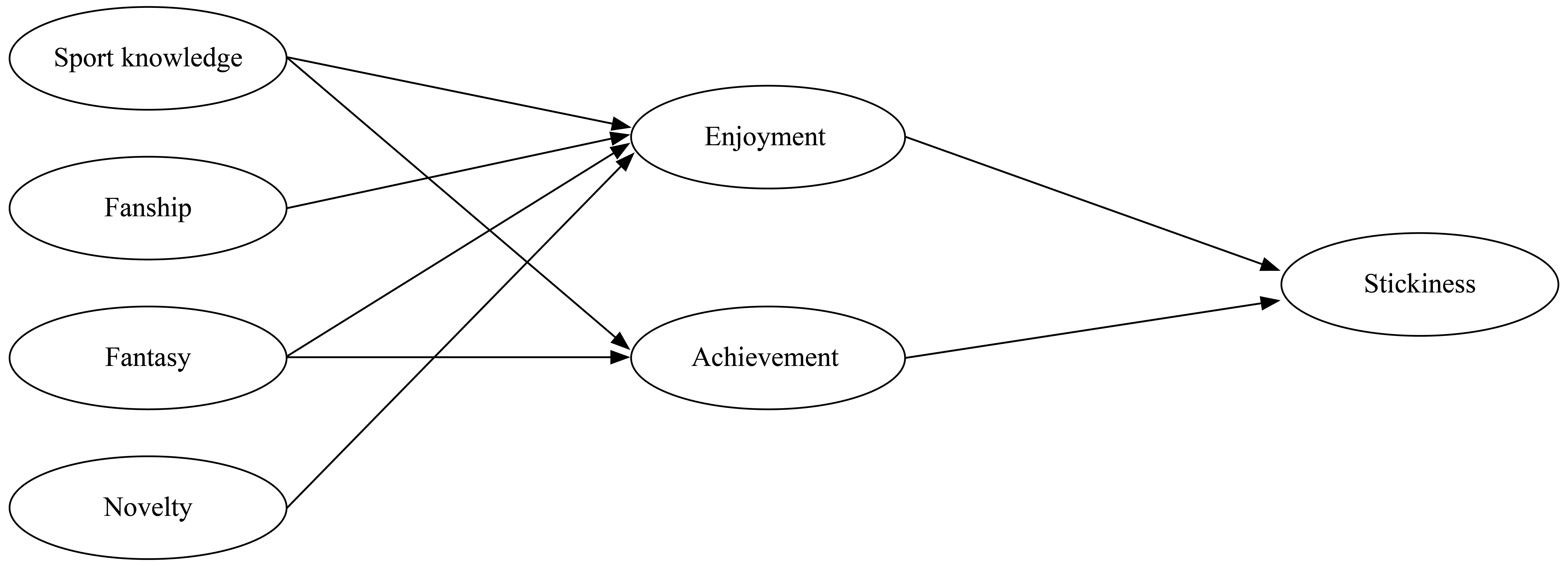
Figure 1. The Proposed Research Model
The Current Study
Method
Participants and Procedure
We conducted a survey on Sojump (http://www.sojump.com), using the paid sample service of this website to recruit survey participants who were Chinese residents ranging between 18 and 65 years of age. Filtering questions were used to identify people who had downloaded and played OSSG in the 6 months prior to the time of the survey. Those who had played only other online games related to sports, such as chess and cards, were excluded from the sample. We recruited 1,330 participants within 10 days. Among the survey forms that were returned, 294 were disqualified, because the respondents had completed the survey in less than the baseline time, missed important items, or used continuous-answer techniques.
Measures
All measures were adopted from existing research and adapted to the OSSG context. A bilingual research assistant translated the measures into Chinese. The measures were then back-translated into English by another bilingual research assistant. Translation discrepancies were resolved through further discussion with these bilingual experts. All items were measured on a 5-point Likert scale, ranging from 1 (strongly disagree) to 5 (strongly agree).
Stickiness
The behavioral construct of stickiness was measured through the frequency of playing and adapted as described above from Chen et al. (2018) and Wu et al. (2010). This scale includes three items, such as “I will continue playing OSSG in the future.” In this study Cronbach’s alpha was .84.
Needs Gratification
Enjoyment was measured using a three-item scale adopted from Billings and Ruihley (2013): “Playing OSSG is fun,” “Playing OSSG is a hobby of mine,” and “Playing OSSG is enjoyable.” Cronbach’s alpha was .82 in this study.
Achievement was measured using a four-item scale adopted from Wu et al. (2010). A sample item is “I have more power than other players in OSSG.” Cronbach’s alpha was .85 in this study.
Player Characteristics
We used a three-item scale adapted from Kim and Ross (2006) to measure players’ sport knowledge application. A sample item is “I simulate my strategies when playing OSSG.” Cronbach’s alpha was .81 in this study.
We used a three-item scale adapted from Billings and Ruihley (2013) to measure players’ fanship. A sample item is “I am a huge fan of OSSG in general.” Cronbach’s alpha was .79 in this study.
Features of Online Sports Simulation Games
We used a three-item scale adapted from Li et al. (2015) to measure the fantasy level of OSSG players: “I pretend I am someone/somewhere else when playing OSSG,” “I play OSSG to experience things I do not experience in daily life,” and “I play OSSG to immerse myself in the lives of the game world.” Cronbach’s alpha was .81 in this study.
We used a four-item scale adapted from Merikivi et al. (2017) to measure the novelty level of OSSG. A sample item is “The game I most often play is imaginative.” Cronbach’s alpha was .80 in this study.
Data Analysis
We used SPSS 21.0 and Amos 27.0 for descriptive statistical analysis and correlation analysis. The data analysis was conducted in two stages. First, we performed a confirmatory factor analysis with maximum likelihood estimation to test for convergent and discriminant validity. We then used structural equation modeling to test the hypothesized relationships.
Results
To examine the measurement model, statistical assumptions of outliers, normality, and linearity were tested. Skewness and kurtosis values (all between −1 and 1) were below than the suggested maximum criteria, indicating there was no normality issue. No outliers were found through calculating z scores and Mahalanobis distance. All correlation values were below .85 and variance inflation factors were below 5.0, which indicated that there was no multicollinearity issue. Reliability and validity results are shown in Table 1.
Table 1. Reliability and Validity Testing
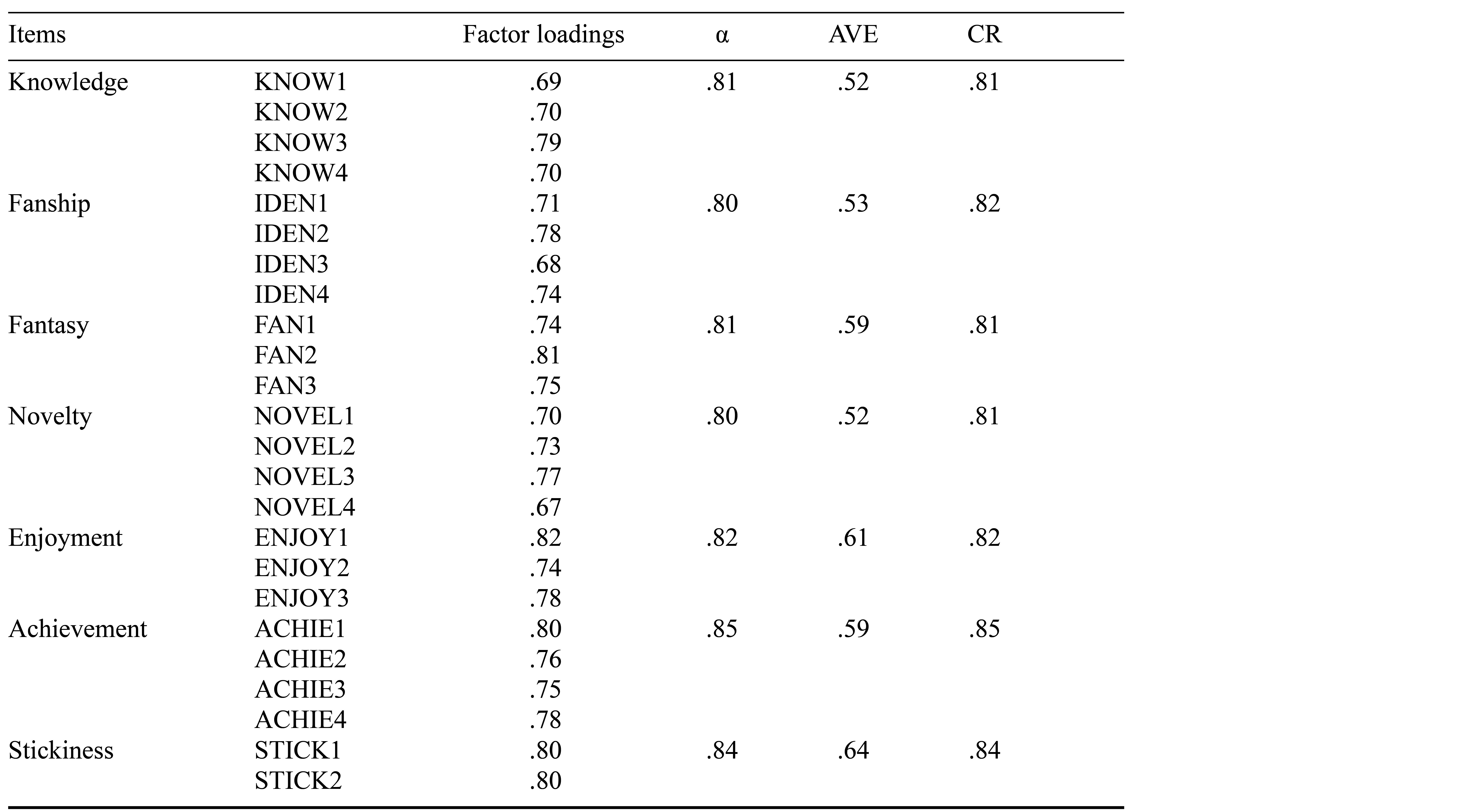
Note. AVE = average variance extracted; CR = composite reliability.
We employed two methods to check for common method bias. First, we used Harman’s single-factor test by conducting a principal component analysis. The results showed that the data contained seven dimensions, and the first factor explained 33.93% of the variance before rotation, which is less than the critical criterion of 50%. Second, the correlation matrix of constructs in Table 2 shows that all correlation coefficients were less than .64. These results indicate the absence of any serious common method bias.
Measurement Model
The results of confirmatory factor analysis showed a good fit to the data, χ2/df = 2.60, p < .001; root-mean-square error of approximation (RMSEA) = .05, comparative fit index (CFI) = .95, normed fit index = .92, goodness-of-fit index = .93. Table 1 shows the seven factors that were extracted had Cronbach’s alpha levels greater than .80; further, the composite reliability for all constructs varied between .81 and .85, and average variance extracted values ranged between .52 to .64, indicating good convergent validity. Table 2 shows all correlation coefficients between each construct and the other constructs were smaller than the square roots of average variance extracted, indicating good discriminant validity.
Table 2. Descriptive Statistics and Correlations of Study Constructs

Structural Model
The goodness-of-fit indices suggested that the model fit the data reasonably well, χ2 (253) = 681.90, p < .001, χ2/df = 2.70, RMSEA = .05, CFI = .95, nonnormed fit index = .92, incremental fit index = .95. As predicted, both enjoyment and achievement were significantly and positively associated with players’ stickiness, thereby supporting Hypotheses 1 and 2. Moreover, enjoyment had greater predictive power than achievement did for stickiness (see Table 3).
Table 3. Hypothesis Testing Results
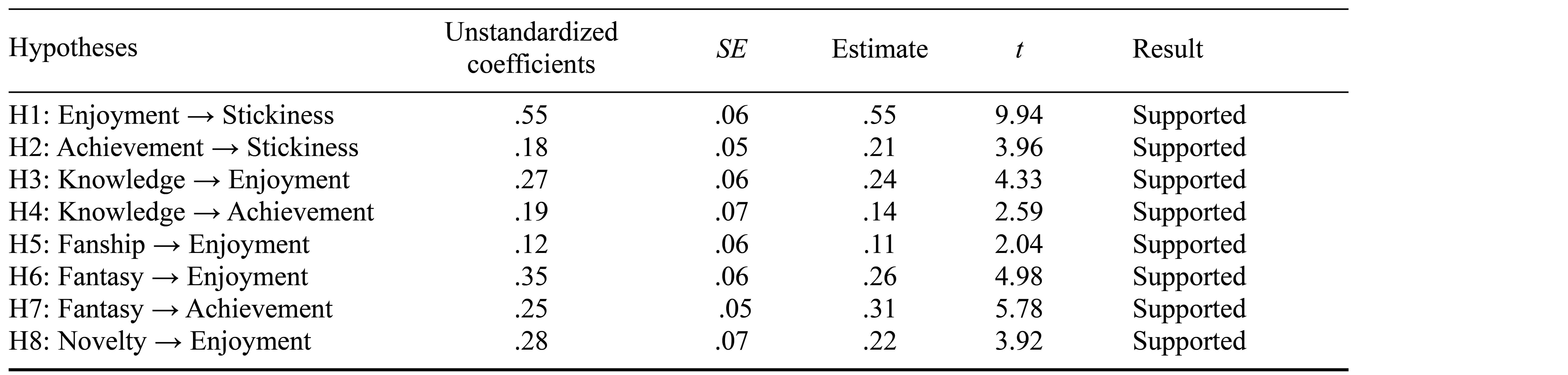
As shown in Table 3, sports knowledge, fanship, fantasy, and novelty each had a significant effect on enjoyment. Thus, Hypotheses 3, 5, 6, and 8 were supported. As for the antecedents of achievement, the impacts of sports knowledge and fantasy were confirmed, thereby supporting Hypotheses 4 and 7.
Discussion
We used the framework of uses and gratification theory to develop a hypothesized model to examine the effects of players’ characteristics (i.e., sports knowledge, fanship) and game features (i.e., fantasy, novelty) on players’ enjoyment and achievement, and, in turn, how these influenced stickiness in OSSG. We found that both enjoyment and achievement significantly and positively affected users’ stickiness. This finding provides support for Weiss and Schiele’s (2013) notion that gratification of both competitive and hedonic needs drives players’ motivation to continue e-sports use. Moreover, the results in our study validated the impact of the player characteristics of sports knowledge and fanship on enjoyment. These results are consistent with those of previous studies, in which it was found that simulation e-sports games’ fans are likely to be real-sport fans (Kim & Ross, 2006), and that if players master adequate sports knowledge and are fully invested in the target sport, they are likely to have more fun playing OSSG (Jang & Byon, 2020). We also found that sports knowledge increased players’ achievement. This result is especially interesting and logical, as it implies that successful players of OSSG are quite different from those of other generic e-sports games, for which only a few skills are required, such as fast reaction time and vigilant monitoring (Jang & Byon, 2020). The effect of fantasy on enjoyment and achievement was also confirmed in our study. This result may be explained by the nature of the OSSG genre: emulating real-life sports offers dual pleasure originating from both playing online games and engaging in a real sport, and players perceive OSSG as a viable alternative to real-life sports to realize their competence and power.
This study contributes to existing academic research in several ways. First, contrary to the extant research in which all e-sports had been considered to be homogeneous, in this study we focused on one specific game genre: OSSG. Our findings contribute to a better understanding of the recreational online sports games market. Second, in this study we extended the uses and gratification model by incorporating both players’ characteristics and game features as antecedents, to identify the game features that positively predict players’ perception of the gratification of their needs for achievement and enjoyment, which, in turn, results in a firmer intention to continue using OSSG. Last, although some researchers had proposed a possible relationship of personal traits with game features and e-sports games consumer behavior (e.g. Martončik, 2015), limited empirical studies have been conducted to test the role of specific dimensions on continued use of e-sports (Baek & Touati, 2017). By revealing the relationships among these variables, the findings in our study enrich existing knowledge of how to increase OSSG players’ loyalty based on players’ characteristics and game design.
Our study findings highlight the key attributes of OSSG consumers: a group of experienced sport fans who are attracted by fantasy and novelty, and who seek to fulfill their achievement and enjoyment needs in the online sports game context. These findings can help practitioners better identify and target segment markets. For instance, a simple preliminary test of sports knowledge can be conducted to screen unmatched customers before their formal participation. As knowledge contributes to both enjoyment and achievement, related sports knowledge and tips can also be offered during each playing interval in the initial stages. The predominant impact of fantasy on the need for gratification of both achievement and enjoyment indicates that corporations who produce OSSG should highlight the games’ fantasy features when developing and promoting products. Details representing their verisimilitude in the context of real-life sports should be emphasized. For instance, iconic moves of sports stars—such as Harden’s step-back shot or Iverson’s crossover—should be emulated as authentically as possible to increase the fantasy quotient of games.
This study has some limitations that provide useful directions for future research. First, a cross-sectional design may not adequately capture the dynamics of consumers’ intentions. Longitudinal studies are recommended to effectively address issues such as common method bias and causality inference. Second, future researchers could include more variables, such as demographic parameters (e.g., culture, gender), players’ experience, and game design aesthetics. Additionally, in this study we investigated only how to increase players’ stickiness in OSSG. Other noteworthy game-consumption behaviors, such as streaming-game spectating, new-player recruitment, and in-game purchases, could also be investigated.
Figure 1. The Proposed Research Model
Table 1. Reliability and Validity Testing
Note. AVE = average variance extracted; CR = composite reliability.
Table 2. Descriptive Statistics and Correlations of Study Constructs
Table 3. Hypothesis Testing Results
This work was supported by a grant from the National Natural Science Foundation of China (71772064).
Yan Yang, School of Sports Science and Engineering, East China University of Science and Technology, 130 Meilong Road, Xuhui District, Shanghai, 200237, People’s Republic of China. Email: [email protected]