The Big Five and sexual attitudes in Spanish students
Main Article Content
The aim of this study was to check the relationship existing between the Big Five, together with attitudes towards sexuality, in a sample of 255 Spanish university students (196 female, 59 male). A shortened Spanish interpretation of the Big Five (Benet-Martinez & John, 1998) was used as the basis for measuring personality traits, and a shortened version of the Sexual Opinion Survey (SOS) by Fisher, Byrne, White & Kelley (1998) was used to measure attitudes to Sexuality. The results obtained give limited support to previous investigations in which the relationship between the personality trait Neuroticism (N) and attitudes to sexuality is marked. Further, traits such as Openness and Conscientiousness were demonstrated to have significant links with attitudes to sexuality.
According to Petty, Wegener and Fabrigar (1997) personality traits and attitudes are the crucial variables in predicting human behavior in general and sexual behavior in particular: personality traits are a general predisposition towards conduct as opposed to attitudes - specific predispositions - for which a value dimension is the most distinguishing mark. Surprisingly, few reports have focused on analysis of the relationship between personality traits and attitudes to sexuality, in spite of the importance of sexuality to a person's well-being (Money, 1991; Tiefer, 1995). The sociologist Eysenck, in studies undertaken in 1972 and 1976, links attitudes to sexuality to a three-factor personality model (extraversion, neuroticism and psychotism). His results show how attitudes, measured by a 96-item questionnaire which he devised, are linked to some personality patterns, regardless of a person's sex. He defines Extraversion, which refers to degrees of sociability, impulsiveness and humor. The extrovert looks for greater stimulation encountering sexual stimuli more eagerly, whereas the introvert being more socially conditioned, tends to demonstrate more socialized and adjusted social behavior. On Neuroticism, Eysenck's second factor (1976), individuals displaying this would find great difficulty in a sexual relationship, being rather more prone to conflict attraction-avoidance. Finally, Psychotism can be defined as the degree of insensitivity towards people relationships: individuals showing a tendency towards loneliness, lack of affection, a proneness to violence and impersonal relationships. Eysenck´s work strongly endorses the relationship between personality traits and attitudes towards sexuality, a relationship which, up until this time had largely been ignored. Twenty years later, Heaven, Fitzpatrick, Craig, Kelly and Sebar`s work (2000) set out to investigate if Eysenck`s associations were to remain unchallenged for longer than two decades. In measuring modern attitudes to sexuality, the Sexual Opinion Survey (SOS) of Fisher, Byrne, White and Kelley (1988), is made up of 21 items whereby individuals are categorized through a bipolar dimension of Erotophobia-Erotophilia, consisting of "the acquired disposition through the particular exposure to restrictions and punishments related to sexuality during the process of socialization." (Fisher et al. p.123).
The aim of this study was to identify the relationship between personality traits and attitudes, suggested by Eysenck (1976) and corroborated by Heaven et al. (2000), and to extend the analysis to the investigation of the relationship between personality traits and specific attitudes towards sexuality.
Method
The sample was 255 students from the University of Vigo (Spain) (76.9% female, 23.1% male), with an average age of 21.43 (SD = 3.91). All subjects were volunteers.
Instruments
A) The Big Five by Costa and McCrae (1992), the short version of the scale in Spanish by Benet-Martinez and John (1998). Cronbach's Alpha was 0.80 in Extraversion, 0.81 in Conscientiousness, 0.79 in Neuroticism, 0.72 in Openness and 0.68 in Agreeableness.
B) Attitudes to sexuality were measured using the short version of the SOS scale by Fisher et al. (1988) comprising 5 items (see Table 1), using the Spanish version by Carpintero and Fuertes (1994). Higher values imply positive attitudes to sexuality. The Cronbach's Alpha was .57.
C) Finally, measuring attitudes to homosexuality, we turned to two items (H1, H2, see Table 1) in the SOS scale (Fisher et al. 1988). Higher values show more positive attitudes to homosexuality and lower values demonstrate a negative attitude. The Cronbach's Alpha was .67.
Results
Table 1 shows the mean differences between the sexes using an unpaired t-test in the variables of sexual attitudes and of five personality traits. There are significant differences for all items of general sexuality and homosexuality: males, generally more than females, (sexual attitude item 1) agree with the idea, that it is not unpleasant (and that masturbation is an exciting experience (sexual attitude item 3) and would consider having a lasting relationship with more than one person (sexual attitude item 5). Both males and females would consider engaging in unusual sexual practices, (sexual attitude item 4). In contrast, there are significant differences in items related to homophobia-homophilia: here females demonstrate a more positive attitude towards homosexuality. With regard to the five items of personality, there are significant differences in traits of Conscientiousness, in Neuroticism and in Extraversion.
In the correlation between attitudes towards sexuality and homosexuality with the five items of personality for both male (r = .51; p < .01) and female (r = .48; p < .01) strong associations emerged between items measuring homophobia-homophilia, when identifying relationships concerning sexual attitudes with the five items of personality, confirming for females, that Openness is expressed by a more positive view of erotic material (r = .16; p < .05). Neuroticism is significantly related to an evaluation of erotic material - the less neurotic the viewpoint, the more positive the viewpoint on erotic material (r = -.16; p < .05). Furthermore, in females there is a positive relationship between the factor of Openness and same-sex physical attraction (r = .21; p < .05). For male and female there is a positive relationship between Openness and a positive view of erotic material (r = .29; p < .05). Table 2 shows the results of multiple regression analysis. For the total group, sex and Openness appear to be predictors of item 1 (almost all pornographic material is nauseating) and item 2 (masturbation can be an exciting experience). Openness, Conscientiousness and Neuroticism appear to be predictors of the item on homosexuality (The idea of my being physically attracted to members of the same sex is not depressing). There are also some noteworthy sex differences (see Table 2).
Table 1. Mean Scores and Standard Deviations for Men and Women on Personality and Sexual Attitude
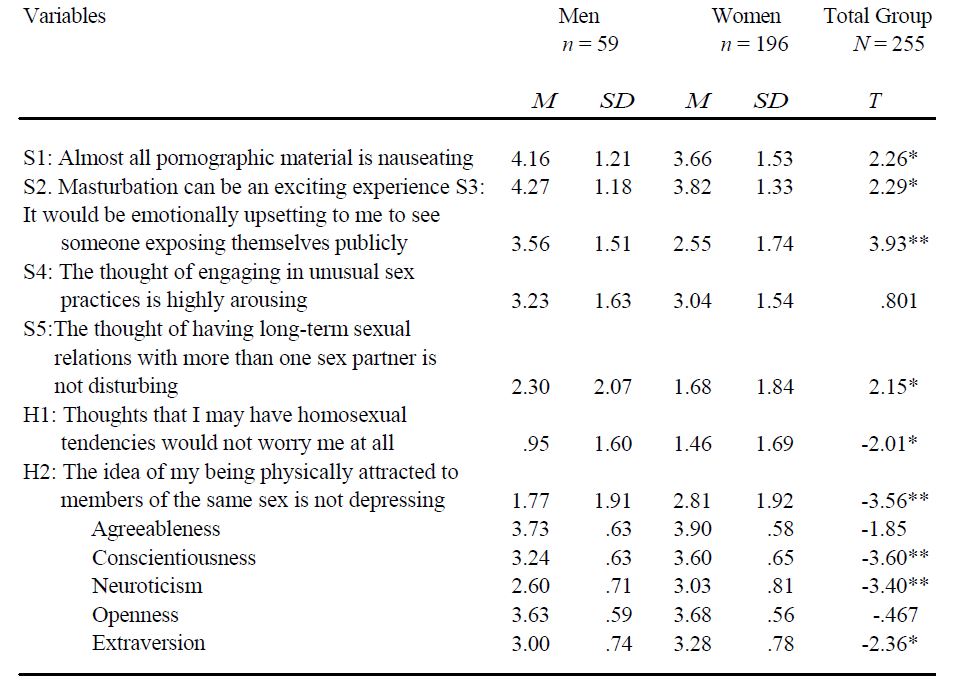
Note: *p < .05, **p < .01
Table 2. Results of Multiple Regression Analyses

Note: * p < .05, ** p < .01
Discussion
The relationship between Neuroticism and sexual attitudes, which Eysenck defends, has been identified only with openness towards erotic material: fewer neurotic females are more positive in feelings towards same-sex attraction. However, in our study there is no clear relationship between Extraversion and attitudes to sexuality, although as demonstrated in the factors of Neuroticism and Extraversion, notable differences occur between sexes: females tend towards being more extrovert and more neurotic, as observed in a recent study (Budaev, 1999). A probable explanation is that connotations of the Openness factor are, today, those that better explain attitudes towards sexuality, more than the extraversion factor. The aim of this study has been to outline the fact that relationships between personality traits and sexual attitudes may not be as strong as once thought, since such diverse personality traits may not be appropriate predictors of predispositions towards specific sexual attitudes, which might be conditioned not only by personality traits but also by elements such as experience and sex education.
Benet-Martínez, V., & John, O. P. (1998). Los cinco grandes across cultures and ethnic groups: Multitrait multimethod analyses of the Big Five in Spanish and English. Journal of Personality and Social Psychology, 75(3), 729-750.
Budaev, S. V. (1999). Sex differences in the Big Five personality factors: Testing an evolutionary hypothesis. Personality and Individual Differences, 26(5), 801-813.
Carpintero, E., & Fuertes, A. (1994). Validación de la versión castellana del Sexual Opinion Survey (SOS). Cuadernos de Medicina Psicosomática y Psiquiatría de Enlace, 31, 52-61.
Costa, P. T., & McCrae, R. R. (1992). Revised NEO Personality Inventory (NEO-PI-R) and NEO five- factor inventory (NEO-FFI) professional manual. Odessa, FL: Psychological Assessment Resources.
Eysenck, H. J. (1972). Psychology is about people. Harmondsworth: Penguin.
Eysenck, H. J. (1976). Sex and personality. London: Open Books Publishing Ltd.
Fisher, W. A., Byrne, D., White, L. A., & Kelley, K. (1998). Erotophobia-Erotophilia as a dimension of personality. The Journal of Sex Research, 25(1), 123-151.
Heaven, P. C., Fitzpatrick, J., Craig, F. L., Kelly, P., & Sebar, G. (2000). Five personality factors and sex: Preliminary findings. Personality and Individual Differences, 28(6), 1133-1141.
Money, J. (1991). Epidemic antisexualis: From Onanism to Satanism. 10th. World Congress of Sexology, 18-22, June.
Petty, R. E., Wegener, D. T., & Fabrigar, L. R. (1997). Attitude and attitude change. Annual Review of Psychology, 48, 609-647.
Tiefer, L. (1995). El sexo no es un acto natural y otros ensayos. Madrid: Talasa.
Table 1. Mean Scores and Standard Deviations for Men and Women on Personality and Sexual Attitude
Note: *p < .05, **p < .01
Table 2. Results of Multiple Regression Analyses
Note: * p < .05, ** p < .01
Appreciation is due to reviewers including Dr. Frank J. Prerost
Professor
College of Health Sciences
Midwestern University
555 31st Street
Downers Grove
IL 60515
USA.
Maria Lameiras Fernández, Department of Psychosociopedagogical Analysis and Intervention, University of Vigo, C/- Las lagunas sn, 32004, Ourense, Spain. Phone: 34-988-387121; Fax: 34-988-387159; Email: [email protected]