Disruptive behaviors in online games: Effects of moral positioning, competitive motivation, and aggression in "League of Legends"
Main Article Content
Disruptive behaviors, such as intentional violations and verbal attacks, frequently happen in multiplayer online games. However, few studies have been conducted to empirically explore the antecedents to such disruptive behaviors or the role of moral positioning in relation to such behaviors. With 343 players of the game League of Legends, we tested an integrated path model of the relationships among moral positioning (i.e., preference for evil roles or characters in the game), aggression, competitive motivation, and disruptive behaviors. The results showed that moral positioning was affected by both aggression and competitive motivation. The increase of moral positioning, in turn, enhanced the degree of disruptive behavior. The theoretical and practical implications of the study results are discussed.
In online gaming, disruptive behaviors is a broad term that refers to antisocial behaviors such as malicious cooperative denials, intentional violations, and verbal attacks, including insults hurled at other game participants (Johansson, Verhagen, & Kou, 2015; Kou, Gui, Zhang, & Nardi, 2017). These behaviors undermine voluntary cooperation and fair competition among the players and, thus, have been pointed out as a major cause of discomfort to them, ruining their fun and immersion in the game, thereby seriously hurting the game environment (Fragoso, 2015; Ladanyi & Doyle-Portillo, 2017).
As online games that require cooperation with one’s teammates and competition with one’s opponents have become popular of late, concerns about disruptive behaviors have emerged as an issue on an industrial scale. Particularly in the game called League of Legends, disruptive behaviors are perceived as a serious threat to having a positive game experience (Griffiths, 2014; Seo & Kim, 2015). As such, the game managers are currently strengthening the game's profanity detection algorithm, managing and punishing disruptive behaviors through a tribunal system, and further operating an honor system in which players are encouraged to exercise good manners and to follow the game’s rules (Kou & Nardi, 2013; Kwak, Blackburn, & Han, 2015; League of Legends, 2016).
Disruptive behaviors encompass both flaming and trolling. Flaming is defined as a malicious accusation and a verbal attack on one’s opponents (Hwang, Lee, Kim, Zo, & Ciganek, 2016; Moor, Heuvelman, & Verleur, 2010). Flaming is reported to be caused by the motivation to exercise dominance over others or to pursue success in the competition (Alonzo & Aiken, 2004), and by the propensity to commit verbal violence (Chu, Choi, & Lee, 2013). Trolling, on the other hand, refers to a behavior that draws negative reactions from other persons and compromises cooperation by repeating toxic behaviors that cause exhaustive controversies or disruptions (Griffiths, 2014). Trolling is often done for the purpose of annoying and hurting other people (Binns, 2012; Coles & West, 2016), and is affected by a dominant competitive motivation (Thacker & Griffiths, 2012). These behaviors exacerbate the negative social perception of game use through the collapse of the gamers’ community; they damage the trust and unity between users and break the social expectation that gaming is a form of social entertainment (Fragoso, 2015; Ladanyi & Doyle-Portillo, 2017). In addition, such behaviors are likely to lead to social problems because their prevention can be difficult, as they can occur more frequently and impulsively in games compared to criminal behaviors like score manipulation, abuse of illegal programs, or hacking.
There are two major factors that influence disruptive behaviors: (a) aggression as an intrinsic propensity and (b) competitive motivation as an extrinsic motivational factor. Aggression is an important predictor of antisocial behavior (Jung, 2011; Olweus, 1979). It is a concept that includes all physical and psychological attempts to harm others (Larson, 1992). A high level of aggression is associated with a preference for violent games (Jeong, Biocca, & Bohil, 2012; Przybylski, Ryan, & Rigby, 2009) and can have antisocial consequences (Eastin, 2007; J. M. Lee, Na, & Doh, 2016).
Competitive motivation is also a major factor affecting antisocial behavior in gaming. According to the uses and gratifications theory (Blumler & Katz, 1974), users actively utilize media based on their expectations. The detailed motivation affects the users’ media use and behavior patterns (Yee, 2006; Zhang, Tang, & Leung, 2011). Billieux et al. (2013) reported that a player with a competitive motivation is highly concerned with killing another player. Likewise, a player who seeks a competitive victory may become more discontented and frustrated with the other players who are not skilled at team play than do those with other types of motivation, and may thus exhibit antisocial behaviors (Eastin, 2007; Seo & Kim, 2015).
In most of the previous relevant studies, researchers have analyzed the effects of the aforementioned factors on either flaming or trolling. These antisocial behaviors are associated with the player’s aggression as a sadistic propensity (Buckels, Trapnell, & Paulhus, 2014; J. M. Lee et al., 2016), and are impulsively driven by the psychological pressure to win the competition (Kou & Gui, 2014; Seo & Kim, 2015).
However, a tendency has developed to emphasize the influence of special environments and social contexts in the interactions among game users (Aström, 2006; Sammut & Gaskell, 2010; Triberti, Villani, & Riva, 2015). An individual’s behaviors in regard to morality and disruption can be influenced not only by his or her personal propensities but also by the moral choices that he or she makes in various social contexts. Research that was recently initiated in this regard was on moral positioning (Kvarnlöf, 2018; Murzyn & Valgaeren, 2016; Triberti et al., 2015). Moral positioning is the process whereby, in order to understand the situation, an individual in a social conflict grants a moral identity to a subject based on his or her own moral experience (Aström, 2006; Kvarnlöf, 2018). Individuals place themselves or others in the moral position of being good, evil, or the victim, considering various environmental clues and contexts to coordinate the social conflicts. Through this process, they become aware of their own behavioral objectives and make decisions accordingly (Aström, 2006).
When applied to online gaming, moral positioning can be interpreted as the arbitrary identity or moral/immoral preference taken by the player in the virtual competitive environment. In the context of online games, evil moral positioning refers to an arbitrary moral identity, in which the player prefers an evil narrative and selects an evil role or character, regardless of the player’s dispositional moral identity (Gao, Weng, Zhou, & Yu, 2017). This evil moral positioning can be highly related to aggression and can have a positive impact on disruptive behaviors (Happ, Melzer, & Steffgen, 2013), but its influence on the player’s aggression varies depending on his or her moral propensity and the narrative context (e.g., killing others for immoral reasons) in the selection of game characters (Gao et al., 2017). For instance, players who assume the role of an evil character bully others or show aggressive behaviors, whereas those who assume the role of a good character show sacrificial and devoted behaviors (Mahood & Hanus, 2017).
Game moral positioning can be influenced by competitive motivation. Motivational factors leading to the execution of specific behaviors can serve as important factors in the selection of a moral preference or stance. Aggressive propensities are associated with the selection of evil characters in games (Murzyn & Valgaeren, 2016). According to findings reported in a previous study, players with high levels of empathy exhibit low levels of aggression (Triberti et al., 2015). In addition, players who are not sociable or who have low levels of empathy prefer killer characters (Hodges & Buckley, 2018).
Competitive motivation can also affect the player’s moral positioning in a game. A player with a competitive motivation puts more importance on the character’s function and performance than on the interpersonal aspect when selecting a character (Lo, Lie, & Li, 2016). In particular, the player’s competitive motivation stimulates his or her desire to accomplish the given task, thereby causing that player to prefer a behavior that more directly drives victory, or a more aggressive behavior, and to select an aggressive character (Gitter, Ewell, Guadagno, Stillman, & Baumeister, 2013). In short, players with high levels of aggression or competitive motivation are highly likely to choose evil moral positioning.
There is still insufficient research on the causes of disruptive behaviors in online games. There have also been few studies conducted to examine moral positioning in relation to disruptive behaviors in online games in which both aggression and competitive motivation have been explored. As the damage caused by these disruptive behaviors increases in relation to the online games that have recently been developed, and social concern about this damage also increases, there is a growing need for multidisciplinary research to devise policy measures for the industry to arrest such disruptive behaviors.
In this regard, in our study we explored the factors affecting disruptive behaviors in online games. We examined the effects of aggression and competitive game motivation, and empirically verified the influence of game moral positioning on disruptive behaviors. In particular, we investigated the influence of aggression and competitive motivation on game moral positioning, and analyzed the influence of the three variables of aggression, competitive motivation, and moral positioning on disruptive behaviors through a structural equation model.
We formed the following hypotheses and raised the following research questions:
Hypothesis 1: As a player’s level of aggression increases, his or her disruptive behaviors will also increase.
Hypothesis 2: As a player’s level of competitive motivation increases, his or her disruptive behaviors will also increase.
Research question 1: How does a player’s moral positioning in a game affect his or her disruptive behaviors when aggression and competitive motivation are controlled?
Research question 2: How do a player’s aggression and competitive motivation affect his or her moral positioning in a game?
Method
League of Legends is a computer-based, multiuser online game that has been distributed globally and is a top game in South Korea. A survey was conducted with 401 players recruited from League of Legends Inven (lol.inven.co.kr) and League of Legends Hungryapp (leagueoflegends.hungryapp.co.kr), which are the top two League of Legends communities in South Korea. Participants each received mobile culture vouchers (valued at around US$3) as compensation for taking part in the study. The research procedures and survey were approved by the Institutional Review Board of Konkuk University.
After excluding participants whose survey forms had values missing, we selected the data obtained from 343 study participants for analysis. They included 299 men (87.1%) and 44 women (12.9%), whose average age was around 26 years (SD = 5.32). The average daily gaming time was 1.54 hours (SD = 54 minutes).
Based on previous studies (C. S. Lee, 2003), we adopted six questions to assess disruptive behaviors (α = .901). The items included the behaviors of curses and mockery (e.g., “I curse when I don’t like the playing style of the other game users”) as well as intentional negligence and behavior that intentionally puts one’s ally in danger (e.g., “I do not participate in the game or let my competitor kill my character to make the other game users feel bad”).
In terms of competitive motivation, we used three items on advancement of competitive game skills (e.g., “I play games to check my game skills and show off to others,” α = .887; Park & Song, 2010). To measure aggression, we used the Short-Form Buss-Perry Aggression Questionnaire (Diamond, Wang, & Buffington-Vollum, 2005). The scale has eight items designed to assess hostility, anger, and verbal and physical aggression (e.g., “If somebody hits me, I hit back,” α = .913).
Finally, in terms of game moral positioning, we modified the scale used by Triberti et al. (2015). The five items to indicate the degree of evil moral positioning included preference for evil roles and characters (e.g., “I tend to choose evil game roles” and “I prefer to make evil choices,” α = .908).
Results
Reliability and validity tests were performed for the multi-item measures. The reliability test results, including Cronbach’s alpha, composite reliability (CR), and average variance extracted (AVE), are summarized with the mean and standard deviation values in Table 1. Likewise, the correlation and discriminant validity results for the constructs are shown in Table 2. All the scores were shown to be valid for the model test (0.8 for CR and 0.5 for AVE; Chin, 1998).
To test the hypotheses and answer the research questions, we performed structural equation analysis, using Amos 22.0. The model (see Figure 1) yielded valid indices for normed fit (NFI), comparative fit (CFI), Tucker–Lewis index (TLI), and root mean square error of approximation (RMSEA) as follows: NFI = .937, CFI = .964, TLI = .956, and RMSEA = .059. The results show that both aggression and competitive motivation significantly increased the degree of disruptive behavior (β = .490 and .174, respectively), supporting Hypotheses 1 and 2. Moral positioning increased the players’ disruptive behaviors (β = .225, p < .001). Both aggression (β = .310, p < .001) and competitive motivation (β = .150, p < .01) substantively influenced moral positioning of players.
Table 1. Reliability and Discriminant Validity of Constructs

Note. CR = composite reliability, AVE = average variance extracted.
Table 2. Correlations and Discriminant Validity Analysis

Note. The square root of average variance extracted is presented in bold in the diagonal cells for the corresponding construct. ** p < .001.
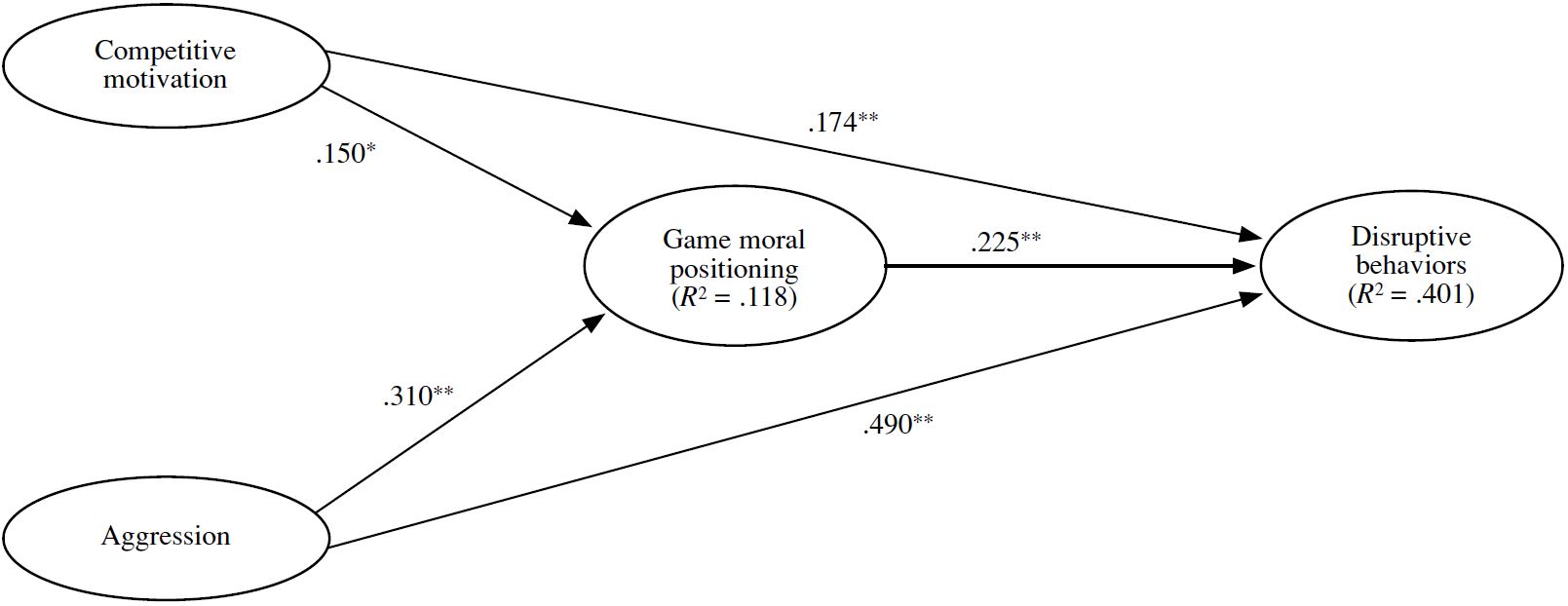
Figure 1. Structural equation model. The coefficients are standardized. p < .01, ** p < .001.
Discussion
The results show that moral positioning had a positive effect on players’ disruptive behavior. This implies that the propensity to select a character designed to kill or harass others can stimulate antisocial behaviors against the other game participants. This result is an empirical clue that the player’s moral position in the specific circumstances of a virtual gaming world can affect his or her behavior.
Our results also demonstrate that players’ moral positioning was positively affected by aggression and competitive motivation. This shows that the personal moral choices made in the specific context of a virtual gaming world are closely related to the factors of the individual player’s temperament or media use motivations. In competitive online games, in order to win the competition players are forced to engage actively in the acquisition of kill scores or in the destruction of a base. In this process, aggressive reactions to the other players are inevitable, and the players who are highly aggressive, and who devote themselves to winning the competition, show a strong tendency to select an aggressive character who can contribute more directly than other characters can to achieving a victory.
These study results provide important clues in predicting the relationship between players’ moral positioning and disruptive behaviors in games. The evil moral positioning that occurs in a virtual environment can sometimes be tolerated because of the play rules or gaming types. However, high levels of aggression and excessive obsession with victory in competition can instigate disruptive behaviors against the other game participants as the player becomes immersed in the evil identity of the characters in the game.
Our results show that aggression had a positive effect on disruptive behaviors. This is consistent with the results of previous research, which showed that user aggression may affect antisocial behaviors like trolling or flaming (Eastin, 2007; J. M. Lee et al., 2016). Our result in the current study supports the fact that the factors of a player’s temperament in the real world can influence greatly his or her actions in the online environment and, especially, that the player’s disruptive behaviors increase as the level of aggression toward others becomes higher.
We also found that the players’ competitive motivation had a positive effect on disruptive behaviors. This result is in line with those of previous studies, in which it has been reported that the motivation of pursuing success in a competition may induce verbal attacks (Chu et al., 2013), and that the excessive pursuit of success in a competition can lead to aggressive behaviors (Seo & Kim, 2015). These results suggest that the propensity to be excessively immersed in winning a competition can lead directly to the player hurling accusations at the other players. Likewise, a player obsessed with victory can react more aggressively than other players would to those on his or her own team who are adversely affecting the competition, such as a fellow player who is poor at team play.
This study has some research implications. First, our findings confirm the influence of moral positioning on disruptive behaviors in a game, which had not been examined much in the previous studies on online games. The proposition that moral positioning in a game is affected by both aggression and competitive motivation was also empirically tested in our study. Our results imply that studies in greater depth are needed on the effects of players’ moral choices in the gaming context. Likewise, in the current study we employed an integrated approach to an examination of in-game antisocial behaviors by using the concept of disruptive behaviors. In most of the previous gaming studies the focus was on either flaming or trolling, but these two behaviors go together frequently and are difficult to separate (Suh, 2012; Griffiths, 2014).
In addition, our results can provide game designers with practical ideas on how to prevent disruptive behaviors. When designing malicious characters, for instance, game designers can devise various options to prevent overreliance on evil roles. Specifically, they can try diverse mechanisms for issuing requests to players to cooperate with friendly forces or respond to other objects. In the same vein, to meet players' desire for victory in a competition, designers may consider providing a variety of modes to offer pleasure, or they could design customized games with increased options and could mitigate the penalty for defeat in the competition. These strategies may relieve the players of the psychological burden to defeat their enemies for the victory of a single game, thereby helping reduce disruptive behaviors by calming the players’ frustration and anxiety during the competition process.
This study has some limitations. First, we could not examine the causal relationship among the variables in a cross-sectional study. In addition, more diverse variables could have been included. For example, when a game is fun and interesting, this can reduce the burden of competition and, thus, there could have been different effects of player aggression on disruptive behaviors. Likewise, moral disengagement could moderate the effects of player motivations on disruptive behaviors. In future studies researchers may consider these factors in a longitudinal setting to establish causality.
Alonzo, M., & Aiken, M. (2004). Flaming in electronic communication. Decision Support Systems, 36, 205–213. https://doi.org/dvsbjb
Aström, T. (2006). Moral positioning: A formal theory. The Grounded Theory Review: An international journal, 6, 29–60. Retrieved from https://bit.ly/2O5cmrM
Billieux, J., Van Der Linden, M., Achab, S., Khazaal, Y., Paraskevopoulos, L., Zullino, D., & Thorens, G. (2013). Why do you play World of Warcraft? An in-depth exploration of self-reported motivations to play online and in-game behaviours in the virtual world of Azeroth. Computers in Human Behavior, 29, 103–109. https://doi.org/f4jvmx
Binns, A. (2012). Don’t feed the trolls! Managing troublemakers in magazines’ online communities. Journalism Practice, 6, 547–562. https://doi.org/fzpt6c
Blumler, J., & Katz, E. (1974). The uses of mass communications: Current perspectives on gratifications research. Beverly Hills, CA: Sage.
Buckels, E. E., Trapnell, P. D., & Paulhus, D. L. (2014). Trolls just want to have fun. Personality and Individual Differences, 67, 97–102. https://doi.org/f58bzw
Chin, W. W. (1998). The partial least squares approach to structural equation modeling. In G. A. Marcoulides (Ed.), Modern methods for business research (pp. 295–336). Mahwah, NJ: Erlbaum.
Chu, K., Choi, J., & Lee, S. (2013). A study on factors influencing flaming behavior in cyberspace [In Korean]. Journal of Cultural Industry Studies, 13, 47–57. Retrieved from https://bit.ly/2xULocY
Coles, B. A., & West, M. (2016). Trolling the trolls: Online forum users’ constructions of the nature and properties of trolling. Computers in Human Behavior, 60, 233–244. https://doi.org/ct67
Diamond, P. M., Wang, E. W., & Buffington-Vollum, J. (2005). Factor structure of the Buss-Perry Aggression Questionnaire (BPAQ) with mentally ill male prisoners. Criminal Justice and Behavior, 32, 546–564. https://doi.org/fjrrwq
Eastin, M. S. (2007). The influence of competitive and cooperative group game play on state hostility. Human Communication Research, 33, 450–466. https://doi.org/dw53vh
Fragoso, S. (2015). “HUEHUEHUE I’m BR”: Spam, trolling and griefing in online games. Revista FAMECOS: Mídia, Cultura e Tecnologia, 22, 37–53. Retrieved from https://bit.ly/2pxrLmP
Gao, X., Weng, L., Zhou, Y., & Yu, H. (2017). The influence of empathy and morality of violent video game characters on gamers’ aggression. Frontiers in Psychology, 8, 1–7. https://doi.org/gckwdr
Gitter, S. A., Ewell, P. J., Guadagno, R. E., Stillman, T. F., & Baumeister, R. F. (2013). Virtually justifiable homicide: The effects of prosocial contexts on the link between violent video games, aggression, and prosocial and hostile cognition. Aggressive Behavior, 39, 346–354. https://doi.org/ct68
Griffiths, M. D. (2014). Adolescent trolling in online environments: A brief overview. Education and Health, 32, 85–87. Retrieved from https://bit.ly/2NyIUuO
Happ, C., Melzer, A., & Steffgen, G. (2013). Superman vs. BAD man? The effects of empathy and game character in violent video games. Cyberpsychology, Behavior and Social Networking, 16, 774–778. Retrieved from https://bit.ly/1nz5cVg
Hodges, D., & Buckley, O. (2018). Deconstructing who you play: Character choice in online gaming. Entertainment Computing, 27, 170–178. https://doi.org/ct69
Hwang, J., Lee, H., Kim, K., Zo, H., & Ciganek, A. P. (2016). Cyber neutralisation and flaming. Behaviour & Information Technology, 35, 210–224. https://doi.org/ct7b
Jeong, E. J., Biocca, F., & Bohil, C. (2012). Sensory realism and mediated aggression in video games. Computers in Human Behavior, 28, 1840–1848. https://doi.org/cvfk
Johansson, M., Verhagen, H., & Kou, Y. (2015, January). I am being watched by the tribunal-trust and control in multiplayer online battle arena games. Proceedings of the 10th International Conference on the Foundations of Digital Games, Pacific Grove, CA, USA. Retrieved from https://bit.ly/2NzsBha
Jung, Y. H. (2011). Early adolescents’ changes in aggression and delinquency according to using computer games: Latent growth curve modeling. Journal of Cybercommunication Academic Society, 28, 89–125. Retrieved from https://bit.ly/2Q0MlXW
Kou, Y., & Gui, X. (2014). Playing with strangers: Understanding temporary teams in League of Legends. CHI PLAY ’14: Proceedings of the First ACM SIGCHI Annual Symposium on Computer-Human Interaction in Play, 161–169. https://doi.org/ct7c
Kou, Y., Gui, X., Zhang, S., & Nardi, B. (2017). Managing disruptive behavior through non-hierarchical governance: Crowdsourcing in League of Legends and Weibo. Proceedings of the ACM on Human-Computer Interaction, 1, 62. https://doi.org/ct7d
Kou, Y., & Nardi, B. (2013). Regulating anti-social behavior on the Internet: The example of League of Legends. iConference 2013 Proceedings, 616–622. Retrieved from http://hdl.handle.net/2142/39981
Kvarnlöf, L. (2018). A need to help: Stories of emergent behaviour from the scene of accident. International Journal of Emergency Services. Advance online publication https://doi.org/gc8xt6
Kwak, H., Blackburn, J., & Han, S. (2015). Exploring cyberbullying and other toxic behavior in team competition online games. CHI ’15 Proceedings of the 33rd Annual ACM Conference on Human Factors in Computing Systems, 3739–3748. https://doi.org/ct7g
Ladanyi, J., & Doyle-Portillo, S. (2017). The development and validation of the Grief Play Scale (GPS) in MMORPGs. Personality and Individual Differences, 114, 125–133. https://doi.org/gdxvzc
Larson, J. D. (1992). Anger and aggression management techniques through the think first curriculum. Journal of Offender Rehabilitation, 18, 101–118. https://doi.org/b3zvff
League of Legends. (2016). Korean slang sanctions system. [In Korean] League of Legends News. Retrieved from https://bit.ly/2OcD5T8
Lee, C. S. (2003). A study of flaming in the virtual community [In Korean]. Journal of the Korean Marketing Association, 18, 3–30.
Lee, J. M., Na, J. H., & Doh, Y. Y. (2016). The relationship between players’ characteristics and trolling behavior: Focused on League of Legends [In Korean]. Journal of Korea Game Society, 16, 63–72. https://doi.org/ct7j
Lo, S.-K., Lie, T., & Li, C.-L. (2016). The relationship between online game playing motivation and selection of online game characters—The case of Taiwan. Behaviour & Information Technology, 35, 57–67. https://doi.org/ct7k
Mahood, C., & Hanus, M. (2017). Role-playing video games and emotion: How transportation into the narrative mediates the relationship between immoral actions and feelings of guilt. Psychology of Popular Media Culture, 6, 61–73. https://doi.org/ct7m
Moor, P. J., Heuvelman, A., & Verleur, R. (2010). Flaming on YouTube. Computers in Human Behavior, 26, 1536–1546. https://doi.org/c65fhc
Murzyn, E., & Valgaeren, E. (2016). Our virtual selves, our virtual morals: Mass effect players’ personality and in-game choices. Proceedings of the 2016 International Conference on Interactive Technologies and Games, 82–86. https://doi.org/ct7s
Olweus, D. (1979). Stability of aggressive reaction patterns in males: A review. Psychological Bulletin, 86, 852–875. https://doi.org/bbnvtf
Park, J. W., & Song, Y. S., (2010). College students’ motivations for playing online games and experiential satisfaction [In Korean]. Korean Journal of Journalism & Communication Studies, 54, 131–154. Retrieved from https://bit.ly/2N1xjz6
Przybylski, A. K., Ryan, R. M., & Rigby, C. S. (2009). The motivating role of violence in video games. Personality and Social Psychology Bulletin, 35, 243–259. https://doi.org/fwjpg3
Sammut, G., & Gaskell, G. (2010). Points of view, social positioning and intercultural relations. Journal for the Theory of Social Behaviour, 40, 47–64. https://doi.org/fb28zg
Seo, S.-E., & Kim, C.-Y. (2015). Recognition of the type and cause of League of Legends trolling [In Korean]. Journal of Korea Game Society, 15, 93–110. https://doi.org/ct7n
Suh, A. (2012). The factors affecting individuals’ flaming behavior in virtual communities—Theoretical exploration and empirical analysis [In Korean]. The E-Business Studies, 13, 89–114. https://doi.org/ct7p
Thacker, S., & Griffiths, M. D. (2012). An exploratory study of trolling in online video gaming. International Journal of Cyber Behavior, Psychology and Learning, 2, 17–33. https://doi.org/ct7q
Triberti, S., Villani, D., & Riva, G. (2015). Moral positioning in video games and its relation with dispositional traits: The emergence of a social dimension. Computers in Human Behavior, 50, 1–8. https://doi.org/ct7r
Yee, N. (2006). Motivations for play in online games. CyberPsychology & Behavior, 9, 772–775. https://doi.org/cm9hfc
Zhang, Y., Tang, L. S.-T., & Leung, L. (2011). Gratifications, collective self-esteem, online emotional openness, and traitlike communication apprehension as predictors of Facebook uses. Cyberpsychology, Behavior, and Social Networking, 14, 733–739. https://doi.org/czznc2
Table 1. Reliability and Discriminant Validity of Constructs
Note. CR = composite reliability, AVE = average variance extracted.
Table 2. Correlations and Discriminant Validity Analysis
Note. The square root of average variance extracted is presented in bold in the diagonal cells for the corresponding construct. ** p < .001.
Figure 1. Structural equation model. The coefficients are standardized. p < .01, ** p < .001.
This paper was supported by Konkuk University in 2016.
Eui Jun Jeong, Media Interface and Network Design Laboratory, Department of Digital Culture and Contents, 412 College of Liberal Arts, Konkuk University, 120 Neungdong-ro, Gwangjin-gu, Seoul, 05029, Republic of Korea. Email: [email protected]