Sociocultural education and empathy in early childhood: Analyzing the battle of Gallipoli
Main Article Content
We aimed to set a precedent for the sociocultural education of preschool children by qualitatively analyzing the Battle of Gallipoli, which has an important place in Turkish history. An interpretative phenomenological analysis was carried out in 2 stages with groups of 6-year-old children: a pilot study (n = 11) and the main application (n = 13). In the main application, participants completed a series of activities, comprising listening to songs, participating in drama skits, drawing pictures, and writing letters. The main aim of these activities was to determine participants’ level of empathic thinking skills. Our findings showed that, within the context of sociocultural education, 6-year-old children can empathize and use dynamic and static imagination types, and that they have a sense of history and understand the concept of time. Thus, we recommend that sociocultural education topics be included in the current preschool curriculum in Turkey.
Literature Review
Sociocultural Education
Sociocultural issues have historical and cultural characteristics (Hudson, 2003) and have long been taught to primary and secondary students in the context of social studies lessons (Michaelis, 1985; Passe & Patterson, 2013) in many countries, including Turkey (Öztürk & Deveci, 2016). Encountering sociocultural subjects at an early age, such as during the preschool years, has a positive influence on children’s future educational lives (A. B. Smith, 1996). Social sciences are included in the preschool curriculum in many countries, including North America, where the social studies programs are divided into history, geography, economics, sociology, and anthropology categories (Passe & Patterson, 2013), and the United Kingdom, where preschool education programs include applications that develop children’s historical thinking skills (North Carolina Department of Public Instruction, 2002; Passe & Patterson, 2013). Within this education program framework, children examine the lives of people from the past. Although Turkey currently lacks a preschool curriculum that includes historical and cultural issues, researchers in Turkey (Aktın, 2014; Aktın & Dilek, 2014; Coşkun Keskin & Daysal Ersoy, 2012; Çulha-Özbaş & Doğan, 2012; Daysal Ersoy, 2011) have been investigating the importance of this field.
Empathy
Empathy, which is defined as an individual’s attempt to understand another individual’s emotions and feelings (M. H. Davis, 1983; Dökmen, 2002; Gehlbach, 2004; Hoffman, 2001), enables individuals to gain knowledge of others through imagination, imitation, observation, use of language, perspective taking, and sharing feelings (Lieber, 1995). Since the 1980s, empathy has been conceptualized as comprising emotional and cognitive components (McDonald & Messinger, 2012). Cognitive empathy is the process by which an individual tries to understand the thoughts, intentions, needs, and emotions of another individual, whereas emotional empathy can be described as an individual’s sensitivity to, and sharing of, the feelings of another individual (McDonald & Messinger, 2012). In contrast, M. H. Davis (1983) considered that empathy has four dimensions: perspective taking, empathic concern, fantasy, and personal stress. Hoffman’s (1987) support for a multidimensional approach stated that empathy comprises global and egocentric empathy, empathy for another’s feelings, and empathy for another’s life condition. Similarly, Damon (1988) stated that the development of empathy is composed of four stages: early infancy, 1 to 2 years of age, early childhood, and 10 to 12 years of age.
Preschool-age children who examine past events should be able to empathize with the perspective of the individuals who experienced the events. This is called historical empathy (O. L. Davis, Yeager & Foster, 2001; Ellenwood, 2017). According to the classical cognitive development approach, preschool children have not yet developed empathy skills (Freud, 1958; Piaget, 1932/1965); however, subsequent researchers have shown that this is a misconception and that empathy development begins in the preschool years (Damon, 1988; M. H. Davis, 1983; Eisenberg-Berg & Lennon, 1980; Hoffman, 1987, 2001; McDonald & Messinger, 2012). The many definitions of historical empathy share a common theme of emphasizing students’ ability to understand historical events through empathy and to use historical thinking skills (Brooks, 2008; Endacott & Brooks, 2013; Foster, 1999; Foster & Yeager, 1998; Lee & Ashby, 2001; Stern, 1998).
Classifications of empathy. The first study that we identified in which the stages of historical empathy were examined was conducted by Shemilt (1984), who proposed a four-stage classification system to enable teachers to determine students’ historical empathy levels. The system comprises patronizing, stereotyping, need for reconstruction, and revisiting and researching alternative source materials. Ashby and Lee (1987) then created a five-level classification based on Shemilt’s empathic stages: the “divi” past, generalized stereotypes, everyday empathy, restricted historical empathy, and contextual historical empathy.
The classification of historical empathy most frequently used now was proposed by Barton and Levstik (2004), who regarded historical empathy as a set of cognitive competences, rather than hierarchical levels, that teachers must recognize and develop. The cognitive competences comprise five elements: sense of otherness, shared normalcy, historical contextualization, recognition of multiple perspectives, and contextualization to the present.
Coşkun Keskin’s (2007, 2014) classification of historical empathy consists of six stages: meaning, acting, imagination, perspective taking, feeling, and understanding. When attempting to understand another individual, an individual assigns a meaning to the other’s experience (meaning) by putting himself or herself in the other’s place (acting), imagining himself or herself as the one experiencing the events (imagination), evaluating the events from the other’s point of view (perspective taking), and feeling what the other feels (feeling). This allows an individual to form an understanding and appreciation of the other’s emotions and feelings (understanding) and to better identify with him or her.
Finally, the most recent classification of the historical empathy process has been made by Endacott (2010), who proposed a four-step framework comprising introduction, investigation, display, and reflection.
Comparison of empathy classifications. A comparison of the classifications for empathy development in children proposed by M. H. Davis (1983), Hoffman (1987), and Damon (1099) shows that each new classification is a revised form of the previous one. Empathy has been considered a two-component structure (cognitive and emotional) in these classifications, which were mainly developed within the academic discipline of psychology.
Further, Ashby and Lee (1987) and Shemilt (1984) discussed empathy as a cognitive process, whereas Barton and Levstik (2004), Coşkun Keskin (2007, 2014), and Endacott (2010) proposed dual-process classifications comprising both emotional and cognitive components. However, Barton and Levstik (2004) and Endacott (2010) placed limited emphasis on the emotional component, and did not explain how cognitive and emotional components interact. In contrast, Coşkun Keskin (2007, 2014) clearly explained the relationship between cognitive and emotional components.
Therefore, in this study we used the six-stage empathic learning process developed by Coşkun Keskin (2007, 2014) to determine the empathic skill levels of preschool students. Although this system is not well known or commonly used, it is based on previously proposed classifications and is very effective, especially in activities based on sociocultural education (Güney & Şeker, 2012). The empathy stages are discussed as a cyclical process in Coşkun Keskin’s model (see Figure 1).

Figure 1. Cyclical scheme showing the empathic learning process. Source: Coşkun Keskin (2014).
According to Coşkun Keskin (2007, 2014) there is no strict hierarchy between the stages in empathic learning. Individuals can begin to empathize with a person or event from any stage until the last one, and can use one or several stages at the same time. The identification, sympathy, and imitation stages are likely to emerge in this process.
An important indicator of children’s historical empathy skills is historical imagination. That historical evidence is often incomplete makes it necessary for individuals to resort to imagination to develop empathy with the past (Dilek, 2009; Dilek & Alabaş, 2010). Historical imagination, the third stage in Coşkun Keskin’s (2007, 2014) classification, involves distinguishing between the past and the present (Brooks, 2008). Fines (2002) divided the imagination processes in historical understanding into static and dynamic phases. In the static imagination stage, students tend to see and describe the past as it is by generating pictures, whereas the dynamic imagination stage involves generating explanations and is characterized by understanding, interpretation, and evaluation. We examined the historical imagination skill, which is directly related to empathy, by analyzing pictures drawn by the students.
The Battle of Gallipoli
The study of historical events in the classroom serves two purposes, namely, to contribute to students’ sociocultural education and to promote their empathy skills. The Battle of Gallipoli is a specific historical event that can be used to achieve both purposes.
The Battle of Gallipoli occurred at a front that was opened when the Ottoman Empire entered World War I. Land and sea battles occurred between November 3, 1914 and January 9, 1916 until the Turks won and the front was closed (Doyle, 2011; Stokesbury & Lowenstein, 1981). An important element in the British Army during World War I was the Australian and New Zealand Army Corps (ANZACs), who arrived on the Gallipoli Peninsula on April 25, 1915 (Avcı, 2015; Sayılır, 2005). Thousands of Australian and New Zealand tourists come to Gallipoli every year to commemorate, in peace and friendship with the Turks, the anniversary of what is now known as ANZAC Day (Hall, Basarin, & Lockstone-Binney, 2010). The ANZACs typically characterize the Turks as heroes and reliable friends when telling their children what they experienced during the Battle of Gallipoli (Ağaoğlu, 2012).
We developed a series of activities related to the Battle of Gallipoli, which is a sociocultural issue, to be applied to preschool students. We aimed to answer the following research questions:
Research Question 1: Which basic skills, such as understanding the concept of time, using correct time expressions, understanding chronology, and establishing a cause-and-effect relationship, shown by children in early childhood are related to sociocultural education?
Research Question 2: How do children in early childhood show historical empathy when engaging with issues related to sociocultural education?
Method
Participants
This study consisted of two stages: a pilot study and the main application. Of 24 six-year-old children whom we recruited via convenience sampling, 11 (n = five girls and six boys) were involved in the pilot study and 13 (n = six girls and seven boys) in the main application. We used interpretative phenomenological analysis (IPA) to process the qualitative data. When this analysis method is used, the number of participants is limited to allow plenty of time to elicit and study each participant’s experiences. Further, homogeneous work groups are often created (Biggerstaff & Thompson, 2008; J. A. Smith, Flowers, & Larkin, 2009). Therefore, every participant in both stages was selected from the same age group (6-year-olds), and the sample size was restricted. The pilot study was carried out to increase the validity of the study and assess the appropriateness of the prepared activities for the students’ level.
First, we interviewed the school administration and teachers and received the necessary official permission. Participants’ parents were also interviewed individually to inform them about the study and the activities to be performed. They were then asked to provide a letter of permission if they were willing to have their child take part in the study, which was conducted in a private kindergarten in the Hendek district of Sakarya Province, Turkey.
Procedure and Data Analysis
The goal of IPA is to indicate what participants’ experiences mean to them (J. A. Smith et al., 2009). Our preschool participants gained new experiences and used their previous experiences to complete the assigned activities. We all prepared and analyzed the activities; however, only one administered the activities in the class.
According to Biggerstaff and Thompson (2008), cultural and social environments have a strong influence on individuals’ experiences. Our participants expressed their inner world experiences and opinions through drawing pictures, writing narratives (i.e., letters), singing songs, acting in drama skits, and playing games (Estes, 2004; Seefeldt, Castle, & Falconer, 2014). This allowed us to elicit and analyze their experiences, opinions, and empathic thinking skills. Given the participants’ age, data were—for the most part—obtained from drawings, interviews, and observations, rather than us asking them to read and write.
The activities relating to the Battle of Gallipoli were prepared and implemented for 1 week (see Appendix A for the activity plan). First, we played a Gallipoli folk song, after which more details about the Battle of Gallipoli were provided and students were encouraged to discuss the events. Their questions and answers provided the data we used to answer the research questions. Students were then given the opportunity to make a creative drama skit about the subject. In the third stage, students drew and then explained their pictures of the Battle of Gallipoli. Finally, students were asked to empathize with the ANZAC soldiers and write letters to their mothers from the soldiers’ perspective. Those who wrote letters as ANZAC soldiers were later asked to write letters as Turkish soldiers. As many children in this age group do not read and write, students were first given time to think about writing empathic letters. Then, students were taken aside on an individual basis to a remote point in the classroom, where they verbally expressed their letters. These discourses were recorded by camera and we transcribed the 4 hours of footage. Then, observation records and all visual and verbal products made by the students during the activities were subjected to IPA.
It was our responsibility to protect the confidentiality of participants’ identity during the personal data collection and publication of results. Thus, participants’ names were coded as M1, M2, and so forth for boys and as F1, F2, and so forth for girls.
Validity and Reliability of the Study
The persuasiveness of a study is important in qualitative research because the truth may vary according to the individuals and their situation (Yıldırım, 2010). To ensure the internal validity of this study we recorded all activities on video and described them in detail by transcribing them as a script. To ensure external validity, we (an historical educator and two preschool specialists) undertook the data transcription. We ensured internal validity by obtaining the opinions of three experts in qualitative research throughout the interpretation process. The formula of Reliability = Consensus/(Consensus + Dissension) × 100 was applied to the document analysis we made with another field researcher (Miles & Huberman, 1994). This rate was calculated at 89% among us, supporting the reliability of the data analysis.
Results
Activity 1a: Gallipoli Folk Song
In the first activity, a Gallipoli folk song (see Appendix B) was played for the class and then introduction speeches were made about the Battle of Gallipoli and the ANZAC soldiers.
Dialogue [Gallipoli folk song is played.]
(1) Teacher: Do you know what this song I played is?
(2) M5: Gallipoli folk song.
(3) F3: Teacher, I know this. I heard it when I went to Gallipoli.
(4) Teacher: Did you go to Gallipoli? Why did you go there?
(5) M5: My parents took me there.
(6) Teacher: Okay, children, have you ever heard about the Battle of Gallipoli?
(7) M5: I may have heard, perhaps I didn’t.
(8) F5: No.
(9) Teacher: Children, almost 100 years ago, there were people who wanted to capture our country. They brought to our country people called the ANZACs, who had left their country to fight against us. They asked the ANZACs to capture our country.
(10) M1: We didn’t do anything to them. Why did they want to capture our country?
(11) Teacher: The ANZAC soldiers had to come to our country to fight when they were asked to do so by ill-intentioned people.
(12) M2: We didn’t attack them. They attacked us.
(13) F2: Once, I heard about this. My mother told me. I have been thinking of them since that day.
This dialogue shows that M5(2) and F3(3) were familiar with the Gallipoli folk song. F5(7) did not know about the Battle of Gallipoli, whereas the lack of a “No” response from the remaining 12 students (92%) implies that they had heard of this battle.
Activity 1b: Discussion of the Events of the Battle of Gallipoli
After a brief description of the Battle of Gallipoli was given, the students were encouraged to discuss the relationship between ANZAC and Turkish soldiers.
Dialogue. (1) Teacher: Children! Our soldiers had no bread and no water when the Battle of Gallipoli took place. However, the ANZAC soldiers had no bread to eat, either. What do you think Turkish soldiers could do?
(2) F1: Turkish soldiers were taking food to ANZAC soldiers.
(3) Teacher: Yes, children! When the fighting was less severe our soldiers shared their meals with ANZAC soldiers who had no food. ANZAC soldiers and nurses helped the wounded Turkish soldiers.
(4) M1: Teacher, our guys are giving bread to ANZAC soldiers who have none by splitting their bread in half.
(5) M2: So, teacher, Turkish soldiers are giving them food, and they are giving food to us, aren’t they?
(6) F2: Teacher, our soldiers are bad [tough], but their hearts are too soft. My grandmother is a very tough woman, but her heart is very soft.
(7) M1: ANZAC soldiers have soft hearts, although their feelings are tough.
(8) M2: Villains wear body armor but our soldiers aren’t. Our soldiers’ hearts are very soft as well.
(9) Teacher: We won the Battle of Gallipoli and didn’t let the ill-intentioned people capture our country.
(10) F1: Teacher, what happened to the ill-intentioned people?
(11) Teacher: They couldn’t capture our country.
(12) M3: This event happened in the past. I was not born yet.
(13) F1: My mother wasn’t, either.
F1(2) was aware that the Turkish soldiers helped the ANZAC soldiers. M2(8) made predictions about the soldiers’ attire. Similarly, F2(6) made inferences by thinking that, although the facial expressions of the soldiers in pictures of the Battle of Gallipoli were tough, their hearts were soft, because they helped the ANZAC soldiers. It is also possible that this student used a visual reading to compare the objects and events around him.
As can be seen from the discourse of F1(10), children eagerly question what they listen to by establishing a cause-and-effect relationship according to the order of events. M3(12) and F1(13) were able to perceive the concept of time and put the events in chronological order.
Activity 2: Drama Skit
Next, nine of the students (approximately 70% of the sample; n = four girls and five boys) created a drama skit on the subject of the Battle of Gallipoli. Students were divided into three groups, one of which portrayed ANZAC soldiers, the second, Turkish soldiers, and the third, ANZAC nurses. The students who played the two groups of soldiers first fought one another and then helped one another at the front. The students who played the nurses helped the Turkish and ANZAC soldiers and treated their wounds.
Using improvisation the students portrayed a Turkish soldier who shared his bread after crawling over to an ANZAC soldier, and an ANZAC nurse who treated the Turkish soldier’s wound. This shows that the children focused most on the cooperation that occurred during the Battle of Gallipoli, a feature for which this war is remembered (Hall et al., 2010).
Activity 3: Drawing Pictures
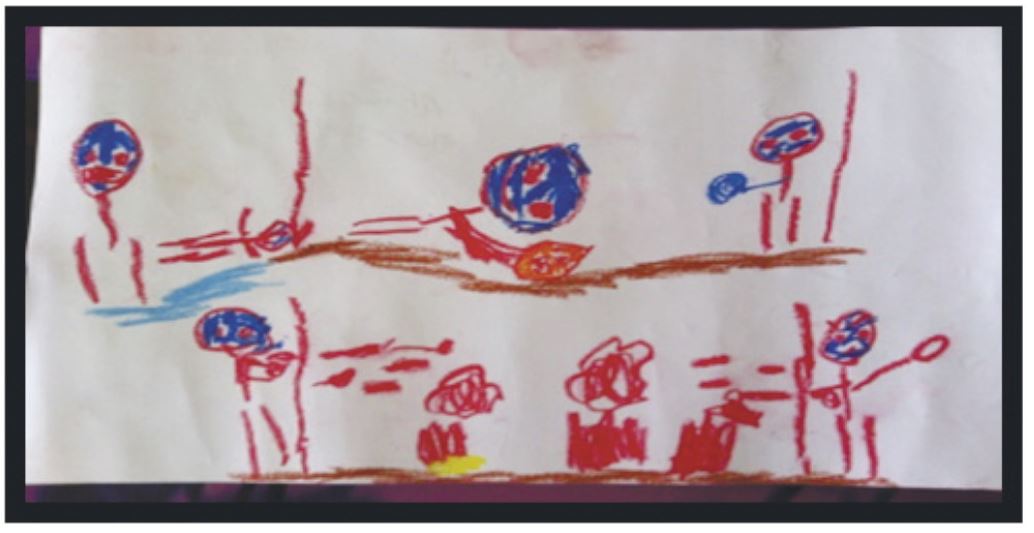
Ten students (77% of the sample; n = five girls and five boys) then drew pictures about the Battle of Gallipoli and explained their pictures to us. Seven of the 10 students (70%) picturized the battle (see Appendix C), two (20%) drew pictures that were not about the Battle of Gallipoli, and one (10%) could not demonstrate empathy skills when drawing the battle’s victory in an epic dimension. The seven students’ descriptions of their Battle of Gallipoli pictures, IPA results for the drawings, and the type of imaginative power (static and dynamic) used are presented in Table 1.
Table 1. Students’ Explanations of Their Drawings and Our Interpretative Analysis

When the pictures in Appendix C are evaluated as a whole, it can be seen that the students understood the historical events explained to them and transferred them into the pictures by imagining the battle. Thus, preschool children can learn about history topics in sociocultural education. In the context of the stages of empathy proposed by Coşkun Keskin (2007), the students’ drawings show that they put themselves in the position of others. In summary, seven of the 10 students who participated in the drawing activity were able to use their empathy skills.
Activity 4: Reading a Short Story
Next, a short story called Ali the Hennaed was read to the students. In Turkish tradition, mothers sending their children to fight paint the children’s hair with henna to show that they sacrifice their children for the motherland. Ali the Hennaed was sent to the Battle of Gallipoli after his mother had painted his hair, and he was martyrized in the battle. A letter from Ali’s mother mentioned in the short story was part of correspondence between her and Ali.
Activity 5: Letter Writing
The final task was a letter writing activity that took place in two stages. Students who wanted to participate were asked to write their mother a letter from the battlefront, putting themselves in the place of, first, an ANZAC soldier or nurse, and then a Turkish soldier. Seven (54%; n = three girls and four boys) of the 13 students volunteered to participate in the first stage of this activity. All these students exhibited empathy skills. Two of the three girls tried to empathize by putting themselves in the place of an ANZAC nurse. This can be interpreted in a cultural sense because in Turkey military service is mainly perceived as a male profession, whereas nursing is perceived as a female profession (Yağan Güder & Güler Yildiz, 2016). Table 2 shows our IPA of the letters written by the students, and the empathic stages they reached.
Table 2. Interpretative Analysis of Letters Written by Students Who Put Themselves in the Place of an ANZAC Soldier or Nurse

Ten of the 13 students (77%; n = six girls and four boys) volunteered to participate in the second stage, and nine (90%) of them exhibited empathy skills. Table 3 shows the results of our IPA of the letters, and the empathic stages they reached. The first letter was written by the student who did not exhibit empathy skills, whereas the other two letters belong to students who did exhibit empathy.
Table 3. Interpretative Analysis of Three Letters Written by Students Who Put Themselves in the Place of a Turkish Soldier

When we evaluated the Battle of Gallipoli activities in the context of sociocultural education and empathy in general, we observed that the students could engage in questioning, establishing cause-and-effect relationships, and deduction. Further, they used both dynamic and static imagination types, showed an understanding of the concept of time, made visual readings, and could empathize.
Discussion
It is important for children in early childhood to recognize their culture and empathize by understanding past cultural events (Ashby & Lee, 1987; Barton & Levstik, 2004; Brooks, 2008; Damon, 1988; Ellenwood, 2017; P. Lee & Ashby, 2001). This can be facilitated by providing sociocultural education and by teaching empathy. Sociocultural education activities should be consistent with the children’s cognitive, psychomotor, social, and emotional development, such as those we used with participants in this study (e.g., participating in active drama, drawing pictures to which they can add elements from their dream world, and writing letters in which they can show their empathy skills).
Indeed, several researchers have emphasized that the use of creative drama activities during early childhood creates a foundation for quality learning (Egan, 2012; Mages, 2008; McGee, 2003; Seefeldt et al., 2014). In this study, participants in the creative drama activity portrayed two groups of soldiers, ANZACs and Turks, who helped one another at the front. This allowed the participants to internalize this cooperation by using their empathy skills.
According to Piaget (1932/1965), 6-year-old children are in the preoperational stage where they cannot establish logical cause-and-effect relationships between issues, because they lack the necessary cognitive skills (Aydın, 2004). However, in this study, at the end of the sociocultural education activities, participants displayed cognitive skills, including establishing cause-and-effect relationships and deduction. This aligns with the findings of C. B. Lee, Koh, Cai, and Quek (2012), who showed that preschool children can exhibit many cognitive skills, such as establishing a cause-and-effect relationship and decision making.
In addition, Coşkun Keskin and Daysal Ersoy (2012) found that, after completing sociocultural education activities, Turkish preschool children understood the concepts of time and chronology. Other researchers have also determined that preschool children can understand chronological order and the concept of time (Aktın, 2014; Egan, 2012; Seefeldt et al., 2014). In this study, at the end of the sociocultural education and empathy activities, participants were skilled in understanding the concept of time, using correct time expressions, and understanding chronology. They also displayed empathy, as evidenced in the letters that the majority wrote.
A major classification regarding thinking skills comprises the static and dynamic imagination types proposed by Fines (2002; see also Dilek, 2009; Nichol, 2002). Participants in this study used their static and dynamic imagination to assess the Battle of Gallipoli. Specifically, they used their static imagination to try to understand and picture the events as they had happened, and their dynamic imagination to interpret the events of the Battle of Gallipoli and empathize with soldiers and nurses who took part in the battle. Our finding supports those of M. H. Davis (1983), Hoffman (1987, 2001), and Kahraman (2007), as well as Eisenberg and Lennon (1980), the latter of whom found that children aged 4–5 years old could empathize.
In light of our results, we recommend that sociocultural education topics be included in the current preschool curriculum in Turkey. Other researchers in Turkey have also emphasized this inclusion of sociocultural issues (Aktın, 2014; Aktın & Dilek, 2014; Coşkun Keskin & Daysal Ersoy, 2012; Çulha-Özbaş & Doğan, 2012; Daysal Ersoy, 2011) to give children the opportunity to understand elements of their culture by, for example, visiting significant places. Proposals for activities should be prepared to add purpose to the curriculum for all themes and topics in the context of sociocultural education, and further, teachers should be qualified to teach these subjects through in-service training.
We have conducted a pioneering study in the teaching of sociocultural issues at a preschool in Turkey. A limitation is that we restricted our focus to the Battle of Gallipoli. Further, we mainly examined the status of children’s historical empathy skills, with other skills considered as secondary outputs. Future researchers can assess the cognitive skills and affective features of children of this age in relation to different sociocultural and historical issues.
Appendix A
Activity Plan

Appendix B
Gallipoli Folk Song
In Gallipoli stands the Mirror Bazaar.
Mother I set forth against the enemy,
Oh, my youth, alas!
In Gallipoli, there’s a long cypress tree.
Some of us are engaged, some of us married,
Oh, my youth, alas!
Gallipoli’s heights are shrouded with smoke.
The thirteenth division marched to war,
Oh, my youth, alas!
In Gallipoli, there’s a full jug,
Mothers and fathers stopped sending letters,
Oh, my youth, alas!
Note. The Mirror Bazaar is a covered marketplace previously named Halyo Bazaar, in Gallipoli Province. The cypress tree is used as a metaphor in Turkish for young people.
Appendix C
Pictures Drawn by the Students



Ağaoğlu, Y. S. (2012). Visiting Gallipoli Peninsula: Perception of Australian and New Zealand visitors towards Anzac Day in Turkey [In Turkish]. Gümüşhane Üniversitesi Sosyal Bilimler Enstitüsü Elektronik Dergisi, 3(6). Retrieved from https://bit.ly/2HX2HjJ
Aktın, K. (2014). Preschool social studies education: A case study related to the teaching of the professions [In Turkish]. Turkish Studies, 9, 139–155. https://doi.org/cnf8
Aktın, K., & Dilek, G. (2014). History teaching in pre-school history/social studies curricula: Example of U.S. [In Turkish]. International Eurasian Social Sciences Journal, 5, 36–56. Retrieved from https://bit.ly/2OjoR0b
Ashby, R., & Lee, P. (1987). Children’s concepts of empathy and understanding in history. In C. Portal (Ed.), The history curriculum for teachers (pp. 62–88). London, UK: Falmer Press.
Avcı, H. E. (2015). Dünya medyasında Çanakkale savaşları: The Dardanelles campaign in world media 1915 [In Turkish]. Istanbul, Turkey: Timaş Yayınları.
Aydın, A. (2004). Psychology of development and learning [In Turkish]. Mersin, Turkey: Tek Eylül.
Barton, K. C., & Levstik, L. S. (2004). Teaching history for the common good. Mahwah, NJ: Erlbaum.
Biggerstaff, D., & Thompson, A. R. (2008). Interpretative phenomenological analysis (IPA): A qualitative methodology of choice in healthcare research. Qualitative Research in Psychology, 5, 214–224. https://doi.org/chxjdr
Brooks, S. (2008). Displaying historical empathy: What impact can a writing assignment have? Social Studies Research and Practice, 3, 130–146. Retrieved from https://bit.ly/1L4fyuP
Coşkun Keskin, S. (2007). Use of education techniques that are based on empathy skills in social studies [In Turkish] (Unpublished doctoral dissertation). Marmara University, Istanbul, Turkey.
Coşkun Keskin, S. (2014). From what isn’t empathy to empathic learning process. Procedia - Social and Behavioral Sciences, 116, 4932–4938. https://doi.org/cngj
Coşkun Keskin, S., & Daysal Ersoy, D. (2012). The example of a study of socio-cultural education in early childhood: Architect Sinan [In Turkish]. International Online Journal of Educational Sciences, 4, 117–130. Retrieved from https://bit.ly/2LUEeub
Çulha-Özbaş, B., & Doğan, Z. (2012, June). Children’s historical reconstruction in the early years [In Turkish]. Paper presented at the Second International Symposium on History Education, Trabzon, Turkey. Retrieved from https://www.pegem.net/Akademi/sempozyumbildiri_detay.aspx
Damon, W. (1988). The moral child: Nurturing children’s natural moral growth. New York, NY: Free Press.
Davis, M. H. (1983). Measuring individual differences in empathy: Evidence for a multi-dimensional approach. Journal of Personality and Social Psychology, 44, 113–126. https://doi.org/bzrqk5
Davis, O. L., Yeager, E. A., & Foster, S. J. (Eds.). (2001). Historical empathy and perspective taking in the social studies. New York, NY: Rowman & Littlefield.
Daysal Ersoy, D. (2011). Socio-cultural education in early childhood: Famous Turkish elders [In Turkish] (Unpublished master’s thesis). Sakarya University, Sakarya, Turkey. Retrieved from https://bit.ly/2TwP24S
Dilek, D. (2009). The reconstruction of the past through images: An iconographic analysis on the historical imagination usage skills of primary school pupils. Educational Sciences: Theory and Practice, 9, 665–689.
Dilek, D., & Alabaş, R. (2010). Historical imagination [In Turkish]. In M. Safran (Ed.), How is history taught? Special teaching methods for history teachers [In Turkish] (pp. 104–110). Istanbul, Turkey: Yeni İnsan.
Dökmen, Ü. (2002). Communication conflicts and empathy: A framework for Turkish cultural understanding [In Turkish]. Ankara, Turkey: Sistem.
Doyle, P. (2011). Battle story: Gallipoli 1915. Stroud, UK: The History Press.
Egan, K. (2012). Primary understanding: Education in early childhood. New York, NY: Routledge.
Eisenberg-Berg, N., & Lennon, R. (1980). Altruism and the assessment of empathy in the preschool years. Child Development, 51, 552–557. https://doi.org/brkpmm
Ellenwood, T. D., Jr. (2017). Historical empathy: Judging the people of the past in a secondary social studies classroom. Learning to Teach, 6(1). Retrieved from https://bit.ly/2vaN2Fd
Endacott, J. L. (2010). Reconsidering affective engagement in historical empathy. Theory & Research in Social Education, 38, 6–47. https://doi.org/fzw5db
Endacott, J. L., & Brooks, S. (2013). An updated theoretical and practical model for promoting historical empathy. Social Studies Research and Practice, 8, 41–58.
Estes, L. S. (2004). Essentials of child care and early education. Boston, MA: Pearson.
Fines, J. (2002). Imagination in history teaching. International Journal of Historical Learning, Teaching and Research, 2, 63–77.
Foster, S. J. (1999). Using historical empathy to excite students about the study of history: Can you empathize with Neville Chamberlain? The Social Studies, 90, 18–24. https://doi.org/ds8nrh
Foster, S. J., & Yeager, E. A. (1998). The role of empathy in the development of historical understanding. International Journal of Social Education, 13, 1–7.
Freud, S. (1958). Civilization and its discontents. Garden City, NY: Doubleday.
Gehlbach, H. (2004). Social perspective taking: A facilitating aptitude for conflict resolution, historical empathy, and social studies achievement. Theory & Research in Social Education, 32, 39–55. https://doi.org/fxwg5d
Güney, B. G., & Şeker, H. (2012). The use of science as a cultural tool to promote students’ empathy with the culture of science. Educational Sciences: Theory & practice, 12, 533–539.
Hall, J., Basarin, V. J., & Lockstone-Binney, L. (2010). An empirical analysis of attendance at a commemorative event: Anzac Day at Gallipoli. International Journal of Hospitality Management, 29, 245–253. https://doi.org/fhqjnv
Hoffman, M. L. (1987). The contribution of empathy to justice and moral judgment. In N. Eisenberg & J. Strayer (Eds.), Cambridge studies in social and emotional development: Empathy and its development (pp. 47–80). New York, NY: Cambridge University Press.
Hoffman, M. L. (2001). Empathy and moral development: Implications for caring and justice. New York, NY: Cambridge University Press.
Hudson, A. H. (2003). Multicultural education and the postcolonial turn. Policy Futures in Education, 1, 381–401. https://doi.org/d3grvk
Kahraman, H. (2007). The influence of empathy education on the empathic skills and conduct problems of preschooler children [In Turkish] (Unpublished master’s thesis). Mersin University, Mersin, Turkey.
Lee, C. B., Koh, N. K., Cai, X. L., & Quek, C. L. (2012). Children’s use of meta-cognition in solving everyday problems: Children’s monetary decisionmaking. Australian Journal of Education, 56, 22–39. https://doi.org/cng5
Lee, P., & Ashby, R. (2001). Empathy, perspective taking, and rational understanding. In O. L. Davis, E. A. Yeager, & S. J. Foster (Eds.), Historical empathy and perspective taking in the social studies (pp. 21–50). Oxford, UK: Rowman & Littlefield.
Lieber, F. W. (1995). The legacy of empathy: History of psychological concept (Unpublished doctoral dissertation). Indiana University, Bloomington, IN.
Mages, W. K. (2008). Does creative drama promote language development in early childhood? A review of the methods and measures employed in the empirical literature. Review of Educational Research, 78, 124–152. https://doi.org/cqctpt
McDonald, N. M., & Messinger, D. S. (2012). The development of empathy: How, when, and why. In A. Acerbi, J. A. Lombo, & J. J. Sanguineti (Eds.), Free will, emotions, and moral actions: Philosophy and neuroscience in dialogue (pp. 341–368). Rome, Italy: IF-Press.
McGee, L. M. (2003). Book acting: Storytelling and drama in the early childhood classroom. In D. M. Barone & L. M. Morrow (Eds.), Literacy and young children: Research-based practices (pp. 157–172). New York, NY: Guilford Press.
Michaelis, J. U. (1985). Social studies for children: A guide to basic instruction (8th ed.). Englewood Cliffs, NJ: Prentice- Hall.
Miles, M. B., & Huberman, A. M. (1994). Qualitative data analysis: An expanded sourcebook (2nd ed.). Thousand Oaks, CA: Sage.
Nichol, J. (2002). Letting the past speak. International Journal of Historical Learning, Teaching and Research, 2, 5.
North Carolina Department of Public Instruction. (2002). Social studies standard course of study. Raleigh, NC: Author.
Öztürk, C., & Deveci, H. (2016). Evaluation of social studies curriculum of different countries [In Turkish]. In C. Öztürk (Ed.), Social studies curriculum of different countries [In Turkish] (pp. 2–41). Ankara, Turkey: Pegem.
Passe, J., & Patterson, N. C. (2013). The evolution of a national survey of social studies teachers. In J. Passe & P. G. Fitchett (Eds.), The status of social studies: Views from the field (pp. 3–17). Charlotte, NC: Information Age.
Piaget, J. (1932/1965). The moral judgment of the child (M. Gabain, trans.). New York, NY: Free Press.
Sayılır, B. (2005). The religious-ethnic structure of the Confederate troops in the Dardanelles War and the Turkish image they possess [In Turkish]. Ankara University Ottoman History Research and Application Center Journal, 18, 319–331.
Seefeldt, C., Castle, S. D., & Falconer, R. D. (2014). Social studies for the preschool/primary child (9th ed.). Upper Saddle River, NJ: Pearson.
Shemilt, D. (1984). Beauty and the philosopher: Empathy in history and classroom. In A. Dickinson, P. Lee, & P. Rogers (Eds.), Learning history (pp. 39–84). London, UK: Heinemann.
Smith, A. B. (1996). The early childhood curriculum from a sociocultural perspective. Early Child Development and Care, 115, 51–64. https://doi.org/dd3js8
Smith, J. A., Flowers, P., & Larkin, M. (2009). Interpretative phenomenological analysis: Theory, method and research. London, UK: Sage.
Stern, B. S. (1998). Addressing the concept of historical empathy: With “Frauen: German women recall the Third Reich.” International Journal of Social Education, 13, 43–48.
Stokesbury, J. L., & Lowenstein, R. (1981). A short history of World War I. New York, NY: Morrow.
Yağan Güder, S., & Güler Yildiz, T. (2016). Role of the family in preschool children’s perception of gender [In Turkish]. Hacettepe University Journal of Education, 32, 426–446.
Yıldırım, K. (2010). Raising the quality in qualitative research [In Turkish]. Elementary Education Online, 9, 79–92.
Figure 1. Cyclical scheme showing the empathic learning process. Source: Coşkun Keskin (2014).
Table 1. Students’ Explanations of Their Drawings and Our Interpretative Analysis
Table 2. Interpretative Analysis of Letters Written by Students Who Put Themselves in the Place of an ANZAC Soldier or Nurse
Table 3. Interpretative Analysis of Three Letters Written by Students Who Put Themselves in the Place of a Turkish Soldier