Off the hook: Exploring reasons for quitting playing online games in China
Main Article Content
China is now one of the biggest online game markets, and the games are seen as both an economic opportunity and a social threat, especially to the young. I investigated the nature of, reasons for, and influences of online game quitting in China with 176 participants selected using deviant case sampling. I examined the relationships between the attitudes of those who were quitting playing toward online games, their perception of media portrayal of online games, family pressure, peer influence, functional alternatives, self-esteem, loneliness, online game quitting, and satisfaction with life after quitting. Results showed that the more negatively the participants felt about online games, the more likely they were to quit, and perception of peers’ negative attitude toward online gaming, perception of alternatives, and lower income were significant predictors of game quitting. These findings could help policy makers rethink healthy gaming and antiaddiction strategies.
Online gaming has become big business and a cultural phenomenon of growing importance (Fung, 2016; Taylor, 2006), and China is now at the forefront in terms of development and use of online games. According to statistics, the number of Chinese Internet users reached 731 million by the end of 2016, of which 417 million were online game players (China Internet Network Information Center, 2017), which makes the Chinese online game market very attractive to game developers and marketers. Online games currently constitute 57% of popular Internet services. Other popular Internet services include online news and online shopping (China Internet Network Information Center, 2017), and have become a vital part of Netizens’ lives.
Online games have characteristics that are different from other popular entertainment activities, and players can be hooked into the virtual world by games that satisfy various motivations, such as achieving game goals, socializing, and immersion (Kuss, 2013). Online gaming can be very time-consuming, because game players interact both with the game and other players and the sessions last for long periods. There are many reports regarding juvenile problems associated with playing online games, about the negative impacts of Internet gaming addiction, alienation, and other social and/or psychological negative consequences in many countries, and some governments have developed policies to regulate the online games industry (Golub & Lingley, 2008; Jiang & Leung, 2011; King, Haagsma, Delfabbro, Gradisar, & Griffiths, 2013; Kuss, 2013; Lee, Cheung, & Chan, 2015; Leung & Lee, 2012; Mehroof & Griffiths, 2010; Tao, 2007). For example, in China, opening Internet cafés or game laboratories within 200 meters around schools is prohibited, and there are strict licensing procedures, control of the business hours, and restrictions of minors’ entry into Internet cafés. Antiaddiction systems and antifatigue software, such as E-Shield, are installed, which help control the time individuals spend gaming online (Tao, 2007).
To date, considerable attention has been paid to the study of online game addiction, but much less interest has been shown by researchers in people who quit playing online games. In the current study, further insights into reasons for quitting can be gained that will be of interest to game developers and marketing companies who want to better understand the barriers and disincentives to online gaming. Moreover, more knowledge about the motivations of players can be helpful for policymakers to rethink the development of policies around healthy gaming and antiaddiction strategies. Therefore, my aim was to explore the motivations of those who quit online gaming.
Literature Review
Internet Gaming Addiction and Online Game Quitting
Research regarding online game playing or consumption tends to lean toward the aspect of online game addiction (e.g., Lee et al., 2015; Orsolya et al., 2014), but comparatively little is known about online game quitting (Bergstrom, 2017; Dutton, 2007; Pearce, 2009). To address this gap, I investigated the reasons that online game players discontinue playing.
Reports of excessive online gaming denominated as Internet gaming addiction have increased in mass media (Kuss, 2013). The body of research available about Internet gaming addiction has also been growing rapidly, and the focus in these studies has been on the demographic makeup of gamers (e.g., Festl, Scharkow, & Quandt, 2013; Petry, 2013), risk factors (e.g., Kuss, van Rooij, Shorter, Griffiths, & van de Mheen, 2013; Mehroof & Griffiths, 2010), diagnostic criteria (e.g., American Psychiatric Association, 2013; King et al., 2013; Király et al., 2014), and treatment (e.g., Beranuy, Carbonell, & Griffiths, 2013; Winkler, Dorsing, Rief, Shen, & Glombiewski, 2013). In the Diagnostic and Statistical Manual of Mental Disorders (5th ed.), the American Psychiatric Association (2013) has officially recognized Internet gaming disorder as a condition that requires consideration by researchers and clinicians, and has begun to focus on the preoccupation some people develop with certain aspects of online gaming, such as compulsive play to the exclusion of other interests, persistent and recurrent online activity resulting in clinically significant impairment or distress, endangering academic or job functioning because of the amount of time of playing, and symptoms of withdrawal when kept from gaming (American Psychiatric Association, 2013; Kuss, 2013). However, few studies have been conducted to investigate the other side of the coin, for example, who are those people who quit playing games online, and what drives them to quit (Bergstrom, 2017). Since the introduction of massive multiplayer online role-playing games in 2000, online games have become a vital part of Netizens’ lives in China. In 17 years, this growing industry has matured, but research around online games in China is still limited, and studies of people in China who have quit playing online games are close to nonexistent. Therefore, a study of those who have quit playing online games is timely.
There are plenty of studies regarding quitting in other fields, for example dropping out of school, or quitting education (Amdouni, Paredes, Kribs, & Mubayi, 2017; Eicher, Staerkle, & Clemence, 2014; Itthida, 2015), in which the researchers have examined psychological, social, and environment factors. The phenomenon of quitting using a technology is different from that of not adopting a technology in the first place. Initial adopters who stop using a technology may be owners of the technology, but certainly cannot be considered users (Batt & Katz, 1998). There has been a variety of informative studies regarding the nonadoption of different types of communication media, including television (Edgar, 1977), videotex (Carey & Pavlik, 1993), the telephone (Umble, 1997), Internet (Rice & Katz, 2003), and social networking sites (Dindar & Akbulut, 2014; Stieger, Burger, Bohn, & Voracek, 2013). Previous studies conducted to explore quitting experiences have been among players of specific games, such as EVE Online (Bergstrom, 2017) and World of Warcraft (Dutton, 2007). I hoped to fill this gap, both theoretically and practically.
Theoretical Framework, Hypotheses, and Research Question
The expectation violations theory has been used by researchers to explain and predict attitudes and behaviors in a wide variety of communication contexts (Burgoon, 2011). In this theory, it is suggested that negative violations decrease the attraction of the violator (Bevan, Ang, & Fearns, 2014; Burgoon, 2011; Ramirez & Wang, 2008). Online gaming is an interactive entertainment activity, and thus quite time-consuming. Therefore, some players, especially those who are addicted to online gaming, and who cannot maintain their social/ psychological well-being, and who experience dissatisfaction and regret as a result of their game playing, may respond to negative violations by choosing to quit playing online games.
I also utilized and extended the technology acceptance model (Davis, 1985, 1989) to examine the drivers and impediments for online game quitting. According to the technology acceptance model, actual use can be predicted by users’ motivations, which can be explained by perceived ease of use, perceived usefulness, and attitude toward using (Al-Ghaith, 2015; Davis, 1989). Thus, players’ attitude toward online games can be an important predictor of quitting. I also applied the push–pull–mooring theory (Chang, Liu, & Chen, 2013) to examine quitting. I investigated the push (i.e., dissatisfaction and pressure), pull (i.e., attractiveness of alternatives), and mooring (i.e., switching costs) factors that influence people’s intention to quit playing online games (Chang et al., 2013; Sun et al., 2017; Xu, Yang, Cheng, & Lim, 2014).
Findings reported in the literature show that players’ perception of media portrayal of online games, their perception of family pressure, and perception of peer influence can be influential push factors of Internet gaming addiction and online game quitting. Internet gaming addiction has become a prominent problem and caused public concern in China (Golub & Lingley, 2008). Online games are portrayed as Internet opium in the media and there are many hospitals and clinics for online game addicts. In light of stories in the media showing negative social, physical, and psychological outcomes for players, public concerns continue to mount regarding the risks of excessive online gaming (Jiang & Leung, 2011). Thus, media portrayal may have a significant influence on people’s perception of, and attitude toward, online games, and may encourage them to quit playing. As a new communication media cultural form, online games are primarily identified with the young (Connolly, Boyle, MacArthur, Hainey, & Boyle, 2012). For adolescents and young adults, influence from family members and peers constitutes an important predictor of their Internet attitudes and behaviors (de Morentin, Cortés, Medrano, & Apodaca, 2014; Livingstone & Helsper, 2008; Tsai, Lin, & Tsai, 2001). Therefore, I specifically assessed the influence of family and peers on players’ quitting online gaming. Family intervention has been found to be a factor strongly associated with online gaming addiction and online risks among the young, such as online harassment, breaches of privacy, and pornographic or violent content (Hyun et al., 2015; Ko et al., 2014; Leung & Lee, 2012; Wu, Ko, Wong, Wu, & Oei, 2016). Evidence is also provided in studies illuminating significant peer influence on Internet gaming (Blinka & Mikuška, 2014; Wu et al., 2016). For example, it was found that peers’ positive attitude was a significant predictor of Internet gaming addiction (Wu et al., 2016). Thus, family pressure and peers’ negative attitude toward Internet gaming may predict online game quitting.
Based on the push–pull–mooring theory, I examined perception of alternatives as pull factors that influence online game quitting (Chang et al., 2013; Sun et al., 2017; Xu et al., 2014). Findings reported in both research and theory suggest that pull factors may be influenced by the user’s rational, calculative commitment rather than by affective commitment to technology (Gustafsson, Johnson, & Roos, 2005; Jin, Park, & Kim, 2010). If the user makes a calculative commitment to online gaming, he or she is likely to continue to play games online if there are limited viable alternatives, and vice versa. Hence, those players who cannot afford to spend so much time playing games might choose to quit and turn to some other functional alternatives for entertainment.
As for mooring factors, I investigated the switching costs. Findings in previous studies have revealed that self-esteem and loneliness are closely related to the switching costs of those who quit and to their satisfaction with life after quitting, and that people who rely heavily on the Internet for their sense of well-being tend to experience low self-esteem and rejection from family and friends offline (Mei, Yau, Chai, Guo, & Potenza, 2016; Yao, He, Ko, & Pang, 2014; Y. Zhang et al., 2015). Many game players who are very active in the virtual world become leaders of guilds in the games, which is a way to gain self-esteem (Hyun et al., 2015; Király et al., 2014; Park, Han, Kim, Cheong, & Lee, 2016). Self-esteem has also been regarded as an important predictor in studies about why students drop out of school (Capuzzi & Gross, 2014; Orth, Robins, Widaman, & Conger, 2014; Virtanen, Kiuru, Lerkkanen, Poikkeus, & Kuorelahti, 2016). Although some individuals may be driven to gaming by low self-esteem in the first place, and these low-self-esteem players may have fewer opportunities compared with those with high self-esteem and fewer opportunities for demonstrating their individuality other than virtual communities in online games, high-self- esteem game players might have more channels in which to demonstrate their individuality in various offline activities after quitting online games. Therefore, it is possible that people with lower self-esteem than their peers might tend to stay in an online game and try to gain more self-esteem from it, whereas those with higher self-esteem may tend to leave when they want. Researchers have also identified a significant relationship between students’ degree of loneliness and rate of dropping out of school (Bouwman, Aartsen, van Tilburg, & Stevens, 2016; Wang et al., 2015; N. Zhang, Fan, Huang, & Rodriguez, 2018). Some researchers have examined the relationship between loneliness and communication media consumption and found that increasing consumption can be used to resolve, alleviate, or minimize loneliness (Baek, Bae, & Jang, 2013; Yao & Zhong, 2014). Online communities may present additional or alternative opportunities for lonely people to develop friendship and warm relationships and they may be able to express themselves better on the Internet than with the people they know offline (Khan, Gagné, Yang, & Shapka, 2016; Martončik & Lokša, 2016; van Ingen & Wright, 2016; Yao & Zhong, 2014). In the all-consuming and even noisy virtual world created by online games, players may experience less loneliness and social anxiety than in the real world (Kardefelt-Winther, 2014; Kowert, Vogelgesang, Festl, & Quandt, 2015; Martončik & Lokša, 2016). Therefore, it is possible that people who are lonelier than are their peers, and who play online games to cope with loneliness, may find it quite difficult to quit playing, but those who are less lonely can choose to quit more easily. Therefore, the following hypotheses and research question were proposed:
Hypothesis 1: The more alternative entertainment online games players have, the greater their determination to quit playing online games.
Hypothesis 2: Players with a higher level of self-esteem will show greater determination in quitting online games compared to players with a lower level of self-esteem.
Hypothesis 3: Players who are less lonely, will show greater determination in quitting online games compared to those who are lonelier.
Research Question: In what ways can players’ attitudes toward online games, their perception of communication media portrayal of online games, their perception of family pressure, perception of their peers’ negative attitude toward online gaming, perception of alternative entertainment, level of self-esteem, and degree of loneliness predict degree of determination in quitting online games?
Method
Procedure
I utilized deviant case sampling to recruit people who had quit playing online games. This type of sampling has been widely used in studies regarding quitters and dropouts to identify individuals whose characteristics differ from those of the predominant group (Seawright, 2016). To do this, the researcher uses a variety of techniques to locate a collection of unusual, different, or peculiar cases that are not representative of the whole group (Neuman, 2006; Seawright, 2016). In this study, I used SPSS 20.0 for statistical analyses, and G*power 3.1.9.2 was used to confirm that the sample size was large enough to yield adequate power (Faul, Erdfelder, Buchner, & Lang, 2009; Faul, Erdfelder, Lang, & Buchner, 2007).
Participants
The sample comprised 176 Chinese citizens who had quit playing online games and who all completed the survey. All analyses were performed on the data from the 176 samples. In regard to age, 1.1% were below 18 years, 63.2% were aged between 18 and 24 years, 33.3% were between 25 and 29 years 1.7%
were between 30 and 34 years, and 0.6% were between 35 and 44 years. Of the participants, 58% of them were students, 62.6% were men, and 37.4% were women. The quitting reasons included being too busy, losing interest or getting bored, alternative activities, study or work pressure, seeing online games as a waste of time, health concerns, bad experiences in online games, cost issues, family pressure, and peers’ negative attitude toward online gaming. Demographic characteristics including sex, age, educational level, occupation, and income level were collected.
Measures
Data were divided into 10 parts: attitude toward online games, perception of media portrayal of online games, perception of family pressure, perception of peers’ negative attitude toward online gaming, perception of alternatives, satisfaction with life after quitting, self-esteem, loneliness, online game quitting, and demographics. Based on existing literature, self-esteem and loneliness were measured by adopting established scales, which were translated and back- translated by the author and a graduate student from the United States, and the other constructs were measured based on responses to the items in focus interviews with current online game players and those who had quit.
Attitude toward online games. Participants were asked to indicate on a 5-point Likert scale (1 = strongly disagree and 5 = strongly agree) if they agreed with the following statements: (1) Online games are a waste of time (reversed), (2) I think online games are fun, (3) I think online games are useless (reversed), (4) I think online games are a good invention, (5) I think online games are harmful (reversed), (6) I think online games mean a lot to me, and (7) I think online games are of no concern to me (reversed). Cronbach’s alpha of this subscale was .85.
Perception of media portrayal of online games. Participants rated their agreement with the following statements on a 5-point Likert scale (1 = strongly disagree and 5 = strongly agree): (1) Online games are portrayed as harmful in the media, (2) Online games are always described negatively in local media, and (3) Online games are portrayed as Internet opium in the media. Cronbach’s alpha of this subscale was .75.
Perception of family pressure. Participants were asked to indicate on a 5-point Likert-type scale (1 = strongly disagree and 5 = strongly agree) if they agreed with the following statements: (1) My family doesn’t like me playing online games, (2) I can share my feelings and experiences of online game playing with my family (reversed), (3) Playing online games is acceptable to my family (reversed), and (4) My family doesn’t want to listen to me talk about online games. Cronbach’s alpha of this subscale was .74.
Perception of peers’ negative attitude toward online gaming. Participants rated their agreement with the following statements on a 5-point Likert scale (1 = strongly disagree and 5 = strongly agree). (1) Most of my friends play online games (reversed), (2) My friends don’t like me to play online games, and (3) My friends don’t want to listen to me talk about online games. Cronbach’s alpha of this subscale was .74.
Perception of alternatives. Participants indicated on a 5-point Likert scale (1 = strongly disagree and 5 = strongly agree) if they agreed with the following statements: (1) I cannot think of anything else I could do except playing online games in my leisure time (reversed), (2) I have many recreational activities other than online games, (3) A lot of things are more interesting than playing online games, and (4) Playing online games is more fun than doing anything else in my leisure time (reversed). Cronbach’s alpha of this subscale was .79.
Satisfaction with life after quitting. Participants were asked to indicate on a 5-point Likert scale (1 = strongly disagree and 5 = strongly agree) if they agreed with the following statements: (1) I feel lost without an online game to play (reversed), (2) I don’t miss playing online games for a period of time, (3) I cannot act normally without playing online games each day (reversed), (4) I feel lonely after quitting online games (reversed), and (5) I have more time to do interesting things after quitting online games. Cronbach’s alpha of this subscale was .79.
Self-esteem. Rosenberg’s Self-Esteem Scale was employed (Rosenberg, 1965). Ten items (e.g., “Generally, I am satisfied with myself.”) are measured using a 4-point Likert scale, ranging from 1 = strongly disagree to 4 = strongly agree. Cronbach’s alpha of this subscale was .85.
Loneliness. A revised version of the loneliness scale developed at the University of California, Los Angeles (UCLA Loneliness Scale; Shevlin, Murphy, & Murphy, 2015) was adopted. Participants are asked to self-report how they experience emotions concerning their interpersonal relationships on the 20-item measure (e.g., “I lack companionship.”) using a 4-point Likert scale ranging from 1 = never to 4 = often. The reliability of the scale was tested using SPSS and Cronbach’s alpha was .86.
Online game quitting. Participants were asked to report their degree of determination in quitting online games (“How long could you easily go without online games?” and “In the near future, how long do you think you won’t play online games?”) using a 5-point Likert scale ranging from 1 = several days to 5 = more than one year. Cronbach’s alpha of this subscale was .73.
Results
Gender Differences in Online Game Quitting
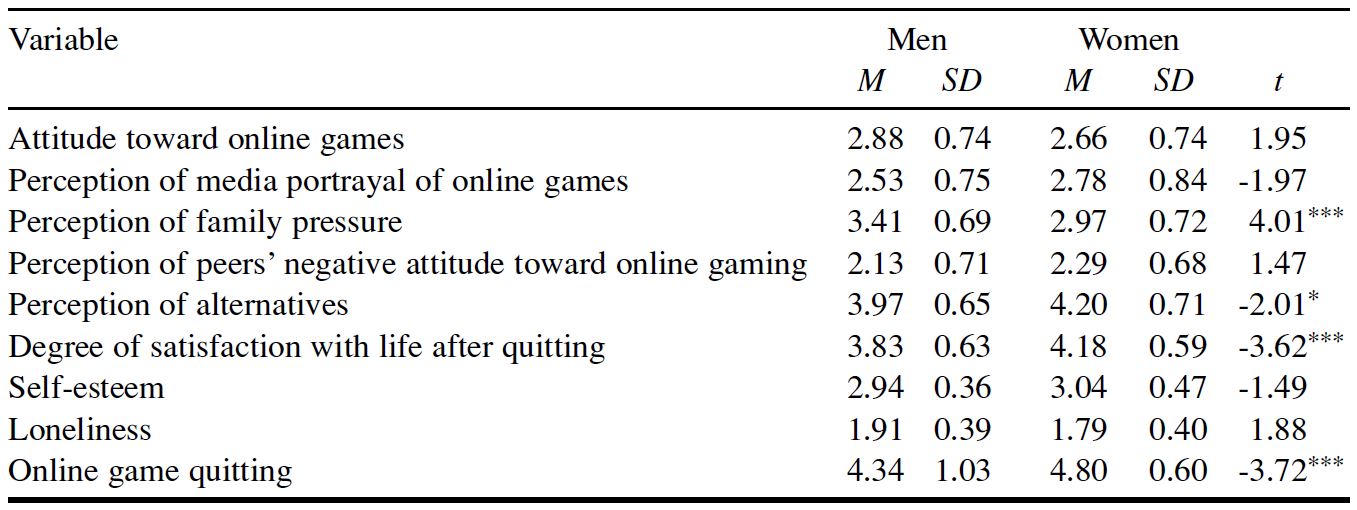
To examine possible gender differences in online game quitting variables, t tests were performed. Significant gender differences were found in the perception of family pressure, perception of alternatives, satisfaction with life after quitting, and degree of determination in quitting online games (see Table 1).
Table 1. Means and Standard Deviations of Online Game Quitting Variables by Gender
Note. N = 176.
* p < .05, *** p < .001.
Compared to women, men were less likely to believe that there were other comparable recreational and leisure-time alternatives to gaming and were less satisfied with their life after quitting. However, results of t tests showed no significant gender difference in attitude toward online games, perception of media portrayal of online games, perception of peers’ negative attitude toward online gaming, level of self-esteem, or degree of loneliness.
Correlations Between Online Game Quitting Variables
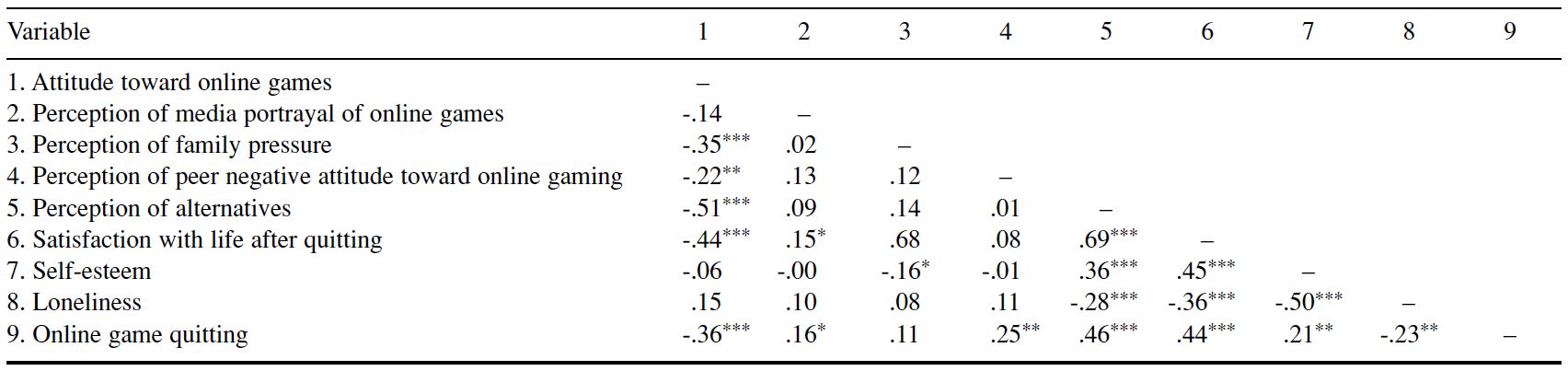
Correlations were performed to examine possible relationships between the online game quitting variables. Results showed that all the hypotheses were supported. Those in the participant group who had a stronger perception of alternatives, higher self-esteem, and a lower degree of loneliness than others in the group had, showed greater determination to quit playing online games (see Table 2).
Predictors of Online Game Quitting
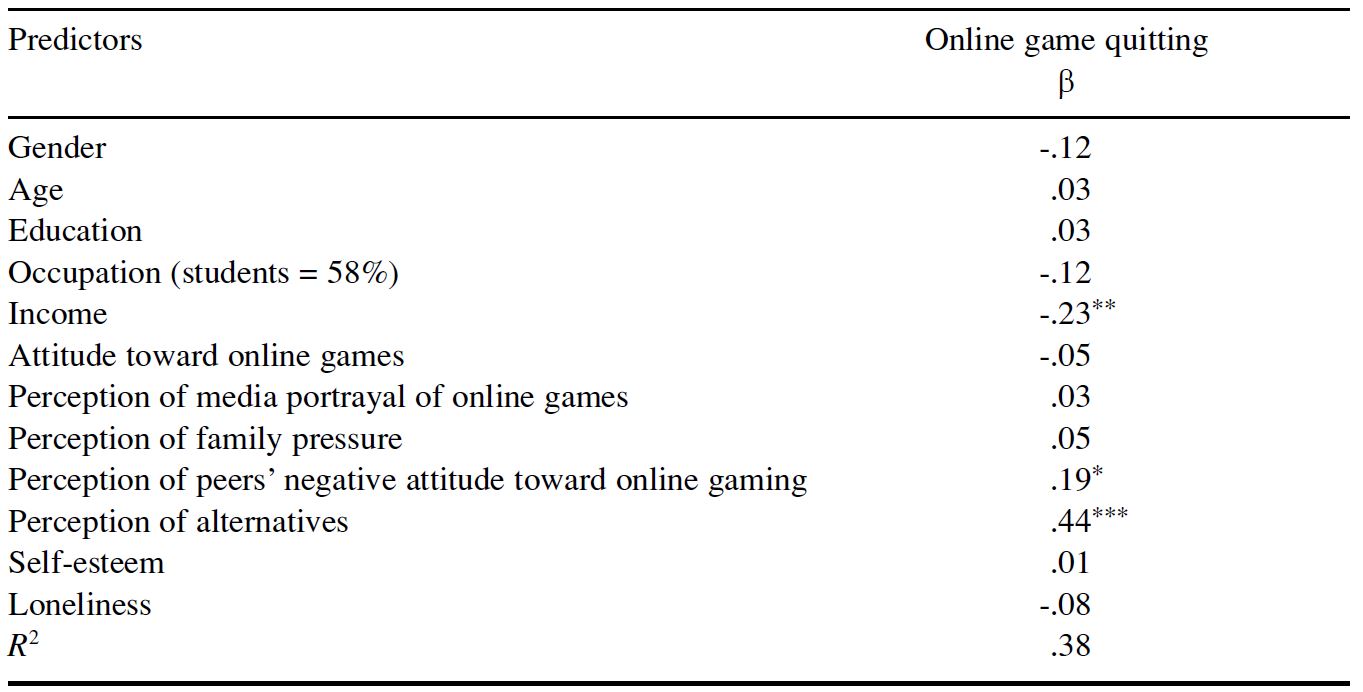
A multiple regression analysis was conducted to answer the research question. The predictors were entered simultaneously into the multiple regression equation. The model was significant, R2 = .38, F(7, 124) = 7.88, p < .001. Among the predictors, income, perceptions of peers’ negative attitude toward online gaming and perception of alternatives were found to be significant predictors of online game quitting. However, attitude toward online games, perception of media portrayal of online games, perception of family pressure, level of self-esteem, degree of loneliness, and demographic characteristics other than income were not significant in the prediction of online game quitting (see Table 3).
Table 2. Summary of Correlation Results
Note. N = 176.
* p < .05, ** p < .01, *** p < .001.
Table 3. Summary of Regression Analysis for Variables Predicting Online Game Quitting
Note. N = 176.
* p < .05; ** p < .01; *** p < .001.
Discussion
Although attention has been paid by researchers to online game addiction, little is known about those who quit playing games online (Bergstrom, 2017; Dutton, 2007). As an exploratory investigation, my study is among the first in which people in China who have quit playing online games have been examined, and may provide a new perspective for online game research, and also offer practical guidance for game companies and policy makers.
Consistent with the theory that negative violations decrease attraction, and the proposition in the technology acceptance model that attitudes can help explain motivation and actual use (Al-Ghaith, 2015; Bevan et al., 2014; Burgoon, 2011; Davis, 1989; Ramirez & Wang, 2008), my results indicate that the more negatively the participants felt about online games, the more likely they were to quit. I also applied the push–pull–mooring theory to improve understanding of factors that influence online game quitting. Results showed that these three categories of factors had varying degrees of effects on quitting intention. Perception of peers’ negative attitude toward online gaming was found to be the significant push factor. Consistent with existing studies (Chang et al., 2013; Sun et al., 2017; Xu et al., 2014), as a pull factor, perception of alternatives was the strongest predictor, which is also related to users’ rational and calculative commitment to technologies (Gustafsson et al., 2005; Jin et al., 2010). In line with findings that online gaming can be costly (Fung, 2016; Golub & Lingley, 2008; Leung & Lee, 2012), in the current study lower income was a significant predictor of online game quitting. As for mooring factors, although the results revealed that level of self-esteem and degree of loneliness were closely related to participants’ perception of satisfaction with life after quitting, the two factors were not significant predictors of online game quitting.
By investigating people who had quit playing games online, a more balanced view can be developed regarding online games and online game players. According to my findings, it is important for those in the online game industry to manage its positive image because people’s attitudes toward online games play a significant role in their gaming practices. As for policy makers, my findings about why people quit playing games online can be helpful for them to rethink the development of policies around healthy gaming and antiaddiction strategies. As the participants in this study demonstrated, finding recreational and leisure-time alternatives to gaming is particularly important to increase the likelihood of quitting, and doing so may even enhance life satisfaction and self-esteem, and reduce loneliness. Moreover, peers can be influential in helping at-risk gamer friends quit, with those participants in my study who had a stronger perception of peers’ negative attitudes toward online games having a greater determination to quit. Therefore, consistent with findings of previous studies on Internet gaming addiction, from a holistic perspective (Kuss, 2013), it can be helpful to integrate more alternatives and group therapy with peer influence in the development of efficacious treatment for online game addiction.
My study has some limitations. First, previous studies on game quitting have been based on a qualitative research method (Dutton, 2007), or on data from a small sample (Bergstrom, 2017). As a deviant-case sample, my findings might not represent the whole group of people who quit playing games online in China. Thus, future researchers should enroll a large-scale sample and re-examine the effects. Second, I regarded quitting as a result, whereas a previous researcher has pointed out that quitting can be transient; some who have quit may return to online gaming (Bergstrom, 2017). Therefore, longitudinal studies are needed to investigate whether the quitting is a temporary break or a permanent departure. Third, I examined people who had quit playing games online, which is quite different from the online game addicts of previous studies, who cannot stop gaming even after experiencing various problems (Kuss, 2013). I did not assess online game addiction, so I could not verify how many of the participants suffered from online game addiction before quitting. Future comparative studies can be conducted to explore differences between online game addicts and people who quit playing the games.
Al-Ghaith, W. (2015). Applying the technology acceptance model to understand social networking site (SNS) usage: Impact of perceived social capital. International Journal of Computer Science & Information Technology, 7, 105–117. https://doi.org/ckx4
Amdouni, B., Paredes, M., Kribs, C., & Mubayi, A. (2017). Why do students quit school? Implications from a dynamical modelling study. Proceedings of the Royal Society A: Mathematical, Physical & Engineering Sciences, 473. https://doi.org/ckx5
American Psychiatric Association. (2013). Diagnostic and statistical manual of mental disorders (5th ed.). Washington DC: American Psychiatric Association. Retrieved from www.DSM5.org
Baek, Y. M., Bae, Y., & Jang, H. (2013). Social and parasocial relationships on social network sites and their differential relationships with users’ psychological well-being. Cyberpsychology, Behavior, and Social Networking, 16, 512–517. https://doi.org/ckx6
Batt, C. E., & Katz, J. E. (1998). Consumer spending behavior and telecommunications services: A multi-method inquiry. Telecommunications Policy, 22, 23–46. https://doi.org/fg9b65
Beranuy, M., Carbonell, X., & Griffiths, M. D. (2013). A qualitative analysis of online gaming addicts in treatment. International Journal of Mental Health and Addiction, 11, 149–161. https://doi.org/ckx7
Bergstrom, K. (2017). Temporary break or permanent departure? Rethinking what it means to quit EVE Online. Games and Culture: A Journal of Interactive Media. Advance online publication. https://doi.org/ckx8
Bevan, J. L., Ang, P.-C., & Fearns, J. B. (2014). Being unfriended on Facebook: An application of expectancy violation theory. Computers in Human Behavior, 33, 171–178. https://doi.org/f5xvgn
Blinka, L., & Mikuška, J. (2014). The role of social motivation and sociability of gamers in online game addiction. Cyberpsychology: Journal of Psychosocial Research on Cyberspace, 8, 1–10. https://doi.org/ckx9
Bouwman, T. E., Aartsen, M. J., van Tilburg, T. G., & Stevens, N. L. (2016). Does stimulating various coping strategies alleviate loneliness? Results from an online friendship enrichment program. Journal of Social and Personal Relationships, 34, 793–811. https://doi.org/gbtm97
Burgoon, J. (2011). Expectancy violations theory. In E. A. Griffin (Ed.), A first look at communication theory (7th ed., pp. 84–97). New York, NY: McGraw-Hill.
Capuzzi, D., & Gross, D. R. (Eds.). (2014). Youth at risk: A prevention resource for counselors, teachers, and parents (6th ed.). Hoboken, NJ: Wiley.
Carey, J., & Pavlik, J. V. (1993). Videotex: The sword in the stone. In J. V. Pavlik & E. E. Dennis (Eds.), Demystifying media technology (pp. 163-168). Mountainview, CA: Mayfield Publishing.
Chang, I.-C., Liu, C.-C., & Chen, K. (2013). The push, pull and mooring effects in virtual migration for social networking sites. Information Systems Journal, 24, 323–346. https://doi.org/ckzb
China Internet Network Information Center. (2017, January 22). The 39th statistical survey report on Internet development in China. Retrieved from https://bit.ly/2ptSznA
Connolly, T. M., Boyle, E. A., MacArthur, E., Hainey, T., & Boyle, J. M. (2012). A systematic literature review of empirical evidence on computer games and serious games. Computers & Education, 59, 661–686. https://doi.org/gcm4tv
Davis, F. D. (1985). A technology acceptance model for empirically testing new end-user information systems: Theory and results (Unpublished doctoral dissertation). MIT Sloan School of Management, Cambridge, MA.
Davis, F. D. (1989). Perceived usefulness, perceived ease of use, and user acceptance of information technology. MIS Quarterly, 13, 319–340. https://doi.org/cc6
de Morentin, J. I. M., Cortés, A., Medrano, C., & Apodaca, P. (2014). Internet use and parental mediation: A cross-cultural study. Computers & Education, 70, 212–221. https://doi.org/x2f
Dindar, M., & Akbulut, Y. (2014). Why do pre-service teachers quit Facebook? An investigation on “quitters forever” and “quitters for a while”. Computers in Human Behavior, 39, 170–176. https://doi.org/f6mkb9
Dutton, N. T. (2007). Participatory quitting: Quitting texts and World of Warcraft player culture (Master’s thesis). Ohio University, Ohio. Retrieved from https://bit.ly/2u6kxLJ
Edgar, P. (1977). Families without television. Journal of Communication, 27, 73–77. https://doi.org/fh8p8f
Eicher, V., Staerkle, C., & Clemence, A. (2014). I want to quit education: A longitudinal study of stress and optimism as predictors of school dropout intention. Journal of Adolescence, 37, 1021–1030. https://doi.org/f6mvhv
Faul, F., Erdfelder, E., Buchner, A., & Lang, A.-G. (2009). Statistical power analyses using G*Power 3.1: Tests for correlation and regression analyses. Behavior Research Methods, 41, 1149–1160. https://doi.org/b22kn7
Faul, F., Erdfelder, E., Lang, A.-G., & Buchner, A. (2007). G*Power 3: A flexible statistical power analysis program for the social, behavioral, and biomedical sciences. Behavior Research Methods, 39, 175–191. https://doi.org/bxjdcg
Festl, R., Scharkow, M., & Quandt, T. (2013). Problematic computer game use among adolescents, younger and older adults. Addiction, 108, 592–599. https://doi.org/kr9
Fung, A. (Ed.). (2016). Global game industries and cultural policy. Cham, Switzerland: Palgrave Macmillan.
Golub, A., & Lingley, K. (2008). ‘‘Just like the Qing Empire’’: Internet addiction, MMOGs, and moral crisis in contemporary China. Games and Culture, 3, 59–75. https://doi.org/b8wbhp
Gustafsson, A., Johnson, M. D., & Roos, I. (2005). The effects of customer satisfaction, relationship commitment dimensions, and triggers on customer retention. Journal of Marketing, 69, 210–218. https://doi.org/bpqvf5
Hyun, G. J., Han, D. H., Lee, Y. S., Kang, K. D., Yoo, S. K., Chung, U.-S., & Renshaw, P. F. (2015). Risk factors associated with online game addiction: A hierarchical model. Computers in Human Behavior, 48, 706–713. https://doi.org/f7bnn2
Itthida, G. (2015). “Progressive promotion”: Dropout issue in Lao primary education and the misplaced policy. Procedia–Social and Behavioral Sciences, 197, 2355–2361. https://doi.org/ckzc
Jiang, Q., & Leung, L. (2011). Effects of individual differences, awareness-knowledge, and acceptance of Internet addiction as a health risk on willingness to change Internet habits. Social Science Computer Review, 30, 170–183. https://doi.org/dcmqps
Jin, B., Park, J. Y., & Kim, H.-S. (2010). What makes online community members commit? A social exchange perspective. Behaviour & Information Technology, 29, 587–599. https://doi.org/dsp266
Kardefelt-Winther, D. (2014). A conceptual and methodological critique of Internet addiction research: Towards a model of compensatory internet use. Computers in Human Behavior, 31, 351–354. https://doi.org/f5trp5
Khan, S., Gagné, M., Yang, L., & Shapka, J. (2016). Exploring the relationship between adolescents’ self-concept and their offline and online social worlds. Computers in Human Behavior, 55, 940–945. https://doi.org/f76ffq
King, D. L., Haagsma, M. C., Delfabbro, P. H., Gradisar, M., & Griffiths, M. D. (2013). Toward a consensus definition of pathological video-gaming: A systematic review of psychometric assessment tools. Clinical Psychology Review, 33, 331–342. https://doi.org/f5c3zv
Király, O., Griffiths, M. D., Urbán, R., Farkas, J., Kökönyei, G., Elekes, Z., Tamás, D., & Demetrovics, Z. (2014). Problematic Internet use and problematic online gaming are not the same: Findings from a large nationally representative adolescent sample. Cyberpsychology, Behavior, and Social Networking, 17, 749–754. https://doi.org/f6q2xb
Ko, C.-H., Wang, P.-W., Liu, T.-L., Yen, C.-F., Chen, C.-S., & Yen, J.-Y. (2014). Bidirectional associations between family factors and Internet addiction among adolescents in a prospective investigation. Psychiatry and Clinical Neurosciences, 69, 192–200. https://doi.org/ck2n
Kowert, R., Vogelgesang, J., Festl, R., & Quandt, T. (2015). Psychosocial causes and consequences of online video game play. Computers in Human Behavior, 45, 51–58. https://doi.org/f63dbg
Kuss, D. J. (2013). Internet gaming addiction: Current perspectives. Psychology Research and Behavior Management, 6, 125–137. https://doi.org/gcp5jx
Kuss, D. J., van Rooij, A. J., Shorter, G. W., Griffiths, M. D., & van de Mheen, D. (2013). Internet addiction in adolescents: Prevalence and risk factors. Computers in Human Behavior, 29, 1987–1996. https://doi.org/bfbr
Lee, Z. W. Y., Cheung, C. M. K., & Chan, T. K. H. (2015). Massively multiplayer online game addiction: Instrument development and validation. Information & Management, 52, 413–430. https://doi.org/ck2p
Leung, L., & Lee, P. S. N. (2012). The influences of information literacy, internet addiction and parenting styles on internet risks. New Media & Society, 14, 117–136. https://doi.org/fgcf33
Livingstone, S., & Helsper, E. J. (2008). Parental mediation of children’s internet use. Journal of Broadcasting & Electronic Media, 52, 581–599. https://doi.org/c2jxmk
Martončik, M., & Lokša, J. (2016). Do World of Warcraft (MMORPG) players experience less loneliness and social anxiety in online world (virtual environment) than in real world (offline)? Computers in Human Behavior, 56, 127–134. https://doi.org/bvnv
Mehroof, M., & Griffiths, M. D. (2010). Online gaming addiction: The role of sensation seeking, self-control, neuroticism, aggression, state anxiety, and trait anxiety. Cyberpsychology, Behavior, and Social Networking, 13, 313–316. https://doi.org/ccjmdm
Mei, S., Yau, Y. H. C., Chai, J., Guo, J., & Potenza, M. N. (2016). Problematic Internet use, well-being, self-esteem and self-control: Data from a high-school survey in China. Addictive Behaviors, 61, 74–79. https://doi.org/f922rm
Neuman, W. L. (2006). Social research methods: Qualitative and quantitative approaches. Boston, MA: Pearson/Allyn and Bacon.
Orsolya, K., Griffiths, M., Róbert, U., Farkas, J., Kökönyei, G., Elekes, Z., Domokos, T., & Zsolt, D. (2014). Problematic Internet use and problematic online gaming are not the same: Findings from a large nationally representative adolescent sample. Cyberpsychology, Behavior, and Social Networking, 17, 749–754. https://doi.org/f6q2xb
Orth, U., Robins, R. W., Widaman, K. F., & Conger, R. D. (2014). Is low self-esteem a risk factor for depression? Findings from a longitudinal study of Mexican-origin youth. Developmental Psychology, 50, 622–633. https://doi.org/q4x
Park, J. H., Han, D. H., Kim, B.-N., Cheong, J. H., & Lee, Y.-S. (2016). Correlations among social anxiety, self-esteem, impulsivity, and game genre in patients with problematic online game playing. Psychiatry Investigation, 13, 297–304. https://doi.org/f8pgn2
Pearce, C. (2009). Communities of play: Emergent cultures in multiplayer games and virtual worlds. Cambridge, MA: MIT Press.
Petry, N. M. (2013). Commentary on Festl et al. (2013): Gaming addiction—How far have we come, and how much further do we need to go? Addiction, 108, 600–601. https://doi.org/ck2r
Ramirez, A., Jr., & Wang, Z. (2008). When online meets offline: An expectancy violations theory perspective on modality switching. Journal of Communication, 58, 20–39. https://doi.org/b5f3zj
Rice, R. E., & Katz, J. E. (2003). Comparing internet and mobile phone usage: Digital divides of usage, adoption, and dropouts. Telecommunications Policy, 27, 597–623. https://doi.org/f53
Rosenberg, M. (1965). Society and the adolescent self-image. Princeton, NJ: Princeton University Press.
Seawright, J. (2016). The case for selecting cases that are deviant or extreme on the independent variable. Sociological Methods & Research, 45, 493–525. https://doi.org/f8wdw2
Shevlin, M., Murphy, S., & Murphy, J. (2015). The latent structure of loneliness: Testing competing factor models of the UCLA Loneliness Scale in a large adolescent sample. Assessment, 22, 208–215. https://doi.org/ck2s
Stieger, S., Burger, C., Bohn, M., & Voracek, M. (2013). Who commits virtual identity suicide? Differences in privacy concerns, Internet addiction, and personality between Facebook users and quitters. Cyberpsychology, Behavior, and Social Networking, 16, 629–634. https://doi.org/f5gxf4
Sun, Y., Liu, D., Chen, S., Wu, X., Shen, X.-L., & Zhang, X. (2017). Understanding users’ switching behavior of mobile instant messaging applications: An empirical study from the perspective of push-pull-mooring framework. Computers in Human Behavior, 75, 727–738. https://doi.org/gbs9pv
Tao, R. (2007). Internet addiction: Analysis and intervention [In Chinese]. Shanghai: Shanghai People’s Press.
Taylor, T. L. (2006). Play between worlds: Exploring online game culture. Cambridge, MA: MIT Press.
Tsai, C.-C., Lin, S. S. J., & Tsai, M.-J. (2001). Developing an Internet Attitude Scale for high school students. Computers & Education, 37, 41–51. https://doi.org/fpntjk
Umble, D. Z. (1997). Holding the line: The telephone in old order Mennonite and Amish life. Utopian Studies, 8, 245–246.
van Ingen, E., & Wright, K. B. (2016). Predictors of mobilizing online coping versus offline coping resources after negative life events. Computers in Human Behavior, 59, 431–439. https://doi.org/f8hw49
Virtanen, T. E., Kiuru, N., Lerkkanen, M.-K., Poikkeus, A.-M., & Kuorelahti, M. (2016). Assessment of student engagement among junior high school students and associations with self-esteem, burnout, and academic achievement. Journal for Educational Research Online, 8, 136–157. Retrieved from https://bit.ly/2GOeu0O
Wang, H., Yang, C., He, F., Shi, Y., Qu, Q., Rozelle, S., & Chu, J. (2015). Mental health and dropout behavior: A cross-sectional study of junior high students in northwest rural China. International Journal of Educational Development, 41, 1–12. https://doi.org/f7d99j
Winkler, A., Dorsing, B., Rief, W., Shen, Y., & Glombiewski, J. A. (2013). Treatment of Internet addiction: A meta-analysis. Clinical Psychology Review, 33, 317–329. https://doi.org/f4nxfh
Wu, J. Y. W., Ko, H.-C., Wong, T.-Y., Wu, L.-A., & Oei, T. P. (2016). Positive outcome expectancy mediates the relationship between peer influence and Internet gaming addiction among adolescents in Taiwan. Cyberpsychology, Behavior, and Social Networking, 19, 49–55. https://doi.org/f77rm5
Xu, Y., Yang, Y., Cheng, Z., & Lim, J. (2014). Retaining and attracting users in social networking services: An empirical investigation of cyber migration. The Journal of Strategic Information Systems, 23, 239–253. https://doi.org/f6ntnf
Yao, M. Z., He, J., Ko, D. M., & Pang, K. (2014). The influence of personality, parental behaviors, and self-esteem on Internet addiction: A study of Chinese college students. Cyberpsychology, Behavior, and Social Networking, 17, 104–110. https://doi.org/bqcx
Yao, M. Z., & Zhong, Z. (2014). Loneliness, social contacts and Internet addiction: A cross-lagged panel study. Computers in Human Behavior, 30, 164–170. https://doi.org/6n3
Zhang, N., Fan, F., Huang, S., & Rodriguez, M. A. (2018). Mindfulness training for loneliness among Chinese college students: A pilot randomized controlled trial. International Journal of Psychology, 53, 373–378. https://doi.org/ck2v
Zhang, Y., Mei, S., Li, L., Chai, J., Li, J., & Du, H. (2015). The relationship between impulsivity and Internet addiction in Chinese college students: A moderated mediation analysis of meaning in life and self-esteem. PLOS One, 10, e0131597. https://doi.org/ck2w
Table 1. Means and Standard Deviations of Online Game Quitting Variables by Gender
Note. N = 176.
* p < .05, *** p < .001.
Table 2. Summary of Correlation Results
Note. N = 176.
* p < .05, ** p < .01, *** p < .001.
Table 3. Summary of Regression Analysis for Variables Predicting Online Game Quitting
Note. N = 176.
* p < .05; ** p < .01; *** p < .001.
Funding for this study was provided by project 14CXW031 supported by the National Social Science Foundation of China.
Qiaolei Jiang, Department of Journalism and Communication, Dalian University of Technology, No. 2 Linggong Road, Ganjingzi District, Dalian City, Liaoning Province, People’s Republic of China 116024. Email: [email protected]