The curvilinear relation between coworker knowledge hiding and employee job crafting
Main Article Content
Drawing on relative deprivation theory, we explored the mechanism for the influence of coworker knowledge hiding on employee job crafting and the moderating role of supervisor developmental feedback from the perspective of status competition. Thus, we tested the tripartite interpersonal interactions among knowledge-hiding individuals, knowledge-seeking employees, and supervisors. We conducted a two-wave time-lagged study on 354 employees who worked for Chinese owned and operated companies in China. We found that there was an inverted U-shaped relationship between coworker knowledge hiding and employee job crafting, in which an employee’s sense of relative deprivation played a mediating role. Furthermore, supervisor developmental feedback negatively moderated the relationship between coworker knowledge hiding and an employee’s sense of relative deprivation. To increase the level of employee job crafting, managers should pay attention to the degree of employee’s sense of relative deprivation and attempt to moderate that by providing supervisor developmental feedback.
Article Highlights
- Coworker knowledge hiding had an inverted U-shaped effect on employee job crafting in a competitive workplace environment.
- An employee’s sense of relative deprivation played a mediating role in the relationship between coworker knowledge hiding and employee job crafting.
- Supervisor developmental feedback moderated the effect of coworker knowledge hiding on employee’s sense of relative deprivation.
To survive in a competitive workplace environment, knowledge may be the most valuable and least shared asset with peers (Garg et al., 2022). Knowledge hiding is defined as an intentional attempt by an individual to withhold or conceal knowledge that has been requested by another person (Connelly et al., 2012). Coworker knowledge hiding is widespread in organizations and greatly impairs the effectiveness of the knowledge management system (Connelly et al., 2019). Job crafting has been conceptualized as seeking resources and challenges, and reducing demands (Tims et al., 2012), which contributes to balancing the relationship between job demands and job resources, to ensure a good person–environment fit (D. Wang, 2022). However, there is much debate about whether coworker knowledge hiding is positive or negative for employees in the context of status competition. Whether or not coworker knowledge hiding promotes or inhibits employee job crafting behavior remains an open question and is an issue that researchers need to explore further.
In competitive corporate environments, given that resources within a team or organization are limited, and in order for employees to protect their individual interests and needs, employees compete with each other for limited job resources, such as challenging tasks, job discretion, career development opportunities, and so on (Dong et al., 2023). The dichotomous interaction between employees results in coworkers hiding their knowledge out of self-interest, which triggers employees to feel out of control over hidden resources, leading to discordant workplace relationships (Y. Wang et al., 2018). Employee job crafting is a resource expansion aimed at building individual strengths (Dong et al., 2023), which is also essentially a competition for resources (Bindl et al., 2019). Coworker knowledge hiding is likely to trigger a process of social comparison, in which employees may perceive coworkers as being in a more desirable and advantageous position to gain resources. This perception may lead to employees feeling a sense of relative deprivation (Dong et al., 2023) which in turn affects their job crafting behavior (Yeşiltaş et al., 2023).
Developmental feedback refers to the extent to which supervisors provide useful information to subordinates to enable the subordinates to learn, develop, and improve in their future work (Zhou, 2003). According to Su et al. (2019), when employees are driven by a vision based on developmental feedback from their supervisors, they are not limited to short-term gains and losses, which stimulates their interest in the work itself. Thus, employees are more motivated to work on their own initiative (Zhou, 1998) and complete their tasks with higher quality standards (Tierney & Farmer, 2004).
Therefore, we hypothesized and tested a moderated mediation model to analyze the interaction mechanisms among coworker knowledge hiding, employee job crafting, employee’s sense of relative deprivation, and supervisor developmental feedback. We explored how coworker knowledge hiding affects employee job crafting and expanded the research on how knowledge hiding affects employee relationships within organizations.
Coworker Knowledge Hiding and Employee Job Crafting
Mediating Effect of Employee’s Sense of Relative Deprivation
Moderating Role of Supervisor Developmental Feedback

Method
Participants and Procedure
We entered all survey scales into the Questionnaire Star website (https://www.wjx.cn/) to create an online questionnaire and sent a link to the participating employees’ WeChat text messaging service. We administered two surveys with a 2-week lag on March 1 and March 15, 2023. At Time 1 (T1), we measured coworker knowledge hiding, relative deprivation, supervisor developmental feedback, and collected demographic data; At Time 2 (T2), we measured employee job crafting.
We selected more than 30 technology companies in the northwest and southeast coastal regions of China and distributed 355 questionnaires to employees. At T1 354 employees completed the first survey, and at T2 we collected 341 valid questionnaires, with a response rate of 96%. In this sample, 191 (53.95%) were from men and 163 (46.05%) were from women. Participants’ ages ranged from 20 to 62 years (M = 37.44, SD = 11.20), 140 (39.55%) were 20–29 years old, 76 (21.47%) were 30–39 years old, 67 (18.93%) were 40–49 years old, 70 (19.77%) were 50–59 years old, and 1 (0.28%) was over 60 years old. Regarding participant education level, 6 (1.69%) had a level below high school, 21 (5.93%) were high school or technical secondary school graduates, 62 (17.51%) were junior college graduates, 192 (54.24%) had a bachelor’s degree, and 74 (20.90%) had a master’s degree or above.
Measures
We measured all variables using well-established, publicly available scales, and used 5-point Likert scales ranging from 1 (strongly disagree) to 5 (strongly agree). We invited three professional Chinese-English translation researchers to first translate the already selected English scale items into Chinese according to the Chinese cultural context, then we had three employees from different companies take the test to find any ambiguously worded or very difficult to understand items. We completed necessary revisions then the measurement questions were widely distributed to collect data.
To measure knowledge hiding we adopted the scale developed by Connelly et al. (2012), which includes 12 items, such as, “When a colleague asks me for knowledge, I will superficially agree to help them, but I do not intend to actually help them.” The Cronbach’s alpha coefficient in this study was 0.96 indicating the scale was reliable.
To measure job crafting we adopted the scale developed by Tims et al. (2012), which includes 21 items, such as, “I make sure that I use my capacities to the fullest.” The Cronbach’s alpha coefficient in this study was 0.98 indicating the scale was reliable.
To measure sense of relative deprivation we adopted the scale developed by Callan et al. (2011), which includes five items, such as, “I feel deprived when I think about what I have compared to what other people like me have.” The Cronbach’s alpha coefficient for this scale in this study was 0.84 indicating the scale was reliable.
To measure supervisor developmental feedback we adopted the scale developed by Zhou (2003), which includes three items, such as, “While giving me feedback, my supervisor focuses on helping me to learn and improve.” The Cronbach’s alpha coefficient in this study was 0.83 indicating the scale was reliable.
Control Variables
To prevent over-control of variables, only the age and gender of employees were used as control variables in this study.
Analysis Tools
We used SPSS version 23.0 and Mplus 8.0 for data processing.
Data Analysis
The level of coworker knowledge hiding was expressed by averaging the team employee knowledge hiding scores. Given that coworker knowledge hiding is a team-level variable, and the statistics are derived from individual employees, this study required data aggregation tests for employee knowledge hiding to confirm the intra-group consistency and intergroup variability of the variables. We used the intragroup consistency index rwg value and intragroup correlation index (ICC) value to test the internal consistency of the data. It was found that the ICC(1) value of coworker knowledge hiding was .87 and the ICC(2) value was .98, which was greater than .7, and rwg was greater than .7. This indicates that the aggregation of individual-level knowledge hiding to coworker level is reasonable and valid.
Results
Confirmatory Factor Analyses
To check whether knowledge hiding, sense of relative deprivation, supervisor developmental feedback, and job crafting could be mutually discriminated, this study used Mplus 8.0 to conduct confirmatory factor analyses (see Table 1). The results show that the hypothesized four-factor model fitted better with the data, and significantly better than the three-factor, the two-factor, and the single-factor model. Hence, the discriminant validity of this study was good and suitable for subsequent hypotheses testing.
Table 1. Results of Confirmatory Factor Analyses

Note. N = 354; CFI = confirmatory factor analysis; TLI = Tucker–Lewis index; RMSEA = root mean square error of approximation; SRMR = standardized root mean square residual. a Knowledge hiding, Supervisor developmental feedback, Sense of relative deprivation, Job crafting. b Knowledge hiding, Supervisor developmental feedback + Sense of relative deprivation, Job crafting. c Knowledge hiding + Supervisor developmental feedback + Sense of relative deprivation, Job crafting. d Knowledge hiding + Supervisor developmental feedback + Sense of relative deprivation + Job crafting.
Descriptive Statistics and Correlation Analyses
Table 2 shows the results of descriptive statistics and correlational analyses, including means, standard deviations, and intercorrelations among the variables studied. There was a significant correlation between all the main study variables, which provides initial support for Hypothesis 1, Hypothesis 2, Hypothesis 3, and Hypothesis 4. Table 2 reports the results of descriptive statistics.
Table 2. Descriptive Statistics and Correlation Coefficients of Variables

Hypothesis Testing
Direct Effects Testing
Table 3. Results of Hierarchical Regression Analyses
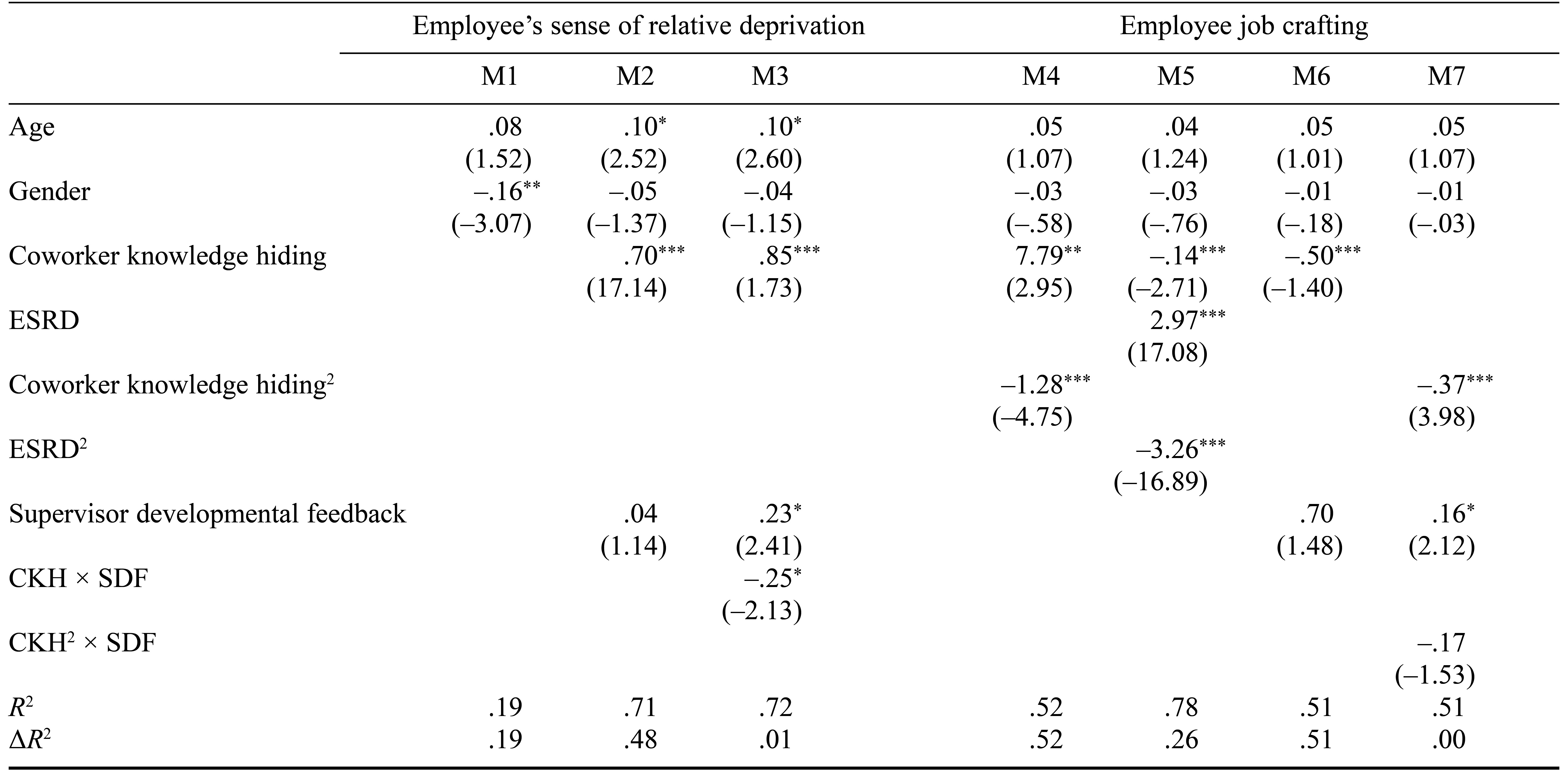
The results show that coworker knowledge hiding has an inverted U-shaped effect on employee job crafting (see Figure 2). Specifically, this relationship initially shows a positive correlation (upward stage), which then becomes negative (decline stage); the curve starts with the upward stage, where the strengthening of coworker knowledge hiding stimulates employees to increase their level of job crafting, and when a certain optimal moment is exceeded, the curve enters the decline stage, where the strengthening of coworker knowledge hiding causes employees job crafting to start decreasing. Therefore Hypothesis 1 was supported.

Figure 2. The Inverted U-shaped Relationship Between Coworker Knowledge Hiding and Employee Job Crafting
In Model 2 (M2), the influence coefficient of coworker knowledge hiding on employee’s sense of relative deprivation was also significantly positive, γ = 0.70, p < .001. Additionally, the influence coefficient of employee’s sense of relative deprivation on employees job crafting in Model 5 (M5) was significantly positive, γ = 2.97, p < .001, but the coefficient of the squared term of employee’s sense of relative deprivation on employee job crafting was significantly negative, γ = –3.26, p < .001, indicating an inverted U-curve relationship between employees’ relative deprivation and job crafting (see Figure 3). Hence, Hypothesis 2 received initial support.

Figure 3. The Inverted U-Shaped Relationship Between Employee’s Sense of Relative Deprivation and Employee Job Crafting
Mediation Effect Testing
Table 4. Results of the Test for Instantaneous Mediated Effects

Note. N = 354. CKH = coworker knowledge hiding; CI = confidence interval. LL = lower level, UL = upper level. IIE = instantaneous indirect effect.
Moderating Effect Testing

Figure 4. The Moderating Effect of Supervisor Developmental Feedback
Discussion
We tested a moderated mediation model to explore how coworker knowledge hiding affected employee job crafting. Below, we discuss how these findings contribute to research and practice.
Theoretical Contribution
First, the status competition perspective is one of the innovative points of this study. Previously, few studies have examined the effect of knowledge hiders on knowledge seekers’ behavior, for example, how employee knowledge hiding stimulates coworkers’ creativity (Zakariya & Bashir, 2021). We explored the tripartite interaction mechanism of coworker knowledge hiding based on the relative deprivation theory. This study has expanded the research perspective of knowledge hiding and reveals the motivational factors behind knowledge-hiding behaviors.
Second, the results of this study are particularly valuable in terms of the mediating role of employee relative deprivation. Our study elucidates the process of employee relative deprivation in coworker knowledge hiding and the resulting impact on employee job crafting behaviors. It provides insight for future scholars to explore how employee relative deprivation affects individual behavior in organizations.
Third, supervisor developmental feedback as a boundary condition is an innovative point. We found that supervisor developmental feedback moderated the relationship between coworker knowledge hiding and employee’s sense of relative deprivation. This finding further enriches and argues for Tims et al.’s (2022) view of the future trend of job crafting based on the team perspective.
Practical Implications
First, the inverted U-shaped effect of coworker knowledge hiding on employee job crafting in a competitive workplace environment suggests that managers should maintain knowledge hiding within an appropriate range by improving the interpersonal environment within the organization. Effective human resource practices are beneficial for improving the organizational environment (Haar et al., 2022). Specifically, in an organizational environment with high levels of knowledge hiding, managers should establish a sharing and collaborative atmosphere and keep the effect of coworkers’ knowledge hiding on employees’ job crafting in a moderate range, so as to increase employees’ behavior and willingness to craft their jobs. Second, this study found that coworker knowledge hiding can trigger an employee’s sense of relative deprivation, which in turn affects their job crafting. Therefore, managers should not ignore the impact of negative emotions such as employee’s sense of relative deprivation on job crafting. Managers should communicate with employees in a timely manner to understand their true emotions and core demands towards colleagues and supervisors. In addition, managers should guide employees to correctly regulate negative emotions, thereby improving their job crafting level and ensuring the effectiveness of knowledge management. Third, based on our findings that supervisor developmental feedback moderated the effect of coworker knowledge hiding on employee’s sense of relative deprivation, managers should make full use of opportunities to interact with employees to encourage and support their creative achievements. Managers should observe and develop employees’ personal strengths, which helps to stimulate employees’ self-confidence and improve their ability to engage in self-development. In addition, an important way of improving supervisor developmental feedback is for companies to provide employees with adequate job resource support (Liu & Long, 2021).
Limitations and Future Directions
First, the data in this study come from Chinese technology companies, so our research conclusions are influenced by geography and both national and industry culture. Future researchers can conduct research in different countries and companies from different industries, to try to draw more universal research conclusions. Second, this study was conducted using two-wave survey data to reduce common method bias, but the data were all individual evaluations, which has limitations in the study of interactions. Future studies can further examine the tripartite interaction between supervisors, employees, and coworkers using a combination of self-evaluation, employee mutual evaluation, and scale measures. Third, there is a relative lack of research on the effect of knowledge hiding in the existing literature, and we only explored the relationship between coworker knowledge hiding and employee job crafting. Future research can explore the psychological mechanisms of knowledge hiding and other boundary conditions in individual and team levels based on multilevel theory.
Table 1. Results of Confirmatory Factor Analyses
Note. N = 354; CFI = confirmatory factor analysis; TLI = Tucker–Lewis index; RMSEA = root mean square error of approximation; SRMR = standardized root mean square residual. a Knowledge hiding, Supervisor developmental feedback, Sense of relative deprivation, Job crafting. b Knowledge hiding, Supervisor developmental feedback + Sense of relative deprivation, Job crafting. c Knowledge hiding + Supervisor developmental feedback + Sense of relative deprivation, Job crafting. d Knowledge hiding + Supervisor developmental feedback + Sense of relative deprivation + Job crafting.
Table 2. Descriptive Statistics and Correlation Coefficients of Variables
Table 3. Results of Hierarchical Regression Analyses
Figure 2. The Inverted U-shaped Relationship Between Coworker Knowledge Hiding and Employee Job Crafting
Figure 3. The Inverted U-Shaped Relationship Between Employee’s Sense of Relative Deprivation and Employee Job Crafting
Table 4. Results of the Test for Instantaneous Mediated Effects
Note. N = 354. CKH = coworker knowledge hiding; CI = confidence interval. LL = lower level, UL = upper level. IIE = instantaneous indirect effect.
Figure 4. The Moderating Effect of Supervisor Developmental Feedback
Xiaocai Gao, School of Public Administration, Northwest University, No. 1 Xue Fu Avenue, Chang’an, Xi’an, Shaanxi 710127, People’s Republic of China. Email: [email protected]