Anxiety and brand topic searches during COVID-19: The mediating role of vaccination behavior
Main Article Content
I described the development of a country-level model to explore whether anxiety prevalence is positively associated with brand topic search interest (BTSI) through COVID-19 vaccination behavior. Secondary data for country-level anxiety prevalence and vaccination rate were collected for 60 countries. To assess BTSI, I extracted brand keywords from Google Trends’ national search interests to compose four categories of country-level BTSI. The results indicated that people living in areas with higher rates of both vaccination and anxiety prevalence were significantly interested in searching for entertainment and sports brands. COVID-19 vaccination rate positively mediated the relationship between country-level anxiety prevalence and BTSI in tourism, video games, and sports categories. This study enhances understanding of consumers’ brand topic search behaviors during the COVID-19 pandemic and offers practical implications that will enable researchers and policymakers to explore cross-national BTSI through anxiety prevalence and vaccination rate.
Article Highlights
- Country-level anxiety prevalence was found to be positively associated with COVID-19 vaccination rate and brand topic search interests.
- COVID-19 vaccination rate was positively associated with brand topic search interests in four categories.
- COVID-19 vaccination rate positively mediated the relationship between country-level anxiety prevalence and brand topic search interests in tourism, video game, and sports categories.
- Terror management processes from laboratories can be examined at cross-national and brand levels.
Personality differences are associated with health behaviors during the COVID-19 pandemic (Blagov, 2021). Anxiety, as one facet of the personality, can be thought of as a personality trait or state (Wilt et al., 2011). The American Psychological Association (n.d.) defines anxiety as “a future-oriented, long-acting response broadly focused on a diffuse threat.” Given the future-oriented aspect of anxiety, regional differences in anxiety prevalence in 2020 (Santomauro et al., 2021) may have been associated with 2021 COVID-19 vaccination results (Bendau et al., 2021; Bodner et al., 2022), as a kind of health-related behavior.
In addition, it is expected that higher vaccination rates may encourage recovery of consumer confidence. However, which consumer brands may benefit in regions with higher vaccination rates and anxiety prevalence is unclear. The invention of the internet has led to widespread online search behavior, with 75% of consumers using the Google search engine for prepurchase information searches (Google, 2020). Google holds a global market share of 84% (Statista, 2022a), making it a representative indicator of brand keyword search behaviors. Upon reviewing 30 relevant Social Sciences Citation Index journals pertaining to consumer, brand, and marketing domains (see Table 1), 10 articles were found to utilize Google search data to examine product, brand, or consumer-related matters. This highlights the trustworthiness of Google search data as a reliable tool for analyzing marketing search behavior. However, only two articles explored the determinants of product-related search behavior.
The COVID-19 pandemic over 2020 (with high anxiety prevalence) and 2021 (with vaccinations) may be associated with online brand search behavior to reveal brand opportunities. Therefore, this study described the development of a 60-country model from a terror management theory perspective to examine which consumer market opportunities reflecting brand topic search interests (BTSI) are associated with national anxiety prevalence and COVID-19 vaccination behavior.
Terror Management Theory and the COVID-19 Pandemic
Terror management theory (TMT; Greenberg et al., 1986) can be used to determine which products and brands may be sought to cope with unconscious anxiety. Greenberg et al. (1986) developed experimental methods to determine how people respond to reminders of mortality salience. TMT suggests that awareness of self-worth and death influences many human experiences, including panic-buying consumption and health behaviors during COVID-19 (Fairlamb et al., 2022; Li et al., 2021). People reduce their number of death-related thoughts to limit mortality salience anxiety by developing a psychological defensive system that includes striving to maintain cultural beliefs (e.g., cultural worldviews) and increasing self-esteem (Routledge & Vess, 2018). The cultural worldview provides a shared and symbolic realistic value to impart a sense of meaning and durability to individuals, since materialism can be a way to attain symbolic immortality in a society in which a person’s worth is largely determined by their possessions (Arndt et al., 2004; Routledge & Vess, 2018). Thus, consumers can curb mortality salience fears by looking at specific brand qualities and the cultural worldview they represent. This behavior indicates that mortality salience anxiety can lead people to consume specific brands as coping strategies to maintain cultural worldviews and self-esteem (Routledge & Vess, 2018).
The prevalence of anxiety during the COVID-19 pandemic in part references death anxiety. TMT explicitly indicates that COVID-19 mortality salience is associated with conscious and unconscious death anxiety (Courtney et al., 2020; Pyszczynski et al., 2021). When death anxiety is highly accessible and commands focal attention, people adopt proximal defenses, such as denial or adaptive behavior (e.g., protection behaviors), to avoid conscious death-related thoughts. When death anxiety is highly accessible but is not a focus, it gradually recedes to unconscious thoughts that trigger distal defensive responses to uphold cultural worldviews and maximize the self-esteem of an individual to combat inevitable mortality salience and the subsequent triggering of death anxiety (Pyszczynski et al., 2021; Routledge & Vess, 2018). In 2020, constant reminders of COVID-19 in news reports that referenced growing numbers of deaths and provided vivid images of overburdened hospitals (Pyszczynski et al., 2021), along with COVID-19-related conspiracy beliefs (Stojanov et al., 2021), may have sustained such anxiety.
People employ proximal and distal defense strategies to cope with COVID-19 anxiety (Courtney et al., 2020; Pyszczynski et al., 2021). COVID-19 vaccination is a type of proximal defense strategy, since it protects both the vaccinated individuals and others. As COVID-19 vaccine performance and uptake improve, the number of deaths has declined (Vilches et al., 2022). Prior studies echo TMT to show that higher anxiety about death due to COVID-19 (Bodner et al., 2022), as well as anxiety about infection (Bendau et al., 2021), can enhance vaccination intention. Therefore, anxiety prevalence around the world in 2020 during the COVID-19 pandemic should, in turn, have increased the frequency of proximal coping strategies, such as vaccination behavior.
In terms of distal defense strategies, reflecting on consumer-related behaviors can reduce unconscious COVID-19 anxiety by providing a sense of meaning and worth that enables people to feel valued in society (Jin & Ryu, 2022; Miao et al., 2021). According to TMT, distal defense strategies encompass an enhanced desire for conspicuous, entertainment, and physical fitness products to justify status, materialism, and health-related possessions, respectively (Arndt et al., 2003; Kasser & Sheldon, 2000; Routledge & Vess, 2018). Online keyword search behavior for products or brands is a prerequisite for making purchase decisions (Kotler & Keller, 2012). Thus, exploring online brand search interests of conspicuous, entertainment, and fitness keywords may help to clarify which distal response strategies that reflect mentioned brands are associated with efforts to cope with anxiety.
Online Brand Topic Search Interests
The global penetration rate of the internet reached 67.9% in 2022 (Internet World Stats, 2022). The increasing penetration of the internet and smartphones is driving the growth of e-commerce businesses. People may search online for different topics of product or brand keywords before making a purchase. Jansen and Schuster (2011) investigated the use of 40,000 Google keywords and found evidence that 96% of online product and brand keywords are searched for as a form of prepurchase assistance. Therefore, BTSI for product and brand keywords on Google are critical determinants of consumers’ shopping decisions.
Google Trends (Google, n.d.) records search interests for various keywords in the Google search engine, then extracts these to generate standardized values for the relative search volume, indexed from 0 to 100 (Bansal et al., 2021), to display the search interest for each keyword among countries. Notably, Google Trends’ topic keywords are used in the same manner in nearly every language (Yeung, 2019), indicating that search interest in topic keywords of brands may reveal people’s search behaviors across different countries. This index reflects the global ranking of target topic keywords in terms of search interest (Google, n.d.). For example, in 2021 the topic brand keyword “Nike” was popular in 59 countries. The Netherlands ranked first with 100 points, whereas France had 74 points (see Figure 1). TMT researchers (see, e.g., Pelham et al., 2017) have emphasized the necessity of utilizing Google Trends data for cross-national analyses.
Table 1. Compilation of Papers Using Google Search Data in 30 Social Sciences Citation Index Journals Within the Consumer, Brand, and Marketing Fields
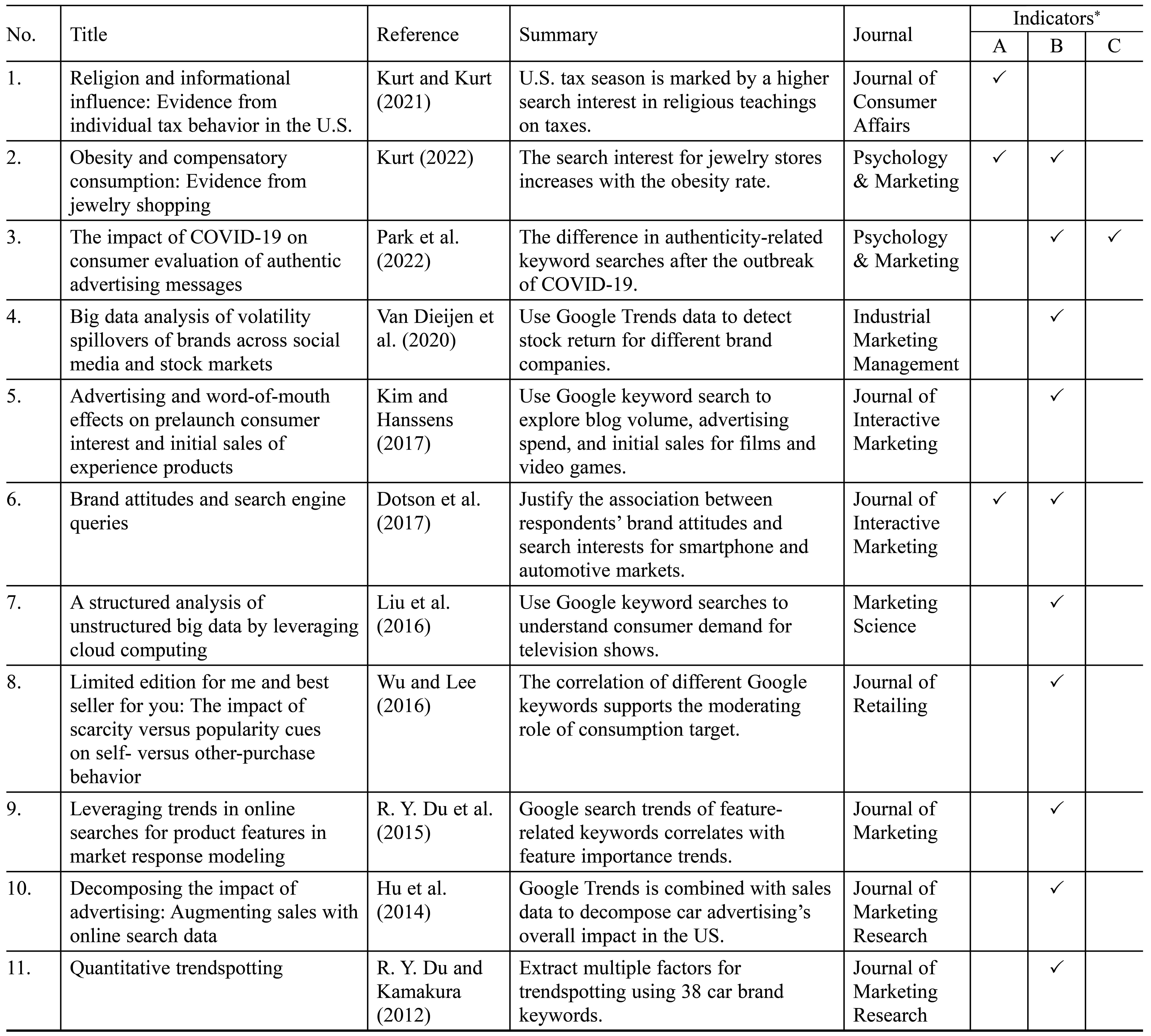
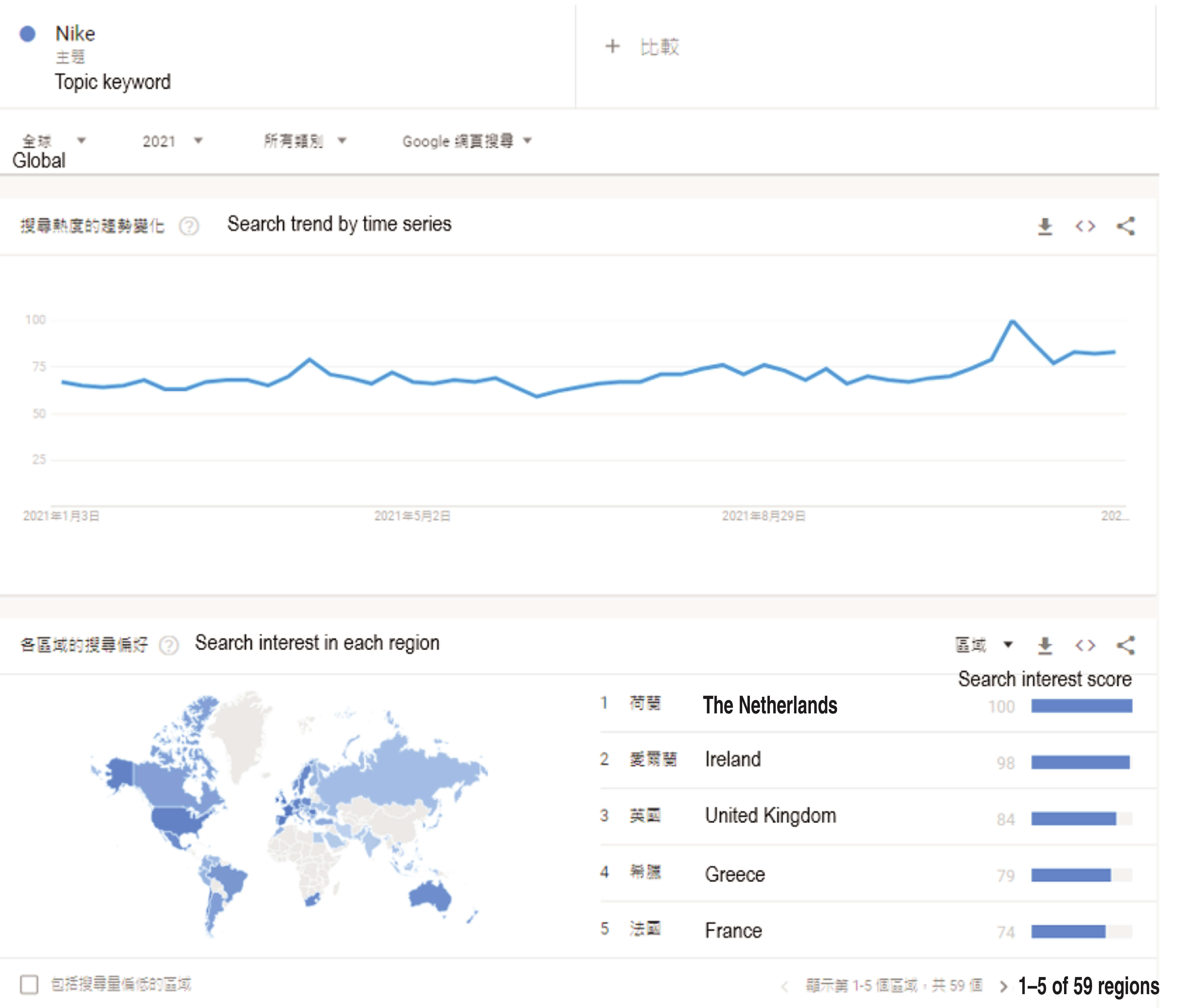
Figure 1. Example of Regional Search Interests for the Topic Keyword
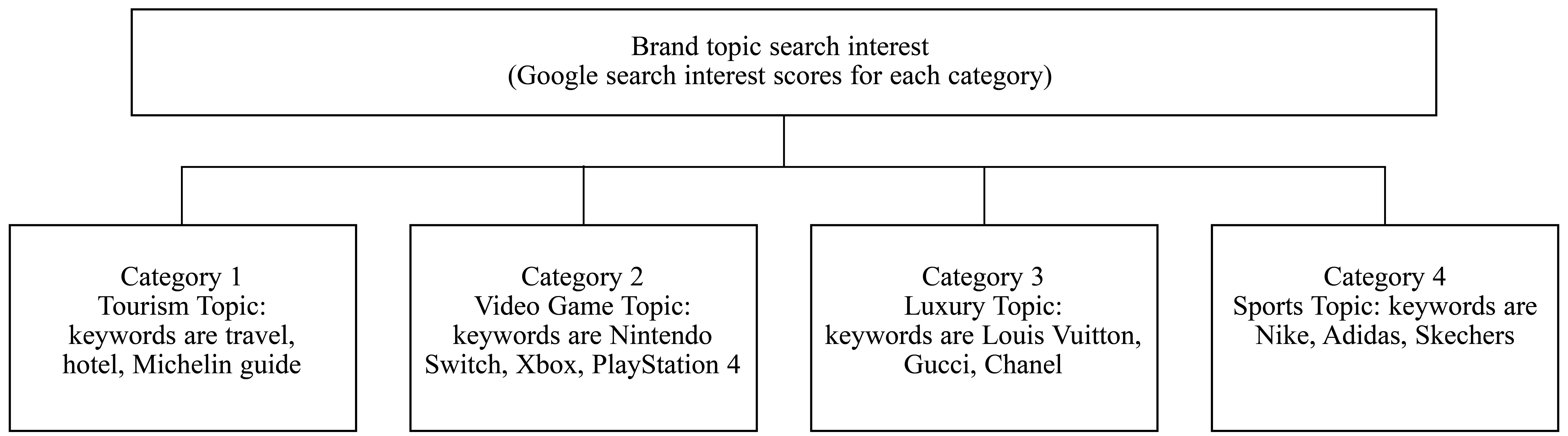
The COVID-19 pandemic has affected various aspects of consumer behavior and brand preference (Chae, 2021; Knowles et al., 2020). Several studies have demonstrated that real-world data representing external stimuli, such as number of confirmed COVID-19 cases (Fetzer et al., 2021; Kurian et al., 2020), lockdown policies (Brodeur et al., 2021), infection rates (H. Du et al., 2020), and death tolls (Wang, 2023), can affect the trends in COVID-19-related keyword searches in many fields (e.g., face mask, stimulus check, anxiety, panic buying, recession, stock market crash, consuming products). However, the relationships between real-world anxiety prevalence, COVID-19 vaccination behavior, and country-level BTSI are unclear. I developed four BTSI categories from popular Google keywords in 60 regions, as shown in Figure 2. Using TMT, this study examined how anxiety prevalence affects the critical social behaviors of COVID-19 vaccination behavior and online BTSI.
Anxiety Prevalence and Vaccination Rate
Anxiety Prevalence and Brand Search Interest for Four Categories
COVID-19 Vaccination Rate and Brand Topic Search Interests for Four Categories
The Mediating Role of COVID-19 Vaccination Behavior
Method
Data Sources
This study used secondary data, with the regional 2020 prevalence of anxiety per 100,000 population in 60 countries from Santomauro et al. (2021, see their supplemental Table S8) selected as an independent variable. Santomauro et al. (2021) identified 5,683 unique data sources and conducted a systematic review of data reporting the prevalence of anxiety disorders during the COVID-19 pandemic.
Data for vaccination rates were downloaded and converted from Our World in Data (Mathieu et al., n.d.). This research used as the mediating variable the cumulative first-dose vaccination rates (total number of people in the general population who received a dose of the vaccine) from January 1 to September 30, 2021. This date was chosen because vaccine supplies were widely sufficient on September 30, 2021 according to Google Trends data (https://bit.ly/3RQiq5T, https://bit.ly/3lpyRtL), which indicated keywords related to COVID-19 vaccine shortage were popular only before June 2021. Further, with the exception of South Africa, where vaccine supplies were plentiful (Henderson, 2021), low-income African countries with vaccine-shortage issues (World Health Organization, 2021) were not included in my sample. Thus, I chose this date to reduce bias associated with changes in vaccine supply for the countries in this study. The average cumulative vaccination rate I calculated in the selected 60 countries from January 1 to September 30, 2021 was 57.6% (see Table 2).
Then, I used Google Trends keywords to create four categories of BTSI as the dependent variables. The BTSI of each category is the sum of Google product or brand search interest in the three selected keywords from January 1, 2021 to February 28, 2022 (see Figure 2). The rationale for choosing this date was that November, December, and February are important promotion months and holidays in many countries (e.g., Thanksgiving Day, Christmas, New Year, Chinese New Year), and therefore at these times consumers may be more interested in searching for their favorite brand topics online. In addition, this date range is later than September 30, 2021, which is when I obtained the cumulative COVID-19 vaccination rate to use as the mediating variable, which will help with assessing causality. Since each brand keyword was popular in 55–65 countries, this study chose 60 countries as the research population.
This study included three control variables—unemployment rate, Gini index, and sex ratio—which may be determinants of brand search interests expressed before purchase decisions are made. The unemployment rate was taken from the Sustainable Development Report (2022) website. The Gini index (representing each country’s income inequality, with lower values indicating higher equality. For instance, the Gini index is 27.6 in Norway and 42.0 in the Philippines) and sex ratio (the number of males for each female in the total population. For instance, the sex ratio is 0.96 in Austria and is 1.05 in Egypt) were sourced from The World Bank (n.d.) and Central Intelligence Agency (n.d.), respectively.
Data Analysis
This study conducted a regression analysis using SPSS 22.0 and Model 4 of the SPSS PROCESS macro (Hayes, 2017) to evaluate the total and indirect effects on each BTSI during the two periods, with the three control variables taken as covariates. Bootstrapping analysis with 5,000 resamples was used to examine the significance of both total and specific indirect effects, where 95% confidence intervals that do not contain zero indicate significance. Especially, Preacher and Hayes (2004) noted that a mediation effect “implies that the total effect X → Y was initially present. There is no such assumption in the assessment of indirect effects. It is quite possible to find that an indirect effect is significant even when there is no evidence of a significant total effect” (p. 719). However, this study examined only the mediation relationship.
Results
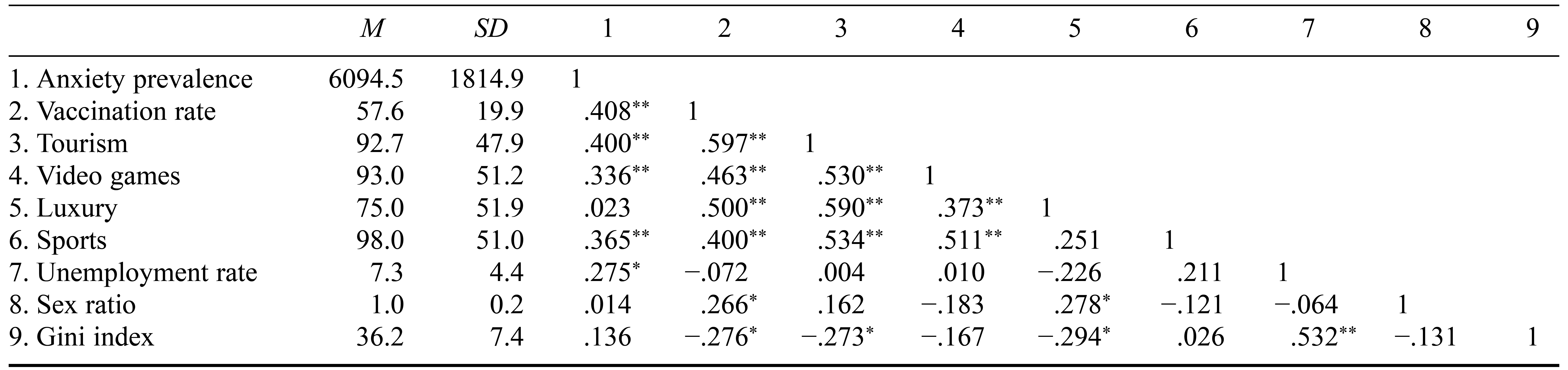
Pearson correlation analysis of the variables involved in this study showed that anxiety prevalence was positively correlated with vaccination rate and three categories of BTSI: tourism, video games, and sports (see Table 2).
Table 2. Correlations Between Anxiety Prevalence, Vaccination Rate, Brand Search Interests, and Control Variables
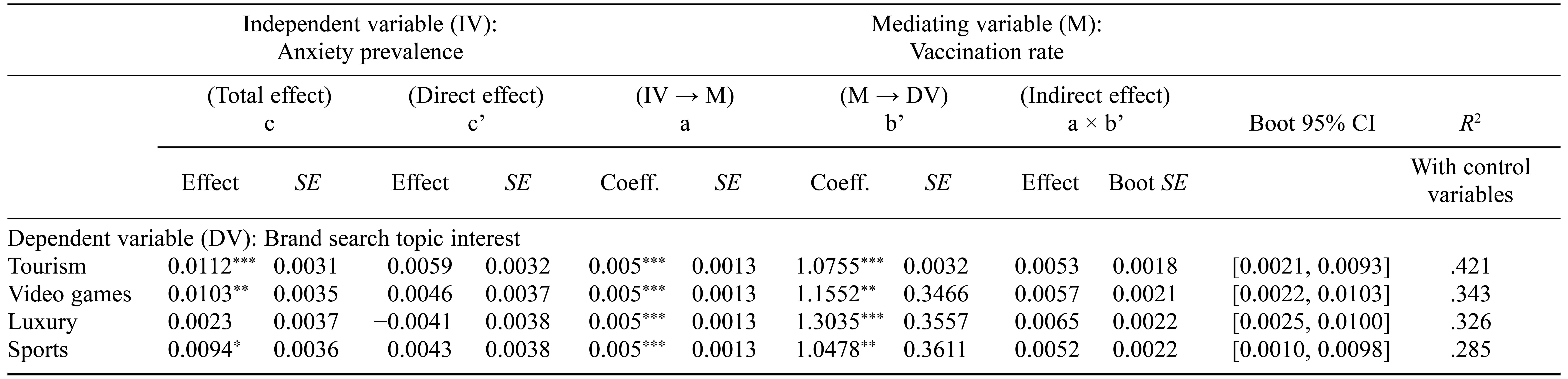
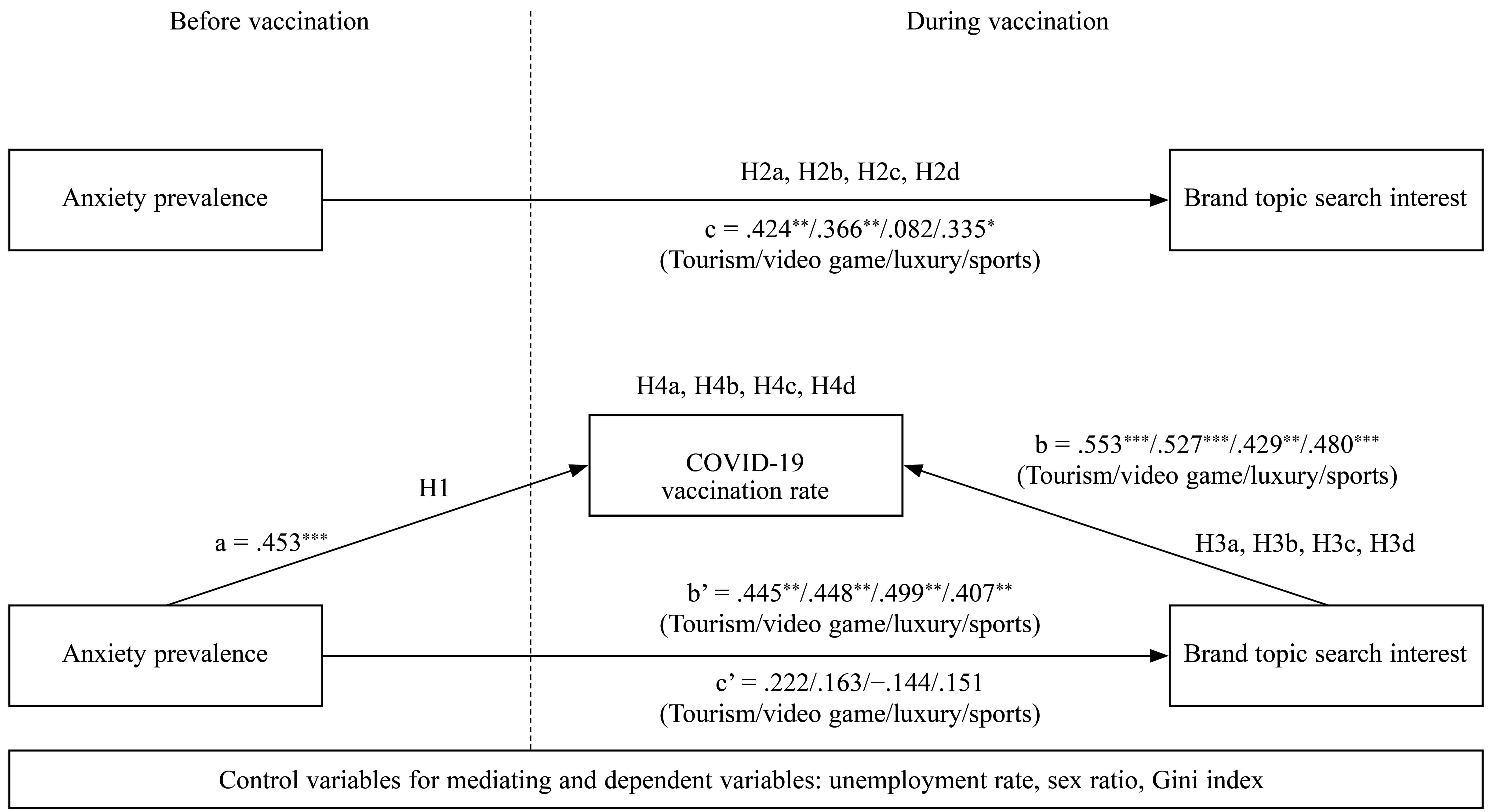
After controlling for unemployment rate, Gini index, and sex ratio, country-level anxiety prevalence was significantly and positively associated with COVID-19 vaccination rate, which supported Hypothesis 1 (see column a in Table 3 or see Figure 3). Country-level anxiety prevalence rate influenced the BTSI of tourism, video games, and sports categories, which supported Hypotheses 2a, 2b, and 2d. However, Hypothesis 2c was not supported. Further, country-level vaccination rate was positively associated with each BTSI, as shown in Figure 3 (see section b), thus supporting Hypotheses 3a, 3b, 3c, and 3d. Locations with higher COVID-19 vaccination rates had higher BTSI for tourism, video game, luxury, and sports topics.
Finally, according to Preacher and Hayes (2004), the mediation effect “implies that the total effect X → Y was initially present” (p. 719); thus, the mediating role of vaccination rate luxury category (Hypothesis 4c) was not supported since the total effects between anxiety prevalence rate and luxury category were not significant (Hypothesis 2c). However, the mediating role of COVID-19 vaccination rate between anxiety prevalence and BTSI in the categories of tourism, video games, and sports was significant, supporting Hypotheses 4a, 4b, and 4d (see Table 3). Furthermore, the direct effect (see the c’ section in Table 3) for the categories of tourism, video games, and sports were nonsignificant, indicating there was a full mediation effect. These findings show that country-level vaccination rate fully mediated the relationship between anxiety prevalence rate and each of these three BTSI. In places with higher country-level anxiety prevalence and vaccination rates, the BTSI of tourism, video games, or sports was higher.
Table 3. Mediating Effect of Anxiety Prevalence on Each Brand Topic Search Interest
Discussion
Theoretical Implications
This study offers several theoretical contributions. First, the multinational model shows that higher anxiety prevalence in 2020 in the countries included in this study was associated with a higher vaccination rate in 2021, which in part echoes single-country surveys indicating that COVID-19 anxiety and risk perceptions are positively associated with vaccination intention (Bendau et al., 2021; Bodner et al., 2022; Majid et al., 2022). This study also examined the relationship in a novel country-level manner using real-world data.
Second, COVID-19 vaccination behavior in 2021 positively influenced BTSI in 2021. From the perspective of TMT, this finding suggests that vaccination is a proximal defense behavior that eliminates conscious anxiety to arouse brand search as a distal defense behavior, thus allowing continued reduction of unconscious anxiety. BTSI regarding tourism, video game, and sports categories were highlighted, which echoes previous TMT studies (Arndt et al., 2003; Kasser & Sheldon, 2000). Moreover, this study supports TMT as a replicable value to explore search behaviors for given brand keywords.
Third, Audrin et al. (2018) demonstrated that according to TMT, attitudes toward materialism moderate the relationship between mortality salience and luxury brand preference. When faced with the stimulus of mortality salience, nonmaterialistic respondents tended to avoid luxury consumption; conversely, those with higher materialistic values preferred luxury goods. Their findings reveal that these two groups have diametrically opposite attitudes toward materialistic luxury consumption. Therefore, I argue that cross-cultural differences in materialism (Ger & Belk, 1996; Zawadzka et al., 2021) might explain the ambiguity and nonsignificance between anxiety prevalence and BTSI of luxury items in my cross-cultural study.
Fourth, online searches for product or brand keywords are a common prepurchase behavior (Jansen & Schuster, 2011). However, my findings indicate that people search for brand topics not only as a prepurchase activity but when there is a higher prevalence of anxiety. Thus, social behavioral researchers conducting studies on mental health should consider the importance of examining online brand behaviors. Understanding online BTSI, as one type of social behavior in modern societies, might help understand how to regulate anxiety prevalence.
Practical Implications
The results of this research also have practical significance. First, social behavior and marketing practitioners can replicate this model to examine other brand keywords (e.g., luxury category in the automotive or cosmetics industry) related to distal defenses to determine which BTSI will benefit in places with higher anxiety prevalence and COVID-19 vaccination rates. People may use these keywords to support their areas of interest, especially relative to self-reported data. For diseases that emerge in the future, the framework of this research can be replicated to help understand online query preferences for brands and product consumption in different societies.
Second, some product and brand opportunities as distal defensive responses may rebound strongly in specific countries postpandemic. Nintendo Switch was one successful product during this pandemic (Lau, 2021) due to stay-at-home restrictions. Nike and Adidas achieved high annual sales turnover in 2021 (Statista 2022b, 2022c), performing better than they had in the previous 5 years (2016–2020). For brands related to travel, sales rebounds may be evaluated in terms of anxiety prevalence and vaccination outcome to help investigate market opportunities through online search behavior. Furthermore, replicating this model in different periods of time will help researchers to detect whether a specific brand opportunity is lasting. Brands’ product demand planners, suppliers, management teams, and stakeholders can benefit from using this model.
Third, these findings can emphasize to policymakers that online BTSI for specific brands are positively associated with anxiety prevalence. According to TMT, some BTSI might play roles in anxiety buffering. Government agencies could work with entertainment and sports brands to create ways to relieve anxiety during the COVID-19 pandemic. Historical events echo TMT. After the 9/11 attacks in the United States, President George W. Bush encouraged citizens to come out and consume. Consequently, between October and December 2001, consumption rose substantially at an annual rate of 6%. During this time, American consumers bought electrical appliances, furniture, and electronic products (Arndt et al., 2004). The model in my study similarly suggests that some countries may be able to avoid a recession if policymakers focus on distal consumption potential.
Limitations and Directions for Future Research
The first limitation of this study is the exclusive use of data sourced from Google. However, Google dominates the global search engine market, with an 84% market share as of July 2022. As such, Google Trends would seem to be the best data source. The number of countries interested in a topic keyword search was limited to 60 to ensure effectiveness, and regions having very low Google Trends penetration rates as reflected in the keyword search rankings were excluded. This structure helped to reduce statistical bias due to the unpopularity of given keywords in specific countries. I did select well-known brand keywords based on their global popularity in given periods; however, future researchers could extract different BTSI based on TMT to examine this model. Second, apart from the brand keyword of “Michelin guide,” the tourism industry lacks other globally recognized brands that are equivalent to Nike for sports brands. I thus chose other popular product terms (“travel” and “hotel”) to develop the tourism topic, but I acknowledge that the composition of tourism BTSI is a limitation. Third, the R2 effect sizes ranged from .285 to .421. Since the focus of this study was on examining important TMT variables at the cross-country level, the linear trend providing underlying support could be examined in future studies. Future researchers could include more variables to support the patterns found. In addition, the significant correlation coefficients between the real-world data (anxiety prevalence, vaccination rate) and Google Trends index (BTSI) ranged from 0.336 to 0.597, which is greater than the values reported in similar country-level or state-level studies, such as that by MacInnis and Hodson (2014), whose values ranged from 0.25 to 0.55, and Vaughan (2014), whose values ranged from −0.31 to −0.40.
On the basis of my findings, I believe that anxiety prevalence is associated with BTSI, as one type of distal defensive response. Future studies could extend the current model to develop appropriate search interest indices in response to events such as the COVID-19 pandemic. Google Trends results can also be compared with self-reported findings to develop repositories for different information sources as a baseline for management decisions.
Table 1. Compilation of Papers Using Google Search Data in 30 Social Sciences Citation Index Journals Within the Consumer, Brand, and Marketing Fields
Figure 1. Example of Regional Search Interests for the Topic Keyword
Table 2. Correlations Between Anxiety Prevalence, Vaccination Rate, Brand Search Interests, and Control Variables
Table 3. Mediating Effect of Anxiety Prevalence on Each Brand Topic Search Interest
The author thanks Dr. Hui Chih Wang, Dr. Her Sen Doong, and Ms. Ying Wen Chi for their continuous feedback and encouragement.
The data that support the findings of this study were derived from the following resources available in the public domain: https://doi.org/10.1016/S0140-6736(21)02143-7; https://bit.ly/3u9121e
Tsang Hsien Wang, Graduate Institute of Management, National Taiwan University of Science and Technology, No. 43, Keelung Road, Sec. 4, Da’an District, Taipei City 106335, Taiwan. Email: [email protected]