Perceived value and willingness to consume in online mobile games
Main Article Content
We investigated the relationship between perceived value of virtual goods and willingness to consume virtual goods in online mobile games, and examined the roles of gamers’ intention to use virtual goods and extraversion in this relationship. We constructed a moderated mediation model to analyze data from 894 undergraduate students in China. Perceived value was positively correlated with willingness to consume, and intention to use played a mediating role in this relationship; further, the indirect effect of intention to use was moderated by extraversion, with a weaker effect occurring for lower extraversion. Thus, perceived value positively predicted intention to use, which increased willingness to consume, and extraversion enhanced the influence of perceived value on intention to use.
Many software applications (apps) have been developed to allow various services to satisfy the daily needs of users. This trend has resulted in the dramatic expansion of the online gaming market in recent years, regarding both market size and the number of gamers (Park & Lee, 2011). The number of mobile phones in China reached 823 million in December 2019 (J.-Y. Kim & Lee, 2020), which means it provides a stable environment for mobile gaming market development. As a form of entertainment, mobile games are not limited by time or space: They are different from computer and traditional ball games that require venues or larger devices. Therefore, they have gradually entered into public life. According to a report by Niko Partners, the number of regular players of online mobile games has already reached 630 million in China, representing a market share of 181.7 billion yuan (Lei, 2020). Gamers invest their time in gaming, but recently they have begun to invest money as well; for example, global players spent $6 billion on mobile games in August 2020 (Molinillo et al., 2020).
Many previous researchers have focused on game user behavior (Mozgovoy, 2018; Nacke, 2015; Wang et al., 2019), game addiction (Bharathi et al., 2016; King & Delfabbro, 2020; Lee & Kim, 2017; Madigan, 2015), gamers’ motivation to play online games (Wibowo & Simanjuntak, 2020), and factors affecting intention to play online games (Athapaththu & Kulathunga, 2018; Buchan & Taylor, 2016). Although it is important to analyze these characteristics in potential gamers, it is also important for gaming companies to know what affects gamers’ willingness to consume virtual goods in online mobile games, to increase profits. Researchers have shown that perceived value is closely related to willingness to consume; for example, perceived quality, price, emotional values, and environmental factors have been found to significantly and positively influence consumers’ purchasing attitudes (Zhang et al., 2020). Of the factors that affect willingness to consume, consumption intention has a particularly strong influence (Cooke et al., 2016). In addition, empirical results have shown that performed value promotes intention to consume (Fu et al., 2018; S. Kim & Choe, 2019).
However, few researchers have examined the relationship between perceived value of virtual goods and willingness to consume virtual goods in the context of online mobile games, especially with a sample of undergraduate students, who, as a group with a relatively unique social life, have much free time and money to invest in online mobile games. Using data from a questionnaire completed by undergraduate student participants, we investigated the relationship between perceived value and willingness to consume, and also the roles of gamers’ intention to use virtual goods and extraversion in this relationship.
Literature Review and Hypothesis Development
Of the many factors that affect consumption, the role of perceived value is particularly prominent. Perceived value is consumers’ evaluation of the benefits of a product or service based on their advance sacrifices and ex post perceived performance when they use mobile value-added services (Kuo et al., 2009). More broadly, perceived value refers to the degree to which individuals believe that using a particular product or service can improve their performance (Davis, 1989). Empirical researchers have demonstrated that perceived value promotes consumption willingness (Jaworska et al., 2020; Johnson & Ramirez, 2020). For example, Hwang et al. (2020) reported that perceived value has the strongest total effect on online shoppers’ willingness to continue using online shopping websites. Further, Li et al. (2020) argued that subjective norms and perceived value have a significant effect on willingness to purchase environmentally friendly agricultural food. Researchers of the online consumption of specific goods have shown that when the perceived usefulness of goods increases, consumers’ willingness to consume online also increases, whether it is physical goods (Bonn et al., 2016) or services (Renny et al., 2013) that is on offer. Thus, we proposed the following hypothesis:
Hypothesis 1: Perceived value of virtual goods will be positively associated with willingness to consume virtual goods in online mobile games.
Mediating Role of Intention to Use Virtual Goods
Regarding the willingness to consume virtual goods, another essential influencing factor is intention to use, which refers to a player’s intention to use virtual goods in the game without considering the cost; further, willingness to consume is the intention to purchase them (Hamari et al., 2017). It is pointed out in the online willingness to consume model that intention to use online information tools is an important factor in online consumption (Shim et al., 2001). Researchers of augmented reality contexts have also found that the intention to use related technologies affects consumers’ willingness to consume (Kim & Choe, 2019). Similarly, studies of online games have reported that intention to use is the prefactor and proximate cause of gamers’ willingness to consume (Hamari et al., 2017). As virtual goods can be purchased only on a gamer’s individual gaming platform, intention to use online goods has a strong positive effect on willingness to consume (Hamari & Keronen, 2017). In their meta-analysis Hamari and Keronen (2017) also found a significant positive correlation between intention to use virtual goods and willingness to consume. According to the technology acceptance model, perceived value is an important factor in an individual’s willingness to use technology and related products, and the effect of perceived value on willingness to consume is mediated by intention to use (Davis, 1989). Empirical researchers have shown that the perceived value of Internet goods or services is strongly positively correlated with consumers’ intention to use these services and goods (Bauer et al., 2006; Chang & Chou 2012). Therefore, we proposed the following hypothesis:
Hypothesis 2: Intention to use virtual goods will mediate the relationship between perceived value and willingness to consume.
Moderating Role of Extraversion
Consumer personality characteristics are also essential factors that affect online consumption (Hamari, 2015). For example, extroverts pay more attention to external information, and introverts pay more attention to their inner thoughts and feelings (Barkhi & Wallace, 2007). Thus, the attitudes and decisions of extroverts (vs. introverts) are more susceptible to external details (Barkhi & Wallace, 2007). Studies of online consumption have also shown that information on shopping websites has a stronger influence on the online consumption attitudes of highly extroverted (vs. introverted) individuals (Chen & Lee, 2008). As highly extroverted individuals also adjust more quickly to changes in external information (Walczuch & Lundgren, 2004), they may also be more likely to adjust their intention to use according to perceived value of online goods. Thus, we proposed the following hypothesis:
Hypothesis 3: Extraversion will play a moderating role in the relationship between perceived value and intention to use virtual goods.
The research model is presented in Figure 1.
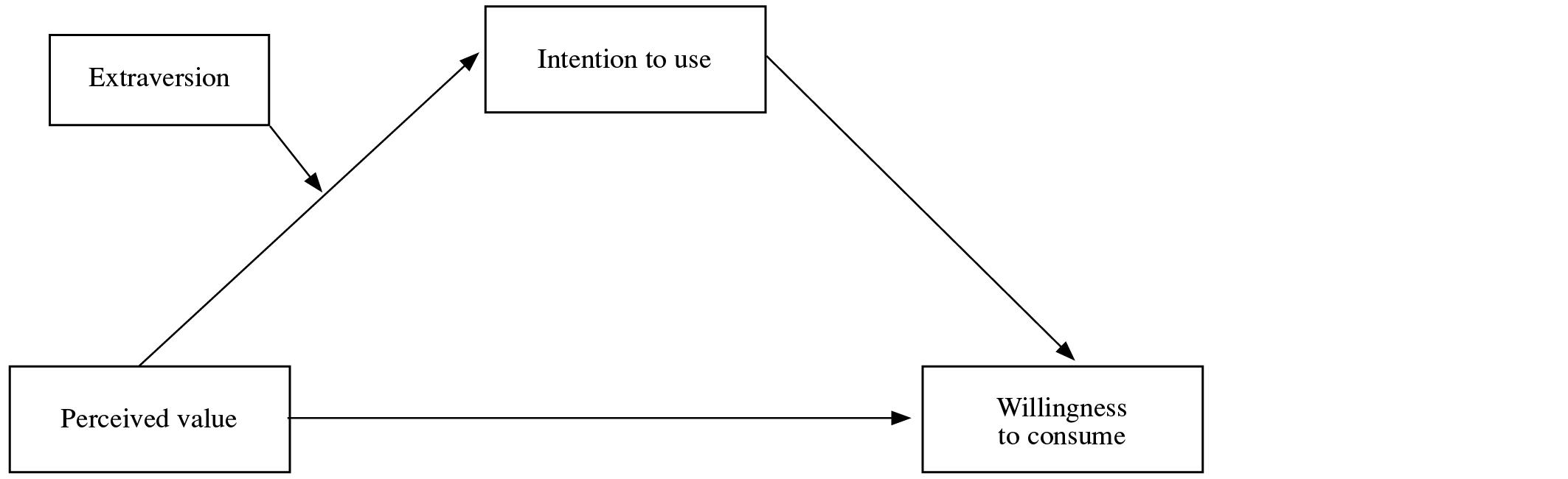
Figure 1. Theoretical Model
Method
Participants and Procedure
Participants were mainly Chinese undergraduate students in Guangzhou, Shanghai, Beijing, and Wuhan. They were informed of the purpose of the survey before completing the questionnaire, and we obtained data authorization for the study. All participants voluntarily completed a battery of self-report questionnaires, and did not receive any payment. Data were collected between June 10 and August 20, 2020, using the Chinese professional survey website Wenjuanxing (https://www.wjx.cn/), which enabled generation of a hyperlink to the survey.
We sent out 960 questionnaires, of which 894 valid questionnaires were obtained after we had eliminated those with missing answers and identical responses throughout (effective rate = 92.25%). Of the participants, 392 were women (43.85%) and 502 were men (56.15%), they comprised 376 freshmen, 230 sophomores, 132 juniors, and 156 seniors, and their average age was 20.06 years (SD = 1.36).
Measures
Willingness to Consume
We used the five-item Willingness to Buy Scale (Dodds et al., 1991) to measure willingness to consume online mobile games. Items are assessed on a 7-point Likert scale ranging from 1 (very low) to 7 (very high). A sample item is “The probability that I would consider buying virtual goods in online mobile games is…” Higher scores indicate greater willingness to consume virtual goods.
Perceived Value
We used the five-item Perceived Value Scale (Dodds et al., 1991) to measure perceived value. Items are assessed on a 7-point Likert scale ranging from 1 (strongly disagree) to 7 (strongly agree). A sample item is “The virtual goods in online mobile games are considered to be a good buy.” Higher scores indicate greater perceived value of virtual goods.
Intention to Use
We used the two-item Intention to Use Scale (Joo et al., 2017) to measure intention to use. Joo et al.’s (2017) scale was used to investigate intention to use digital textbooks, so we reworded the items to replace the key term of digital textbooks with virtual goods in online mobile games. Items are assessed on a 7-point Likert scale ranging from 1 (strongly disagree) to 7 (strongly agree). A sample item is “I intend to increase my use of virtual goods in online mobile games in the future.”
Extraversion
We used the eight-item Extraversion Scale (John et al., 1991) to measure extraversion. Items are assessed on a 5-point scale ranging from 1 (strongly disagree) to 5 (strongly agree). A sample item is “I have an assertive personality.” This scale is one of the most commonly used personality test tools (Molinillo et al., 2019).
Control Variables
We included the control variables of gender, age, and grade because several researchers have found that individual differences in these demographic variables influence the willingness to consume (Park & Lee, 2011). Gender was dummy coded as 1 = male and 0 = female; grade was classified as freshmen, sophomores, juniors, or seniors; and age was considered as a continuous variable.
Results
Reliability and Validity
We determined the internal reliability of the scale by calculating Cronbach’s alpha values, which were .89 for the Willingness to Buy Scale, .82 for the Perceived Value Scale, .86 for the Intention to Use Scale, and .75 for the Extraversion Scale. As all values were over .70, the measures had acceptable internal reliability. Descriptive statistics and correlation analysis results are shown in Table 1. The results show that perceived value, willingness to consume, and intention to use were significantly and positively correlated with one another.
Table 1. Means, Standard Deviations, and Correlations for Study Variables

Note. N = 894.
*** p < .001.
Relationship Between Willingness to Consume and Perceived Value
To test the mediating role of intention to use in the relationship between perceived value and willingness to consume, we used the SPSS Process macro Model 4 (Hsu & Lin, 2019). We examined the relationship between perceived value and willingness to consume, and then between perceived value and intention to use; thus, intention to use and willingness to consume were the dependent variables. Results in Table 2 show that perceived value was significantly and positively associated with willingness to consume (Model 4), and that perceived value was significantly and positively associated with intention to use (Model 2). We then used the dependent variable to regress the independent variable and the mediating variable at the same time, and the positive relationship between perceived value and willingness to consume still held (Model 5).
Table 2. Mediating Effect of Intention to Use
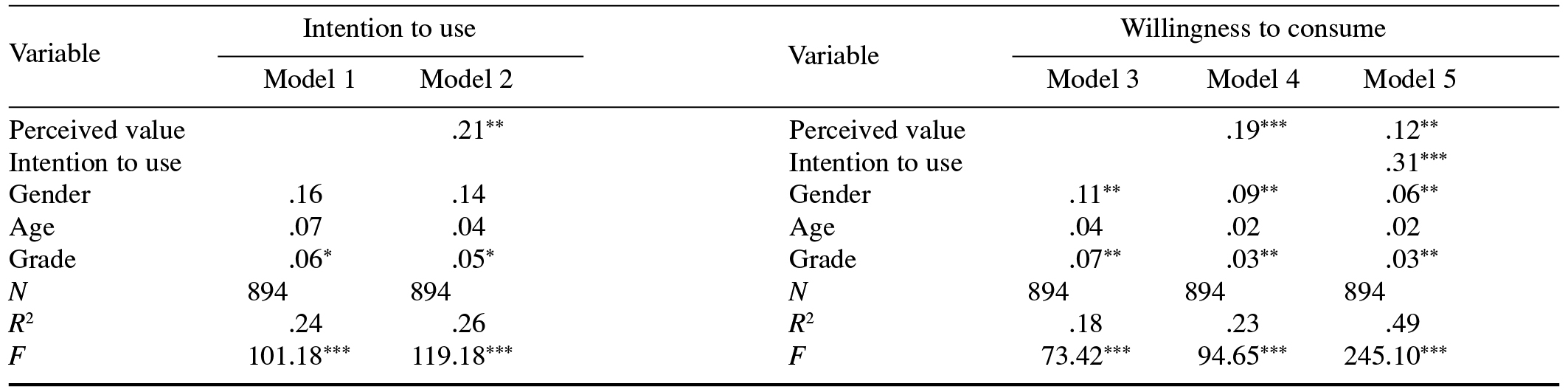
Note. * p < .05. ** p < .01. *** p < .001.
To make the results more robust, we used the Process Macro (Hsu & Lin, 2019) to perform a bootstrapping analysis in SPSS with 5,000 resamples and 95% confidence intervals (CIs) of the mediating effect. The nonparametric percentile method of deviation correction was used. The indirect effect was .07, 95% CI [0.03, 0.12], and the proportion of the mediating effect in the total effect (.19) was 36.84%. Because the direct effect was significant, there was a partial mediating effect of intention. Therefore, Hypothesis 2 was supported.
Next, we used the SPSS Process macro Model 7 (Hsu & Lin, 2019) to examine the moderating effect of extraversion. The results show that the relationship between perceived value and intention to use was significantly positive, with an influence coefficient of 0.2 (p < .05), and extraversion was not significantly correlated with intention to use (p > .10; see Table 3). The coefficient of the interaction between perceived value and extraversion was significantly positive (Model 9, β = .06, p < .01), indicating that extraversion played a moderating role in the relationship between perceived value and intention to use. The index was 0.06, CI [0.02, 0.14], which did not contain zero, indicating that the moderated mediating effect was significant. Thus, the perceived value of virtual goods was more positively associated with intention to use in individuals with high (vs. low) extraversion.
Table 3. Moderating Effect of Extraversion
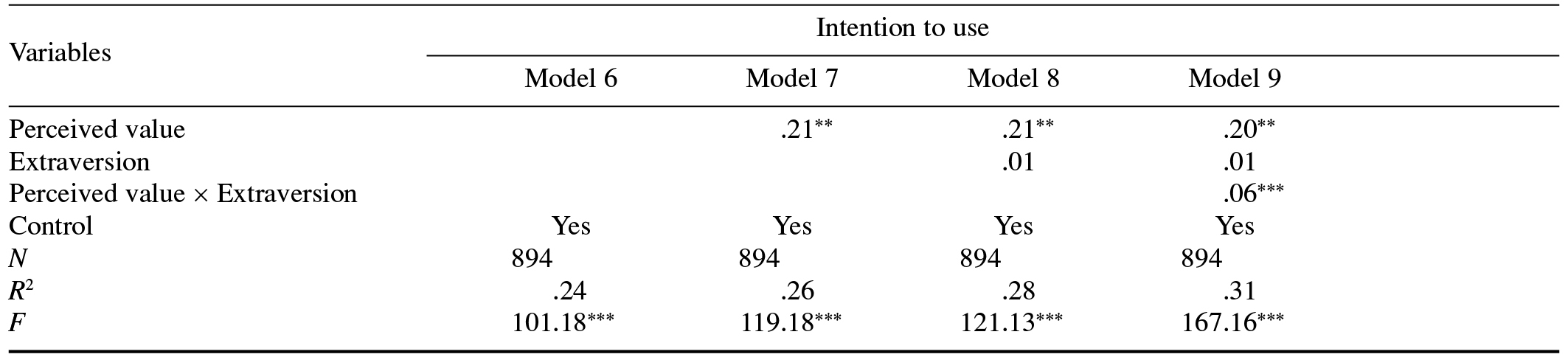
Note. ** p < .01. *** p < .001.
To further explore the moderating effect, we used Hsu and Lin’s (2019) approach to divide participants into high and low extraversion groups, on the basis of standard deviations above or below the average extraversion score (±1 SD). The indirect effect of the high extraversion group was .08, 95% CI [0.04, 0.13], and that of the low extraversion group was .05, CI [0.03, 0.08]. Further, slope analysis of the regression results reveals that perceived value had a significant positive predictive effect on intention to use (simple slope = .15, t = 5.52, p < .001) in the low extraversion group. In the high extraversion group, perceived value had a stronger predictive effect on intention to use (simple slope = .27, t = 10.39, p < .001).
Discussion
Previous researchers have highlighted the need for further exploration of the mechanisms and conditions underlying online game consumption (Hamari & Keronen, 2017). An understanding of these mechanisms is necessary for the promotion or restriction of online game products. In this study we empirically examined the mechanism of virtual commodity characteristics underlying the intention to consume virtual goods in online mobile games. We assessed the joint effect of player and virtual commodity characteristics to better understand differences in the effect of the latter on game players with different personality traits.
Our results show that perceived value of virtual goods had a positive predictive effect on willingness to consume virtual goods in online mobile games. Further, intention to use virtual goods played a mediating role in this predictive effect: When game players perceived the value of virtual goods, their intention to use them was enhanced (Huang, 2018; Jung & Lee, 2018). Previous researchers have found that willingness to consume increases when gamers have a higher intention to use online game products (Hamari & Keronen, 2017). Therefore, gaming companies should pay more attention to the role of virtual goods, and meet players’ needs when they are designing virtual goods in online mobile games. Further, gaming companies could consider providing free or limited-time free virtual goods to improve gamers’ intention to use them, and to increase willingness to consume virtual goods in online mobile games.
We also found that extraversion moderated the predicted perceived value of virtual goods on intention to use, such that strong positive correlations were found between perceived value of virtual goods and intention to use in the high extraversion group. Previous researchers have found that extroverts pay more attention to intense and stimulating experiences, and to feelings brought about by consumption (Balakrishnan & Griffiths, 2018). Their decisions are, thus, more dependent on external information (Bilgihan, 2016). In turn, this suggests that the characteristics of virtual goods will more strongly influence the use intention of more extroverted (vs. introverted) individuals (Balakrishnan & Griffiths, 2018). At the same time, extroverted people are more inclined to adjust their decisions according to changes in external information (Calvo-Porral & Nieto-Mengotti, 2019). Altogether, this shows that when the perceived value of virtual goods is high, more extroverted individuals are more inclined to use them, and are also more prone to stop using them. Therefore, designers should pay attention to satisfaction from virtual goods and how they can meet gamers’ needs in online mobile games, to provide optimal conditions for the engagement of extroverts.
Our study has some limitations. First, the sample was composed mainly of undergraduate students, who are the main consumers of online games. However, the number of younger gamers is increasing as online mobile games become more popular, as is the number of older game users as early users of online mobile games get older. Therefore, future researchers could survey participants of different ages. Second, we found a moderating role of extraversion in the relationship between perceived value and intention to use. However, other personality traits, such as openness and conscientiousness, should also be examined, as they may also have a moderating effect in this relationship.
Athapaththu, J. C., & Kulathunga, D. (2018). Factors affecting online purchase intention: Effects of technology and social commerce. International Business Research, 11(10), 111–128.
https://doi.org/10.5539/ibr.v11n10p111
Balakrishnan, J., & Griffiths, M. D. (2018). Loyalty towards online games, gaming addiction, and purchase intention towards online mobile in-game features. Computers in Human Behavior, 87, 238–246.
https://doi.org/10.1016/j.chb.2018.06.002
Barkhi, R., & Wallace, L. (2007). The impact of personality type on purchasing decisions in virtual stores. Information Technology and Management, 8(4), 313–330.
https://doi.org/10.1007/s10799-007-0021-y
Bauer, D. J., Preacher, K. J., & Gil, K. M. (2006). Conceptualizing and testing random indirect effects and moderated mediation in multilevel models: New procedures and recommendations. Psychological Methods, 11(2), 142–163.
https://doi.org/10.1037/1082-989X.11.2.142
Bharathi, A. K. B. G., Singh, A., Tucker, C. S., & Nembhard, H. B. (2016). Knowledge discovery of game design features by mining user-generated feedback. Computers in Human Behavior, 60, 361–371.
https://doi.org/10.1016/j.chb.2016.02.076
Bilgihan, A. (2016). Gen Y customer loyalty in online shopping: An integrated model of trust, user experience and branding. Computers in Human Behavior, 61, 103–113.
https://doi.org/10.1016/j.chb.2016.03.014
Bonn, M. A., Kim, W. G., Kang, S., & Cho, M. (2016). Purchasing wine online: The effects of social influence, perceived usefulness, perceived ease of use, and wine involvement. Journal of Hospitality Marketing & Management, 25(7), 841–869.
https://doi.org/10.1080/19368623.2016.1115382
Buchan, A., & Taylor, J. (2016). A qualitative exploration of factors affecting group cohesion and team play in multiplayer online battle arenas (MOBAs). The Computer Games Journal, 5(1), 65–89.
https://doi.org/10.1007/s40869-016-0017-0
Calvo-Porral, C., & Nieto-Mengotti, M. (2019). The moderating influence of involvement with ICTs in mobile services. Spanish Journal of Marketing - ESIC, 23(1), 25–43.
https://doi.org/10.1108/sjme-08-2018-0036
Chang, S.-C., & Chou, C.-M. (2012). The roles of constraint-based and dedication-based influences on users’ continued online shopping behavior [In Spanish]. The Spanish Journal of Psychology, 15(3), 1177–1200.
https://doi.org/10.5209/rev_SJOP.2012.v15.n3.39406
Chen, S.-H., & Lee, K.-P. (2008). The role of personality traits and perceived values in persuasion: An elaboration likelihood model perspective on online shopping. Social Behavior and Personality: An international journal, 36(10), 1379–1399.
https://doi.org/10.2224/sbp.2008.36.10.1379
Cooke, R., Dahdah, M., Norman, P., & French, D. P. (2016). How well does the theory of planned behaviour predict alcohol consumption? A systematic review and meta-analysis. Health Psychology Review, 10(2), 148–167.
https://doi.org/10.1080/17437199.2014.947547
Davis, F. D. (1989). Perceived usefulness, perceived ease of use, and user acceptance of information technology. MIS Quarterly, 13(3), 319–340.
https://doi.org/10.2307/249008
Dodds, W. B., Monroe, K. B., & Grewal, D. (1991). Effects of price, brand, and store information on buyers’ product evaluations. Journal of Marketing Research, 28(3), 307–319.
https://doi.org/10.1177/002224379102800305
Fu, Y., Liu, X., Wang, Y., & Chao, R.-F. (2018). How experiential consumption moderates the effects of souvenir authenticity on behavioral intention through perceived value. Tourism Management, 69, 356–367.
https://doi.org/10.1016/j.tourman.2018.06.023
Hamari, J. (2015). Why do people buy virtual goods? Attitude toward virtual good purchases versus game enjoyment. International Journal of Information Management, 35(3), 299–308.
https://doi.org/10.1016/j.ijinfomgt.2015.01.007
Hamari, J., Hanner, N., & Koivisto, J. (2017). Service quality explains why people use freemium services but not if they go premium: An empirical study in free-to-play games. International Journal of Information Management, 37(1), 1449–1459.
https://doi.org/10.1016/j.ijinfomgt.2016.09.004
Hamari, J., & Keronen, L. (2017). Why do people buy virtual goods: A meta-analysis. Computers in Human Behavior, 71, 59–69.
https://doi.org/10.1016/j.chb.2017.01.042
Hsu, P.-F., & Lin, S.-K. (2019). Effects of reciprocal, perceived person–environment fit, and emotional labor on job involvement: Moderated mediation analyses. Cogent Business & Management, 6(1), Article 1603816.
https://doi.org/10.1080/23311975.2019.1603816
Huang, R.-T. (2018). What motivates people to continuously post selfies? The moderating role of perceived relative advantage. Computers in Human Behavior, 80, 103–111.
https://doi.org/10.1016/j.chb.2017.11.007
Hwang, A. H.-C., Oh, J., & Scheinbaum, A. C. (2020). Interactive music for multisensory e-commerce: The moderating role of online consumer involvement in experiential value, cognitive value, and purchase intention. Psychology & Marketing, 37(8), 1031–1056.
https://doi.org/10.1002/mar.21338
Jaworska, D., Królak, M., Przybylski, W., & Jezewska-Zychowicz, M. (2020). Acceptance of fresh pasta with β-glucan addition: Expected versus perceived liking. Foods, 9(7), Article 869.
https://doi.org/10.3390/foods9070869
John, O. P., Donahue, E. M., & Kentle, R. L. (1991). Big Five Inventory (BFI) [Database record]. APA PsycTests.
https://doi.org/10.1037/t07550-000
Johnson, O., & Ramirez, S. A. (2020). The influence of showrooming on millennial generational cohorts online shopping behaviour. International Journal of Retail & Distribution Management, 49(1), 81–103.
https://doi.org/10.1108/IJRDM-03-2020-0085
Joo, Y. J., Park, S., & Shin, E. K. (2017). Students’ expectation, satisfaction, and continuance intention to use digital textbooks. Computers in Human Behavior, 69, 83–90.
https:/doi.org/10.1016/j.chb.2016.12.025
Jung, Y., & Lee, J. (2018). Learning engagement and persistence in massive open online courses (MOOCS). Computers & Education, 122, 9–22.
https://doi.org/10.1016/j.compedu.2018.02.013
Kim, J.-Y., & Lee, J.-H. (2020). Effect of mobile commerce interaction characteristics on game advertising effect and game re-purchase intent. Research in World Economy, 11(2), 59–69.
https://doi.org/10.5430/rwe.v11n2p59
Kim, S., & Choe, J. Y. (2019). Testing an attribute-benefit-value-intention (ABVI) model of local food consumption as perceived by foreign tourists. International Journal of Contemporary Hospitality Management, 31(1), 123–140.
https://doi.org/10.1108/IJCHM-10-2017-0661
King, D. L., & Delfabbro, P. H. (2020). Video game addiction. In C. A. Essau & P. Delfabbro (Eds.), Adolescent addiction: Epidemiology, assessment, and treatment (2nd ed., pp. 185–213). Academic Press.
https://doi.org/10.1016/b978-0-12-818626-8.00007-4
Kuo, Y.-F., Wu, C.-M., & Deng, W.-J. (2009). The relationships among service quality, perceived value, customer satisfaction, and post-purchase intention in mobile value-added services. Computers in Human Behavior, 25(4), 887–896.
https://doi.org/10.1016/j.chb.2009.03.003
Lee, C., & Kim, O. (2017). Predictors of online game addiction among Korean adolescents. Addiction Research & Theory, 25(1), 58–66.
https://doi.org/10.1080/16066359.2016.1198474
Lei, L. (2020). Analysis of the development and potential of China’s gaming industry [In Chinese]. Marketing Research, 5, 65–69.
https://doi.org/10.13999/j.cnki.scyj.2020.05.025
Li, L., Long, X., Laubayeva, A., Cai, X., & Zhu, B. (2020). Behavioral intention of environmentally friendly agricultural food: The role of policy, perceived value, subjective norm. Environmental Science and Pollution Research, 27(15), 18949–18961.
https://doi.org/10.1007/s11356-020-08261-x
Madigan, J. (2015). Getting gamers: The psychology of video games and their impact on the people who play them. Rowman & Littlefield.
Molinillo, S., Japutra, A., & Liébana-Cabanillas, F. (2020). Impact of perceived value on casual mobile game loyalty: The moderating effect of intensity of playing. Journal of Consumer Behaviour, 19(5), 493–504.
https://doi.org/10.1002/cb.1831
Mozgovoy, M. (2018, August 15–17). Analyzing user behavior data in a mobile tennis game [Paper presentation]. 2018 IEEE Games, Entertainment, Media Conference (GEM), Galway, Ireland.
https://doi.org/10.1109/gem.2018.8516512
Nacke, L. E. (2015). Games user research and physiological game evaluation. In R. Bernhaupt (Ed.), Game user experience evaluation (pp. 63–86). Springer.
https://doi.org/10.1007/978-3-319-15985-0_4
Park, B.-W., & Lee, K. C. (2011). Exploring the value of purchasing online game items. Computers in Human Behavior, 27(6), 2178–2185.
https://doi.org/10.1016/j.chb.2011.06.013
Renny, Guritno, S., & Siringoringo, H. (2013). Perceived usefulness, ease of use, and attitude towards online shopping usefulness towards online airlines ticket purchase. Procedia - Social and Behavioral Sciences, 81, 212–216.
https://doi.org/10.1016/j.sbspro.2013.06.415
Shim, S., Eastlick, M. A., Lotz, S. L., & Warrington, P. (2001). An online prepurchase intentions model: The role of intention to search. Journal of Retailing, 77(3), 397–416.
https://doi.org/10.1016/s0022-4359(01)00051-3
Walczuch, R., & Lundgren, H. (2004). Psychological antecedents of institution-based consumer trust in e-retailing. Information & Management, 42(1), 159–177.
https://doi.org/10.1016/j.im.2003.12.009
Wang, Y., Tian, L., & Chen, Z. (2019). Game analysis of access control based on user behavior trust. Information, 10(4), Article 132.
https://doi.org/10.3390/info10040132
Wibowo, D. C. S., & Simanjuntak, E. R. (2020). Factors affecting repurchase intention of digital products on online games in Indonesia. International Journal of Management and Humanities, 4(10), 14–23.
https://doi.org/10.35940/ijmh.g0681.0641020
Zhang, Y., Xiao, C., & Zhou, G. (2020). Willingness to pay a price premium for energy-saving appliances: Role of perceived value and energy efficiency labeling. Journal of Cleaner Production, 242, Article 118555.
https://doi.org/10.1016/j.jclepro.2019.118555
Figure 1. Theoretical Model
Table 1. Means, Standard Deviations, and Correlations for Study Variables
Note. N = 894.
*** p < .001.
Table 2. Mediating Effect of Intention to Use
Note. * p < .05. ** p < .01. *** p < .001.
Table 3. Moderating Effect of Extraversion
Note. ** p < .01. *** p < .001.
Boyuan Wu, School of Economics, Huazhong University of Science and Technology, No. 1037 Luoyu Road, Wuhan, Hubei 430074, People’s Republic of China. Email: [email protected]