Proactive personality and employee outcomes: The moderating role of team autonomy
Main Article Content
We used self-determination theory to investigate the effects of proactive personality on employees’ work engagement and helping behavior, as well as the moderating role of team autonomy in this relationship. Two-wave data were collected from 75 sales teams (75 team leaders and 464 team members) from a large private company in South China. Multilevel path model analysis was used to test our hypotheses. The impact of proactive personality was amplified in teams with a higher level of team autonomy. Our findings not only provide empirical support for self-determination theory, but also contribute to the proactive personality literature by revealing the critical boundary condition of the effectiveness of proactive personality. Theoretical and practical implications are discussed.
With rapid changes occurring in the external environment, organizations nowadays have higher expectations of employees’ timely and proactive responses to transient and unpredictable demands (e.g., Friedman, 2005; Fugate et al., 2004). Fuller and Marler (2009) pointed out that proactive personality serves as one of the key drivers of individuals’ success and the competitive advantages of organizations. Proactive personality, a concept proposed by Bateman and Crant (1993), describes a relatively stable dispositional tendency for individuals to initiate change in the environment. Prior researchers have found that proactive personality is positively related to performance (Thomas et al., 2010; Thompson, 2005), innovation, and career success (Fuller & Marler, 2009; Seibert et al., 2001). Employees who are able to succeed in a dynamic environment are more likely to proactively create circumstances to reach their goals, rather than passively obeying or enduring unsatisfying circumstances (Ashford & Black, 1996; Chan & Schmitt, 2000). Thus, employees with a higher level of proactive personality are of great value to organizations (Seibert et al., 2001; Thomas et al., 2010).
On the basis of self-determination theory (SDT; Deci & Ryan, 1985), we investigated the impacts of employees’ proactive personality on employees’ in-role and extrarole behaviors. In-role behaviors refer to behaviors that are expected, evaluated, and rewarded in the workplace (Van Dyne et al., 1994), whereas extrarole behaviors refer to efforts that employees exert voluntarily beyond the requirements of the formal reward system (Becker & Kernan, 2003). We operationalized employees’ in-role behaviors as work engagement, and extrarole behaviors as helping behaviors. Specifically, work engagement captures the “state including vigor, dedication, and absorption” (Bakker & Demerouti, 2008, p. 209), reflecting employees’ energy and enthusiasm about their work, and is one of the most prominent indicators of employees’ in-role performance (Schaufeli et al., 2006). Helping behaviors have long been conceptualized as a typical manifestation of employees’ organizational citizenship behavior, reflecting employees’ extrarole behaviors in the workplace. Therefore, we investigated the impacts of proactive personality on both work engagement and helping behaviors.
Moreover, building on SDT, we further investigated the cross-level moderating role of team autonomy in shaping the impacts of proactive personality on employee outcomes. Taken together, this study contributes to the literature of both self-determination theory and proactive personality in examining the boundary condition of the benefits from need satisfaction of proactive personality.
Theoretical Background and Hypothesis Development
Proactive personality refers to an individual’s tendency to actively influence the surrounding environment (Bateman & Crant, 1993). Research has shown that proactive personality is a trait that explains unique variance in criteria beyond the Big Five personality factors (Crant & Bateman, 2000). That is, when investigating the impacts of personality on employee outcomes, prior studies found that proactive personality is a prominent predictor that impacts on a wide array of employees’ positive behavioral outcomes in the workplace (e.g., job performance, taking charge, voice), and such positive effects of proactive personality have been found to be more salient as compared to the effects of other personality variables, such as the Big Five trait factors (i.e., agreeableness, extraversion, openness to experience, conscientiousness, and neuroticism; Crant & Bateman, 2000; Fuller & Marler, 2009). Proactive individuals choose or even create conditions to achieve their goals (Seibert et al., 1999). Thus, they are more likely to search actively for information, identify opportunities, take actions, and persevere until they create new and favorable circumstances (Crant, 1995; Frese & Fay, 2001; Thomas et al., 2010). In other words, these individuals are more likely to engage in proactive behaviors that can turn their ideas into reality (Bergeron et al., 2014; Seibert et al., 1999). In contrast, individuals with a lower level of proactive personality tend to adapt passively to the circumstances of the situation, with relatively limited proactive activities initiated to change the environment (Bateman & Crant, 1993).
SDT is one of the fundamental theories delineating human motivation, personality, and behavioral self-regulation (Ryan et al., 1997). Specifically, this theory suggests that, compared with activities involving less autonomy, activities that are pursued for autonomous reasons are more effective in satisfying people’s basic psychological needs (Deci & Ryan, 2000). Given that proactive behaviors are self-initiated (Parker et al., 2006) and are aligned with the focal individuals’ values and interests, employees with a higher (vs. lower) level of proactive personality are more likely to experience a greater sense of self-determination (Seibert et al., 1999). Hence, employees with a higher level of proactive personality are more likely to engage in proactive behaviors in the workplace. Building on these ideas, we further investigated the impacts of proactive personality on employees’ in-role behaviors (e.g., work engagement) and extrarole behaviors (e.g., helping behaviors).
Work engagement, which has been found to be a critical work outcome that is initiated by employees’ proactive personality (e.g., Bakker et al., 2012; Christian et al., 2011), represents a positive and fulfilling state of mind in work that is characterized by vigor, dedication, and absorption (Schaufeli et al., 2002). High engagement in work-related activities means that the employee believes work is something meaningful to pursue, and that it is aligned with their personal values and interests. Therefore, employees with a higher (vs. lower) level of proactive personality more frequently engage in task activities (Bergeron et al., 2014) and are more willing to actively change their work environment to push projects forward even when there are great challenges or obstacles (Bateman & Crant 1993). Further, employees with a higher level of proactive personality tend to immerse themselves in their job (M. Li et al., 2017). Thus, we proposed the following hypothesis:
Hypothesis 1: Proactive personality will be positively related to work engagement.
Moreover, proactive employees in work teams engage in a wide range of proactive activities to realize their goals (e.g., Bateman & Crant, 1993; Parker, 1998), including activities that are not formally required by work roles. Specifically, extrarole or organizational citizenship behavior (OCB) refers to voluntary actions taken to “support the social and psychological environment in which task performance takes place” (Organ, 1997, p. 95). It is notable that although such behaviors can improve the operational effectiveness of the organization, they are not directly rewarded by the organization’s formal compensation system (Organ, 1997). Organ (1988) identified five categories of OCB: altruism, courtesy, sportsmanship, conscientiousness, and civic virtue. Among these, helping behaviors capture employees’ discretionary behaviors that are aimed at helping a specific other person with a work-related task or problem (Organ, 1997, 1988).
We conceptualized helping behaviors as a form of self-initiated behavior for proactive employees to change the environment. That is, employees can actively change their working environments (e.g., fixing work-related problems) by helping their colleagues. According to SDT, such employees with a higher level of proactive personality should be more likely to perform such helping behaviors, as these align with the employees’ psychological needs and thereby facilitate higher intrinsic motivation to help.
Supporting our theorizing, prior studies have suggested that proactive personality plays an important role in facilitating employees’ helping behaviors in the workplace. For example, Bergeron et al. (2014) found that proactive personality was positively related to the frequency of engaging in OCB. Further, Greguras and Diefendorff (2010) found a positive relationship between proactive personality and OCB. Moreover, the meta-analysis conducted by Fuller and Marler (2009) showed a positive relationship between proactive personality and employees’ voice, and taking-charge behaviors. Therefore, we proposed the following hypothesis:
Hypothesis 2: Proactive personality will be positively related to helping behavior.
Even though humans are liberally endowed with intrinsic motivational tendencies, the maintenance and enhancement of their inherent propensity requires supportive conditions (Ryan & Deci, 2000). In teams, the effect of personality traits on outcome variables is often influenced by contextual factors such as team psychological empowerment. Spreitzer (1995) divided psychological empowerment into four dimensions: meaningfulness (recognition of the meaning of one’s work), self-efficacy (perception of one’s ability to perform a task), autonomy (recognition of the ability to determine one’s own work behavior), and influence (the perception that one can have a significant impact on the outcome of work in an organization).
SDT suggests that individuals are motivated to maintain an optimum level of stimulation and have basic needs for competence, autonomy, and relatedness (Deci & Ryan, 2000). In particular, the need for autonomy refers to individuals’ need to act with a sense of ownership of their behavior and feel psychologically free (Deci & Ryan, 2000), and it is conceivable that the need for autonomy can be satisfied by the external environment (e.g., a work group with a higher level of team autonomy). Specifically, in groups with a higher level of team autonomy, employees can work with a sense of choice and volition on teamwork (Van den Broeck et al., 2016), and such an environment also ensures the possibility for employees to actively change their work circumstances. Therefore, for employees with higher levels of proactive personality, working in teams with higher levels of autonomy strengthens the impact of proactive personality by not only amplifying their psychological needs satisfaction, but also facilitating the possibility of initiating proactive changes in the work environment. Taken together, we proposed the following hypotheses:
Hypothesis 3: Team autonomy will moderate the relationship between proactive personality and work engagement. When the level of autonomy is high, the positive effect of proactive personality on work engagement will be stronger than when the level of autonomy is low.
Hypothesis 4: Team autonomy will moderate the relationship between proactive personality and helping behavior. When the level of autonomy is high, the positive effect of proactive personality on helping behavior will be stronger than when the level of autonomy is low.
Method
Participants and Procedure
The current study was performed in accordance with the ethical standards of the institutional and/or national research committee and with the 1964 Helsinki Declaration. Informed consent was obtained from all participants. Data were collected from 75 sales teams in a large private company in South China. Each sales team comprised a team leader and then employees who performed tasks such as developing and maintaining customer relationships, preparing and submitting contracts for orders, and negotiating prices or terms of sale or agreement. Before initiating the data collection process, we distributed a study announcement with the help of the Department of Human Resources to the company’s 75 sales teams (N = 521 employees). In the announcement we emphasized that participation was voluntary and that their responses would be kept confidential and used only for third-party research purposes. As a result, we received responses from all 75 supervisors (response rate = 100% at team level) and 464 employees (response rate = 87% at individual level). There were 241 (52%) women and 223 (48%) men, with an average age of 26.65 years (SD = 5.06, range = 21–34) and an average length of education of 15.76 years (SD = 1.67, range = 14–19).
Data collection was conducted at two time points separated by 3 months, and at the same time for all candidates in each wave. At Time 1 employees reported their demographic information and level of proactive personality via a self-report questionnaire. Three months later (Time 2), employees completed a questionnaire measuring helping behavior and work engagement, and the leaders of each sales team completed questionnaires measuring team autonomy. As such, all the Level 1 variables were measured by employees, and the Level 2 variable was measured by team leaders.
Measures
All the surveys were presented in Chinese, and the original English scales were translated into Chinese following Brislin’s (1980) translation–back translation procedure. The translators were well-qualified in both the original and target languages, and were familiar with the research area. Except for the control variables, all items were measured on a 7-point Likert scale ranging from 1 (strongly disagree) to 7 (strongly agree).
Proactive Personality
We measured proactive personality using the 10-item scale developed by Seibert et al. (1999). A sample item is “I’m always on the lookout for new ways to improve my life.” Cronbach’s alpha was .81 in this study, and the scale has been shown to be reliable and valid in prior research too (see, e.g., N. Li et al., 2010; Seibert et al., 2001).
Work Engagement
Work engagement was measured using the 17-item scale developed by Schaufeli et al. (2006). A sample item is “I am passionate about my work.” Cronbach’s alpha was .95 in this study and previous research suggests that the current scale is reliable and valid for use with samples working in various industries (e.g., Bakker et al., 2012; N. Lin, 2010).
Helping Behaviors
The five-item scale assessing altruism, which was extracted from the OCB scale developed by Podsakoff et al. (1990), was used to measure helping behaviors. A sample item is “I help people who are absent from work.” Cronbach’s alpha was .80 in this study and the scale has been shown to be reliable and valid across various industries and organizations in previous literature (see, e.g., LePine et al., 2002; Rioux & Penner, 2001).
Team Autonomy
The seven-item scale assessing team autonomy extracted from the psychological empowerment scale developed by Kirkman et al. (2004) was used to measure team autonomy. A sample item is “My team can select different ways to do the team’s work.” Cronbach’s alpha was .83 in this study and the scale has been shown to be reliable and valid in prior research (e.g., Kirkman et al., 2004; Seibert et al., 2011).
Results
Participants and Procedure
Table 1 presents the means, standard deviations, and between-subjects correlations for all studied variables. Proactive personality was positively related to both work engagement (r = .27, p < .01) and helping behavior (r = .28, p < .01), providing preliminary support for Hypotheses 1 and 2.
Table 1. Means, Standard Deviations, and Correlations for Study Variables
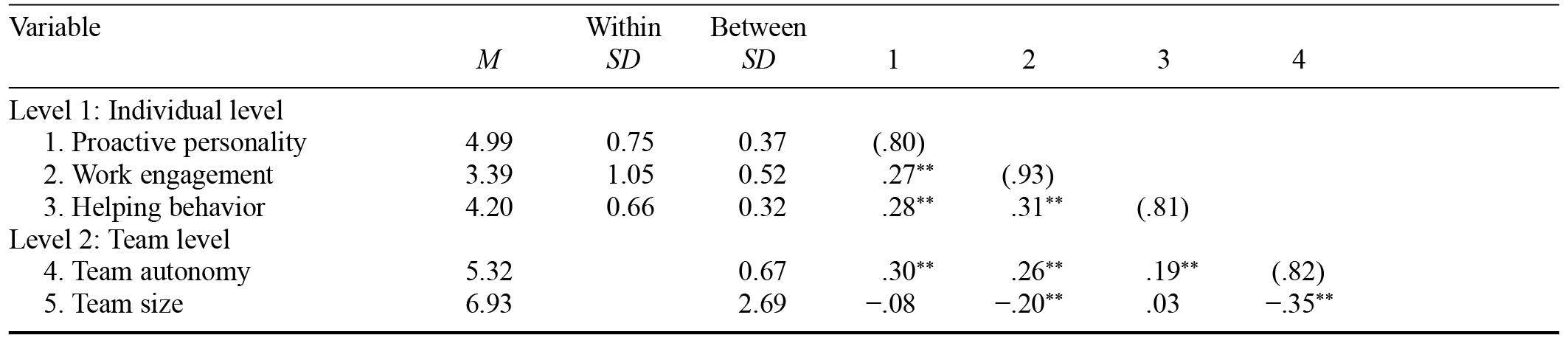
Note. N = 464 at Level 1; N = 75 at Level 2. Within SD = within-groups standard deviation; Between SD = between-groups standard deviation. Means of Cronbach’s alphas are reported in the parentheses along the diagonal.
* p < .05. ** p < .01.
Hypothesis Testing
A one-way analysis of variance revealed that the dependent variables of helping behavior, F(74, 433) = 1.47, p < .05, and work engagement, F(74, 433) = 1.56, p <. 01, both displayed significant between-team variance, supporting our use of a multilevel path model to test the hypotheses. We used Mplus 7.4 (Muthén & Muthén, 2015) to test the hypothesized multilevel model. In line with previous studies, we also included the control variable of team size at the team level. The unstandardized coefficients in the hypothesized model are presented in Table 2 and Figure 1. The direct effects of proactive personality on work engagement (r = .31, p < .01) and on helping behavior (r = .19, p < .01) were both positive and significant, supporting Hypotheses 1 and 2. Further, team autonomy significantly moderated the effect of proactive personality on work engagement (r = .24, p < .05), but the relationship between proactive personality and helping behavior was not significantly influenced by team autonomy helping (r = −.08, p > .05). As such, Hypothesis 3 was supported by the data, whereas Hypothesis 4 was not.
Table 2. Results of Multilevel Path Model

Note. * p < .05 (two-tailed). ** p < .01 (two-tailed).

Figure 1. Final Model with Unstandardized Coefficient Estimates
Note. * p < .05. ** p < .01.
Following Cohen et al.’s (2003) recommendations, in Figure 2 we plotted the moderating role of team autonomy in the relationship between proactive personality and work engagement. As shown in Figure 2, when the level of team autonomy was high (M + 1 SD), proactive personality was positively related to work engagement (r = .48, p < .01), whereas when team autonomy was low (M − 1 SD), proactive personality was not significantly related to work engagement (r = .15, p > .05).

Figure 2. The Moderating Role of Team Autonomy in the Relationship Between Proactive Personality and Work Engagement
Discussion
We investigated the in-role and extrarole outcomes of proactive personality, and the moderating effect of team autonomy in these relationships. By applying SDT we found that proactive personality was positively related to both work engagement and helping behavior. This finding suggests that employees with a higher level of proactive personality are likely to have a higher level of work engagement and to display helping behaviors. Further, we found that team autonomy moderated the positive relationship between proactive personality and work engagement, such that the relationship was significant and positive only in teams with a higher level of autonomy.
Our findings contribute to the literature and are in line with those of previous researchers. Specifically, our results corroborate existing theorizing that people are not just passive recipients of environmental processes (Buss, 1987). We obtained empirical support for the proposal that proactive personality serves as a critical antecedent of employees’ in-role behaviors, such as work engagement (Bakker et al., 2012; Christian et al., 2011), and extrarole behaviors, such as helping behavior (Greguras & Diefendorff, 2010). Further, our findings indicate that team autonomy played an important role in shaping the impacts of proactivity, especially the impact of proactive personality on work engagement.
However, our findings show that the relationship between proactive personality and helping behavior was not significantly influenced by team autonomy. This is probably because team autonomy is more relevant to work-related activities, whereas helping behavior typically requires more initiative from employees. As such, helping behavior would be more likely to be performed because of the employee’s personal characteristics (e.g., proactive personality), and such an effect is less likely to be shaped by work-related environmental factors. Therefore, we encourage future researchers to build upon our findings to further advance understanding regarding the boundary conditions of the relationship between proactivity and employee outcomes.
In practice, choosing and hiring more employees with a proactive personality could improve team operation efficiency and obtain proactive solutions for dynamic problems, which could help the organization gain a competitive advantage when facing dynamic industry environments. More than that, teams consisting of proactive employees should be appropriately empowered to establish team autonomy. Only in this kind of team environment can proactive employees have confidence in their ability and give full play to their advantages.
It is notable that we were able to collect the multiwave data from two different sources. That is, we collected individual-level data (i.e., employees’ proactivity personality, their in-role and extrarole behaviors) from employees, and collected team-level data (i.e., team autonomy) directly from team leaders. As employees are more familiar with their own behavioral tendency and team leaders are generally able to gather more accurate information about the context of team functioning, our study design ensures relatively accurate measurement.
There are several limitations in this study. First, we conducted this study with employees from one enterprise to exclude the effect of organization culture and other industry characteristics, which limits the generalizability of the results. Future studies could examine our findings in other fields or industries. Further, we collected data from 75 sales teams, where team context or properties (e.g., team autonomy) may be affected by the nature of their jobs. It is possible that employees in different functional teams may have different work routines and behavioral patterns, thereby influencing intrateam interaction. Therefore, we also encourage future studies to replicate our findings in different industries and recruit participants with diverse functional backgrounds.
Second, we derived our hypotheses on the basis of SDT, positing the critical role of need satisfaction in transmitting the impacts of proactive personality. However, due to constraints in the data collection process, we were not able to collect data regarding participants’ psychological needs satisfaction. We encourage future studies to further examine the underlying psychological mechanisms of the impacts of proactive personality on employees’ work-related outcomes.
Third, we chose work engagement and helping behavior as outcome variables of proactive personality, and team autonomy as the cross-level moderator. According to SDT, needs for autonomy, competence, and relatedness are essential for individuals to achieve psychological growth, internalization, and well-being (Deci & Ryan, 2000). Therefore, future studies could examine the psychological outcomes of proactive personality, and the supportive conditions of competence need and relatedness need within the framework of SDT.
Further, as we collected data using a survey approach, it is possible that our results may have been affected by social desirability bias among participants. We encourage future researchers to build on our findings and further investigate the impacts of employees’ proactive personality using objective data (e.g., objective performance or behavioral outcomes), thereby providing more solid and robust results for our model.
Ashford, S. J., & Black, J. S. (1996). Proactivity during organizational entry: The role of desire for control. Journal of Applied Psychology, 81(2), 199–214.
https://doi.org/10.1037/0021-9010.81.2.199
Bakker, A. B., & Demerouti, E. (2008). Towards a model of work engagement. Career Development International, 13(3), 209–223.
https://doi.org/10.1108/13620430810870476
Bakker, A. B., Demerouti, E., & ten Brummelhius, L. L. (2012). Work engagement, performance, and active learning: The role of conscientiousness. Journal of Vocational Behavior, 80(2), 555–564.
https://doi.org/10.1016/j.jvb.2011.08.008
Bateman, T. S., & Crant, J. M. (1993). The proactive component of organizational behavior: A measure and correlates. Journal of Organizational Behavior, 14(2), 103–118.
https://doi.org/10.1002/job.4030140202
Becker, T. E., & Kernan, M. C. (2003). Matching commitment to supervisors and organizations to in-role and extra-role performance. Human Performance, 16(4), 327–348.
https://doi.org/10.1207/S15327043HUP1604_1
Bergeron, D. M., Schroaeder, T. D., & Martinez, H. A. (2014). Proactive personality at work: Seeing more to do and doing more? Journal of Business and Psychology, 29(1), 71–86.
https://doi.org/10.1007/s10869-013-9298-5
Brislin, R. W. (1980). Translation and content analysis of oral and written material. In H. C. Triandis & J. W. Berry (Eds.), Handbook of cross-cultural psychology: Methodology (Vol. 2, pp. 389–444). Allyn and Bacon.
Buss, D. M. (1987). Selection, evocation, and manipulation. Journal of Personality and Social Psychology, 53(6), 1214–1221.
https://doi.org/10.1037/0022-3514.53.6.1214
Chan, D., & Schmitt, N. (2000). Interindividual differences in intraindividual changes in proactivity during organizational entry: A latent growth modeling approach to understanding newcomer adaptation. Journal of Applied Psychology, 85(2), 190–210.
https://doi.org/10.1037/0021-9010.85.2.190
Christian, M. S., Garza, A. S., & Slaughter, J. E. (2011). Work engagement: A quantitative review and test of its relations with task and contextual performance. Personnel Psychology, 64(1), 89–136.
https://doi.org/10.1111/j.1744-6570.2010.01203.x
Cohen, J., Cohen, P., West, S. G., & Aiken, L. S. (2003). Applied multiple regression/correlation analysis for the behavioral sciences (3rd ed.). Lawrence Erlbaum Associates.
Crant, J. M. (1995). The Proactive Personality Scale and objective job performance among real estate agents. Journal of Applied Psychology, 80(4), 532–537.
https://doi.org/10.1037/0021-9010.80.4.532
Crant, J. M., & Bateman, T. S. (2000). Charismatic leadership viewed from above: The impact of proactive personality. Journal of Organizational Behavior, 21(1), 63–75.
https://doi.org/10.1002/(SICI)1099-1379(200002)21:1<63::AID-JOB8>3.0.CO;2-J
Deci, E. L., & Ryan, R. M. (1985). Intrinsic motivation and self-determination in human behavior. Plenum Press.
Deci, E. L., & Ryan, R. M. (2000). The “what” and “why” of goal pursuits: Human needs and the self-determination of behavior. Psychological Inquiry: An International Journal for the Advancement of Psychological Theory, 11(4), 227–268.
https://doi.org/10.1207/S15327965PLI1104_01
Frese, M., & Fay, D. (2001). Personal initiative: An active performance concept for work in the 21st century. Research in Organizational Behavior, 23, 133–187.
https://doi.org/10.1016/S0191-3085(01)23005-6
Friedman, T. L. (2005). The world is flat: A brief history of the twenty-first century. Picador.
Fugate, M., Kinicki, A. J., & Ashforth, B. E. (2004). Employability: A psycho-social construct, its dimensions, and applications. Journal of Vocational Behavior, 65(1), 14–38.
https://doi.org/10.1016/j.jvb.2003.10.005
Fuller, B., Jr., & Marler, L. E. (2009). Change driven by nature: A meta-analytic review of the proactive personality literature. Journal of Vocational Behavior, 75(3), 329–345.
https://doi.org/10.1016/j.jvb.2009.05.008
Greguras, G. J., & Diefendorff, J. M. (2010). Why does proactive personality predict employee life satisfaction and work behaviors? A field investigation of the mediating role of the self-concordance model. Personnel Psychology, 63(3), 539–560.
https://doi.org/10.1111/j.1744-6570.2010.01180.x
Kirkman, B. L., Rosen, B., Tesluk, P. E., & Gibson, C. B. (2004). The impact of team empowerment on virtual team performance: The moderating role of face-to-face interaction. Academy of Management Journal, 47(2), 175–192.
https://doi.org/10.5465/20159571
LePine, J. A., Erez, A., & Johnson, D. E. (2002). The nature and dimensionality of organizational citizenship behavior: A critical review and meta-analysis. Journal of Applied Psychology, 87(1), 52–65.
https://doi.org/10.1037/0021-9010.87.1.52
Li, M., Wang, Z., Gao, J., & You, X. (2017). Proactive personality and job satisfaction: The mediating effects of self-efficacy and work engagement in teachers. Current Psychology, 36(1), 48–55.
https://doi.org/10.1007/s12144-015-9383-1
Li, N., Liang, J., & Crant, J. M. (2010). The role of proactive personality in job satisfaction and organizational citizenship behavior: A relational perspective. Journal of Applied Psychology, 95(2), 395–404.
https://doi.org/10.1037/a0018079
Muthén, L. K., & Muthén, B. O. (2015). Mplus user’s guide (7th ed.). Author.
Organ, D. W. (1988). Organizational citizenship behavior: The good soldier syndrome. Lexington Books/DC Heath and Com.
Organ, D. W. (1997). Organizational citizenship behavior: It’s construct clean-up time. Human Performance, 10(2), 85–97.
https://doi.org/10.1207/s15327043hup1002_2
Parker, S. K. (1998). Enhancing role breadth self-efficacy: The roles of job enrichment and other organizational interventions. Journal of Applied Psychology, 83(6), 835–852.
https://doi.org/10.1037/0021-9010.83.6.835
Parker, S. K., Williams, H. M., & Turner, N. (2006). Modeling the antecedents of proactive behavior at work. Journal of Applied Psychology, 91(3), 636–652.
https://doi.org/10.1037/0021-9010.91.3.636
Podsakoff, P. M., MacKenzie, S. B., Moorman, R. H., & Fetter, R. (1990). Transformational leader behaviors and their effects on followers’ trust in leader, satisfaction, and organizational citizenship behaviors. The Leadership Quarterly, 1(2), 107–142.
https://doi.org/10.1016/1048-9843(90)90009-7
Rioux, S. M., & Penner, L. A. (2001). The causes of organizational citizenship behavior: A motivational analysis. Journal of Applied Psychology, 86(6), 1306–1314.
https://doi.org/10.1037/0021-9010.86.6.1306
Ryan, R. M., & Deci, E. L. (2000). Self-determination theory and the facilitation of intrinsic motivation, social development, and well-being. American Psychologist, 55(1), 68–78.
https://doi.org/10.1037/0003-066X.55.1.68
Ryan, R. M., Kuhl, J., & Deci, E. L. (1997). Nature and autonomy: An organizational view of social and neurobiological aspects of self-regulation in behavior and development. Development and Psychopathology, 9(4), 701–728.
https://doi.org/10.1017/S0954579497001405
Schaufeli, W. B., Bakker, A. B., & Salanova, M. (2006). The measurement of work engagement with a short questionnaire: A cross-national study. Educational and Psychological Measurement, 66(4), 701–716.
https://doi.org/10.1177/0013164405282471
Schaufeli, W. B., Salanova, M., González-Romá, V., & Bakker, A. B. (2002). The measurement of engagement and burnout: A two sample confirmatory factor analytic approach. Journal of Happiness Studies, 3(1), 71–92.
https://doi.org/10.1023/A:1015630930326
Seibert, S. E., Crant, J. M., & Kraimer, M. L. (1999). Proactive personality and career success. Journal of Applied Psychology, 84(3), 416–427.
https://doi.org/10.1037/0021-9010.84.3.416
Seibert, S. E., Kraimer, M. L., & Crant, J. M. (2001). What do proactive people do? A longitudinal model linking proactive personality and career success. Personnel Psychology, 54(4), 845–874.
https://doi.org/10.1111/j.1744-6570.2001.tb00234.x
Seibert, S. E., Wang, G., & Courtright, S. H. (2011). Antecedents and consequences of psychological and team empowerment in organizations: A meta-analytic review. Journal of Applied Psychology, 96(5), 981–1003.
https://doi.org/10.1037/a0022676
Spreitzer, G. M. (1995). Psychological empowerment in the workplace: Dimensions, measurement, and validation. Academy of Management Journal, 38(5), 1442–1465.
https://doi.org/10.5465/256865
Thomas, J. P., Whitman, D. S., & Viswesvaran, C. (2010). Employee proactivity in organizations: A comparative meta-analysis of emergent proactive constructs. Journal of Occupational and Organizational Psychology, 83(2), 275–300.
https://doi.org/10.1348/096317910X502359
Thompson, J. A. (2005). Proactive personality and performance: A social capital perspective. Journal of Applied Psychology, 90(5), 1011–1017.
https://doi.org/10.1037/0021-9010.90.5.1011
Van den Broeck, A., Ferris, D. L., Chang, C.-H., & Rosen, C. C. (2016). A review of self-determination theory’s basic psychological needs at work. Journal of Management, 42(5), 1195–1229.
https://doi.org/10.1177/0149206316632058
Van Dyne, L., Graham, J. W., & Dienesch, R. M. (1994). Organizational citizenship behavior: Construct redefinition, measurement, and validation. Academy of Management Journal, 37(4), 765–802.
https://doi.org/10.5465/256600
Table 1. Means, Standard Deviations, and Correlations for Study Variables
Note. N = 464 at Level 1; N = 75 at Level 2. Within SD = within-groups standard deviation; Between SD = between-groups standard deviation. Means of Cronbach’s alphas are reported in the parentheses along the diagonal.
* p < .05. ** p < .01.
Table 2. Results of Multilevel Path Model
Note. * p < .05 (two-tailed). ** p < .01 (two-tailed).
Figure 1. Final Model with Unstandardized Coefficient Estimates
Note. * p < .05. ** p < .01.
Figure 2. The Moderating Role of Team Autonomy in the Relationship Between Proactive Personality and Work Engagement
Ping Luo, School of Management, Zhongkai University of Agriculture and Engineering, No. 501, Zhongkai Road, Haizhu District, Guangzhou, People’s Republic of China, 510225. Email: [email protected]